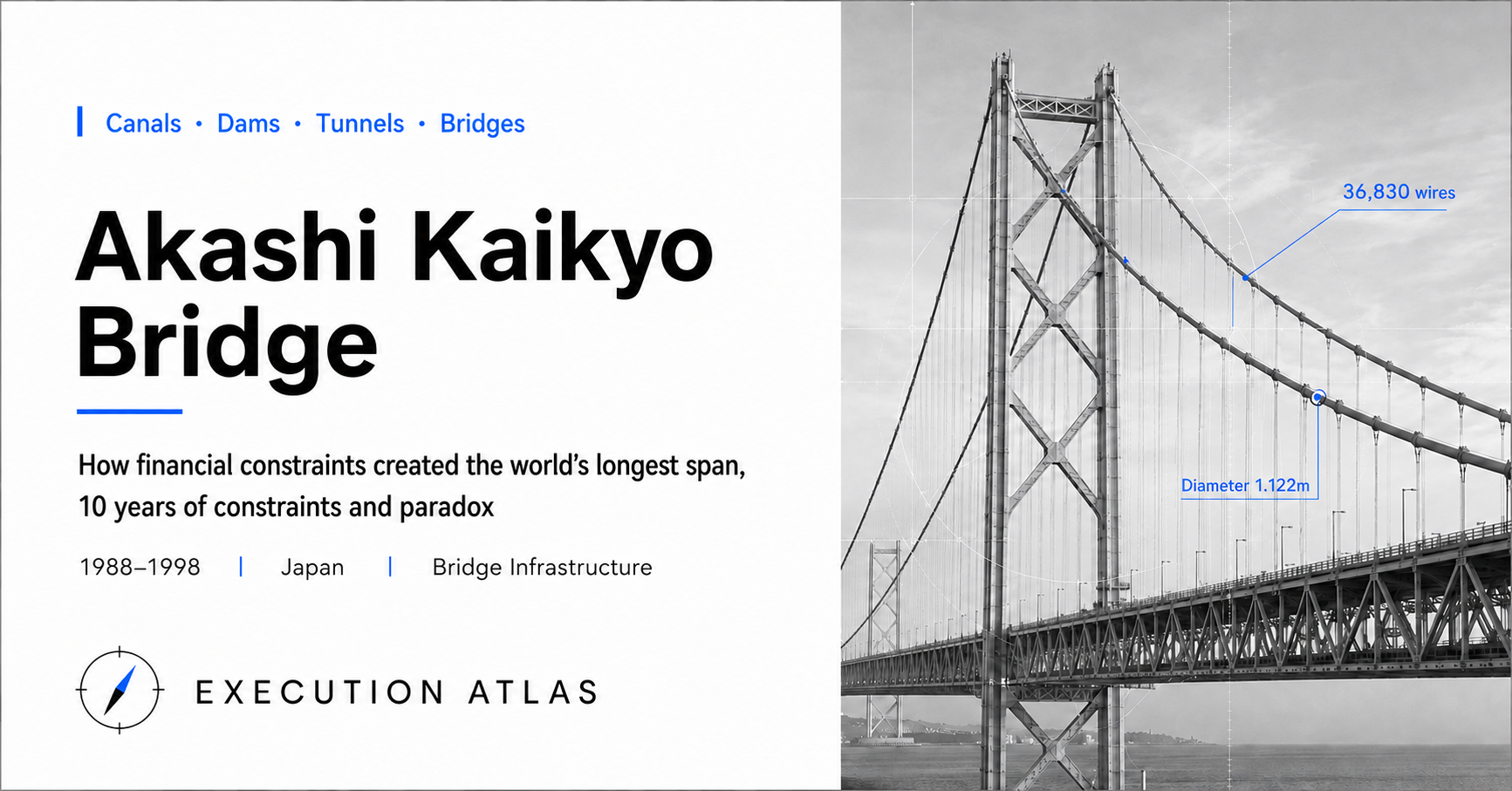
Main span 1,991 meters. The Akashi Kaikyo Bridge opened on April 5, 1998, as the world’s longest suspension bridge.
The main towers rise 298.3 meters above sea level — just under the height of Tokyo Tower — standing in a pair from a churning strait. Each main cable bundles 36,830 individual wires. Four cables, each 1.122 meters in diameter, carry the deck.
Total construction cost: approximately ¥500 billion. Cumulative workforce: 2.1 million. Duration: ten years. Fatal accidents: zero.
Seven years into construction, on January 17, 1995, an M7.3 earthquake struck almost directly beneath the site. The towers shifted. The bridge stretched 1.1 meters. Work continued.
Mission: 1,430 Dead Built This Bridge
September 26, 1954. The Toya Maru, a ferry crossing the Tsugaru Strait, encountered Typhoon Marie and sank. 1,430 dead or missing. Japan’s worst maritime disaster on record.
The wreck revived a longstanding argument. Every typhoon season, straits became kill zones. Freight and passengers depended on ferries. “Build a bridge and ferries become unnecessary.”
The idea predates the war. Industry groups in Shikoku had been petitioning the national government for a Honshu-Shikoku crossing for decades. But financing, technology, and political will never aligned at the same moment.
In 1970, the Honshu-Shikoku Bridge Authority was established. A national project to link the two islands by three separate routes took organizational form: the Kobe-Naruto route, the Onomichi-Imabari route, and the Kojima-Sakaide route. The Akashi Kaikyo Bridge was the centerpiece of the Kobe-Naruto route.
The Akashi Strait carries more than 1,000 ships per day — Japan’s busiest maritime corridor. Maximum depth: 110 meters. Fast currents, dense fog, direct typhoon exposure. Width: approximately 4 kilometers.
Design: Cutting Made It Longer
The plan started with a combined road-and-rail bridge. Rail is heavy. More load means heavier decking, which means heavier overall structure, which forces the tower spacing to decrease. The original main span: 1,780 meters.
In 1985, the plan changed. Fiscal pressure forced a decision: drop the rail component and build road-only. The press called it a political retreat. Critics called it an irreversible choice that foreclosed rail forever.
The engineers had a different calculation.
Removing the rail loads cut the deck’s design weight significantly. Less weight meant less cable tension. Less tension meant the same cable specification could carry a longer span. Tower spacing could expand from 1,780 to 1,991 meters — 211 meters wider.
A cost-driven scope reduction had opened up technical headroom. Cutting made it longer.
Design requirements were extreme: withstand winds of 80 m/s, survive an M8.5 earthquake, tolerate 10-meter wave heights, stand for 200 years.
Engineers built a 1/100-scale model and ran repeated wind tunnel tests. Every change to the deck’s cross-section moved the flutter threshold — the wind speed at which a suspension bridge begins resonating destructively. The Tacoma Narrows Bridge had collapsed in 1940. Suspension bridges fail in wind. Wind tunnel testing was the core of the design.
Execution: Ten Years at Sea
May 1988. Field construction began.
First: the foundations. Divers and remote machinery excavated down to bedrock. The Kobe-side tower foundation went 60 meters deep. Same for the Awaji Island side. Circular steel caissons were sunk to the seabed and filled with concrete.
By 1993, both towers stood complete. 298.3 meters. Among the largest structures standing in open water at the time.
Next: cable spinning. Workers strung individual wires one by one between anchorages — massive concrete blocks positioned outside each tower — then bundled them into cables. 36,830 wires. This work was essentially complete by late 1994.
January 17, 1995. 5:46 a.m.
An M7.3 struck with its epicenter near the northern tip of Awaji Island, almost directly beneath the construction site. Later named the Great Hanshin-Awaji Earthquake. It registered intensity 7 in Kobe and killed 6,434 people.
Damage crews moved fast. The Awaji Island tower had tilted approximately 10 centimeters. Ground displacement had stretched the total bridge length by 1.1 meters. The main span had grown from 1,990.0 to 1,990.8 meters; the Awaji side span from 960.0 to 960.3 meters.
The Authority’s engineers decided to continue.
The reasoning: design margin. The towers had been designed to accommodate more than one meter of sway at the top under normal use and temperature variation alone. A 10-centimeter tilt was inside tolerance. “Practically no problem.”
The 1.1-meter extension required new stiffening girder sections. Engineers fabricated new truss members — 80 centimeters for the center span, 30 centimeters for the Awaji side — and incorporated them after the fact.
The schedule did not slip badly. The bridge opened April 5, 1998, close to the original target.
Over ten years, 2.1 million workers passed through the site. Zero fatalities. 575 people working daily on an open-sea construction site, for ten years, zero deaths. Mandatory safety equipment and strict weather-based work-suspension rules built that number.
People: The Organization That Built It
The Akashi Kaikyo Bridge has no John Roebling. No single genius.
The Honshu-Shikoku Bridge Authority held the design philosophy. Multiple construction firms and technical research institutes advanced the engineering in parallel. The project’s main actor was an organization, not any individual’s charisma.
One engineer did articulate the vision.
Authority engineer Kunihiko Kita said in a lecture in the 1980s: “The Akashi Kaikyo Bridge aims for a design life of 200 years.”
Two hundred years. Standard bridge design life is 50 to 100 years. A target two to four times that meant accepting responsibility for a future none of the engineers would see. The people who built it designed for a bridge still standing in 2198.
The philosophy reached the physical structure. A forced-air dehumidification system — pumping dry air continuously through the cable interiors to prevent corrosion — was developed for this project, a world first. Standard cable service life is 60 to 80 years; this system extends it toward 200. The main towers have internal service elevators to carry maintenance crews to the top. Walkways run inside the cables. Every element assumes someone will be servicing this structure a century from now.
Legacy: 24 Years at the Top
April 5, 1998. On the day the Akashi Kaikyo Bridge opened, a main span of 1,991 meters was the longest suspension bridge record in the world.
The record lasted until 2022. In March of that year, Turkey’s 1915 Çanakkale Bridge opened with a main span of 2,023 meters — the first time the record changed in 24 years.
The bridge is still in service. Daily traffic on the Kobe-Awaji-Naruto Expressway runs approximately 18,000 vehicles. The freight and passenger flows that once depended on ferries to Awaji Island and Shikoku have shifted to the bridge.
The forced-air dehumidification system was subsequently adopted across all suspension bridges in the Honshu-Shikoku network. A corrosion-prevention technology developed specifically for this bridge became the domestic standard for infrastructure maintenance.
Whether the 200-year design target will be met can only be known in 2198.
Learnings
”Cutting” produced the world’s longest span
The 1985 redesign — from combined road-and-rail to road-only — read at the time as retreat. An irreversible decision that permanently foreclosed rail, critics said.
The result was the world’s longest span.
Removing the rail loads reduced deck weight, letting the same cable specification carry a longer span. The expansion from 1,780 to 1,991 meters would not have happened without that constraint. A scope reduction normally signals project shrinkage. Here it opened a technical degree of freedom that produced expansion along a different axis. What to cut and what to expand: the moment a constraint is accepted, the landscape of what is possible changes shape.
The earthquake was within tolerance
The earthquake stretched the bridge 1.1 meters. Work continued.
The decision rested on design margin. A structure already built to allow more than one meter of tower-top movement under normal use. A 10-centimeter shift was “within tolerance” — a judgment the data supported.
Designing to put the improbable inside tolerance rather than outside it. The extreme-looking specifications — 80 m/s winds, M8.5 — were the investment required to widen that range. How wide to make it is always a cost tradeoff. The Akashi Kaikyo Bridge chose margins far beyond the standard. When the earthquake came in January 1995, those margins justified continuing.
Sources
- Nikkei XTECH, “地震で1m伸びた! 明石海峡大橋” (JP Only)
- Wikipedia, “Akashi Kaikyo Bridge” (https://en.wikipedia.org/wiki/Akashi_Kaikyo_Bridge)
- JB Honshi Co., Ltd., “Akashi Kaikyo Bridge” (https://www.jb-honshi.co.jp/english/akashi/)
- Obayashi Corporation, “Akashi Kaikyo Bridge Construction Record” (JP Only)
- National Diet Library Reference Cooperative Database, “Akashi Kaikyo Bridge total cost and length” (JP Only)
- Fuwakukai / Kunihiko Kita, “Akashi Kaikyo Bridge aims for a design life of 200 years” (JP Only)