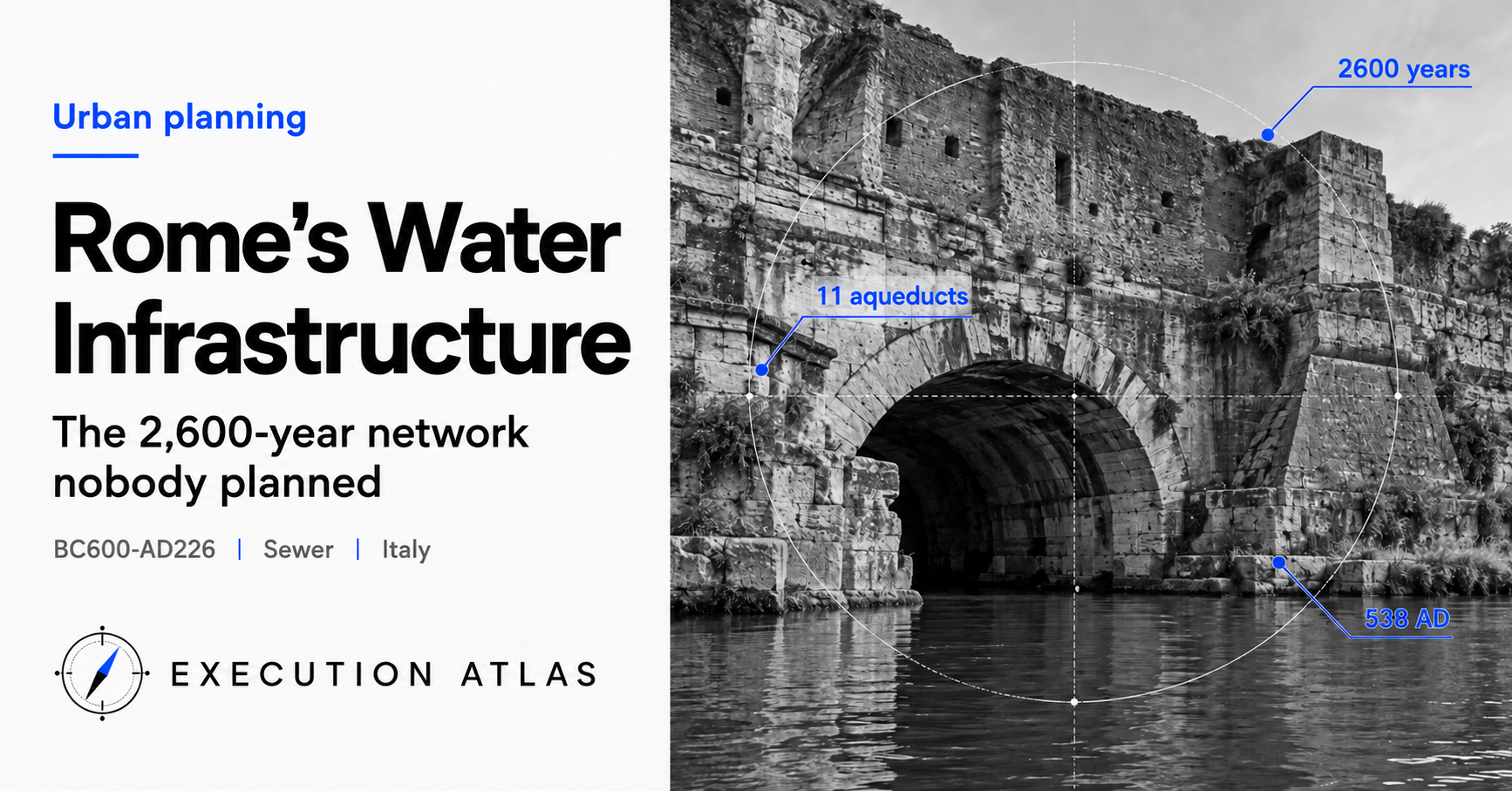
Around 600 BC, a drainage channel commissioned by Tarquinius Priscus, the fifth king of Rome, is still collecting rainwater from the heart of Rome and discharging it into the Tiber — in the year 2026.
Its name is the Cloaca Maxima. Roughly 1,600 meters in length, with a maximum cross-section of 4.2 meters high and 3.2 meters wide. A stone vault large enough for a cart to pass through runs beneath the ground, serving the same purpose across 26 centuries — from the age of the Latin kings to the Italian Republic.
Running parallel to it, eleven aqueducts were built into the city of Rome over 538 years, from 312 BC to AD 226. Their combined length stretched roughly 500 kilometers. According to Frontinus’s calculations, approximately 560,000 cubic meters of water flowed into the city each day.
This was not “infrastructure built on a 500-year plan.” Not one person, not a single individual, conceived the whole. And yet the network, expanded cumulatively over centuries, survived the fall of the Western Roman Empire, outlasted the Papal States, survived the Kingdom of Italy, and is now woven into the underground of modern Rome.
How does infrastructure that lasts 2,600 years emerge without being planned?
Mission: A Drainage Channel to Turn Wetlands into a City
Around the eighth century BC, the area that would become the Forum Romanum was a wetland spread across the Tiber’s floodplain. Between the Palatine and Capitoline hills lay a swamp called the Velabrum. In the rainy season, the water never drained. In the dry season, the stench was unbearable. It could not become the center of a city.
Tarquinius Priscus, Rome’s fifth king of Etruscan descent, decided to convert this wetland into habitable land. His approach was twofold. First, raise the ground artificially by packing in fill — an estimated 10,000 to 20,000 cubic meters of earth, gravel, and rubble. Second, dig a permanent drainage channel to draw away the standing water to the Tiber.
The second measure became the prototype of the Cloaca Maxima. The work was carried out by Etruscan engineers and Roman commoners. No wage records survive. Labor during the royal period is generally understood to have been partly corvée.
The original specification was simple: lay stone along an existing streambed, reinforce the walls and floor, and let it function as an open channel. No cover. A narrow open trench cutting through the heart of the city.
In modern terms, this was a drainage project for wetland reclamation — not urban planning, not a sanitation project. It was geological improvement to raise land values and prepare ground for residential use. The concept of public health did not yet exist.
The result was the creation of a plaza: the later Forum Romanum. The Senate, temples, courts, and public halls that formed the nerve center of Rome would be built on top of a swamp. The decision-making institutions of an empire sat above a drainage ditch.
Design: From Open Channel to Underground, Entirely by Gravity
The design of the Cloaca Maxima underwent a fundamental transformation in the second century BC. The open channel was covered with a stone vault and moved underground. The surface was incorporated into the Forum’s building lines, and the channel disappeared from view.
This was technically a difficult choice: vaulting over existing structures, building without halting the flow, progressively reconnecting tributary pipes. But the reason was not sanitation — it was the real estate value above ground. An open channel stank, consumed width, and divided the most valuable urban center in Rome. Cover it, and you could build temples and public halls on top.
The aqueducts followed the same logic.
In 312 BC, Appius Claudius Caecus, serving as censor, broke ground on Rome’s first aqueduct, the Aqua Appia. Total length: 16 kilometers. Remarkably, roughly 11 kilometers ran underground and roughly 5 on arches. Aqueduct bridges are conspicuous, but the body of a Roman aqueduct lies underground.
The reason for going underground was not sanitation either. Surface channels lose water to evaporation, warm in sunlight and grow algae, and above all are vulnerable to enemy sabotage. Running underground reduced loss, contamination, and disruption all at once.
All eleven aqueducts followed a common design principle.
Water moves by gravity alone. No pumps. The elevation difference between source and city drives the water at a gradient of a few centimeters to a few meters per kilometer. The Aqua Marcia stretched 91 kilometers, 80 of them underground. Tunnels were bored through terrain; where valleys intervened, arches bridged them; where ridges intervened, tunnels pierced them. But the priority was always: underground first, valley-bottom route second, bridge last.
The material was Roman concrete — lime, pozzolana (volcanic ash), aggregate, and water — poured into formwork and allowed to cure. Pozzolana reacts with water to form calcium silicate hydrate crystals; exposed to seawater or groundwater, the crystals actually continue to grow. There is no evidence that the designers understood this long-term chemical behavior. They arrived at this mix through accumulated experience, and incidentally acquired durability for 2,000 years they never anticipated.
The other defining design feature was distributed decision-making. Eleven aqueducts had eleven patrons: Appius Claudius, Quintus Marcius, Agrippa, Augustus, Claudius, Trajan. Each built one aqueduct as a monument to his own honor. But the technical standards they used were shared: Roman concrete, gravity-fed, underground-first. This “distributed decision-making with unified technical standards” bound eleven separate construction projects into a single network.
Complex decisions were not integrated at the top. The architecture pushed self-sufficient specifications down to field-level commanders. The same architecture that governed the Roman road system governed the aqueducts.
Execution: Distributed Development Across 538 Years
Laying out the construction dates of the eleven aqueducts makes the absence of planning visible.
| Aqueduct | Completed | Length | Patron |
|---|---|---|---|
| Aqua Appia | 312 BC | 16 km | Appius Claudius Caecus (censor) |
| Anio Vetus | 272 BC | 64 km | Manius Curius Dentatus |
| Aqua Marcia | c. 140 BC | 91 km | Quintus Marcius Rex |
| Aqua Tepula | 125 BC | 18 km | Censors |
| Aqua Julia | 33 BC | 23 km | Agrippa |
| Aqua Virgo | 19 BC | 21 km | Agrippa |
| Aqua Alsietina | 2 BC | 33 km | Augustus |
| Aqua Claudia | AD 52 | 69 km | Claudius |
| Anio Novus | AD 52 | 87 km | Claudius |
| Aqua Traiana | AD 109 | 57 km | Trajan |
| Aqua Alexandrina | AD 226 | 22 km | Severus Alexander |
From the first to the last, 538 years. One aqueduct every 50 years on average — but in practice there were gaps of a century, and periods when two were completed in the same year. The Aqua Claudia and Anio Novus were both started by Caligula and completed by Claudius in the same year. One emperor running two in parallel. In other eras, more than a century passed with no emperor building a new aqueduct.
Construction times are not precisely recorded either. The Aqua Appia was probably completed in a few years. The Aqua Claudia and Anio Novus took 14 years from Caligula’s groundbreaking to Claudius’s completion. The Aqua Marcia is estimated at four to five years.
Total cost cannot be calculated in any principled way. Aqueducts of the Republican period were built from the private funds (sua pecunia) of censors and patrons. The imperial period mixed imperial personal wealth, war spoils, and provincial taxes. A substantial share of labor was performed by legionary soldiers, whose wages were already included in the state budget. The accounting unit varied project by project.
Agrippa’s activities in 33 BC most clearly illustrate the character of this distributed development.
Marcus Vipsanius Agrippa, born in 63 BC and then around thirty years old — the military leader of Octavian’s faction before the naval victory at Actium (31 BC) — had already served multiple terms as consul and governed provinces. Yet he deliberately stepped down to the rank of aedile (curule aedile), a junior magistracy responsible for public buildings and urban infrastructure — a post no one of senatorial rank would normally seek.
The reason was direct control over authority and budget. Aedile was the only office from which an infrastructure program could be driven without Senate approval at each step. In a single year, using this post, Agrippa accomplished the following:
Major repairs to three existing aqueducts (Aqua Appia, Anio Vetus, Aqua Marcia). Construction of the Aqua Julia. Reconstruction of the Cloaca Maxima. Installation of 700 cisterns and 500 fountains throughout the city. Maintenance of 170 public baths. All largely from his personal funds — because water and infrastructure were the chosen instruments of Octavian’s political campaign.
At his death, Agrippa bequeathed 240 slaves to the state for aqueduct maintenance. He transferred ownership to the state while leaving day-to-day operation to a group of skilled workers. Called the aquarii, this slave corps was inherited by successive emperors.
Meanwhile, the names of the builders of the Cloaca Maxima survive not at all. Anonymous laborers of the royal period and Etruscan engineers. The names of the nobles who gave speeches above ground were transmitted to posterity; the names of those who laid stone underground were erased. The asymmetry between the honor and the labor of infrastructure was established 2,600 years ago.
People: Agrippa’s Demotion and Frontinus’s Documentation
Agrippa’s decision to serve as aedile in 33 BC was exceptional by any measure of Roman political history.
Marcus Vipsanius Agrippa, born 63 BC, was roughly thirty. A multiple former consul and provincial governor, he voluntarily stepped into a junior office. The reason was direct control over authority and budget. Only as aedile could he run an infrastructure program as a single coherent package without Senate approval.
He used this position to build the physical foundation of Octavian’s political credibility in a single year. The city’s water and sewerage became tied to the legitimacy of the regime.
“Among his contemporaries he was a man who never displayed himself. He avoided luxury, preferred duty, was loyal to his colleagues, did not keep spoils for himself but returned them to the treasury and the city.”
So wrote Velleius Paterculus of him in later years. The tone is plainly propagandistic, but the fact of funding public works from private resources is corroborated by inscriptions and surviving structures.
A hundred and forty years later, a man of entirely different character confronted Rome’s water infrastructure. Sextus Julius Frontinus, born around AD 40, had served as governor of Britain and Africa before being appointed curator aquarum (water commissioner) by Emperor Nerva in AD 97 — at fifty-seven years of age.
His first task on taking office was audit and documentation. De aquaeductu in two books. The specifications of each aqueduct, source locations, lengths, flow rates, historical maintenance records, distribution points, usage fees, the reality of illegal connections, maintenance structures — all laid out systematically.
The problem at the time was that water distribution was personalized and illegal tapping rampant. People were constantly cutting unauthorized branches into pipes and diverting public water to homes and businesses. Frontinus’s response was not to prosecute individual cases but to “make the whole picture a matter of public record.” Visualize flows and entitlements, and you can identify exactly where theft is occurring.
“Compare the indispensable structures of so many aqueducts, with their stupendous mass, with the idle Pyramids, or the useless, though famous, works of the Greeks.”
He wrote that himself. A clear assertion that practical infrastructure is worth more than monuments or temples. De aquaeductu is the primary source for Roman aqueduct research and the foundation of modern engineering history and hydrology.
Agrippa built; Frontinus wrote it down. Both men extended the lifespan of the infrastructure through their individual names.
Legacy: Living Sewers After 2,600 Years, Severed After 1,500
The Cloaca Maxima still functions.
It collects rainwater from the Forum Romanum, the Velabrum, and the Forum Boarium in central Rome and discharges it into the Tiber. Most of its structure is Republican- and Imperial-period stone and Roman concrete, now connected directly to the modern sewer network. It incorporates a mechanism to prevent sewage backflow when the Tiber floods. In the 1600s the Papal administration levied a municipal tax to fund its maintenance. From 1842 to 1852 the interior was drained for archaeological survey. It is a “working ruin.”
The eleven aqueducts fared differently.
In AD 537, during the Gothic War, the Ostrogothic king Witigis, besieging Rome, cut all the aqueducts. He destroyed underground tunnels and bridge sections near the sources, physically halting the water supply. This was the trigger for the collapse of Rome as a city. Public baths fell silent; fountains dried up. During the early Middle Ages, Rome’s population collapsed from roughly a million to tens of thousands.
Of the aqueducts, only the Aqua Virgo continued to function partially through the medieval period — its mainly underground course had made it harder to destroy. This aqueduct still supplies water to the Trevi Fountain today. An aqueduct built by Agrippa in 19 BC feeds a tourist landmark 2,000 years later.
Portions of the Aqua Marcia, Aqua Claudia, and Anio Novus were reused in the sixteenth century and after, when the Papal administration revived aqueduct repair. They rehabilitated existing tunnels and bridges to restore flow and resume supply to Rome. The Acqua Paola (1612) and the Acqua Felice (1587) are both reuses of ancient waterworks.
More than a thousand years after the Gothic severance, the same channels were put to the same use. The structures survived beyond their builders’ design intent, and a different age revived them for a different purpose.
There is a notable paradox from the perspective of public health.
For all its aqueducts, sewers, public baths, and public latrines, Rome appears to have had higher rates of intestinal parasites — whipworm, roundworm, Entamoeba histolytica — than the Iron Age. A 2016 study from the University of Cambridge found that coprolites and parasite eggs from Roman-period sites are more abundant than those from pre-Roman contexts.
Multiple factors contributed: communal sponges (tersoria) in public latrines served as transmission vectors; sewers and food preparation areas were physically close; untreated sewage flowed into the Tiber, and city residents drew water from the same river; and above all, urban population density had risen sharply, multiplying opportunities for fecal-oral infection.
Building infrastructure and achieving public health are not the same thing. Between provision and outcome lie layers of use, operation, and complementary institutions. This lesson carries forward to Tokyo’s G-Cans project, Bazalgette’s London sewers, and Belgrand’s Paris network two thousand years later.
Lessons
This project was not planned.
No one intended to build “infrastructure that lasts 2,600 years.” The Cloaca Maxima was dug as a wetland drain. Eleven aqueducts were built individually for the honor of eleven politicians. No design document described the whole; no plan spanned 538 years. And yet the physical network came into being.
Three structural features made it possible.
First, unified technical standards. Even with fragmented patronage, every project converged on Roman concrete, gravity-fed supply, and underground-first routing. Design freedom was not adjudicated at the top. Material and principle were fixed; field-level magistrates were handed specifications they could execute independently. This “distributed decision-making with unified technical standards” bound 538 years of investment into a single network.
Second, the economics of honor. Infrastructure investment was directly tied to personal reputation. Appius of the Appian Way, Marcius of the Aqua Marcia, Agrippa of the Aqua Julia. Attach your name to the structure; empty your purse for it. Private expenditure on public works converted elite ambition into public goods. It also made corner-cutting and corruption structurally harder to sustain.
Third, continuity of ownership. Agrippa bequeathed 240 slaves; the Papal administration introduced a maintenance tax; the Italian government incorporated the infrastructure into the modern sewer network. Even as ownership changed, the asset itself was passed on. “Who does this infrastructure belong to?” was redefined, in each era, to fit that era’s power structure. Not fixing the manager was what made 2,600 years of continuity possible.
Roman concrete’s longevity was not an intended outcome. A material selected by accumulated experience happened to yield 2,000 years of durability through the long-term chemistry of pozzolana and water. When the choice was made, no one was planning for 500 years hence. But a material choice constrained the degrees of freedom of the future.
What was intended: converting wetland into habitable ground, building the physical base for a political campaign, documenting flow rates. What was not intended: 2,600 years of continuous operation. And yet the network survived.
Infrastructure without a defined “completion,” without a planned “whole picture,” with an ownership that kept changing — and it is still in service.
Does any system currently running in your organization have the degrees of freedom to be converted to a different purpose 2,600 years from now?
Or will it disappear, together with the plan document that described its intended use?
Sources
- Cloaca Maxima - Wikipedia — construction c. 600 BC, Tarquinius Priscus, underground c. 2nd century BC, Agrippa’s repair, still functional
- Sanitation in ancient Rome - Wikipedia — public latrines, integration of aqueducts and sewers, intestinal parasites
- Aqua Marcia - Wikipedia — 91 km, built 144–140 BC, 80 km underground
- Aqua Appia - Wikipedia — 312 BC, Rome’s first aqueduct, 16 km, Appius Claudius Caecus
- De aquaeductu - Wikipedia — Frontinus’s treatise, appointed curator aquarum AD 97, two books
- Cloaca Maxima | Britannica — eleven aqueducts ultimately connected to the sewer, outfall to the Tiber
- The Water System of Ancient Rome - Engineering Rome — eleven Roman aqueducts, total length estimates, daily water volumes
- Agrippa Part IV: His Top 5 Building Projects as Aedile of Rome - Time Travel Rome — Agrippa as aedile in 33 BC, three aqueducts repaired/built, bequest of 240 slaves
- Roman toilets gave no clear health benefit - University of Cambridge — parasitic infection higher in Roman period than Iron Age
- Cloaca Maxima - Madain Project — total length 1,600 m, survey 1842–1852