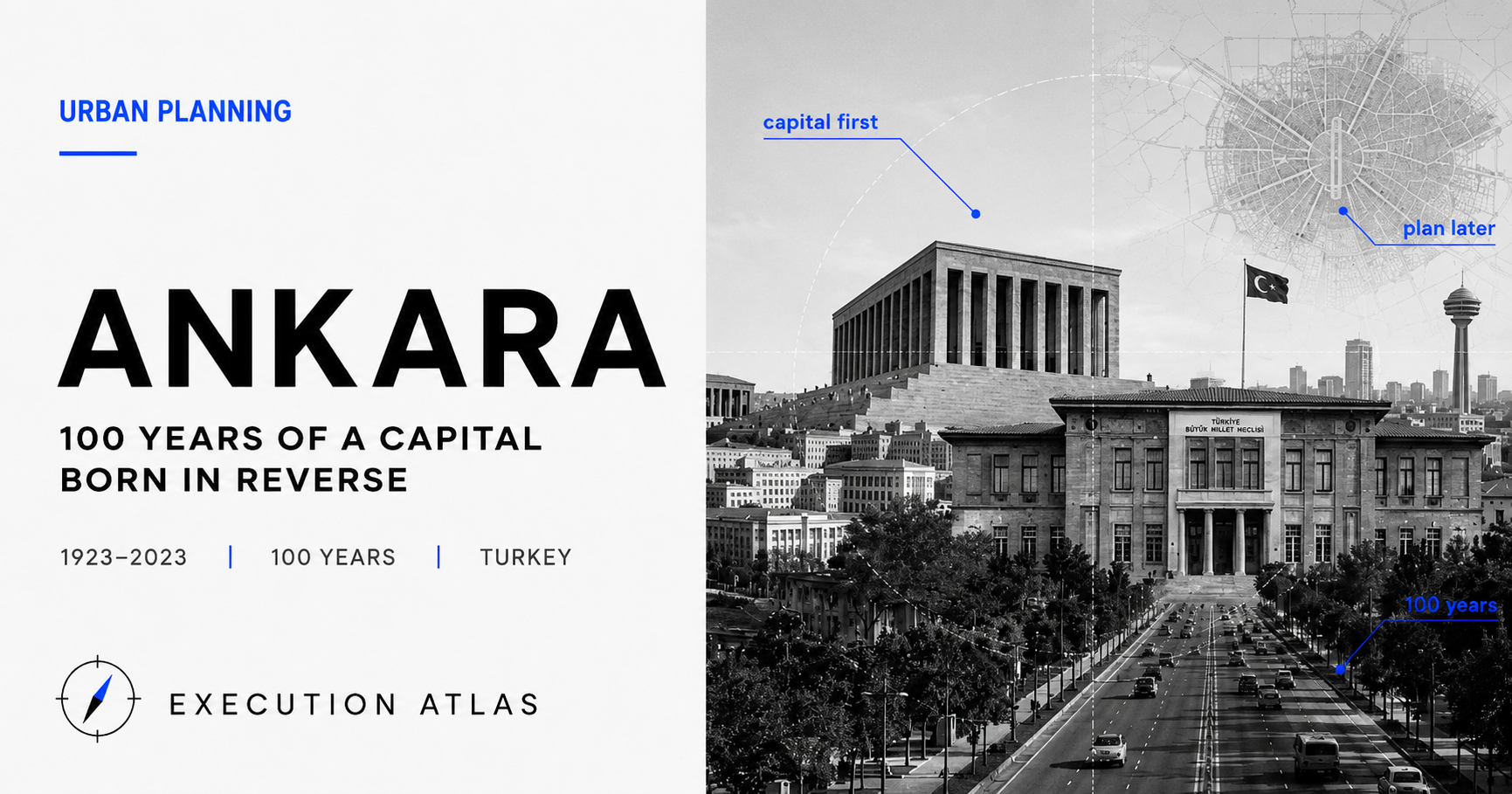
Population 35,000. One railway station. Almost no paved roads.
On October 13, 1923, the Grand National Assembly of Turkey designated this town as the nation’s capital.
Not Istanbul. Abandoning the city that had been “the center of the world” for 1,600 years, and planting a capital on an inland plateau. No buildings, no water or sewage systems, no housing — nothing. Yet the decision was irreversible.
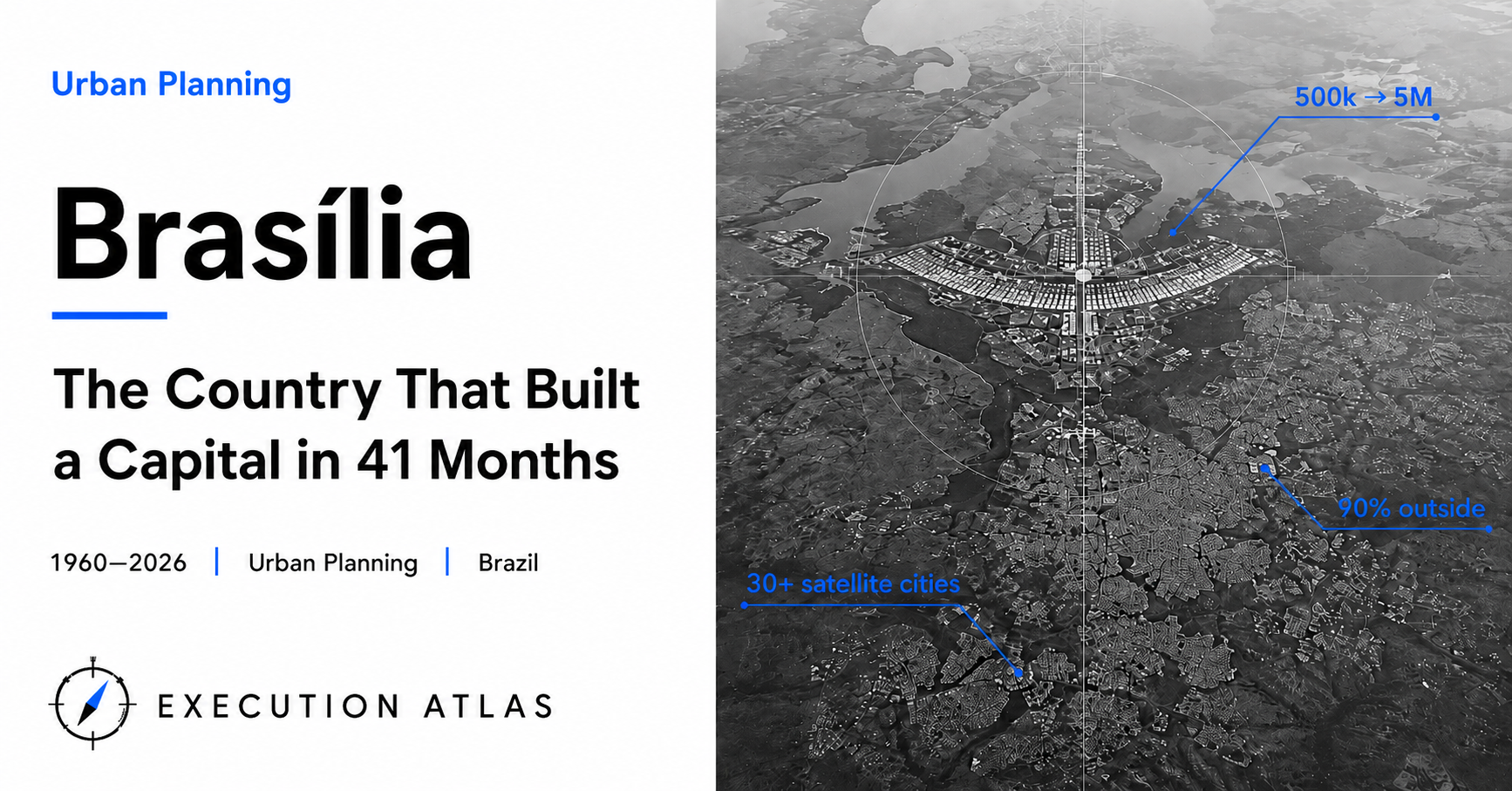
Brasília was “built in 41 months after the decision.” Ankara was more reckless than that. They decided, then built. Not in sequence — simultaneously.
Mission: A Place Not Under Occupation
Why not Istanbul?
The answer is simple: Istanbul was under Allied occupation. Beginning on November 12, 1918, immediately after World War I’s defeat, British, French, and Italian forces were stationed in Constantinople (as it was then called). The occupation did not lift until October 4, 1923 — two days after Allied withdrawal was complete, Turkish forces entered the city. The Sultan’s government operated under Allied surveillance and could not make independent political decisions.
The nationalist movement led by Atatürk convened the Grand National Assembly in Ankara on April 23, 1920. They would build another government in the unoccupied interior — not a government-in-exile, but one on Turkish territory. Two governments running in parallel within the same country. The Sultan’s government signed agreements with the Allies; the Ankara government continued fighting them.
There were three reasons for choosing Ankara.
First, geography. Ankara was a transportation hub in central Anatolia, where the north-south and east-west axes of northern Anatolia crossed. It had been a strategic strongpoint since antiquity.
Second, politics. The Allies occupied Istanbul, the Aegean coast, and the Mediterranean coast. The inland plateau was untouched — hard for enemies to reach. The terrain favored defenders over attackers who would face long supply lines.
Third, symbolism. Returning to Istanbul, the Ottoman capital, would evoke a return to the Ottoman order. The new republic needed a new capital. A political declaration of distance from 1,600 years of legacy.
On October 29, 1923, the Republic of Turkey was proclaimed. Sixteen days earlier, on October 13, 1923, the Grand National Assembly had formally decided to make Ankara the capital. The record shows that the capital was decided before the republic was declared.
At that moment, Atatürk was 42 years old, known as “Gazi Mustafa Kemal” — gazi being an honorific meaning “warrior.” His father, a customs officer, had died when he was seven. He had risen through the military and was known as the commander who repelled Allied landings at Gallipoli.
The requirement could be written in one line: “Build a modern, independent, non-Ottoman capital here.”
But “here” had nothing.
Design: A Capital Declared Without a Plan
Brasília was different. Construction began in 1956; the city was inaugurated on April 21, 1960. Forty-one months. President Kubitschek established the construction organization NOVACAP after taking office, held an urban planning competition, adopted Lúcio Costa’s proposal, then began construction. The sequence was clear.
Ankara’s sequence was different. The capital was decided on October 13, 1923. For years afterward, construction proceeded without a master plan. Not until 1929 did Hermann Jansen win an international competition, and not until 1932 was the plan formally approved. Nine years passed between the capital decision and the plan’s approval. By then, major buildings including the Ankara Palas Hotel (1927) and the Ziraat Bank building (1929) had already been built.
They built while running, without blueprints.
Jansen was German, born in 1869 — sixty years old when he won the competition. He beat France’s Léon Jaussely and Germany’s Josef Brix in the 1929 international competition.
Three elements formed the core of Jansen’s plan.
Old and new in parallel. Rather than demolishing the existing small town (later called Ulus), he would build a new district (Yenişehir) on the hills to the south. The old commercial center would continue functioning while a new administrative and residential district rose alongside it. This stood in contrast to the Ottoman approach of demolition and reconstruction.
Functional zoning. Separating residential, commercial, industrial, administrative, and cultural areas. Divided into 18 residential districts, each developed with a different pattern. A concept unfamiliar in Turkey at the time.
Integrated green space. Distributing green belts and parks throughout the city. Houses with front and back gardens. A vision of overlaying an artificial green network over the dry landscape of the central plateau.
The problem was that by 1932, when the plan was approved, nine years had already passed since the capital decision. Buildings constructed in the interim were retrofitted into Jansen’s framework. The plan did not organize reality; reality had defined the plan’s premises.
Execution: Plan and Reality Chasing Each Other
Between 1923 and 1950 — 27 years — Ankara’s population grew roughly eightfold, from about 35,000 to 286,781.
To calibrate the pace: while Brasília’s 41-month construction produced a city of nearly 100,000, Ankara’s structure was fundamentally different — it took nine years from capital decision to a working plan. Ankara was not “a city built by a plan” but “a city that emerged from a decision.”
The major early buildings were constructed before the plan.
The Ankara Palas Hotel, completed in 1927. A three-story stone building that became the lodging for foreign ambassadors and government dignitaries. Atatürk himself used it frequently. Located across the road from the First Grand National Assembly building, it functioned as a venue for political gatherings.
The Ziraat Bank building, constructed between 1926 and 1929. Designed by Italian architect Giulio Mongeri in a neoclassical style, built to symbolize the new republic’s economic center. The sequence — a new capital needs lodging and a bank first — appeared directly in the built record.
In 1927, a monument to the republic was erected at the center of Ulus Square, as a symbol of the War of Independence. In 1932, Jansen’s plan was approved. Around 1935, residential construction in the new city district began in earnest.
Jansen’s plan was logically coherent on paper. But different logic operated on the ground.
Land flowed from the government to private investors. Residential districts in the Jansen plan were rarely built with the planned density or form. Speculative land transactions increased; zoning was applied loosely. The strict functional separation was a poor fit with the traditional Turkish urban pattern of mixed commercial and residential neighborhoods.
In 1938, Atatürk died. That same year, citing political interference with his plan, Jansen requested that his signature be withdrawn from the master plan. Six years after approval, the reality of construction had diverged from the logic of the plan.
“A planned city” had quietly become “a city that appeared as the consequence of a decision.”
In project management terms, Ankara had no completion date. Brasília had an immovable political deadline: April 21, 1960. Ankara had only the declaration “this shall be the capital” — no defined criteria for what success would look like beyond that.
Cost was equally hard to track. Government budgets, donations, foreign embassies’ self-funded construction, and private investment were mixed together, with little official record of any aggregate total. The unit of construction was the whole city; individual budgets ran separately.
By project management standards, this is failure. Yet the capital functioned. Why?
People: The Declarer and the Planner
Two key figures shaped this project. One declared it; the other planned it. They never sat at the same table.
Atatürk. Forty-two years old at the 1923 capital decision. Died at 57 in 1938. For his 15 years in office, he rarely left Ankara. He concentrated the machinery of the new government — parliament, cabinet, military command, diplomatic facilities — in Ankara, and made it his home. When the presidential residence at Çankaya was completed in 1932, he did not move from it.
“A capital is not where the ruler lives. It is where the institutions of the republic gather.”
That was Atatürk’s thinking. So the absence of buildings did not matter as long as the institutions were functioning. His strategy was simple: by being there himself, he made the capital a capital. He lived there for 15 years, kept the government running, and created an unquestionable fait accompli.
Hermann Jansen. Sixty years old when he won the 1929 competition. An academic who taught urban planning at the Technical University of Berlin, and a practitioner with a record in Berlin’s suburban development. He was involved with the Ankara plan from 1929 to 1938, but he was not a long-term resident in Turkey. He drew plans and wrote explanations in Berlin; the local construction was carried out by others.
Distance was the problem. Jansen was positioned to offer the “correct plan” but could not intervene in its local implementation. Land transactions, building permits, residential lot divisions — the practical work was done by Turkish engineers and government bureaucrats. The planner provided the vision; reality was decided on-site.
In 1938, when Jansen requested withdrawal of his signature, he was 69 and his health was failing. It was the year before World War II began, and conditions inside Germany were deteriorating. He died in Berlin in 1945. He never returned to Ankara.
İsmet İnönü should not be forgotten. Atatürk’s right hand, who served as prime minister for roughly 13 years across the republican period, and became the second president when Atatürk died in 1938. The task of building Ankara’s administrative functions belonged not to Atatürk, who made the declaration, but to İnönü, who ran the operations.
The three-way structure: Atatürk declared it, Jansen planned it, İnönü implemented it. Each operated by different logic, and Ankara emerged where those three logics overlapped.
Legacy: Can a City Be Born from a Declaration Alone?
The current population of Ankara is approximately 5.8 million. Turkey’s second-largest city. It cannot approach Istanbul, but its role as the center of administration, diplomacy, and the military remains unchanged.
Jansen’s plan assumed a population of 500,000. Today the city has more than ten times that. The plan’s numbers were long since surpassed.
What worked: the republican political institutions have functioned continuously in Ankara since 1923. For 100 years, the capital has not been moved elsewhere. Anıtkabir — Atatürk’s mausoleum — was completed in 1953 and attracts more than five million visitors annually as a national shrine. The placement of major institutions — the presidential palace at Çankaya, the Grand National Assembly, the foreign embassy district, military command — still carries traces of the Jansen plan.
What didn’t: Jansen’s functional zoning became a shell. To the south, east, and north of the new city district, sprawling informal settlements (gecekondu — meaning “built in the night,” a type of slum) spread. From the 1950s onward, rapid urbanization and rural migration outpaced the plan’s framework. Most of today’s Ankara lies outside the area Jansen designed.
The contrast with Brasília is sharp.
Brasília maintained the sequence of plan → construction → operation, then generated a dual structure: 500,000 people living inside the plan and 4.5 million living outside it. A completed center called “the island of illusion” runs parallel to an impoverished periphery.
Ankara ran in the sequence of decision → operation → plan → construction. When the plan could not catch reality, the boundary between inside and outside the plan became blurred. There is inequality between center and periphery, but it is not as stark as Brasília’s.
This is not a question of which is better. Brasília’s high planning precision produced people pushed to the periphery outside the plan. Ankara’s absent planning produced a disordered but continuous city.
What both share is that the project called “capital construction” never had a clear definition of completion. A hundred years later, both cities can still be called “under construction.” A capital, as a function, does not end.
Lessons: Declaration First, or Plan First?
The deepest lesson in Ankara’s capital construction is a tradeoff between the “irreversibility of a decision” and the “cost of a delayed plan.”
The October 13, 1923 capital decision was made with virtually no infrastructure. By ordinary judgment, this was reckless. No blueprints, no budget, no buildings, no housing. “This shall be the capital” was declared with nothing in place.
But the irreversibility of the declaration attracted all subsequent investment. Railways were extended, housing was built, foreign embassies relocated, banks opened branches, commerce gathered. Once “it is decided” became the premise, individual rational decisions accumulated on top of that premise. Conversely, if you wait for adequate preparation before declaring, preparation is never adequate enough.
This is structurally identical to Kubitschek’s decision that resolved Brasília’s “137 years of ‘someday.’” The difference is that Brasília paired the decision with a plan and construction in a short, intense 41-month campaign, while Ankara pushed the decision first and ran the plan and construction afterward.
This approach carries a heavy price.
The cost of delayed planning was paid in disordered expansion. By 1932, when Jansen’s plan was approved, nine years had passed since the capital decision, and the core of the urban area had already been shaped outside the plan. A retroactive plan cannot win against the logic of what has already been built. Land transactions, building permits, and housing supply were decided by markets and politics, not by the plan.
Jansen’s own withdrawal of his signature shows that a planner’s professional judgment cannot win against political decision-making. For a “correct plan” to become an “implementable plan,” the planner must hold implementation authority, or the politician must defer to the plan’s authority. Neither happened here.
Push the decision first and the plan loses its authority. Pair the plan with the decision and the decision is delayed. Ankara shows both sides of this tradeoff in an extreme form.
Which is your project? “Declare once ready” — or “declare and then run”? If you choose the latter, where does the cost of a delayed plan get paid?
In Ankara’s case, it was paid in urban expansion 80 years later.
Sources
- Hermann Jansen - Wikipedia (en) — 1929 competition, 18 residential districts, 1938 signature withdrawal
- Capital of Turkey - Wikipedia (en) — October 13, 1923 capital decision, political situation under Istanbul occupation
- Ankara - Wikipedia (en) — population history, Ulus–Yenişehir separation, early buildings
- History of Ankara - Wikipedia (en) — 1920 Grand National Assembly, urban changes of the republican era
- Ulus, Ankara - Wikipedia (en) — Republic Monument, First Grand National Assembly building, Ankara Palas
- Mustafa Kemal Atatürk - Wikipedia (en) — tenure, political reforms, industrialization policy