
September 5, 2006. Groundbreaking.
October 30, 2011. Scheduled opening.
October 31, 2020. Actual opening.
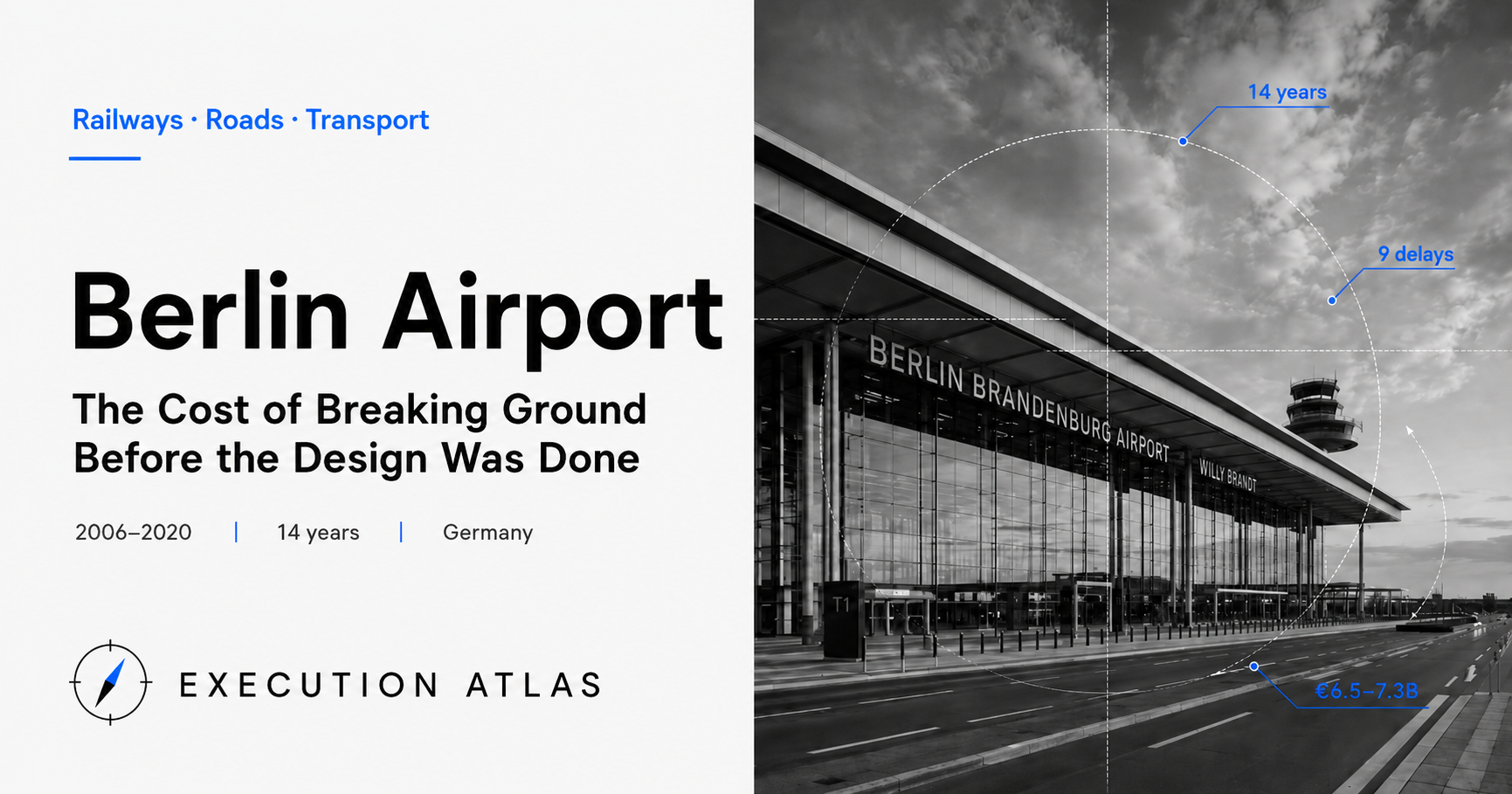
29 years. That is how long it took — from the initial planning in 1992 to the day Berlin Brandenburg Airport (BER) finally received its first passengers. Nine delays. An initial budget of €2.83 billion ballooned to a final cost of €6.5–7.3 billion — a 2.3–2.6x overrun.
Germany is called an industrial powerhouse. Automotive manufacturing, precision engineering, machine tools. That country took 14 years to build one airport.
Mission: Three Airports Into One
In 1989, the Berlin Wall fell. The capital, split in two, reunified, and East Germany ceased to exist.
But Berlin had three airports.
Tegel International Airport (TXL), built for West Berlin. The historic Tempelhof Airport (THF). And Schönefeld Airport (SXF), the old East German hub. The scars of division ran straight through the city’s infrastructure.
A unified Germany’s capital needed a single, large airport — politically symbolic and operationally rational. In 1992, formal planning began.
The plan: expand around the existing Schönefeld Airport. Terminal area of approximately 260,000 m². Annual passenger capacity of 27 million. Cost: €2.83 billion.
Everyone called it “Germany’s new gateway.”
Design: Three Decisions That Determined Everything
Governance Structure
BER was operated by FBB (Flughafen Berlin Brandenburg GmbH), a public-private company jointly owned by the state of Berlin, the state of Brandenburg, and the federal government.
Politicians sat on the supervisory board — the Mayor of Berlin, the Minister-President of Brandenburg, federal ministers. Technical experts were scarce. Every design change triggered political debate, and political judgment consistently overrode technical judgment.
The Fire Suppression System
One design choice sat at the heart of everything.
Conventional airport fire systems extract smoke upward — the chimney principle. Simple, proven, widely used.
BER chose a different direction: extract smoke downward, through 18 kilometers of underground ducts. The goal was aesthetic. They did not want chimney outlets breaking up the clean glass ceiling of the terminal.
This “downward extraction” smoke system had no precedent anywhere in the world. Siemens and Bosch were contracted for the control systems. Eighteen kilometers of ductwork. Complex computer controls. First-of-its-kind technology.
The Procurement Structure
In large-scale construction, a general contractor typically manages the whole. BER did not do this.
Work was split across more than 250 small construction companies to cut costs. But without a general contractor, coordination responsibility floated in the air. When plumbing and electrical runs collided, it was unclear who held the final call.
September 5, 2006. Groundbreaking. The design was not yet complete.
Execution: Nine Years of Cascading Failures
2012: Cancelled 26 Days Before Opening
Construction advanced. The terminal took shape. Passenger signage was installed. Transition plans with airlines were finalized.
May 8, 2012. Twenty-six days before opening. FBB made the announcement: the opening was cancelled.
“Critical defects” had been found in the fire suppression system.
An inspection by TÜV (Germany’s Technical Inspection Agency) found that backup generators could not supply sufficient power to the sprinkler system. Automated door controls malfunctioned. The 18 km of ductwork leaked at numerous points. The downward-extraction computer control system simply did not function as implemented.
The opening was cancelled. Nine more delays followed.
2012: The Imtech Bankruptcy
Imtech Germany GmbH & Co. KG, the primary contractor for electrical and technical systems, collapsed financially.
This was the company responsible for BER’s fire suppression installation. Its bankruptcy left the works suspended. Liability for installed defects became unclear. New contractors arriving on site had to learn everything from scratch.
2014: The Fake Engineer
Alfredo di Mauro, the lead designer of the fire suppression system. His business card read “Ingenieur” — engineer.
In May 2014, FBB terminated him. The dismissal notice cited “serious design defects” and “irreparable breakdown of trust.”
Investigation revealed he held no formal engineering qualification. His actual credential was “Technischer Zeichner” — a technical draughtsman. Not the same as an engineer.
The man who designed the world’s first downward-extraction fire suppression system was not an engineer.
FBB announced the cost to rebuild the fire suppression system as “nine figures.” More than €100 million.
2020: Opening Into a Pandemic
In May 2020, the operating license was finally granted.
October 31, 2020. Official opening.
By then, the world was in the grip of the COVID-19 pandemic. Europe was in its second wave. Air travel demand was at historic lows. When the airport that took 14 years to build opened its doors, almost no one walked through them.
Tegel Airport closed on November 8, 2020 — just eight days after BER opened. Tempelhof had already closed in 2008 and is now a public park.
People: Politicians Managing the Work of Specialists
To understand BER, you have to return to the supervisory board.
Every time a technical problem emerged, the board convened. Most members were politicians. They lacked the expertise to assess the technical severity of any given problem. Because they could not assess, the judgment that prevailed was: “wait a little longer and it will sort itself out.”
When specialists who had seen the problems said “this cannot be fixed,” politicians brought pressure from the other direction: “We can’t afford to miss the opening before the next election.”
The project’s top manager (Projektleiter) changed repeatedly between 2006 and 2020. With each handover, the institutional memory of what had gone wrong thinned, and problems were filed as “the predecessor’s fault.”
Di Mauro’s credential fraud went undetected until 2014. Why? Because no one on the supervisory board was technically qualified to verify it. The business card said “Ingenieur” — they believed it.
Legacy: What Remained
BER now functions. In 2024, it handled 25.5 million passengers, cementing its position as Germany’s third-busiest airport.
But it has been branded globally as a symbol of German infrastructure failure — cited in business schools worldwide as a project management case study, and recorded in the construction industry as a cautionary tale.
The former Tegel Airport site is being redeveloped as the “Tegel Urban Development Project” — research facilities, housing, and parkland on the old airfield. The runway is now a cycling path.
Lesson: The Price of Starting Before the Design Is Done
BER’s failure is a convergence of many factors. But if one had to be named, it is this: construction began before the design was complete.
At the 2006 groundbreaking, the fire suppression system design was not finalized. The terminal’s detailed design was not fixed. They broke ground anyway — to create the political fact of “construction started.”
Once construction begins, the cost of design changes multiplies. Modifying walls and pipes already installed costs tens of times more than changing a drawing. Incomplete design generates large-scale post-construction retrofits. Retrofits consume budget, which extends the schedule. Delays erode trust, political pressure mounts, judgment is distorted, and problems recur.
“Start early” was traded, in the end, for “finish very late.”
Was it simply bad luck that the fire suppression system’s designer held no real credentials? No. A supervisory board without technical review capability cannot catch credential fraud. The failure of governance design allowed the credential fraud to slip through unchallenged.
Governance structure. Technical choices. Procurement structure. Three design decisions made in 2006. The failure that came 14 years later was already written into the blueprints of 2006.
Sources
- Wikipedia: Construction of Berlin Brandenburg Airport — detailed timeline and history of technical issues
- Euronews: Opens 10 years late and three times over budget — opening-day coverage
- Interesting Engineering: How Berlin Brandenburg Airport Became One of the Biggest Engineering Failures — technical failure analysis
- Airport Technology: Berlin Brandenburg Airport construction timeline — chronology
- DLUBAL: Airport BER – Disaster Rarely Comes Alone — structural analysis of cascading failures