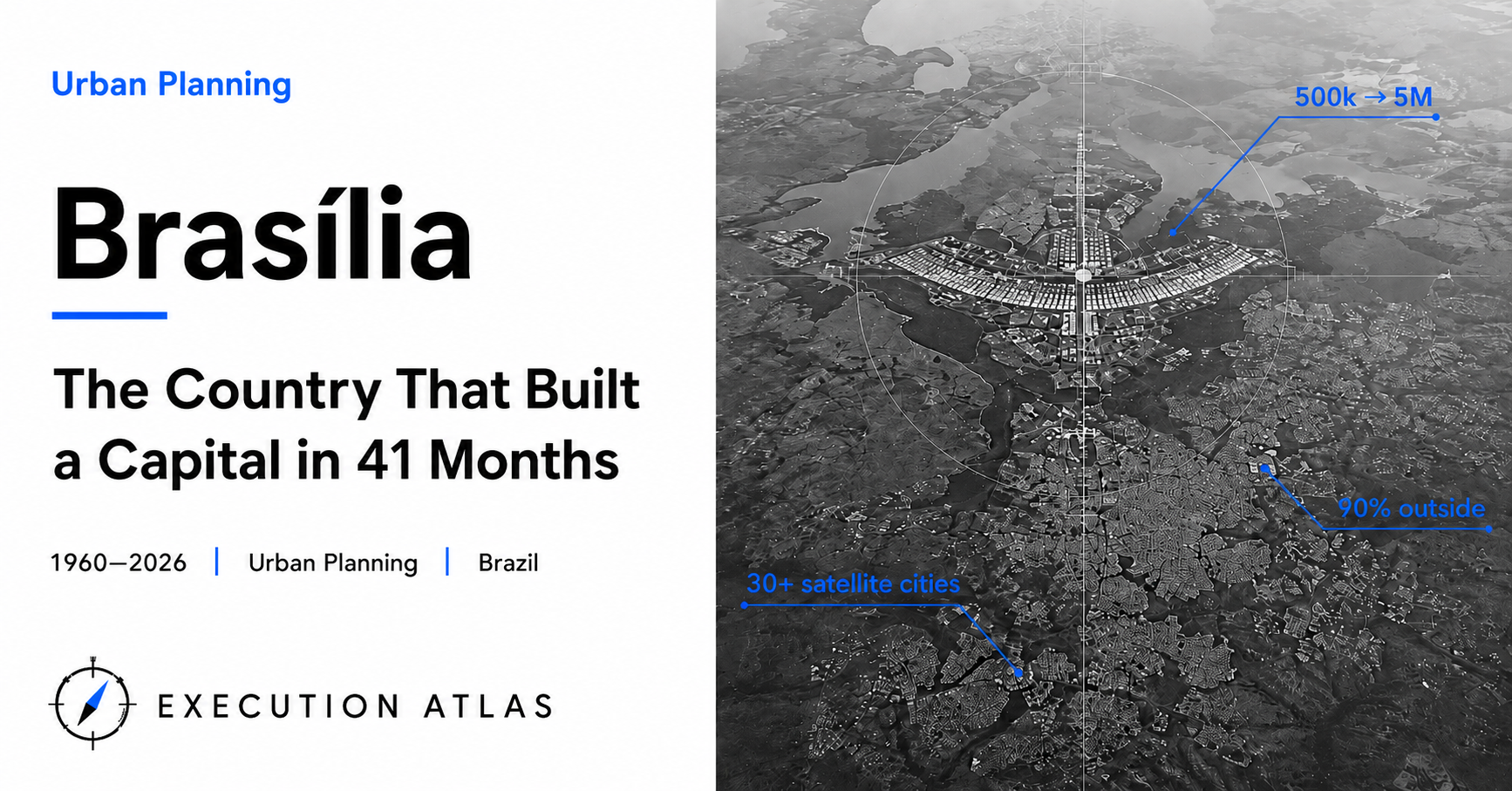
41 months. 60,000 workers. 12.3% of GDP.
Brazil had been trying to move its capital inland since 1823. The 1891 republican constitution made it explicit. For 65 years after that, no one acted.
In 1956, one president broke ground. Four years later, a capital appeared in the middle of the jungle.
Mission: 137 Years of “Someday”
Why move the capital at all?
Brazil’s old capital, Rio de Janeiro, sat on the coast. Most of the population was concentrated along the shore, and the vast interior lagged behind. Balanced national development. That was the official reason for relocation.
But for 137 years, no one moved. The reason was simple: Rio was comfortable. Politicians and bureaucrats had no desire to relocate to an empty highland. Relocation became a constitutional “correct but inconvenient” item, left untouched.
In October 1955, Juscelino Kubitschek won the presidential election. 35.6% of the vote. Far from a majority. “Fifty years of progress in five (Cinquenta anos em cinco).” The 53-year-old former doctor put Brasília at the heart of that campaign promise.
Kubitschek was from Diamantina, Minas Gerais. His father died when he was two. His mother was a teacher. After getting his medical license he entered politics, becoming mayor of Belo Horizonte, then state governor, then president. As mayor, he had worked with architect Oscar Niemeyer. That relationship would matter later.
Kubitschek had done the math. The Brazilian presidential term was five years with no reelection. There was zero guarantee the next president would carry on the project. If it wasn’t finished during his term, Brasília would go back on the “someday” list. As it had for 137 years.
Move the capital inland, and roads and railways would radiate outward. Population would disperse. Industry would spread into the interior. The coastal concentration would ease. At least, that was the expectation.
Design: 15 Sketches
In September 1956, Kubitschek founded NOVACAP (Companhia Urbanizadora da Nova Capital). Eight months after his inauguration in January. Bill drafted, passed through congress, organization stood up. Preparation had run in parallel. Standard government procurement was bypassed. Authority was concentrated in a construction-focused organization, going around the bureaucracy.
The president was engineer Israel Pinheiro. Technical director: Niemeyer. Decision-making was narrowed to two lines.
The urban plan was put out to public competition. 26 entries were submitted.
The winner was Lúcio Costa. 55 years old. An architect who had been Niemeyer’s mentor. Costa’s submission was 15 freehand sketches and 23 paragraphs of handwritten explanation. While other entrants prepared meticulous drawings, Costa’s proposal was strikingly bare.
The first sketch was two crossing lines. That was it. The vertical line was the “monumental axis,” lined with government and public buildings. The horizontal line was the “residential axis,” lined with housing blocks. Bend the horizontal into a bow, and the shape, seen from above, resembled an airplane.
The jury described Costa’s plan as “the only one that combined the practical and symbolic features of a modern capital within an artistic unity.” In December 1956, Costa is said to have sketched the outline aboard a ship returning from New York.
Costa’s plan was deliberately abstract. It set only the skeleton of the city, leaving building design to Niemeyer. Master and student, divided labor. The plan’s freedom built creative latitude into implementation.
Niemeyer was 49 at the time. A disciple of Le Corbusier, and one of the architects of the UN headquarters in New York. He was also a Communist Party member. The presidential palace, the National Congress, the Supreme Court, the cathedral. Every face of Brasília was his.
The Pilot Plan (the urban plan diagram) assumed 500,000 residents. Satellite cities were premised as “to be built, in planned form, in the future.”
Execution: Onto an Empty Highland
The construction site was a central plateau at 1,150 meters elevation. A red-earth tableland in Goiás state. No roads. The railway only reached Anápolis, 90 miles (about 145 km) away. Electricity, water, communications: all zero.
NOVACAP built the first structure in 10 days. The Catetinho Palace. A temporary wooden presidential residence. Kubitschek’s base when he visited the site.
Material transport was the largest bottleneck. The site offered only stone, sand, and brick. Cement, steel, glass, machinery — all had to be brought from outside. The road didn’t reach the construction area until 1960. For the four years before that, vast amounts of material were flown in. The most expensive transport method available.
The Kubitschek administration financed it by printing money and issuing bonds. 12.3% of GDP. The U.S. Apollo program was 2.2% of GDP; the Manhattan Project, 0.4%. Brasília’s investment scale was extraordinary by comparison. Critics rewrote the slogan: “Fifty years of inflation in five.”
60,000 Candangos
Labor came from Brazil’s northeast. The poorest region in the country. Tens of thousands of workers migrated in search of jobs. They were called “candangos.” Originally a slur for mud-covered migrant laborers.
At peak, the workforce exceeded 60,000. Shifts could run over 18 hours. Dormitories stacked beds two to three high. Toilets were holes dug in the ground enclosed by canvas. Water shortages, bedbugs, fleas. Mattresses were stuffed with grass; when the bug infestations got bad, they were burned and remade.
The inauguration deadline was April 21, 1960. A date back-calculated from Kubitschek’s term. Moving it was politically impossible.
The Structure of Project Management
Brasília had a distinctive project management structure.
Budget management barely existed. The cost of concentrating authority in NOVACAP was that normal government accounting and audit procedures were skipped. Economist Eugênio Gudin estimated construction costs at roughly $1.5 billion (12.3% of GDP at the time). But comparing official budget plans against actuals is impossible, because the records were never kept. Speed-first meant that the machinery of cost visibility itself was never built.
Schedule management, by contrast, was extremely clear. April 21, 1960 was an immovable deadline. The schedule had one option: meet it. When the plan looked likely to overrun, only two levers remained — cut scope, or add input. The Kubitschek administration did both. Many buildings were unfinished at inauguration, but the capital function transfer happened on schedule.
Scope management had a structural problem. “Build a capital” is too large a requirement. What counted as “complete” was ambiguous from the start. Was it complete when the presidential palace was built? When housing was in place? When water and sewer reached every corner? For Kubitschek, “complete” meant “transfer the capital function, move government out of Rio.” Urban completeness was secondary.
Risk management essentially did not exist. On February 8, 1959, an incident occurred at the Pacheco Fernandes construction company’s dormitory. Workers protested rotten food, and the argument escalated into a riot. The GEB (Special Police Guard of Brasília) was deployed, was initially pushed back by the workers, and returned that night reinforced, opening fire on the dormitory. The lights were cut, and gunshots echoed in the dark.
Official records list 1 dead, 48 injured. But workers on the scene testified that trucks loaded with bodies were hauled away the next morning. Estimated deaths range from 20 to 200. They cannot be confirmed. Brasília had no newspaper, radio, or television at the time. The first newspaper, Correio Braziliense, launched on inauguration day, April 21, 1960.
The GEB was not a police force. It was a paramilitary organization assembled from former police and jagunços (hired enforcers). No training, no discipline. Violence was the only tool of governance. After the incident, Kubitschek dissolved the GEB and turned security over to the military.
Professor Nair Bicalho put it this way: “Our elites have always maintained a pact of silence regarding violence committed against the people.”
The “speed” of 41 months stood on conditions like these.
People: A Doctor, an Architect, an Urban Planner
Kubitschek was 53 when he took office. A doctor-turned-politician, with no architecture or urban planning expertise, forced through a national project consuming 12.3% of GDP. He delegated all professional judgment to Costa and Niemeyer. His role was reduced to one thing: “decide to do it, and don’t stop.”
He visited the site constantly. He stayed at the temporary Catetinho residence, checking progress. Politically he was always on a tightrope. A fragile 35.6% mandate. Opposition from the legislature and the military. The critique that “that money could go to education.” He didn’t stop.
Costa was 55. A French-born Brazilian architect. The man who won a 26-entry competition with 15 sketches barely participated in Brasília’s construction after designing the Pilot Plan. He drew the skeleton and handed the implementation to his student.
Niemeyer was 49. A Communist Party member. The irony of a Communist designing the capital of a capitalist nation. To Kubitschek, ideology didn’t matter. What mattered was talent — and a trust dating back to his time as mayor. Niemeyer later went into exile in France under the military regime, and lived to 104.
The structural engineer Joaquim Cardozo is less known. The man who made Niemeyer’s bold curves possible in concrete and steel. The twin towers of Congress. The radial columns of the cathedral. Without the structural engineer, the architect’s vision would have stayed on paper.
And 60,000 candangos. Their names are not preserved. The “Two Candangos” statue in the Plaza of the Three Powers is the only evidence they were there.
Legacy: The Island of Fantasy
On April 21, 1960, Brasília officially became the capital. Government functions moved from Rio de Janeiro.
In 1987, UNESCO inscribed it as a World Heritage Site. Inscription as a “city without historical heritage” was unusual. Only 27 years after construction. Modernist architecture and urban planning themselves were recognized as cultural heritage.
But much of what Brasília “was supposed to change” did not change.
Interior development did advance. Roads and railways radiated out from Brasília, accelerating agricultural development in the Center-West. On this front, the relocation achieved its goal.
But the city itself became something different from what its designers intended. The Pilot Plan assumed 500,000 people. The current Brasília metropolitan area has about 5 million. Ten times what was planned.
90% of residents live outside the Pilot Plan, in over 30 satellite cities. Costa had envisioned satellite cities as something to be “built in planned form in the future.” Reality was different. The temporary settlements of candangos who gathered during construction simply became permanent. They did not arise from a plan; they swelled spontaneously.
Inside the Pilot Plan is one of the highest per-capita-GDP areas in Latin America. The surrounding satellite cities suffer from poverty and inadequate infrastructure. Brazilians call Brasília “Ilha da Fantasia” — the Island of Fantasy. A term for the gap between the planned center and the reality outside the plan.
A city designed around the car is hard to navigate on foot or by public transit. The beautiful airplane shape from above shows up on the ground as roads too wide and spaces out of human scale.
The economic cost echoed for a long time. Financing construction with printed money pulled GDP growth from 7% to 4% and industrial growth from 9% to 3.9%. Inflation accelerated, hitting about 80% annually by 1964. Economic crisis and social unrest contributed to a military coup, and Brazil lived under military rule for 21 years, from 1964 to 1985.
Kubitschek himself was stripped of his political rights after the 1964 coup. He returned from exile but died in a car accident in 1976, at 73. There are theories that he was assassinated.
Learnings: Outside the Plan
Brasília’s project management contains both clear success and clear failure, side by side.
The success structure was simple. Set an immovable deadline. Concentrate authority in a dedicated organization. Have the president stay committed. Abstract the plan to its minimum and delegate implementation to specialists. The 15 sketches showed only the vision of “what to build”; “how to build it” was left to the field. The fact that the capital function transfer was completed in 41 months is, as a force of project execution, undeniable.
The failure structure was equally clear. Governance was discarded for speed. A project without cost management can only be evaluated in hindsight. The invoice arrived in the form of inflation, sent to every citizen. Worker safety and human rights became dependent variables of speed.
But the most important lesson is in the relationship between “inside” and “outside” the plan.
The Pilot Plan was designed as a city for 500,000. Perfect bilateral symmetry, zoning separated by function, harmony between green space and housing. But the plan could not control “who would live there.” The 60,000 workers who built the city had no place inside the plan. They built temporary settlements outside it. Those became satellite cities. Eventually, they accounted for 90% of the metropolitan population.
Raising the precision of a plan does not give you control over what’s outside it. A perfectly designed space does not erase chaos. It pushes chaos outside the plan’s boundary. Building a capital in 41 months was a success. Whether a metropolitan area where 90% of the 5 million residents live outside the plan can also be called success is a different question.
A project where “complete” is ambiguous is a project where the real problems begin after completion.
Sources
- Brasília - Wikipedia
- History of Brasília - Wikipedia
- Juscelino Kubitschek - Wikipedia
- Lúcio Costa - Wikipedia
- “Building Brasília” — JSTOR Daily
- “Brasília | Brazil: Five Centuries of Change” — Brown University
- “Favela removal and urban planning in Brasília from the 1950s to the 1970s” — Planning Perspectives
- “The Monetary and Fiscal History of Brazil, 1960-2016” — BFI/University of Chicago
- “Brasília: Concrete Dream in the Central Plateau” — Google Arts & Culture