
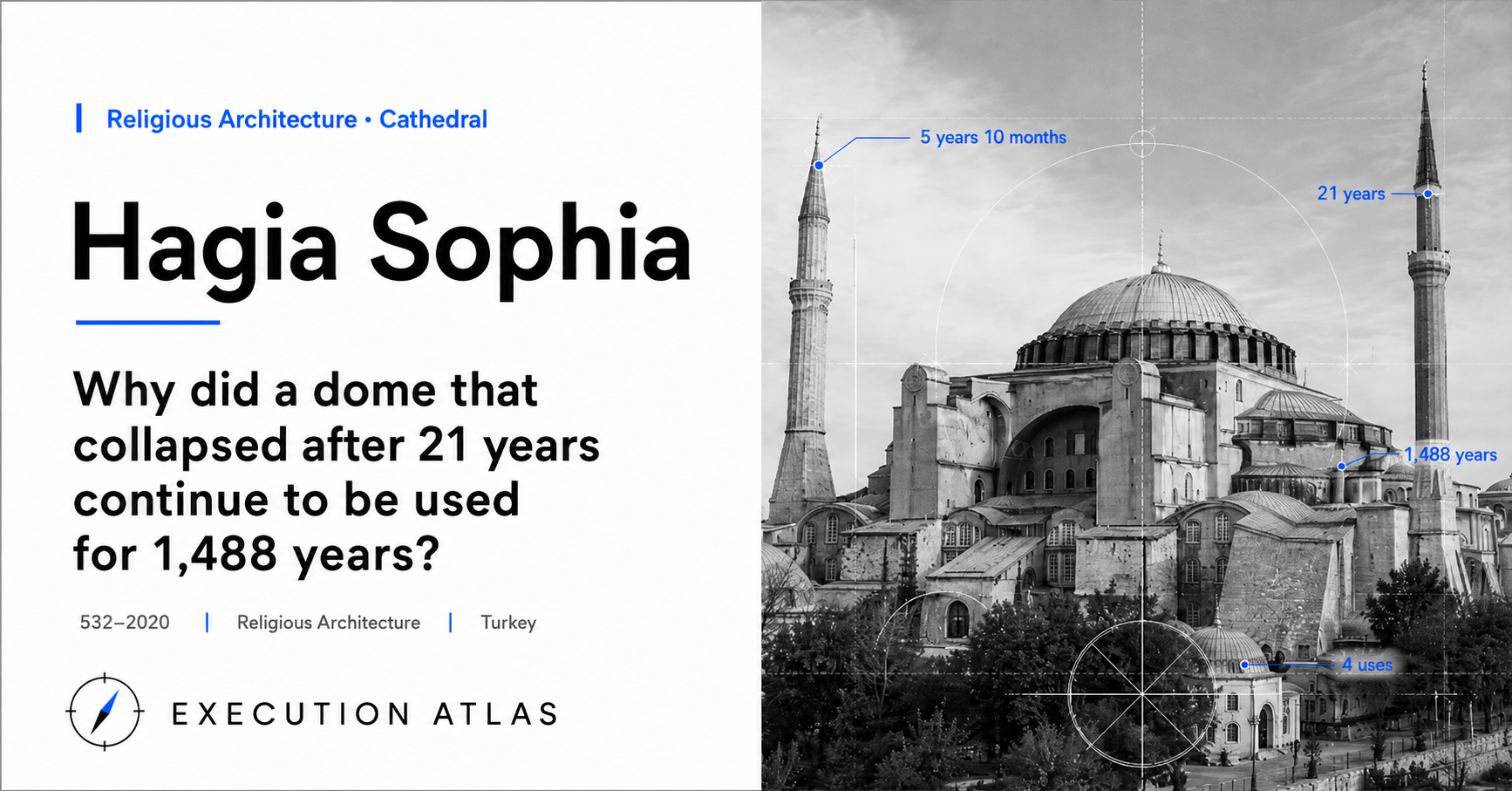
Construction began February 23, 532. Dedicated December 27, 537. Five years and ten months.
Twenty-one years later, the dome fell. On May 7, 558, an aftershock brought the central dome down completely, burying the ambo, the altar, and the ciborium under rubble.
And yet the building still stands. 1,488 years on.
A cathedral for 916 years. A mosque for 481. A museum for 86. A mosque again for a few years more. Through four changes of use, from Constantinople to Istanbul, it outlived three empires and one republic.
Mission: Why It Was Built
January 532. A riot broke out in Constantinople.
It started as a brawl between chariot-racing factions at the Hippodrome. Aristocrats and commoners with their own grievances against the emperor joined in, and half the city burned. The previous Hagia Sophia, the second basilica on the site, was lost in the flames. Chanting “Nika” — meaning victory — the rioters were finally crushed only after some 30,000 of them were killed in the Hippodrome. This was the Nika riots.
Justinian I was around 50. His throne had nearly slipped from him, and a month later, on February 23, he ordered reconstruction. The rubble had not even been cleared.
He did not want a replacement. He wanted something larger, more magnificent than what stood before, something that would surpass the Temple of Solomon. That was the brief.
Behind the brief was a political urgency. When the emperor’s authority is shaking, you need something physical to assert it. The short timeline was a matter of politics, not faith.
Design: Mathematicians Were Named Architects
The two chief architects Justinian appointed were not traditional master builders.
Anthemius of Tralles was a mathematician and physicist. He had written treatises on optics and mechanics, and was known for his work on conic sections and on burning mirrors. Isidore of Miletus was a geometer and engineer, teaching mathematics first in Alexandria and then in Constantinople. Neither had ever led a major architectural project.
Why mathematicians instead of master builders?
Because the structure they were trying to build had no precedent. A circular dome 31 meters across, set on top of a square supported by four piers. Standard basilicas of the time either rested their dome on a cylindrical wall or had no dome at all. Placing a circle on top of a square was a problem known in theory, but no one had solved it at this scale.
The solution they devised was the pendentive. A triangular curved surface rises from each of the four corners of the square, transferring the dome’s circular load down to four piers. Each surface is a section cut from a sphere. You cannot design this from experience. You have to calculate it.
The completed dome was about 31 meters in diameter, 55.6 meters from the floor. Its weight is carried by eight main piers and four pendentives. Forty windows around the dome’s base make the structure appear to float when seen from inside. Light scatters everywhere.
For 1,089 years — until St. Peter’s Basilica was completed in 1626 — it remained the largest pendentive dome in the world.
Execution: Five Years and Ten Months
Ten thousand workers and one hundred master craftsmen were split into two teams and made to compete.
The materials were fired brick and mortar. Only the eight main piers were large stone; the rest was standardized brick, mass-produced and stacked. Decorative marble columns were carted in from existing ruins across the empire — Ephesus, Baalbek, others. Gathering existing stock was faster than quarrying new.
Part of the funding came from the spoils of the Vandal Kingdom. By 534 Justinian had completed the conquest of North Africa and brought enormous amounts of gold back to the capital. The praetorian prefect Phocas allocated 4,000 Roman pounds of gold for the initial construction. The total cost is disputed, but one estimate places it at three years of the Byzantine Empire’s annual revenue.
Anthemius, the chief architect, died soon after construction began. He saw neither the completion nor the collapse that came later.
December 27, 537. The dedication. Justinian and Patriarch Menas consecrated the church. The emperor walked into the nave under the dome, looked up, and is said to have spoken:
“Glory to God. Solomon, I have outdone thee.”
The huge dome, built on a short schedule, looked as if it stood exactly as planned.
People: It Fell After 21 Years
In August 553 and December 557, earthquakes struck Constantinople. Cracks opened in the eastern half-dome and at the center of the main dome.
On May 7, 558, another aftershock came. This time the dome collapsed entirely. The ambo, altar, and ciborium were smashed. The floor was buried in rubble.
There were two causes. The original dome was too flat. The structural calculations from that time have not survived, but modern research indicates that its shallow profile produced larger horizontal thrust than the architects had assumed. The other was uneven weight distribution; the load was not balanced across the piers and walls.
Justinian ordered an immediate rebuild.
The task fell to Isidore the Younger, the nephew of Isidore of Miletus. Both Anthemius and Isidore were already dead. The only people who could trace the original design intent did so through family lineage.
Isidore the Younger did not design it the way his uncle had.
He raised the dome by 6.25 meters to reduce horizontal thrust. He changed the form from a shallow hemisphere to something closer to a ribbed umbrella. Forty structural ribs ran from the apex down to the base, with windows set between them. The weight distribution was recalculated, and the interior walls were reinforced.
He did not rebuild using the same design. He rebuilt in a way that physically removed the cause of the failure.
Completed in 562. This is the dome of Hagia Sophia today. Even so, it has gone through repeated partial collapses and repairs over the centuries. Only eight ribs on the north side and six on the south remain from the 562 reconstruction. The rest are medieval and later replacements.
A finished building that grew slightly different each time it was finished again.
Legacy: A Building That Changes Use
May 29, 1453. Constantinople fell.
After 53 days of siege, the army of the 21-year-old Sultan Mehmed II broke through the walls. Once inside, Mehmed went first to the cathedral of Holy Wisdom. By then the building was already over 900 years old.
Mehmed would not allow it to be destroyed.
One of the soldiers tried to pry up a slab of Proconnesian marble from the floor. Mehmed drew his sword and struck him. Do not touch the building. An accompanying ulama — an Islamic scholar — climbed onto the ambo and recited the shahada: “There is no god but Allah, and Muhammad is his messenger.” That was the declaration that the cathedral had become a mosque.
The use changed within a single day. The building had not changed by a millimeter.
Mehmed did not destroy the mosaics either. He had them plastered over. Plaster can be washed off later; restoration remains possible. Many conquerors of his era tore down infidel structures and built anew. Mehmed chose otherwise.
Minarets were added one after another over the centuries. First was a single wooden minaret. Around 1481, a red brick stone minaret rose at the southeast corner, built by Mehmed II or his son Bayezid II — the oldest of the four still standing. Bayezid II later added another at the northeast corner. In the late 16th century, the architect Mimar Sinan reinforced the exterior with buttresses and built two more stone minarets on the western side. Four minarets, each from a different era, a different sultan, a different style.
November 1934. The cabinet of the young Republic of Turkey made a decision. Mustafa Kemal Atatürk signed it. Hagia Sophia would become a museum. As a symbol of secularism, it would no longer belong to any single religion; it would be treated as a heritage of all humanity. The mosaics beneath the plaster reemerged after nearly 500 years.
On July 10, 2020, Turkey’s Council of State ruled that the 1934 cabinet decision had unlawfully appropriated the property of an Islamic waqf — a religious foundation — and was therefore void. The same day, President Erdoğan signed a decree returning Hagia Sophia to mosque status.
July 24. The first Friday prayer in 86 years.
One person built it. Four people changed its use. Over 1,488 years, the building has gone through repeated partial collapses and repairs; the pendentives and walls have each become slightly different things. And yet, the space Justinian saw and the space in which Erdoğan prayed are structurally continuous.
Learnings
The dome of a building completed in five years and ten months fell apart 21 years later.
“Solomon, I have outdone thee,” spoken at the dedication, was contradicted within twenty years. The completion reached on a short schedule did not equate to a correct design. The gap between what the structure could actually bear and what the architects assumed it could bear was invisible until an earthquake exposed it.
Completion and success are different things.
The story does not end there. The collapsed dome was rebuilt, and after that it went through more partial collapses and more repairs. Completion was never a single event. It arrived again and again, each time leaving behind a slightly different building.
What kept the building standing for 1,488 years was not the structure itself.
It was a spatial design that kept functioning even as the use kept changing. A single large interior beneath a central dome could serve as a Christian cathedral, an Islamic mosque, and a secular museum. None of this was intended by its designers. It happened to come out that way. That accident became the condition for surviving four transfers of power across empires and a republic.
The lifespan of this building was not decided by the people who built it.
The moment on May 29, 1453, when Mehmed II struck down the soldier prying up the marble floor — without that decision, Hagia Sophia would have been razed like so many other churches of Constantinople. Atatürk’s decision in 1934 and Erdoğan’s in 2020 each shaped what the building is now.
The person who builds something is just the first one. Whether it stays standing is decided by everyone who comes after.
Massive symbolic infrastructure becomes a canvas for later powers to overwrite with their own claims. Cathedral, mosque, museum, mosque. The form did not change. The meaning was rewritten over and over.
Does what you are building now leave room for someone in another era, holding a different kind of power, to load it with a different meaning?
Sources
- Hagia Sophia — Wikipedia (https://en.wikipedia.org/wiki/Hagia_Sophia)
- Hagia Sophia — Britannica (https://www.britannica.com/topic/Hagia-Sophia)
- Hagia Sophia, 532–37 — The Metropolitan Museum of Art (https://www.metmuseum.org/essays/hagia-sophia-532-37)
- Construction of Hagia Sophia Under Justinian I (https://hagia-sofia.com/construction-of-hagia-sophia-justinian/)
- How Hagia Sophia was Built — Medievalists.net (https://www.medievalists.net/2015/08/how-hagia-sophia-was-built/)
- The Collapse of Hagia Sophia’s First Dome — Columbia University (https://projects.mcah.columbia.edu/medieval-architecture/htm/or/ma_or_gloss_collapse.htm)
- Italian Art Society — note on the May 7, 558 dome collapse (https://www.italianartsociety.org/2017/05/a-series-of-earthquakes-in-553-and-557-caused-significant-structural-damage-to-the-hagia-sophia-and-during-such-a-tremor-on-7-may-558-the-dome-of-the-basilica-collapsed-completely-destroying-the-am/)
- The structural configuration of the first dome of Justinian’s Hagia Sophia — Soil Dynamics and Earthquake Engineering, 2009 (https://www.sciencedirect.com/science/article/abs/pii/S0267726108001280)
- How was the Hagia Sophia altered during the Ottoman Period? — Britannica (https://www.britannica.com/question/How-was-the-Hagia-Sophia-altered-during-the-Ottoman-Period)
- The Minarets of Hagia Sophia (https://hagia-sofia.com/minarets-of-hagia-sophia/)
- Hagia Sophia: Turkey’s Erdogan orders the conversion of museum back into a mosque — CNN, 2020 (https://www.cnn.com/2020/07/10/europe/hagia-sophia-mosque-turkey-intl)
- The Hagia Sophia Case — Harvard Law Review, Vol. 134 (https://harvardlawreview.org/print/vol-134/the-hagia-sophia-case/)
- “O Solomon, I have Surpassed Thee!” — Gloria Romanorum (http://gloriaromanorum.blogspot.com/2017/12/o-solomon-i-have-surpassed-thee.html)