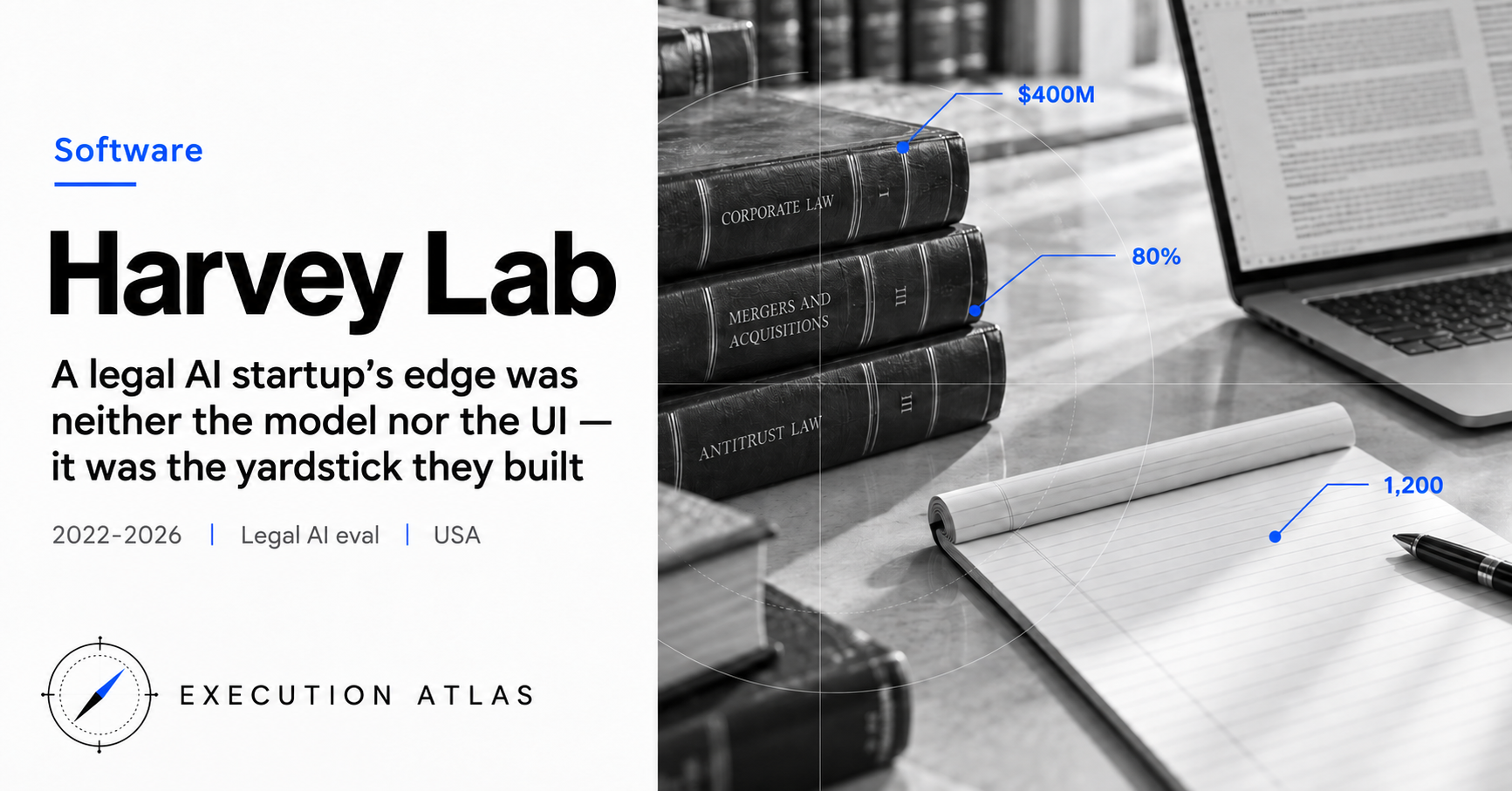
Four years since founding. 3,000 client organizations. 80% of Am Law 100 — the top 100 law firms in the United States — have adopted it. 200,000 lawyers across 70 countries use it daily. ARR grew from $190 million in January 2026 to $400 million by September. That same month, the company’s valuation hit $15.5 billion.
Harvey started in 2022 in a San Francisco apartment. Two roommates. One, an AI researcher who had moved through Google Brain, DeepMind, and Meta. The other, a first-year litigation associate handling securities and antitrust work. “First-year associate” means the person who pulls all-nighters hunting through case law and gets their drafts marked up in red by partners.
The problem they set out to solve wasn’t how to build legal AI.
It was how to measure whether legal work is good or bad.
Designing that measurement system, then releasing it as open source — that was the work of a team inside Harvey. That team is Harvey Lab.
Mission
2022, San Francisco. The GPT-3.5 era. ChatGPT did not yet exist.
Winston Weinberg was a first-year associate at O’Melveny & Myers, a major firm, handling securities and antitrust litigation. He worked overnight shifts searching case law, drafted client letters, and had them marked up red by partners. Gabriel Pereyra was his roommate from their Los Angeles days, a researcher who had worked on AI at Google Brain, DeepMind, and then Meta.
In early 2022, Pereyra showed Weinberg GPT-3. Weinberg was “stunned,” he later said. Something this capable existed, and nobody was applying it to legal practice. They built a prototype together, feeding it legal questions pulled from Reddit. Usable in spots. But not usable.
The line between what it could and couldn’t do was strange. Summaries, fine. Contract drafts looked plausible. But the case citations it offered sometimes didn’t exist. It would ignore client-specific context. Where it should have written from “the client’s position,” it wrote as a “neutral explainer.” A lawyer’s job is not to produce answers — it is to build up evidence and refine arguments in service of the client’s interests. The raw LLM output had none of that process.
Their initial hypothesis formed: to sell LLMs for legal use, you had to own a definition of “well done” for legal work before anything else about model performance. Without that, you couldn’t tell what to improve, couldn’t explain it to clients, and couldn’t track the progression of models from vendors.
With their prototype in hand, they sent a cold email in 2022 to OpenAI’s legal department. On July 4th, a meeting with OpenAI leadership materialized. Harvey became the first investment from the OpenAI Startup Fund — $5 million, announced in November 2022. Jeff Dean (Google AI chief), Elad Gil, and Sarah Guo were co-investors.
Allen & Overy became the first major customer. A storied London firm dating to the 1950s, with offices in over 40 countries at the time. When they signed onto Harvey’s first pilot, the product ran on GPT-3.5. At the stage of setting the pass threshold for the pilot, Harvey had to build their own evaluation criteria.
A few months later, early access to GPT-4 arrived from OpenAI. What happened?
The plan rewrote itself.
Every baseline they’d set — “this model gets us this far” — shifted at once. If the baseline itself wasn’t variable, they couldn’t measure the product’s progress.
The prototype of Harvey Lab, as an organization that held a variable measuring stick, began here.
Design
“Build a measuring stick for evaluation” sounds simple in words. In practice, three design decisions were required.
First: measure long-horizon tasks, not single Q&A.
LLM benchmarks have historically been single-question formats. MMLU, HumanEval, LegalBench — all are structured around “how does the model answer this prompt?” But a working lawyer’s day looks different. Read 300 pages of a contract and list 20 clauses that disadvantage the client. Review due diligence materials for an acquisition and draft the board consent. Deliver a 15-page deposition summary. None of these have a single correct answer. All involve hours of work to build a deliverable.
The unit Harvey chose for evaluation was already familiar in the legal industry.
Time entry.
Lawyers bill clients by the hour. A single piece of work gets recorded as something like “Reviewed amended credit agreement; drafted summary memo of key covenant changes (2.5 hours).” This unit — created to track billable time — is also the natural unit of “one piece of legal work.” Design tasks at this granularity, and the client-side lawyer can directly compare it against their own “2.5 hours.” At onboarding, showing what AI did on a given task at time-entry granularity eliminates one layer of the core objection: “Can this actually be used for my work?”
Second: lawyers inside the company write the rubrics.
Most LLM evaluation pipelines rely on “LLM-as-a-judge” — they have another LLM do the scoring. Harvey adopted this only partially. The rubric itself — the criteria defining what “pass” looks like for a given task — would be written by former BigLaw attorneys.
The organization built for this was the Applied Legal Research team. Attorneys sit alongside engineers, designers, and PMs at the very start of product design. Use-case discovery, dataset collection, rubric creation, UI iteration, end-to-end testing. In most SaaS companies, domain experts sit in the back. At Harvey, they sat at the front.
The rubrics are structured across four layers: structure (format requirements), style (does the advice lead to action?), substance (factual accuracy), and hallucination detection. Each layer carries positive and negative scores. The structure mirrors exactly what a lawyer looks for when receiving a deliverable.
Third: embed evaluation into the product development loop daily.
Harvey held this system in three tiers: direct expert review, automated evaluation pipeline, and a data service managing evaluation data. With every model update, more than 1,000 tasks run automatically and are scored against rubrics. Only in areas where regressions appear does a human attorney step in to pinpoint the problem.
This three-part prototype was announced in September 2024 under the name BigLaw Bench. The public version contained 100 triplets — task, sample answer, rubric — in one set. The moment an internal model comparison became an external asset covered by industry media was the first.
Execution
Saying you’ll build evaluations and actually building them are different things.
Here is what Harvey Lab did over two years, in numbers.
- September 2024: BigLaw Bench Core released. 100 triplets.
- Same period: BigLaw Bench Workflows operated internally. Synthetic multi-step tasks.
- 2025: JudgmentBench developed as an academic extension. 30 tasks, 50+ practicing attorneys, 3,000+ scored pairs and preference judgments obtained per item — the first public dataset of its kind.
- May 6, 2026: Legal Agent Benchmark (LAB) announced. 1,200+ long-horizon tasks, 24 practice areas, 75,000+ expert-written rubric criteria. All-pass scoring: a task passes only if every criterion is satisfied.
- Same day: LAB integrated into Artificial Analysis’s Stirrup agent harness. Agents from each model vendor compete on 120 of Harvey’s private tasks.
One thing becomes clear: no single attorney could write 75,000 rubrics. Fifty people, 1,500 items each. At 10 minutes per item, that’s 250 hours per person. This was a scale that only happened if someone committed to the headcount and the schedule.
Harvey used external partnerships to make it possible.
Mercor handled expert dataset construction. Mercor maintains networks of highly specialized professionals by domain. Harvey could access annotator pools at the granularity of “former M&A attorney,” “former litigator,” “former IP attorney.” A two-stage flow — synthetic data drafts first, then human expert revision — ran through this network.
Fireworks operated on the model side. In an environment that runs long-horizon tasks (reading documents, calling tools, drafting, then looping back to revise — the way an actual attorney works), asynchronous reinforcement learning was applied. The reward signal was Harvey Lab’s rubrics themselves. The evaluation infrastructure became the training infrastructure.
Artificial Analysis handled the visualization layer. Harvey LAB scores appear on the leaderboard of an independent AI evaluation site. When model vendors release a new model and claim strength in legal use cases, they cite that leaderboard. Harvey’s measuring stick became the reference point the industry converges on.
There was no project schedule at founding. But as a result, founding to LAB release took four years. Over those four years, the scope of evaluation expanded in stages: BigLaw Bench → Workflows → JudgmentBench → LAB. Single question to multi-step; 100 triplets to 1,200 tasks; on-premises scoring to open source.
In the same four years, the product side grew. From 1,300 organizations and ARR of $190 million in January 2026, to 3,000 organizations and ARR of $400 million by September of the same year. ARR doubled in 8 months. 80% of Am Law 100. 5 of the Fortune 10. 200,000 lawyers in 70 countries.
The investment in evaluation infrastructure and the growth of the business overlapped across the same four years.
People
The central actor in Harvey Lab is the Applied Legal Research team as an organizational structure, but it is worth briefly sketching the individuals.
Winston Weinberg was in his mid-twenties at founding. He took his bachelor’s at Kenyon College, his JD at USC Gould School of Law, and worked as a first-year associate at O’Melveny & Myers handling securities and antitrust litigation. Reading through contracts, researching precedents, explaining findings to clients, reporting to partners. The tasks a first-year associate spends the most time on are the same tasks he chose as Harvey’s first use cases. He didn’t forget what made his work hard before he turned it into a product.
Gabriel Pereyra studied computer science as an undergraduate at USC and completed a PhD in neuroscience at the University of Oxford (funded fully by DeepMind). He was a resident at Google Brain in 2016, a research scientist at DeepMind from 2017, and then moved to Meta. The paper that defined the next decade of AI — “Attention Is All You Need,” from Google in 2017 — came out while he was part of that generation of researchers.
The two were roommates in Los Angeles before eventually co-founding Harvey. The first financing line was a $5 million seed led by the OpenAI Startup Fund.
The three names that appear as central figures in Harvey Lab are Niko Grupen, Gabe Pereyra, and Julio Pereyra — the LAB announcement was published under all three names. Grupen is Head of Applied Research, and comes from Google Brain. Julio Pereyra is Gabe’s younger brother; before joining Harvey, he spent time as an associate at O’Melveny & Myers and as a judicial law clerk in the U.S. District Court for the District of Maryland. At Harvey, he led the Applied Legal Research team and embedded the methodology of rubric-first dataset synthesis as an organizational practice.
The hiring philosophy for in-house attorneys was explicit: no sitting partners. The target was associates and junior counsel with five to ten years of hands-on experience in M&A, litigation, finance, or tax. The reason: writing a rubric requires the feel of actual practice, not the decision-making perspective of a manager. A partner’s job is to sell judgment calls; it is not to write the mesh of evaluation criteria.
Harvey’s published materials describe the structure this way: engineers get on the phone directly with partners at the world’s leading law firms. In-house attorneys function as quality gatekeepers from evaluation design through regression detection. Without both conditions, Harvey is not Harvey.
Legacy
As of October 2026, here is what Harvey Lab has left behind.
First, open-source evaluation datasets. The public version of BigLaw Bench; JudgmentBench’s 30 tasks × 50+ attorneys × 3,000+ pairs; the task design and rubric structure behind LAB’s 1,200+ tasks. All of these are auditable by anyone. Other companies can run their models against them. They are becoming the de facto reference point for model vendors claiming strength in legal use.
Second, a methodology for integrating evaluation and training. The procedure for post-training domain-specific models using evaluation rubrics as a reward function was made concrete through Harvey’s collaboration with Fireworks. This is less Harvey’s proprietary asset and more the approach the industry will replicate.
Third, a concrete example of an organizational structure that puts domain experts at the front of product development. Lawyers, doctors, accountants, architects — for any company trying to replace “work that requires a licensed professional” with software, the Applied Legal Research team’s design is a readable case study.
The business numbers are the same as those in the opening: ARR of $400 million, $15.5 billion valuation, 3,000 organizations, 80% of Am Law 100. Backers include Sequoia, Andreessen Horowitz, Kleiner Perkins, GIC, Coatue, and Lightspeed. Two rounds in 2026 raised a combined $750 million.
The deepest consequence of releasing the evaluation infrastructure openly, however, sits outside those numbers.
When model vendors release a new model and talk about its performance in legal categories, Harvey’s name surfaces naturally. “GPT-5 achieved X% on Harvey LAB.” “Claude Opus 5 improved Y% on M&A tasks in Harvey LAB over the previous model.” Without Harvey running any ads, its name is embedded in the vocabulary used to narrate the industry’s progress. The cost of marketing has been replaced by the asset of evaluation.
That is the true consequence of releasing evaluation infrastructure as a product.
Lessons
Harvey Lab’s lesson is best reduced to one.
Borrow the model. Build the evaluation.
The differentiation of AI startups has long been framed around whether they own the model: companies that build foundation models from scratch, companies that differentiate through fine-tuning, companies that compete purely on prompts and workflows. Harvey introduced a fourth axis: building your own measuring stick for evaluation.
What happens when you own the evaluation? Three things happen simultaneously.
First, product progress becomes visible internally. When the model changes, when use cases expand, you can state in numbers “where, and by how much, things improved.” The development team detects regressions immediately and can pinpoint which tasks require a human attorney. Evaluation becomes a lever for development velocity.
Second, the way you persuade customers changes. You can say: “For this task, at the same granularity as your attorneys’ time entries, at this quality level, in this amount of time.” The biggest barrier at onboarding is the suspicion that “this can’t actually be used for my work.” Time-entry-based evaluation removes one layer of that suspicion.
Third, your positioning inside the industry changes. As the evaluation proliferates, model vendors and competitors alike all optimize against it. The creator of the measuring stick remains at its center. The evaluation reaches audiences that marketing budgets can’t touch — researchers, technical evaluators, model vendors — naturally. Evaluation becomes a marketing channel.
This pattern is not unique to Harvey.
ImageNet was an educational dataset for deep learning before it was released publicly — the moment it was released, it became the industry benchmark. GLUE and SuperGLUE became the shared language of NLP models. MLPerf became the axis for comparing AI hardware. HumanEval became the standard evaluation for code generation. In each case, the creators defined the progress of an industry by providing its measuring stick.
Evaluation is not an appendage to a product. It can be an independent product in its own right. In domains where “correct” is not uniquely defined and judgment requires expertise, evaluation becomes a scarcer resource than the model.
Two people in their twenties, in a San Francisco apartment in 2022, sensed this. Four years later, they hold the measuring stick for legal AI.
For your own product, what does success look like? Who decides that — you, a competitor, the industry press, the customer?
What Harvey demonstrates is that a strategy of writing the answer yourself, distributing it for free, and letting the industry spread it is viable. The measuring stick may be something you build to give away, not to keep.
What remains after you give it away is just the name of the company that understands it best.
Sources
- Harvey “Introducing BigLaw Bench to Evaluate LLMs” (2024-09, https://www.harvey.ai/blog/introducing-biglaw-bench) — Evaluation framework design, time entry basis, 2-axis scoring: Answer Quality and Source Reliability.
- Harvey “Introducing Harvey’s Legal Agent Benchmark” (2026-05, https://www.harvey.ai/blog/introducing-harveys-legal-agent-benchmark) — LAB scale (1,200 tasks, 24 domains, 75,000 rubrics), open-source policy.
- Harvey “Scaling AI Evaluation Through Expertise” (https://www.harvey.ai/blog/scaling-ai-evaluation-through-expertise) — The three pillars of evaluation (expert-led reviews / automated eval / data services).
- Harvey “Lawyers at Harvey: Applied Legal Research” (https://www.harvey.ai/blog/lawyers-at-harvey-applied-legal-research) — Applied Legal Research team organizational structure.
- Harvey “Training a Legal Agent With Applied Compute” / “Post-training update: Harvey Tenet” — Fireworks RL post-training, Mercor human expert datasets.
- Artificial Analysis “Harvey LAB-AA Benchmark Leaderboard” (https://artificialanalysis.ai/evaluations/harvey-lab-aa) — Stirrup harness, 120 private tasks, multi-vendor agent comparison.
- Artificial Lawyer “Harvey Launches Legal Agent Bench” (2026-05-06, https://www.artificiallawyer.com/2026/05/06/harvey-launches-legal-agent-bench/) — Background on LAB announcement.
- Harvey “Harvey Raises $550M at a $15.5B Valuation” (2026-09, https://www.harvey.ai/blog/harvey-raises-dollar550m-at-a-dollar155b-valuation-to-help-legal-teams-own-their-intelligence) — ARR $400M, 3,000 organizations, 80% of Am Law 100, 200,000 lawyers in 70 countries.
- CNBC “Legal AI startup Harvey valued at $11 billion” (2026-03-25) — $200M raised, $11B valuation.
- Forbes “From roommates to decacorn founders” — Founding story, Allen & Overy, GPT-4 early access.
- LawNext Podcast “From Roommates to Billionaires” (2026-01) — Founders’ backgrounds, from LA roommates to co-founders.
- arXiv “JudgmentBench” (2605.25240) / Snorkel.ai overview — 30 tasks × 50+ attorneys × 3,000+ pairs public dataset, connection to BigLaw Bench.
- ZenML LLMOps Database “Harvey: Building and Evaluating Legal AI at Scale” — Description of attorneys and engineers working in parallel.