On August 2, 1828, in the harbor of Puerto del Hambre (“Port Famine”) at the southern tip of South America, the captain of HMS Beagle, Pringle Stokes, shot himself in his cabin. After fourteen days of confinement following months of solitary survey work in winter conditions, he died on August 12. He was 35.
Three years later, Robert FitzRoy, the 26-year-old appointed as his successor, made an unusual request before the next voyage: “I would wish to have someone with me who is well-educated, who could be a companion on a long, trying voyage.” The botanist Henslow was asked for a recommendation; he suggested his former student. Charles Darwin, 22 years old. Unpaid, self-funded, and with virtually no scientific credentials.
Without that HR decision, the theory of evolution might never have existed.
Mission: Charts for the 19th-Century British Empire
HMS Beagle’s mission was to survey the coasts of South America. Built in 1820 as a Cherokee-class 10-gun brig, she was 27 meters long and displaced 235 tons — one of 115 identical ships, known to sailors as “coffin brigs” for their poor stability.
In the early 19th century, British shipping stretched across the globe, but charts of the southern tip of South America remained incomplete. Patagonia, Tierra del Fuego, the Strait of Magellan — violent winds, treacherous currents, and labyrinthine inlets sank commercial vessels every year.
The Admiralty’s objective was clear: measure longitudes precisely using marine chronometers and produce charts that would serve future generations. The first Beagle voyage (1826–1830) surveyed the east coast of South America. The second was planned to complete the west coast and circumnavigate the globe. The estimated duration: two years.
Then Stokes’s suicide left a vacancy.
Design: Institutionalizing a Predecessor’s Death
FitzRoy’s engineering decisions, in retrospect, operate on three distinct levels.
Redundant Timekeeping
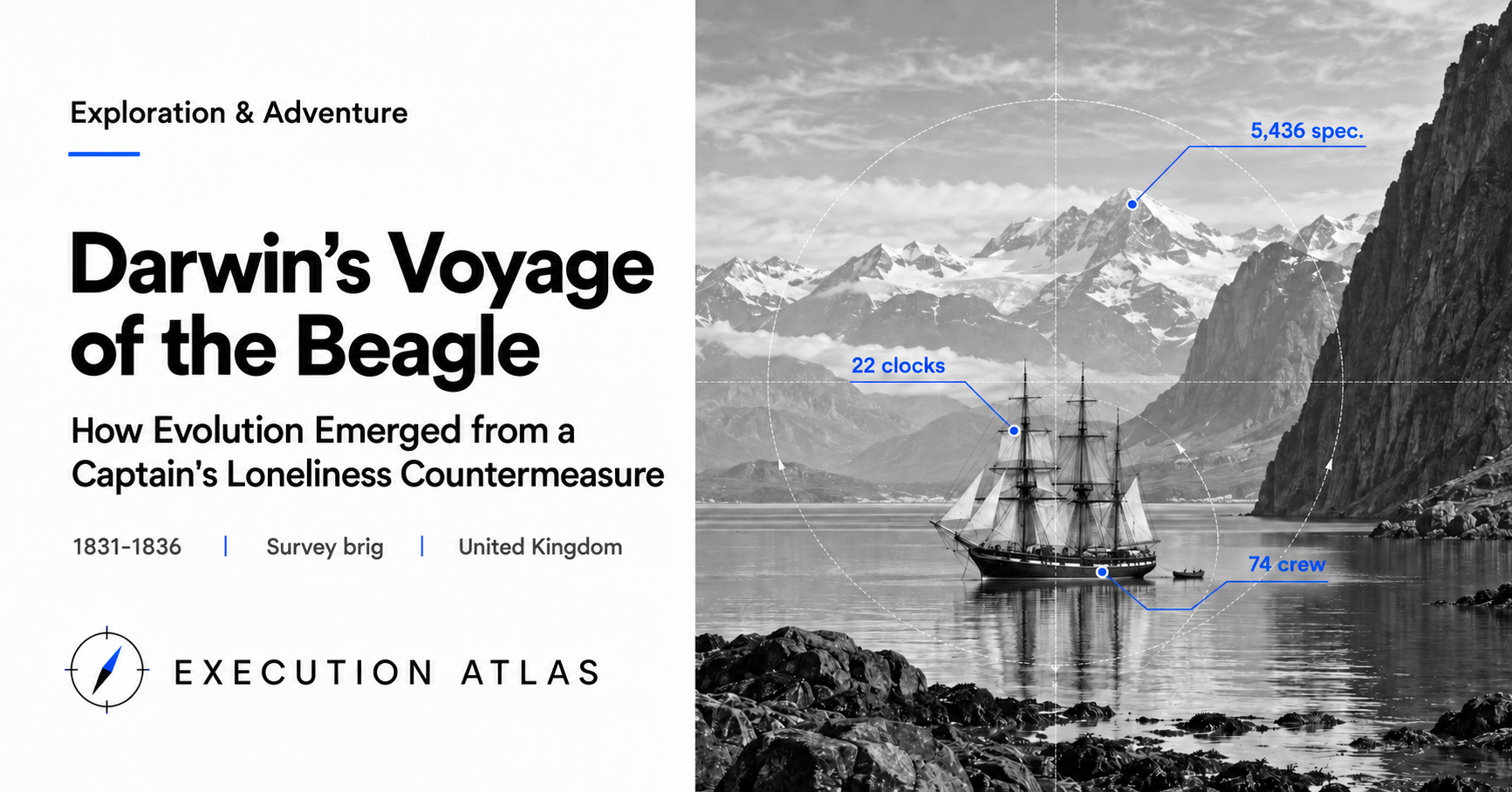
He loaded 22 marine chronometers — an extraordinary number for a survey vessel. With one or two, you can’t tell which has drifted. With 22, a single instrument that slips by a few seconds is detectable by consensus of the other 21. Majority vote to detect anomalies: the same logic as modern distributed systems and the multiple clocks in GPS satellites, implemented by FitzRoy on a 19th-century sailing ship.
Of the 22 chronometers, 11 were Admiralty property, 5 were on loan from manufacturers, and 6 were FitzRoy’s personal instruments. After the Navy rejected his request for brass cannons, he bought those himself too. The salary of the instrument keeper, George Stebbing, also came from FitzRoy’s own pocket.
The Gentleman Companion System
FitzRoy did not attribute Stokes’s tragedy to personal weakness. A captain cannot speak candidly with junior officers. Months of solitude and total responsibility erode the mind. Stokes had lasted six months. The next man to crack was unknowable in advance.
His solution: a “gentleman companion” who could converse with the captain as a social equal. Unpaid was fine. An interest in natural history would be a bonus. The cabin rent would be self-funded. It was an outsourcing of personnel risk.
He asked Henslow to recommend someone. Henslow first approached his brother-in-law Leonard Jenyns, who declined. He then thought of Darwin, who was at Cambridge studying theology with a view to becoming a clergyman. Darwin’s father Robert objected; his uncle Josiah Wedgwood II persuaded him.
A Command Structure with an Average Age of 24
The crew at departure numbered 74. FitzRoy was 26; Darwin was 22. For nearly five years, 74 people lived crammed into 27 meters of ship. The core of the command ran on people in their early-to-mid twenties.
Execution: 5 Years, 5,436 Specimens, an Earthquake
HMS Beagle departed Plymouth on December 27, 1831. The plan was two years; the reality was four years and ten months — roughly 2.4 times the original schedule.
Darwin suffered persistent seasickness, which meant he went ashore at every opportunity. Of the five-year voyage, he spent three years and three months on land, only one year and six months at sea. On land, he walked, dug, shot, and preserved. Back on board, he sorted specimens and packed crates to send to Henslow.
In 1832, at Bahia, Brazil, Darwin encountered tropical forest for the first time — the sheer density and variety of life utterly overwhelmed a young man raised in England’s gentle countryside.
In September 1833, at Punta Alta, Argentina, he found enormous bones in a coastal cliff: fossils of Mylodon, Megatherium, and other extinct mammals as large as elephants. Their anatomy resembled living South American armadillos and sloths, only vastly larger. Similar animals, same land, different sizes, extinct versus living. Question marks multiplied in Darwin’s notebooks.
On February 20, 1835, at Valdivia, Chile, he felt the ground move beneath his feet while walking through the city. An earthquake. When he reached the shoreline, he saw rock with barnacles still attached had risen several feet above the waterline. He had watched a continent move.
“A great earthquake at once destroys our oldest associations: the earth, the very emblem of solidity, has moved beneath our feet like a thin crust over a fluid.”
On September 15, 1835, they reached the Galápagos Islands, where they stayed five weeks. Darwin observed finches, mockingbirds, and tortoises. A local official pointed out that the animals varied subtly from island to island — Darwin had not noticed himself. His labeling was poor enough that he later had to cross-reference colleagues’ records to reconstruct which island’s finches were which.
Meanwhile, FitzRoy worked without interruption. Every day he reconciled the readings of 22 chronometers, took latitude with sextant and theodolite, and accumulated position data accurate to within half a nautical mile at key sites. While Darwin collected specimens ashore, FitzRoy was drawing charts below decks.
On October 2, 1836, they returned to Falmouth. Seventy-four people had circumnavigated the globe on a 27-meter vessel.
Darwin had sent 5,436 specimens back to Britain — animals, plants, fossils, minerals. Most of the shipping and storage costs were borne by his father, Robert, from the family home.
People: Three Captains
Three captains are associated with HMS Beagle — each worth remembering.
Pringle Stokes. Captain of the first voyage. Shot himself on August 2, 1828, at Puerto del Hambre; he died eleven days later. The final pages of his journal are nearly blank.
Robert FitzRoy. Captain of the second voyage. A distant cousin of King George IV on the wrong side of the blanket — his “Fitz” surname marked royal descent through illegitimacy. Four years older than Darwin, and an extreme perfectionist, he was obsessed with his 22 chronometers. His insistence on self-funding equipment upgrades cost him much of his fortune.
His career after the voyage followed an improbable trajectory: Conservative Member of Parliament, Governor of New Zealand (dismissed during a land dispute), and then, in 1854, Meteorological Statistician at the Board of Trade.
FitzRoy coined the term “weather forecast.” On August 1, 1861, he published the world’s first public weather forecast in The Times, collecting data via telegraph from 13 British and 5 French stations to predict the following day’s conditions for fishermen and sailors. It is estimated that his storm warnings saved hundreds of lives along the British coast between 1861 and 1865.
He was also mercilessly attacked for it. When forecasts were wrong, newspapers mocked him; politicians demanded budget cuts. On the morning of April 30, 1865, FitzRoy rose early, kissed his daughter in the hallway, went to his dressing room, and cut his throat with a razor. Suicide in service, just like Stokes. He was 59.
Charles Darwin. Not technically the third “captain,” but among the people who sailed on that ship, he would be remembered longest. He wrote of the voyage:
“The voyage of the Beagle has been by far the most important event in my life and has determined my whole career.”
Twenty-three years after returning, on November 24, 1859, he published On the Origin of Species. The first edition of 1,250 copies sold out on the day of publication.
Legacy: The Main Mission and Three Byproducts
HMS Beagle’s primary purpose was precise charts of the South American coastline. That purpose was achieved. The charts FitzRoy and his crew produced over five years were used by the Royal Navy and merchant shipping for the next hundred years. A longitude accuracy of within half a nautical mile was near the limit of what 19th-century technology could deliver. Those 74 people helped underpin global maritime trade for decades.
Alongside that, the voyage left three byproducts.
The theory of evolution. The extinct mammals Darwin saw in South America, the island-by-island variation in Galápagos finches, the continental uplift at Valdivia: observations ripened over twenty years into On the Origin of Species — the intellectual foundation of biology, medicine, agriculture, and genetic engineering as we know them.
The weather forecast. The public forecasting system FitzRoy invented at the Board of Trade was suspended for 14 years after his death, then quietly revived in 1879. It is the direct ancestor of the modern UK Met Office. The starting point for weather forecasting anywhere in the world existed inside this former captain’s head.
The technical standard for naval surveying. The use of 22 redundant chronometers cross-checked against each other, and the method of networking longitude reference points across the globe, became the template for subsequent naval survey vessels.
The primary charts faded into historical footnotes. The three byproducts changed the world.
Lessons
In large-scale projects, the distinction between the “main output” and the “incidental output” can reverse after the fact. For HMS Beagle, it reversed three times.
FitzRoy did not attribute his predecessor’s suicide to personal weakness. He institutionalized it — built the problem into the next design. The unintended consequence of that personnel risk mitigation was that Darwin ended up on the ship. A decision to turn organizational failure into structural reform rewrote scientific history twenty years later. The lag between cause and effect is too long for the decision-maker to see.
That the byproduct eclipsed the primary output is itself a structure visible only in retrospect. Darwin’s natural history work was treated, by the Navy of the time, roughly as “curiosities collected by the captain’s dinner companion.” But precisely because the charts were completed with such precision, Darwin’s specimens and observations inherited social credibility as “reliable byproducts of a trustworthy expedition.” Had FitzRoy failed at the charts, Darwin’s findings might have been dismissed as “strange stories collected by a dubious young man on a dubious boat.” The byproduct depends on the completion of the primary mission.
The structure in which FitzRoy patched gaps with his personal wealth and mental reserves preserved short-term quality but was unsustainable. The 22 chronometers and self-funded cannons supported five years of voyaging; the storm warnings saved hundreds of lives. But his own wealth and mental health eroded. In 1865, he died the same way his predecessor had. When a leader’s self-sacrifice is not institutionalized, it returns to the organization with a time delay.
Are there observations, records, or experiments you are running as “incidental work” in your current project? Is there a chance that in five years, they will be worth more than the primary output? And simultaneously: how long will the “leader’s personal resources and mental health” that are enabling that incidental work actually hold out?
HMS Beagle was a ship that left both questions sitting, unanswered, alongside each other.
Sources
- FitzRoy, R. Narrative of the Surveying Voyages of His Majesty’s Ships Adventure and Beagle (1839) — first-hand account by the captain; crew of 74, 22 chronometers (https://darwin-online.org.uk/converted/published/1839_Voyage_F10.2/1839_Voyage_F10.2.html)
- Royal Museums Greenwich, “200 years of HMS Beagle: Charles Darwin, Galapagos, and an enduring legacy” — ship specs, mission, Darwin’s recruitment (https://www.rmg.co.uk/stories/maritime-history/curatorial/200-years-hms-beagle-charles-darwin-galapagos-enduring-legacy)
- Darwin Correspondence Project, “Voyage of HMS Beagle” — land/sea time breakdown, Henslow recommendation (https://www.darwinproject.ac.uk/commentary/voyage-hms-beagle)
- Darwin Correspondence Project, “Robert FitzRoy” — FitzRoy’s life and his relationship with Darwin (https://www.darwinproject.ac.uk/robert-fitzroy)
- Met Office, “Robert FitzRoy and the early Met Office” — weather forecast invention, estimated lives saved by storm warnings (https://www.metoffice.gov.uk/research/library-and-archive/archive-hidden-treasures/robert-fitzroy)
- Britannica, “Robert Fitzroy” — full biography, political career, cause of death (https://www.britannica.com/biography/Robert-Fitzroy)
- Britannica, “Charles Darwin / The Beagle voyage” — academic overview of the full voyage (https://www.britannica.com/biography/Charles-Darwin/The-Beagle-voyage)
- Wikipedia, “HMS Beagle” — construction cost £7,803, Cherokee-class context (https://en.wikipedia.org/wiki/HMS_Beagle)
- Wikipedia, “Second voyage of HMS Beagle” — timeline and crew list (https://en.wikipedia.org/wiki/Second_voyage_of_HMS_Beagle)
- Wikipedia, “Ship’s chronometer from HMS Beagle” — breakdown of 22 chronometers, longitude accuracy (https://en.wikipedia.org/wiki/Ship%27s_chronometer_from_HMS_Beagle)