
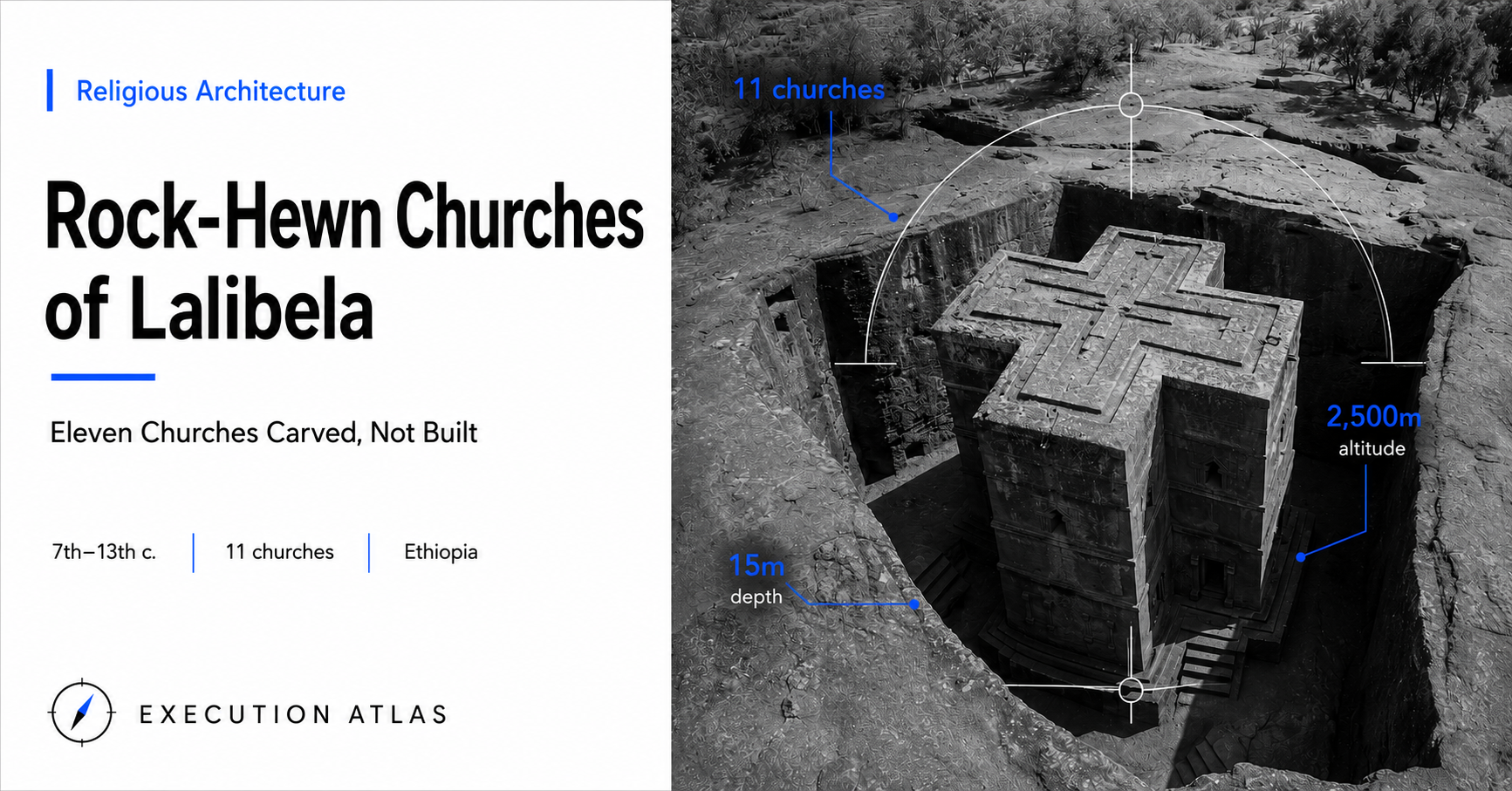
Building Bete Medhane Alem—the House of the Saviour of the World—meant removing about 25,000 cubic meters of rock.
A cube 29 meters on a side, gone. Inside that space stands the largest monolithic church on earth. Seventy-two pillars. Thirty-six inside, thirty-six out, all cut from the same bedrock. Eleven and a half meters tall, thirty-three and a half wide.
No stone was stacked here. It was carved.
In northern Ethiopia, in the Amhara region, at 2,500 meters above sea level, a small town named Lalibela holds eleven churches dug out of a mountain.
Mission: Why Build Them
In 1187, Saladin took Jerusalem. The holy city the Crusaders had held for so long passed out of Christian hands. For the faithful of the Ethiopian Orthodox Church, the endpoint of pilgrimage had vanished.
This, the story goes, is when King Lalibela of the Zagwe dynasty made his decision. Build a New Jerusalem in Ethiopia. He named a local stream the River Jordan, called a hill Golgotha, and copied the geography of the holy land onto the land itself.
How much of this is history is impossible to verify. Thirteenth-century Ethiopia left behind no blueprints, no construction records. The Gadla Lalibela, the hagiography, says that angels worked through the night, matching every cut the masons made by day.
A Portuguese priest, Francisco Álvares, reached the site in the 1520s and recorded what the local clergy told him: the churches had taken 24 years to build. This was more than three centuries after the fact, but it is the only near-contemporary outside account that exists. He wrote: “I weary of writing more about these buildings, because it seems to me that I shall not be believed.”
Design: The Decision Not to Carry Anything
Hauling large quantities of stone up to a site 2,500 meters high was not realistic.
No maintained roads. No great river. No second quarry nearby. The ordinary preconditions of construction were all missing.
The solution was to change the definition of construction. Don’t stack stone up. Carve it out of the bedrock that’s already there. The material is the site itself. The transport problem disappears.
That single choice quietly dissolved other problems too.
No scaffolding needed. In a method that works from the top down, the workers always stand on the rock they have yet to remove. No cranes needed. Nothing heavy has to be lifted. The cut rock just goes down and out.
Drainage was carved into the bedrock as well. Annual rainfall up here exceeds 1,000 millimeters. The roofs are pitched at the same angle as the surrounding rock, sending rainwater out on its own. Channels and trenches steer the water toward sacred pools, or over the edge of the ravine. Many of those drainage routes double as the processional paths pilgrims walk.
The system has kept working for more than 800 years, with no modern maintenance.
Execution: Removing 25,000 Cubic Meters
Bete Medhane Alem is the largest of the eleven churches.
About 15,000 cubic meters excavated from the courtyard, another 10,000 from the interior. Roughly 25,000 cubic meters of rock removed to make the space. Nothing else was brought in. The seventy-two pillars, the carvings, all of it is rock that was left behind.
The tools were chisels and iron picks. Volcanic tuff cuts soft at first and hardens later, as it dries. Carrying the debris up and out of the pit, day after day, was what building a church actually looked like. On a site with no drawings and no logbook, which mason judged what, and how, is something the rock does not say.
The most famous of them, Bete Giyorgis—the Church of Saint George—is called the high point of the method. A pit fifteen meters deep, dug down from ground level. A twelve-meter square sits at the bottom. The triple cross carved into its roof is level with the surrounding ground. Seen from above, a cross simply floats in the earth.
No record of the schedule survives. The figure of “24 years” is hearsay, and the king’s 40-year reign is only a traditional estimate.
What we have is the marks left in the rock.
People: A King and the Archaeology
The name Lalibela means, in Old Agaw, “the bees recognise his sovereignty.” The legend has it that a swarm of bees surrounded the newborn, which his mother read as a sign of the power to come.
Born a prince of the Zagwe dynasty, he was driven into a long exile in Jerusalem by a brother who feared his promise. He returned, seized the throne, and reigned from roughly 1181 to 1221. The Ethiopian Orthodox Church venerates him as a saint.
Most of this portrait comes from the hagiography.
David Phillipson, professor at the University of Cambridge, reached a different conclusion by analyzing the stratigraphy of the rock-cutting. The complex was built in several phases between the 7th and 13th centuries. The earliest structures—Bete Merkorios and Bete Gabriel-Rufael among them—may originally have been fortifications or a palace, not churches at all. Later generations reworked them into a basilica plan and consecrated them. What can be credited to King Lalibela’s reign may be only the final phase, the most refined of the basilica churches.
The French scholars Claude Lepage and Jacques Mercier disagree. The presence of Aksumite style, they argue, doesn’t require an early date. The nearby church of Yemrehana Krestos is Aksumite in style yet dates to the 12th century.
There is no settled answer.
The legend—“Lalibela built them in 40 years”—and the archaeology’s suggestion—“they were cut over centuries, possibly by several hands reusing existing structures”—still stand side by side.
Legacy: A Living Holy Site
In 1978, the churches were inscribed as a UNESCO World Heritage Site.
Every January, during Timkat—the Ethiopian Orthodox Epiphany—pilgrims in white fill the trenches between the rock. Lalibela is a tourist destination and a living holy site at once.
UNESCO installed temporary roofs—tent-like shelters—over some of the churches, to slow the weathering and water erosion of the rock. Critics say they ruin the view. Beside a drainage design that has worked for 800 years stands a temporary roof with no guaranteed lifespan.
Talks between UNESCO and the Ethiopian authorities over how to protect the site continue. Erosion from rising visitor numbers, seismic risk, the sourcing of repair materials. The problems pile up. The churches have not fallen.
Learnings
The constraint determined the method. Because stacking stone wasn’t possible, they chose to carve. That choice swept away two other constraints—scaffolding and cranes—at the same time. It was the result of converting the question “how do we procure what we need” into “what can we make unnecessary.”
The drainage lasted 800 years because the quality of a design directly sets the cost of running it. Whether or not you design for maintenance after completion becomes the difference centuries later.
The other question comes from the archaeology.
Long-running projects tend to attract a story: the founder built it, all at once. The reality is more often an accumulation of additions and conversions. The eleven churches of Lalibela may be the place where both ends of that gap are easiest to see. The legend says one king built it in 40 years; the cut faces of the rock answer, no—this may have taken centuries, and several hands.
Which story is true matters less than the fact that both exist. The story told after a project ends is a different thing from what the people who did it lived through.
How much expansion does your own product’s “founding myth” conceal?
Sources
- UNESCO, “Rock-Hewn Churches, Lalibela” (https://whc.unesco.org/en/list/18)
- The Metropolitan Museum of Art, “The Rock-hewn Churches of Lalibela” (https://www.metmuseum.org/toah/hd/lali/hd_lali.htm)
- Phillipson, D.W., “Rock-cut stratigraphy: sequencing the Lalibela churches,” Antiquity, Cambridge Core (https://www.cambridge.org/core/journals/antiquity/article/abs/rockcut-stratigraphy-sequencing-the-lalibela-churches/B53C45E7808B62840E6C5BF3F6380B88)
- Rock-Hewn Churches, Lalibela — Wikipedia (https://en.wikipedia.org/wiki/Rock-Hewn_Churches,_Lalibela)
- Gebre Meskel Lalibela — Wikipedia (https://en.wikipedia.org/wiki/Gebre_Meskel_Lalibela)
- World Archaeology, “Lalibela, Ethiopia, Rock-Hewn Churches” (https://www.world-archaeology.com/features/lalibela-ethiopa-rock-hewn-churches/)
- My Ethiopia Tours, “Bete Medhane Alem” (https://www.myethiopiatours.com/lalibela-church-bete-medhane-alem/)