In September 1605, a single sheet of weekly news came off the press of a print shop in Strasbourg.
Its title: Relation aller Fürnemmen und gedenckwürdigen Historien — “Report of All Distinguished and Commemorable News.” The world’s first periodical newspaper.
The publisher was Johann Carolus, thirty years old. The year before, he had purchased Strasbourg’s largest print shop for 3,724 gulden. He had the press before he had the paper.
Mission: The Limit of the Scribe
In late sixteenth-century Europe, news traveled by hand.
There existed a profession called the Novellant — information brokers who kept offices in the commercial cities of Venice, Augsburg, and Frankfurt. They gathered political, military, and trade news, copied it onto parchment or paper, and dispatched it to contracted nobles and merchants. Annual subscriptions. High unit prices. A readership of a few dozen at most.
The delivery infrastructure was the postal network of the House of Thurn und Taxis. Operating under Habsburg patronage, this private relay system expanded throughout the sixteenth century. At its peak, 20,000 couriers worked its routes. From Rome to Vienna — 1,400 km — took ten days. From Madrid to Vienna — 2,500 km — took twenty. Between Brussels and Innsbruck, forty-five stations were placed at an average of 35 km apart.
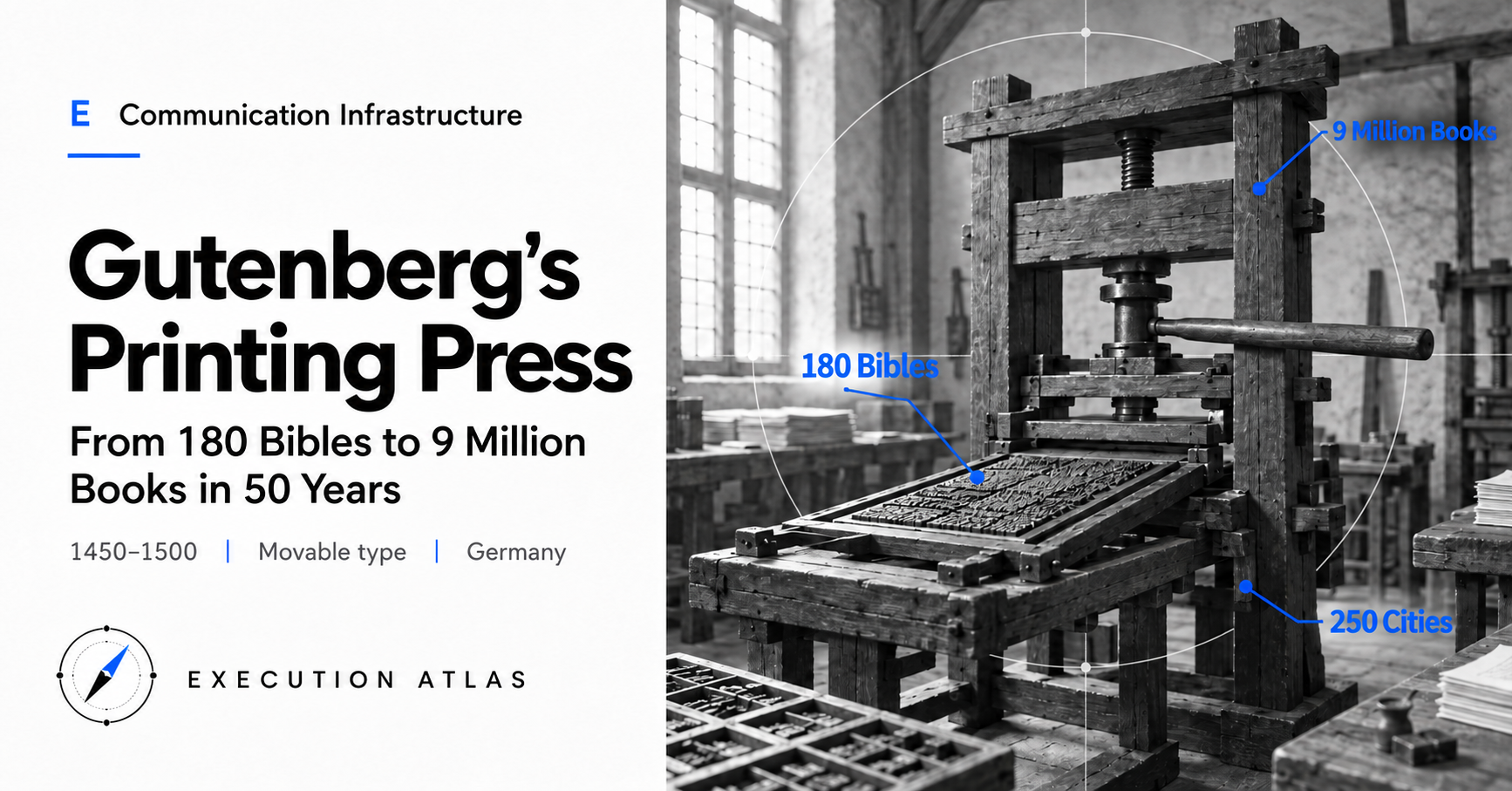
The infrastructure for information was in place. The readers were waiting. The technology existed. Gutenberg’s movable type had been established 150 years prior.
There was exactly one bottleneck: the scribe’s hand.
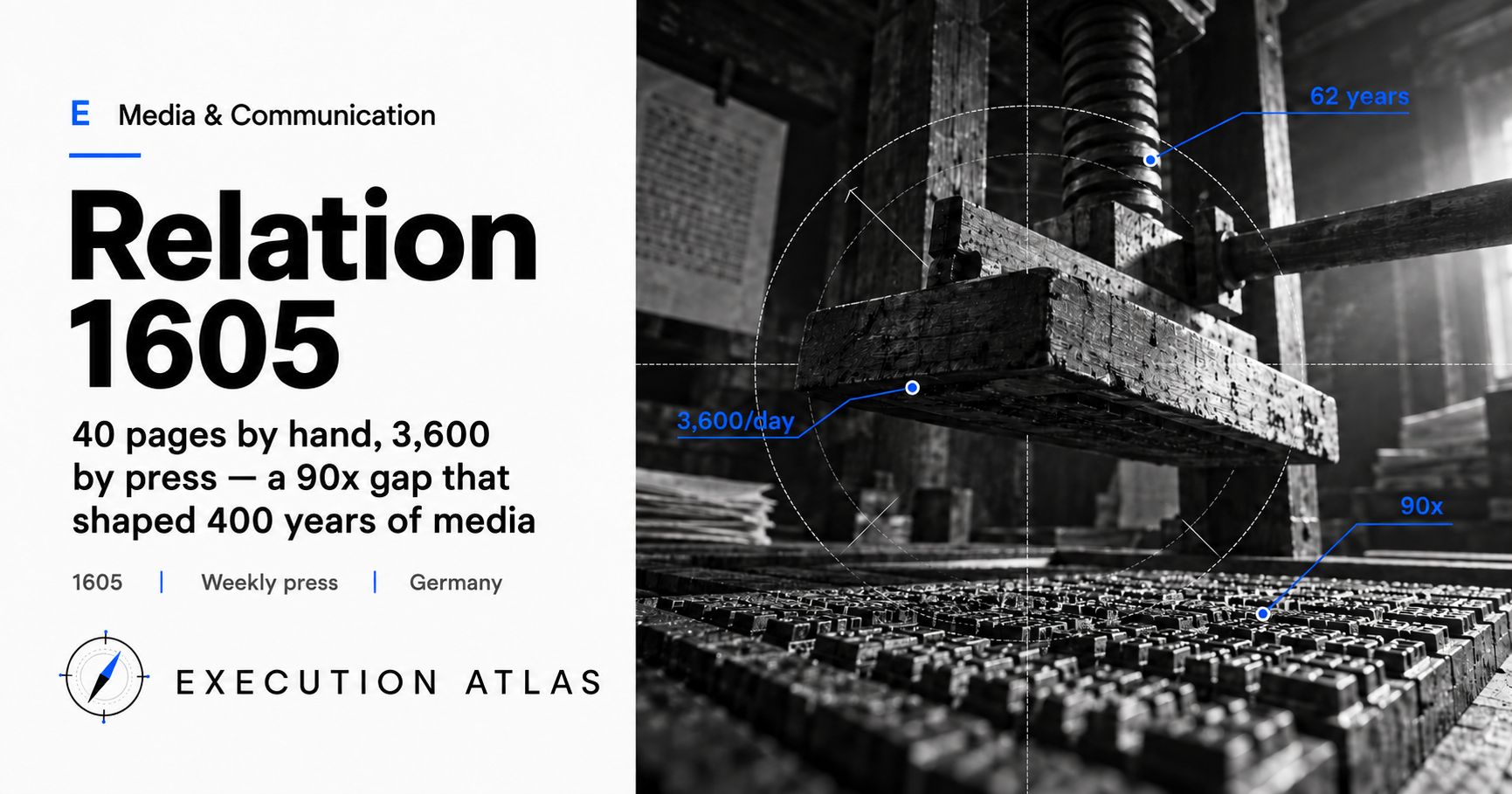
A skilled scribe could copy roughly 40 pages per day. A printing press could produce 3,600. A gap of 90 to 1. And yet handwritten newsletters sold above printed books — they were fresher, more confidential, and priced accordingly. So the scribe model persisted across the entire sixteenth century.
One information broker in Strasbourg broke the equilibrium.
Design: Buy the Press First
Johann Carolus had started as a bookbinder’s apprentice, moved into bookselling, and from there into the business of the Novellant — copying weekly news sheets for sale to wealthy clients. A standard model of the era: a small number of patrons paying annual contracts.
In July 1604, Carolus and his wife made a decision. They purchased Strasbourg’s largest print shop, previously owned by Tobias Jobin, for 3,724 gulden — thirty to forty times the annual wage of a skilled craftsman.
At that moment, Carolus made no public declaration about a newspaper. At least none survives in the record. He may simply have been taking over an existing printing business. But the following year, the first printed issue of the Relation appeared in the world.
The Relation’s design differed from handwritten newsletters on four points.
First, openness: it was sold to anyone who could afford a copy, not just contracted subscribers. Second, regularity: it was issued once a week, on a fixed day. Third, timeliness: the lag between events and publication was minimized. Fourth, variety: politics, military affairs, commerce, religion, disaster, court news — multiple countries in a single issue.
These are the four defining principles of modern journalism. Carolus never wrote them down as a manifesto. He simply combined them on a single page.
There was also a structural consequence: the collapse of marginal cost. Every additional copy of a handwritten newsletter required more of the scribe’s labor. With print, once the initial investment was made, 100 copies or 500 copies cost only paper and ink more. The economics of high-volume, low-price distribution became possible.
Execution: Three Petitions
In 1605, Carolus submitted three petitions to the Strasbourg city council — in September, October, and December. The originals survive in the Strasbourg municipal archive, rediscovered in the 1980s.
He was asking for monopoly rights. He wanted the council to prohibit other printers from reproducing the Relation. Before recovering 3,724 gulden, he could not afford competitors. He understood his enterprise as a capital recovery project.
The council declined.
Carolus kept printing without any exclusive protection. In 1609, Julius Adolph von Söhne in Wolfenbüttel published the Aviso Relation oder Zeitung — the world’s second periodical newspaper. By the 1610s, newspapers were appearing across multiple cities.
The failure to secure a monopoly did not, as it turned out, kill the Relation. Competitors emerged four years after Carolus. But the Relation ran alongside them. When the Thirty Years’ War began in 1618, demand for news exploded across the German-speaking world. Troop movements, delayed wages, spreading plague, fallen cities. People wanted facts. Newspapers expanded, carried by the current of the market.
Carolus’s original plan was stable operation through monopoly. What actually happened was long-term survival in a competitive open market. For sixty-two years, the Relation kept going.
The plan didn’t unfold as designed. It exceeded it.
People: From Bookbinder to Newspaper Publisher
Johann Carolus was born on March 26, 1575, in Mühlbach-sur-Munster in the Holy Roman Empire. His father was a priest.
As a teenager, he entered as an apprentice to a bookbinder. In the era’s book trade, binding and selling were adjacent trades. From apprentice he became a bookseller, touching the downstream end of information distribution through the buying and selling of texts.
At some point during his time as a bookseller, Carolus began working as a Novellant on the side — copying handwritten news sheets for wealthy clients. He edited fragments of information arriving from Venice and Frankfurt, wrote them out cleanly, and dispatched them to subscribers. Manual labor. Long hours. A standard business.
In 1599, at twenty-four, Carolus acquired Strasbourg citizenship through marriage. At the time, citizenship was directly tied to the freedom to work. Many cities barred non-citizens from running print shops.
Five years later, he purchased the press. The equipment he inherited from the previous owner was the largest operation in Strasbourg. Carolus had accumulated four trades — bookbinder, bookseller, Novellant, printer — and arrived at a new category: newspaper publisher.
Few of Carolus’s own words survive. What remains are fragments from his petitions to the city council. “Writing by hand is inefficient; with a dedicated printing press, the political, military, and commercial news of Europe could be distributed more widely and more quickly.” He wrote this to the council in December 1605. In German. At thirty. Addressed to the Strasbourg municipal government.
He did not buy the print shop intending to transform the world’s media. The logic was simpler: copying by hand is tedious; printing is easier. Disruptive innovation often begins not with a grand cause but with an annoyance.
Johann Carolus died on August 15, 1634, at the age of fifty-nine. The Relation continued for another thirty-three years.
Legacy: Four Principles Unchanged
The latest surviving issue of the Relation is dated 1659. It is estimated to have been published until around 1667 — sixty-two years in total.
The business problems Carolus faced at launch remain the central problems of information enterprises today. The cost of producing a single article is low; the cost of maintaining regular publication is high. Regularity is the source of credibility, but it is also the source of fixed costs. That structure has not changed in four hundred years.
More fundamentally, Carolus’s four principles endure: openness, regularity, timeliness, variety.
The daily newspapers of the nineteenth century. Radio and television in the twentieth. News websites, social media feeds, and AI recommendation algorithms in the twenty-first. The medium changes; the curation logic has moved from human editors to machine learning. But every medium still tries to satisfy the same four conditions: available to anyone, delivered at a regular rhythm, fast, and covering diverse topics.
The format of information distribution still runs on a template written in seventeenth-century Strasbourg.
The rival Aviso disappeared within roughly twenty years. The Relation lasted sixty-two. Historical records make it difficult to pinpoint the difference. But the structure Carolus built — four accumulated trades, the print shop purchased in advance — was more naturally suited to continuation than a single-purpose startup. His starting point was not “I want to make a newspaper.” It was “I want to keep selling information.” The means could change; the purpose could not.
The Strasbourg city council refused to grant a monopoly. Had they granted it, the Relation might have lasted longer. At the same time, the newspaper as an industry might never have emerged, and the information revolution of the seventeenth century might not have happened.
Takeaway
A single man devising a medium that would endure for four hundred years is a myth. Carolus was not trying to invent the newspaper. What he did was substitute printing for the scribe’s labor — a local efficiency gain.
Disruptive innovation often emerges as the byproduct of a local efficiency gain. Gutenberg wanted to produce many Bibles in less time. Bezos wanted better inventory management for a bookstore. Page wanted to search the citation network of academic papers. Carolus wanted to stop copying by hand.
In that moment, no one can fully predict what byproduct will emerge. Carolus defined his enterprise as “an investment recovery project requiring monopoly protection” and petitioned accordingly. What actually emerged was an industry that spread too widely for any monopoly to contain. His self-understanding and the phenomenon he set in motion differed in both scale and nature.
One more thing: the order of execution determines the outcome.
Carolus bought the press in 1604 and published the newspaper in 1605. Had the order been reversed — had he conceived the paper first and sought a press second — he would have been dependent on an existing printer, negotiating on price and schedule, and without standing to petition for exclusive rights at all. The capital investment upfront was what gave him control.
The question of order hasn’t changed. Build the product before the team, or build the team before the funding, or talk to customers before either. Whichever sequence you choose sets the options available for the next decade. Carolus chose the press first. That simple choice lasted four hundred years.
Sources
- “Johann Carolus” Wikipedia (https://en.wikipedia.org/wiki/Johann_Carolus) — Carolus’s life, print shop purchase price, petition details
- “Avisa Relation oder Zeitung” Wikipedia (https://en.wikipedia.org/wiki/Avisa_Relation_oder_Zeitung) — information on the rival Aviso, 2005 evidence discovery
- “History of newspaper publishing” Wikipedia (https://en.wikipedia.org/wiki/History_of_newspaper_publishing) — broader context of newspaper history
- Weber, Johannes, “Strassburg, 1605: The Origins of the Newspaper in Europe,” German History Journal, Oxford Academic (https://academic.oup.com/gh/article-abstract/24/3/387/597682) — scholarly research on origins, details of the city council documents
- “Johan Carolus’s Relation, the First Printed European Newspaper or Newsbook” History of Information (https://www.historyofinformation.com/detail.php?id=34) — petition text, Strasbourg municipal archive records
- Britannica, “The first newspapers” (https://www.britannica.com/topic/publishing/The-first-newspapers) — European newspaper history context
- “Thurn und Taxis und die Erfindung der Post” Discover Innsbruck (https://www.discover-innsbruck.at/en/thurn-und-taxis-und-die-erfindung-der-post/) — Thurn und Taxis postal network scale (20,000 couriers)
- “The Printing Revolution in Renaissance Europe” World History Encyclopedia (https://www.worldhistory.org/article/1632/the-printing-revolution-in-renaissance-europe/) — printing press productivity (3,600 pages per day)