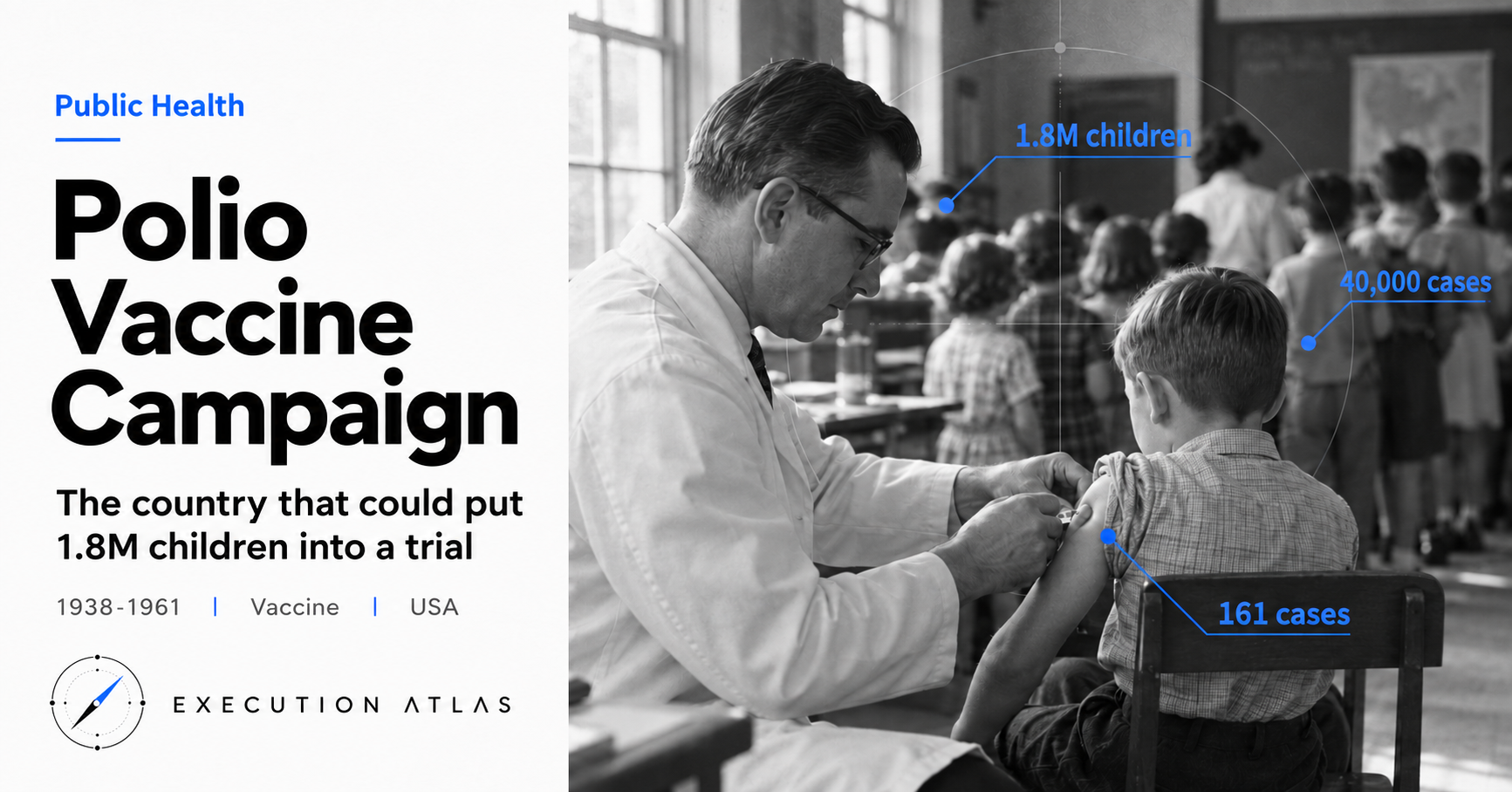
On the morning of April 12, 1955, five hundred reporters packed the Rackham Auditorium at the University of Michigan. Fifty-four national radio networks had run cables for live coverage. Three film studios had set up cameras. The presenter was Thomas Francis, an epidemiologist at Michigan. The results of a trial conducted the previous year on 1.8 million schoolchildren were about to be announced.
Francis read the data for twenty minutes. Jonas Salk’s polio vaccine was 80 to 90 percent effective, with no serious safety concerns. The audience broke into applause. Churches across America rang their bells; factories paused their lines for a few minutes. In Times Square, lunchtime pedestrians stopped and listened to the announcement pouring from loudspeakers.
That same evening, on CBS’s See It Now, reporter Edward R. Murrow asked Salk who owned the patent on the vaccine.
Salk paused, then answered.
The people, I would say. There is no patent. Could you patent the sun?
Two weeks later, vaccinations using lots manufactured at Cutter Laboratories in Berkeley, California, caused roughly 40,000 polio infections and 10 deaths. The campaign nearly died — and then rebooted.
This was an unusual kind of large-scale project in medical history. Not a single central invention. Existing virology, an existing donation model, existing school networks, existing radio broadcasts — bundled together over twenty years. The scale of what was bundled was without precedent.
Mission: The Year a President in a Wheelchair Founded a Foundation
The summer of 1952 set the worst polio numbers the United States had ever recorded: 58,000 cases in a year, 3,145 deaths, 21,269 with lasting paralysis. The epidemic centered on schoolchildren aged seven to thirteen.
The disease moved fast. A child who complained of a stiff neck in the morning couldn’t walk by noon; by the next day, the respiratory muscles were paralyzed. Hospitals in the early 1950s ran short of iron lungs; children died waiting in line. Public pools closed for the summer across the country; summer camps were cancelled; theaters barred children under twelve. Parents told their children not to go near other kids.
Polio was invisible, yet it kept coming closer. Along with the atomic bomb, it was one of two threats American families feared most in the 1950s.
One person had gotten ahead of that fear in 1938.
Franklin Delano Roosevelt. In 1921, thirty-nine-year-old Roosevelt was at Campobello Island for summer vacation when, after swimming, he felt chills and the next morning couldn’t get out of bed. His legs below the waist wouldn’t move. The diagnosis was acute anterior poliomyelitis — polio.
He used a wheelchair for the rest of his life. Even after winning the presidency in 1932, he insisted on standing with crutches in public, asked newspapers not to print photos of him in his wheelchair, and newspapers largely complied. His polio remained vague and unacknowledged to American voters until the very end.
In January 1938, Roosevelt founded the National Foundation for Infantile Paralysis (NFIP). The operations were run by Basil O’Connor, a lawyer who had shared a law firm with Roosevelt in New York. The model used no federal money — it ran on individual donations from citizens.
Radio star Eddie Cantor joined the foundation’s publicity effort and named the campaign the “March of Dimes”: a call for every American to mail a single dime to the White House in the week leading up to Roosevelt’s birthday on January 30.
One week later, the White House mailroom received the equivalent of $268,000 in dimes. Records report that postal workers refused to sort them.
The power was in the design, not the dollar amount. A dime was an amount even a 1930s American child could get from a parent. Sending it to the White House gave it the feeling of reaching the president himself. A fixed date — January 30 — meant news coverage converged on the same week every year. Radio, newspapers, schools — every channel aimed at the same day.
The March of Dimes became a permanent annual event. By the 1940s, 100 million dimes a year were flowing in from across the country. With those funds, NFIP distributed iron lungs to hospitals, built rehabilitation facilities for polio patients, and handed out research grants.
Salk’s polio vaccine research, launched at the University of Pittsburgh in 1948, ran on this money.
Not the National Institutes of Health, not the military — a private foundation fueled by individual donations had been investing in research for nearly two decades. That structure would matter later.
Design: How Do You Put 1.8 Million Children into an Experiment?
By 1952, Salk had finished early trials at his Pittsburgh lab in which children received formalin-inactivated virus. Small-sample tests confirmed antibody production; side effects were within acceptable range.
The next step was a nationwide efficacy trial. NFIP’s Scientific Advisory Committee named Thomas Francis as director. He was an epidemiologist at the University of Michigan and had been Salk’s graduate advisor.
The field trial Francis designed called for scale and methodology simultaneously unlike anything medicine had attempted.
The subjects would be second graders, comparing vaccinated and control groups. That would have been a straightforward epidemiological trial, but Francis imposed two requirements.
First: minimum sample size of one million. Polio incidence ran at tens of cases per 100,000 per year; detecting vaccine efficacy within a 95% confidence interval required an order of magnitude more subjects.
Second: double-blind, placebo-controlled. Neither the physicians administering the shots nor the children’s parents would know which was the real vaccine. The control group would receive saline injections identical in appearance.
Opposition was fierce even within NFIP. Was it ethical to inject healthy children with a placebo on purpose? Could parents be told “your child may be assigned to the placebo group by a coin flip” when a polio epidemic season was weeks away?
In the end, school districts across the country split into two designs. Some used the double-blind, placebo-controlled model Francis wanted. The rest used a simplified version: vaccinate second graders, observe first and third graders as controls. Both datasets would be collected in parallel; which was more reliable would be judged after the fact. A compromise.
NFIP selected roughly 15,000 schools in 44 states. From the cooperating schools, notices went to medical associations, public health offices, and state governments; consent forms were printed for parents. In double-blind districts, the forms explicitly stated: “Your child may be assigned to the control group.”
On April 26, 1954, the first vaccination took place in the gymnasium of Franklin Sherman Elementary School in McLean, Virginia. Local pediatrician Richard Mulvaney held the needle; six-year-old Randy Kerr was the first child. That day, he was called a “Polio Pioneer” on national radio.
NFIP gave that badge to every child in the trial — 1.8 million of them. Whether vaccinated, given a placebo, or simply observed, all 1.8 million received the same badge. Children came home and showed their parents a small metal pin. The trial had been framed not as “a medical experiment” but as “a national event.”
The breakdown of participants:
- Vaccinated (double-blind districts): approx. 200,000
- Placebo (double-blind districts): approx. 200,000
- Vaccinated (observed-control districts): approx. 220,000
- Observed controls (1st and 3rd graders): approx. 1,200,000
- Total: approx. 1,800,000
The personnel mobilized: 20,000+ physicians, 64,000 school staff, 220,000 volunteers. Nearly half of all U.S. pediatricians were involved in some way.
After the trial ended in July 1954, Francis’s lab worked for ten months with 144 staff in a University of Michigan basement. 600,000 IBM punch cards. The final report ran 561 pages.
The April 12 announcement date was chosen deliberately: the tenth anniversary of President Roosevelt’s death in 1945.
Execution: The Accident That Started 15 Days After the Announcement
On April 12, 1955, within hours of the Rackham Auditorium announcement, the federal government issued manufacturing licenses to six companies. The review took just over two hours. The trial had taken eleven months; data analysis had taken ten. Licensing was finished during the press conference.
The six were Eli Lilly, Parke-Davis, Wyeth, Pitman-Moore, Cutter Laboratories, and Cyanamid — all of which had already manufactured vaccine for the trial. Each company was operating on the assumption that it would have supply ready by the start of the school season in May 1955.
On April 25, five-year-old Susie Pierce of Chicago developed polio seven days after her April 18 vaccination. Both arms were paralyzed. Her mother reported it to public health authorities, who queried the vaccine lot number. It was Cutter Laboratories.
The same day, similar reports began coming in from across the country — California, Idaho, Nevada, New Mexico. All were Cutter lots.
At 10:38 a.m. on April 27, Cutter Laboratories sent a telegram to all its distributors nationwide: “Immediately halt shipment and use of Cutter polio vaccine.” Secretary of Health, Education, and Welfare Oveta Culp Hobby issued a halt order at a national press conference that same afternoon.
Post-incident investigation found that two of Cutter’s lots had undergone incomplete inactivation — killing of the virus. Live virus had survived the formalin treatment and caused polio in vaccinated children. The infections spread not just to the vaccinated children but to their families and neighbors through secondary transmission.
The toll, per Paul Offit’s tally in The Cutter Incident, was as follows: 51 cases of paralytic polio and 5 deaths directly from Cutter vaccinations; secondary infections to family and neighbors numbering roughly 113; including tertiary infections, a total of 40,000 polio cases, 164 cases of lasting paralysis, and 10 deaths.
Other manufacturers had minor incident reports at the same time, but Cutter’s case was orders of magnitude worse. The cause was a difference in manufacturing process. Each company had worked from NIH’s published manufacturing manual while developing its own process. Cutter had run fewer post-formalin virus-inactivation confirmation tests than other manufacturers. The manual had not prohibited this.
In response to the accident, the federal government in July 1955 established the Division of Biologics Standards. Vaccine regulation, previously a single unit within NIH, was elevated to an independent enforcement agency. Inspectors were stationed at every manufacturing plant; batch-by-batch inactivation testing was standardized. This regulatory framework became the foundation for the U.S. biologics approval process going forward.
After Cutter, vaccination rates temporarily dropped. But NFIP kept the campaign running, and by late 1956 — a year and a half later — rates had recovered to pre-Cutter levels.
The recovery was surprisingly fast because parents and children already felt that “this vaccine was theirs.” 1.8 million schoolchildren had participated as Polio Pioneers; tens of millions of families had contributed dimes. The result was a sense of ownership: “our vaccine.” If a Cutter-scale accident had happened with a government-issued vaccine in another country, the program itself might have collapsed.
The Salk inactivated vaccine (IPV) had a weakness, though. It required a health worker to administer by injection, and it didn’t produce intestinal immunity, making it harder to stop virus spread in the environment. Multiple booster doses were needed; it wasn’t suited for widespread use in developing countries.
Albert Sabin at the University of Cincinnati was pursuing a different approach: attenuated live virus taken orally, delivered by putting a few drops on a sugar cube. The virus multiplied in the gut, building the same immunity as natural polio infection. One dose was enough.
Sabin’s oral polio vaccine (OPV) had already completed small-scale trials by 1954. But in the United States, NFIP had been driving the Salk camp, and in the wake of Cutter, public resistance to new live-virus trials was strong. The U.S. government was reluctant to sanction large-scale OPV trials.
In 1956, Sabin flew to Moscow. Waiting for him was Mikhail Chumakov, director of the Soviet Polio Research Institute. At the height of the Cold War, two scientists — one American, one Soviet — had organized their own joint research.
Sabin brought frozen vials of his three attenuated strains. Chumakov cultured them in the Soviet Union and began trials in stages starting in 1957: 67 people in the first year, 20,000 the next, 10 million in 1959, and 77 million across the Soviet Union and Eastern Europe in 1960.
The Soviet trial data were submitted to the U.S. FDA in the early 1960s, and OPV was approved in the United States in 1961. Salk and Sabin vaccines would be used in parallel in the United States for decades.
U.S. annual polio cases, which had peaked at 58,000 in 1952, fell to 161 by 1961. The epidemic had virtually disappeared.
People: Not the Discoverers, but the Bundlers
Jonas Salk was born in 1914 in New York City to a Russian-Jewish family. His father was a garment worker; his mother had a middle school education. Salk was the first in his family to attend college. He graduated from New York University School of Medicine in 1939 and entered Thomas Francis’s lab to work on influenza vaccines. In 1947, he became the founding director of the Virus Research Laboratory at the University of Pittsburgh. He was 32.
His CBS line in 1955 — “Could you patent the sun?” — became one of the most quoted sentences in American medical history. But the follow-up is often omitted.
NFIP’s lawyers had explored patenting the vaccine as early as 1954. Their conclusion: “Novelty requirements are not met; a patent is not available.” The cultivation and inactivation techniques had both been disclosed in existing academic literature; it would be difficult to establish patentability for the combination. A legal finding.
More than Salk refusing a patent, he declared publicly “it belongs to the people” in a situation where a patent was unavailable anyway. Whether intentional or not, that declaration ended intellectual property disputes over the vaccine in 1955. A study by the National Institutes of Health in the early 2000s estimated that if Salk had managed to obtain a patent, his lifetime royalty income would have been approximately $7 billion.
Salk lived his entire life on government salaries and university stipends. He later said he “would rather have had the time to build the next vaccine than money.”
Thomas Francis was born in 1900 in Gas City, Indiana, and raised in western Pennsylvania. He was already celebrated for influenza vaccine work; a 1941 Rockefeller Foundation report called him “the leader of epidemiological research in the United States.” He became the field trial director not only because of his mentor-student relationship with Salk but because he was a rare person who “could speak both the language of medical research and public health administration.”
Francis’s lab halted all other work for ten months after the trial ended. During this period he even refrained from exchanging information with Salk’s Pittsburgh lab — he didn’t pass intermediate data to Salk so as to avoid bias. On the day of the April 12, 1955 announcement, Salk and Francis stood at the podium together, but only Francis addressed the statistical data in the press conference.
Basil O’Connor was born in 1892 into a poor family in Massachusetts. He graduated from Harvard Law School through sheer determination and opened a New York law firm with Roosevelt. When he took on NFIP operations in 1938, he was 46. He ran the foundation alone for the next thirty years.
His most consequential decision was continuing to fund both Salk and Sabin simultaneously. Even after Salk’s success in the mid-1950s, he didn’t stop Sabin’s development. His prediction that “intestinal immunity will be needed even after Salk’s vaccine is complete” proved correct with OPV’s 1961 approval. By refusing to back a single horse, O’Connor secured successors for the entire project.
Albert Sabin was born in 1906 in Białystok, then part of the Russian Empire (now Poland). He emigrated to the United States with his family at age fifteen, graduated from NYU Medical School eight years before Salk, and became a virologist at Cincinnati’s Children’s Hospital.
OPV’s delay in the United States was organizational, not scientific. NFIP funding in the early 1950s was heavily tilted toward the Salk camp. Sabin openly criticized NFIP’s allocation as inadequate. His eventual trip to the Soviet Union was a calculation that weighed both the limits of the American research environment and the potential of scientific collaboration across the Cold War.
Soviet counterpart Mikhail Chumakov was born in 1909 and became director of the Soviet Polio Research Institute, established near Moscow in 1955. A 1937 research accident had left him deaf in one ear and unable to move his right hand after a tick-borne encephalitis infection — a powerful personal motivation for infectious disease research. When Sabin came to Moscow in 1956, Chumakov put him up in his home; he and his wife Marina Voroshilova, also a virologist at the same institute, worked through the OPV trial design together.
A 77-million-person trial started from a three-person conversation. There was almost no official government-to-government negotiation. By the time Chumakov secured approval from the Soviet Academy of Sciences in 1960, OPV vaccinations in the Moscow and Leningrad area had already begun.
In 1959, Chumakov and Voroshilova gave drops of the attenuated strain on sugar cubes to their own three sons and their nieces and nephews. Their reasoning: vaccines for children should first be tested on your own children. From that private family trial, the program expanded the following year to large-scale rollouts in Moscow and Leningrad.
Legacy: What Remained After the Vaccine
Annual U.S. polio cases:
- 1952: 58,000
- 1955 (Salk approval): 28,985
- 1957: 5,485
- 1961 (Sabin approval): 161
- 1979: 10 cases (zero from wild-type virus; 10 vaccine-derived)
In 1988, the WHO, Rotary International, UNICEF, and the U.S. CDC jointly launched the Global Polio Eradication Initiative (GPEI), with a target of eliminating wild-type poliovirus from the world by 2000. Global cases, which stood at 350,000 per year in 1990, fell to 2,971 by 2000. Eradication by the target year wasn’t achieved, but the count dropped by two orders of magnitude.
In October 2020, WHO declared wild-type poliovirus types 2 and 3 eradicated. Only type 1 remains, confined to parts of Afghanistan and Pakistan and a few low-vaccination areas. Cumulative GPEI investment over the program’s 36 years totals $22 billion. More than 20 million children are estimated to have been spared paralysis through vaccination.
After polio was effectively eliminated, March of Dimes changed its mission in 1958: from “eradicating polio” to “preventing all birth defects and premature birth.” The dime donation model stayed; the funding target changed. They continue today, directing dimes toward premature birth risk research, newborn screening standardization, and neonatal care across the United States.
In 1960, Salk founded the Salk Institute in La Jolla, California, designed by architect Louis Kahn. The building opened in 1965. He spent the second half of his career working on HIV vaccine and multiple sclerosis research. He died in 1995 at age 80.
In 1972, Sabin donated all rights to OPV, including any patents, to the World Health Organization at no cost. After his death, his wife Heloísa found his personal papers. In a diary from his first Moscow visit in 1956, he had written:
The Cold War is not the enemy of science. Scientists can trust the other side before politicians do.
The GPEI 2024 Annual Report opens with this line.
The parallel deployment of Salk and Sabin vaccines continued until the late 2000s. The United States ended OPV use domestically in 2000 and now uses only IPV. In many developing countries, OPV remains the GPEI supply backbone for its cost and ease of deployment.
The polio vaccine project ran for nearly sixty years from NFIP’s 1938 founding under the same organization and campaign name. Including GPEI, it is still running. It rewrote “what would count as finished” multiple times along the way, carrying forward only the funding, the people, and the campaign name.
Few projects in the history of public health have run this long. The reason wasn’t the Rackham Auditorium press conference, the Cutter Incident response, or the Cold War cross-border trial.
It ran because on the day in 1938 that Eddie Cantor said “please send us a dime” — and that call reached American households one by one.
What We Can Learn: Build the Country That Will Accept the Vaccine, Before the Vaccine
The hardest lesson from this project is this.
Technical success depends not on the superiority of the technology but on the soil that will receive it. Building that soil must start decades before the technology is finished.
In 1954, the only country in the world capable of sending 1.8 million children to an experiment was the United States. Britain and France had the scientific capability for a trial of that scale, but they could not get parents to consent to injecting their healthy children with a placebo.
The United States alone had spent nearly twenty years, beginning in 1938, preparing the soil that made it possible.
That soil was built in three layers.
The first layer was the shared understanding that “polio is the enemy.” In 1930s U.S. medical statistics, polio deaths were one-tenth those from tuberculosis or pneumonia. Yet polio was treated as “the nation’s enemy” because the president himself was a polio patient, and because the epidemic had the narrative quality of “attacking children.” NFIP’s communications spent nearly twenty years embedding the threat in the public’s mind — not in terms of statistical mortality, but in terms of emotional menace.
The second layer was the sense of participation — “we are contributing to the solution.” Donating dimes amounted to a few dollars a year. But the ritual of “sending a coin to the White House every January” created a structure in which 100 million people positioned themselves as stakeholders in fighting polio. By the time the trial began, almost every American household had already developed the self-awareness of being “involved in this project.”
The third layer was the mode of participation — “children can be heroes.” The Polio Pioneer badge was distributed to every child in the trial. Whether vaccinated, given a placebo, or simply observed, all 1.8 million received the same badge and came home wearing it on their chests. Parents sent their children out not as “subjects of a medical experiment” but as “heroes of the nation.”
These three layers, in place together, made the 1954 field trial possible.
After Cutter, vaccination rates recovered quickly for the same reason — that same soil was working. The accident with “our vaccine” was treated as a problem to be solved by “our project.” Parents, schools, and local governments all felt they had “decided for themselves” to keep vaccinating. If NFIP had been a government agency and the vaccine had been “distributed by the government,” recovery would have taken much longer.
This plays out in reverse through the history of modern vaccines.
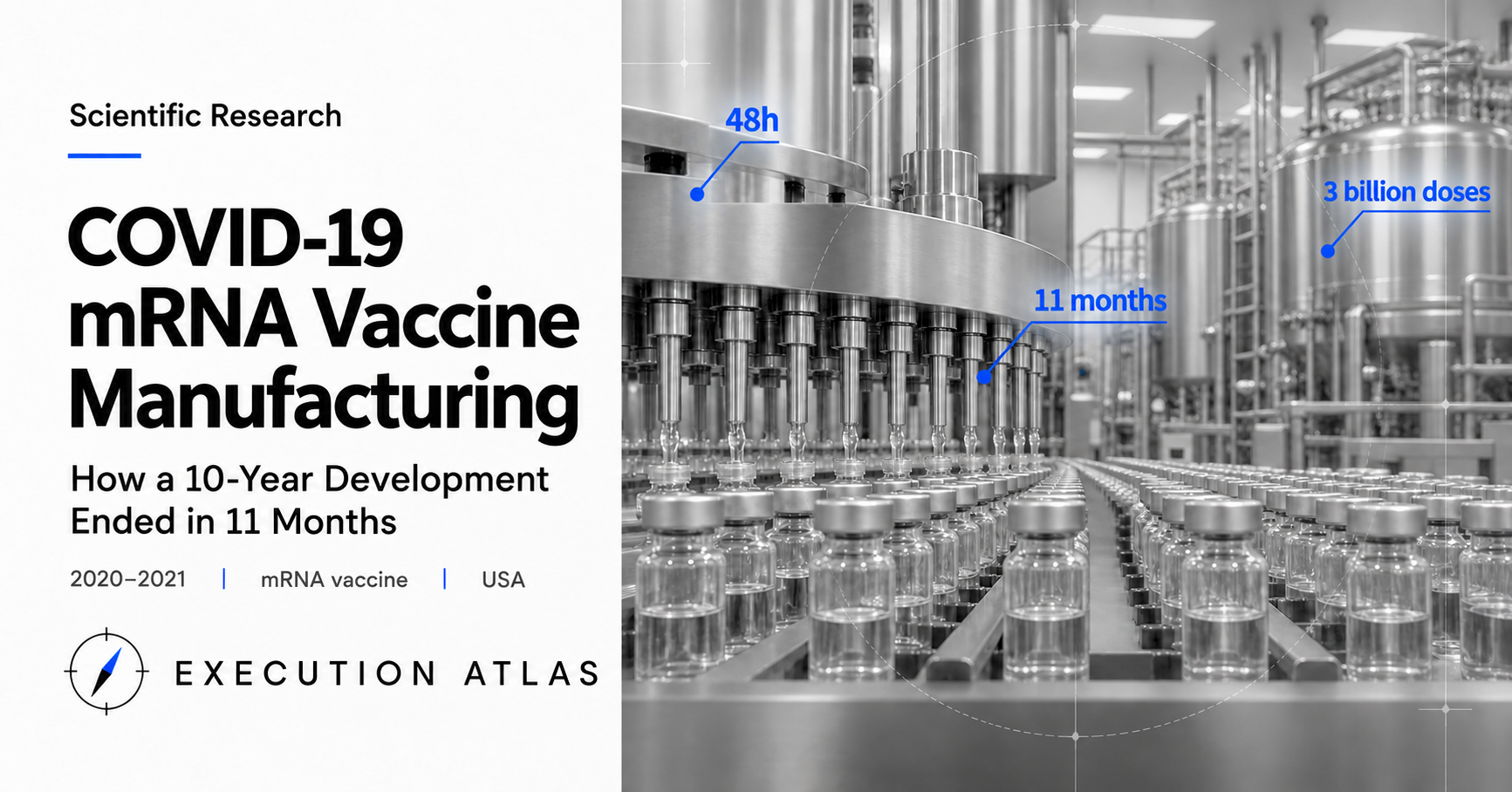
In 2020, the COVID-19 mRNA vaccines were technically far more sophisticated than the polio vaccine. They were developed in under a year, showed 95% efficacy, and had limited side effects. But vaccination rates varied enormously across countries. Even in developed nations, some fell below 60%; anti-vaccine movements organized themselves. The technology was near-perfect. But the soil wasn’t there.
None of the COVID projects had what the polio project had: a decades-long, whole-nation narrative buildup. The pandemic couldn’t wait. Soil can’t be built in a year.
Apply it to your own work.
When introducing a new product, a new institution, or a new business process, we often try to persuade people through “technological superiority.” That works, sometimes. But for something you truly want to deploy at scale, you need to start building the structure that makes users into contributors before the technology is finished.
Beta tester badges, crowdfunding backer lists, open-source contributor credits — these are the minimum units of soil. You can’t do 1.8 million, but if you have 1,000 beta users involved early, the recovery speed when your product hits an incident in production changes by an order of magnitude.
The polio vaccine project was half-finished the moment Eddie Cantor said “please send us a dime” in 1938 — ten years before Salk entered his lab. The other half, the technology, still had time. Salk could afford to take it slow.
A technologist can’t start their work ten years early. But thinking ten years ahead about how the technology will be received — that is the work of design.
The day Salk answered that you can’t patent the sun, what he actually received was not the honors of the medical community.
It was the final line of a twenty-year campaign that had begun in 1938.
References
- American Journal of Public Health (2000), “The Francis Field Trial of 1954” (https://ajph.aphapublications.org/doi/pdf/10.2105/AJPH.90.2.199) — Primary analysis of the 1954 field trial design and results
- JAMA (1955), “1954 Poliomyelitis Vaccine Field Trial: Plan, Field Operations, and Follow-up Observations” (https://jamanetwork.com/journals/jama/fullarticle/301689) — Primary source on trial operations and follow-up
- Paul Offit, The Cutter Incident: How America’s First Polio Vaccine Led to the Growing Vaccine Crisis (Yale University Press, 2005) — Definitive account of the Cutter Incident; casualties and regulatory changes
- Rotary International, “Polio Shot Heard Round the World” (https://www.rotary.org/ja/polio-shot-heard-round-world) — Context of the 1955 announcement and U.S. vaccination trajectory
- CDC, “Poliomyelitis in the United States: 1952” (https://stacks.cdc.gov/view/cdc/71541) — 1952 case statistics, per-100,000 incidence rate
- NCBI Bookshelf, “Sabin Saves the Day — Polio Across the Iron Curtain” (https://www.ncbi.nlm.nih.gov/books/NBK565345/) — Sabin-Chumakov collaboration; scale of Soviet trials
- NCBI PMC, “Albert Bruce Sabin: The Man Who Made the Oral Polio Vaccine” (https://www.ncbi.nlm.nih.gov/pmc/articles/PMC8888238/) — Sabin biography; OPV development history
- Science History Institute, “Jonas Salk and the Polio Vaccine” — Salk biography; background on the 1955 press conference
- Slate (2014), “The real reasons Jonas Salk didn’t patent the polio vaccine” (https://slate.com/technology/2014/04/the-real-reasons-jonas-salk-didnt-patent-the-polio-vaccine.html) — Legal basis for unpatentability; estimated $7B royalty calculation
- GPEI, “Annual Report 2024” (https://polioeradication.org/) — Cumulative $22B GPEI investment; type 2 and 3 eradication declaration
- American View (U.S. Embassy), “How America Beat Polio” (https://amview.japan.usembassy.gov/en/how-america-beat-polio/) — Overview of U.S. polio defeat and current residual outbreaks