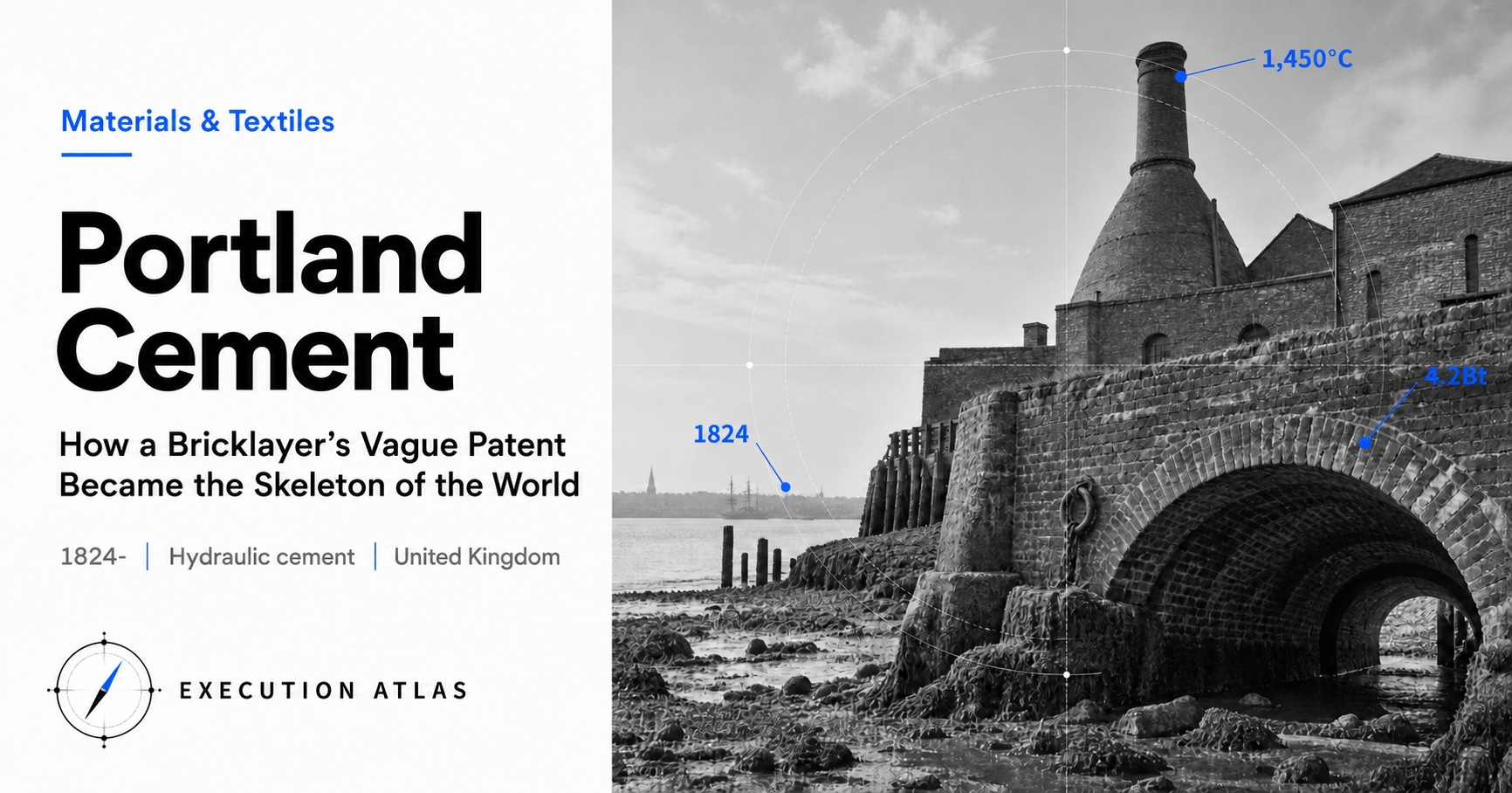
On October 21, 1824, a bricklayer from Leeds, England, was granted a patent. Patent number BP 5022. Its title: “An Improvement in the Mode of Producing an Artificial Stone.”
The specification is strikingly vague. Burn a pure limestone into lime. Mix it with a certain quantity of clay, grind it wet, dry it, and burn it again in a vertical kiln. Crush the result into powder, add water, and you get “artificial stone.”
How much is a certain quantity? It doesn’t say. The firing temperature isn’t stated either. Throughout the 19th century, no one handed this description alone ever managed to reproduce the product.
Two hundred years later, in 2024, world cement production reached 4.2 billion tons. China alone accounts for 47.5%. Every ton of cement releases 0.8 to 0.9 tons of carbon dioxide. Six to eight percent of global greenhouse gas emissions, a quarter of all industrial emissions, come from this one material.
Count the cement industry as a country, and it would be the fourth-largest greenhouse gas emitter on Earth, behind China, the United States and India.
At the source of that enormous flow sits an unreproducible patent written by a bricklayer.
Mission
In the 1820s, when Joseph Aspdin took out his patent, London was a city of brick and timber.
Stone buildings existed. But stone was a luxury. The signature building stone of London’s government offices and cathedrals was a limestone quarried on the Isle of Portland, off the Dorset coast. Portland stone. Cream-colored, it weathers to a pale white under wind and rain. From the Tower of London to St Paul’s Cathedral, nearly every building of standing is made of it.
The problem was cost and supply. The stone came to London by sea. Quarrying it took skilled masons. It was out of reach for middle-class housing and for urban infrastructure. Early 19th-century London needed something more durable than brick and cheaper than stone.
There was a second demand: mortar that would set underwater. In 1756, building the Eddystone Lighthouse off southwest England, John Smeaton mixed hydraulic lime with volcanic ash to make a mortar that hardened even in water. By the early 1800s, the family of products later sold as “Roman cement” had become the standard material for harbor works and canal building.
But Roman cement was weak, and it set slowly. Builders wanted something harder that set faster.
In Leeds, Aspdin chased that material on his own. He had the bricklaying skills he inherited from his father and whatever chemistry he could pick up along the way.
His idea was simple. Make an “artificial stone” that looked and felt like the stone from Portland, and you could borrow all of that stone’s authority. Call it “Portland cement.” There was no cheaper way to give an unknown new material credibility than to borrow an existing brand.
He started using the name, much like a trademark, before the material itself was finished.
Design
Read the BP 5022 specification again, and it’s not entirely clear what the invention claims as new.
Burning lime and clay together to make hydraulic cement was not Aspdin’s idea. In France, Louis Vicat had published a similar composition in 1817. Britain had seen comparable attempts in the 1780s.
Aspdin’s claims lay in the details. Use pure limestone. Keep the ratio to clay constant. Grind wet, dry, then burn a second time. A two-stage process, he argued, made the reaction between clay and lime uniform.
There was no data to back up that uniformity. No firing temperature. After building his works, he kept the details to himself to protect his “secret recipe.”
In 1825 he partnered with a Leeds neighbor, William Beverley, and built the first Portland cement works on Kirkgate in Wakefield. Batch-type vertical kilns, burning a few hundred kilograms at a time. The fired clinker was crushed into powder.
The problem was temperature.
Modern Portland cement is fired at around 1,450°C. At that temperature, calcium silicates (C3S and C2S) form, and it is these compounds that react with water and harden. In Aspdin’s day, nobody understood this chemistry.
His vertical kilns probably reached 1,200 to 1,300°C. Calcium silicates formed only partially. Later historians of technology estimate the strength at a half to a third of modern Portland cement.
In other words, the “Portland cement” Joseph sold was Portland cement in name only. The real thing was a different material.
Execution
The first person to make something close to modern Portland cement was not Joseph. It was his second son, William Aspdin.
William was born in 1815. He grew up in his father’s works and was a fully trained craftsman by his early twenties. In 1841 he left after a violent quarrel with his father. Several biographies touch on the cause, but the accepted version is short: the father was secretive and wouldn’t show his son the recipe.
In 1843 William set up his own works at Rotherhithe, in southeast London. There he fired at higher temperatures than his father ever instructed. It probably began as an accident. An overburnt batch came out clearly harder than any Portland cement before it, and a darker gray.
Technically, he had reached the temperature at which calcium silicates form. There’s no sign he understood the chemistry. “Burn it more and it gets harder.” A craftsman’s rule of thumb.
The Portland cement from Rotherhithe caused a sensation on London building sites. William sold it as “genuine Portland cement” and doubled the price.
William Aspdin had another face, though. The 20th-century historian Norman Davey called him “an incorrigible liar and swindler.” He kept his firing temperatures secret, gave customers false compositions, took on partners and broke with them within months, and spread confusion through the Portland cement trade for the rest of his career. His businesses never succeeded.
The man who turned William’s method into science was someone else entirely: Isaac Charles Johnson.
Johnson was born in Kent in 1811. From 1833 he managed John Bazley White’s works at Swanscombe on the Thames estuary. Around the same time as William, he was exploring high-temperature firing, and he began systematic experiments at his own works. Dozens of batches, burned with different raw material ratios and different temperatures, and every result written down. In 1845 he pinned down the conditions for a batch that “equaled, or surpassed, the cement of Aspdin’s son.”
Only now did “Portland cement” become a reproducible industrial product. Twenty-one years after the patent.
Johnson stayed in the cement industry for decades. In 1880 he patented the chamber kiln and installed it at his Greenhithe and Gateshead works. He died in 1911, at 100. The trade called him its father.
One more decisive process innovation came at the turn of the 20th century. The rotary kiln.
Johnson’s 1880 chamber kiln was still a batch process. Load, fire, unload, repeat. Temperature and time drifted slightly from batch to batch, and quality wavered with them.
Around 1901, a rotary kiln went into the Greenhithe plant. A long tube, set at a slant, turning slowly. Raw material goes in at the top; clinker comes out continuously at the bottom. The process itself guaranteed uniformity. From then on, Portland cement was an industrial product that could be made continuously.
Seventy-seven years after Aspdin’s patent.
People
Joseph Aspdin was born on December 25, 1778, in the Hunslet district of Leeds. His father, Thomas, was also a bricklayer. Almost nothing survives of his childhood. He learned to read and write but had no formal scientific education.
What he had was a brick kiln, a millstone, and a feel in his hands for limestone and clay.
In 1811, at 32, he married. In 1815, his second son William was born. In 1824, at 46, he took out patent BP 5022. In 1825 he founded the Wakefield works with Beverley. In 1844 he retired and handed the works to his eldest son, James. He died in 1855, at 76.
He guarded the secret of his recipe his whole life. He kept outsiders away from the works, and according to one account weighed out the raw materials himself late at night. By 1841 the partnership with Beverley was over, and he was working with James instead.
In his own works, Portland cement never got beyond “Aspdin’s secret.” The people who turned it into a reproducible industrial product were a son who walked out on him and a stranger, both while he was still alive. Both did it outside his works.
William Aspdin was born in Leeds in 1815. Biographers say he grew up without his father ever teaching him the process. In his early twenties he left his father’s works, built his own at Rotherhithe, and sold “genuine Portland cement” across 1840s London.
His advertising was inflated. In 1854 he supplied large quantities of his cement for the decoration of the enormous terraces at the Crystal Palace grounds. His pamphlets said “Aspdin’s Patent Cement.” The patent was his father’s. William held none.
He broke with business partners again and again. He tried to build a works in Germany, moved to Itzehoe near Hamburg, and died there on April 11, 1864, at 48. A road accident. He was surrounded by debt and lawsuits.
In his 1977 history The Cement Industry 1796–1914, the historian A.J. Francis wrote of William: “He turned his father’s invention into an industrial product. At the same time, the lies he spread through the Portland cement trade had to be wiped away by three generations of engineers after him.”
Isaac Charles Johnson was born in Kent in 1811. In his early twenties he worked in Roman cement manufacture, and from 1833 he was John Bazley White’s manager at the Swanscombe works. He came to Portland cement not as an heir but as a hired hand.
In 1845, at Swanscombe, he developed a Portland cement one step beyond the Aspdins’. By firing the raw materials at higher temperature, he found the conditions under which the calcium silicates C3S and C2S formed properly. Later called “meso-Portland cement,” it was the first industrial product close to modern Portland cement.
His method was the opposite of the Aspdins’. Not a secret recipe, but experiments systematic enough to be published. Dozens of samples fired side by side at different ratios and temperatures, results recorded in notebooks, the conditions of failure and success sorted. Much later, Alwin Mittasch would screen high-pressure catalysts for the Haber-Bosch process in the same spirit. Johnson was doing it more than half a century earlier.
For the rest of his life he insisted that he, not the Aspdins, was the true father of Portland cement. The dispute split the British trade in the late 19th century. Johnson was trusted enough to serve as mayor of Gateshead, and the view that he was “the real inventor of Portland cement” is still well established among historians of technology.
Johnson himself was modest about it. “I only reproduced Aspdin’s invention. But they couldn’t reproduce it, so I did.” That was his position.
He died in 1911, at 100. That year, London’s earliest rotary kilns were entering their tenth year, and in Germany the first standard of 1878 had reached its fourth revision. He was one of the few people who saw the whole passage, within a single lifetime, from Portland cement as “a breeding ground for fraud” to a standardized industrial material.
There’s one more person who can’t be left out.
Joseph Bazalgette was born in London in 1819, into a family of French descent; his father was a Royal Navy commander. He chose civil engineering, and in 1856 he became chief engineer for London’s sewers.
In the summer of 1858, London was hit by the Great Stink. Raw sewage poured into the Thames made the smell so bad that Parliament could barely sit. Parliament rushed through approval for a sewer system. Bazalgette planned 82 miles (132 km) of main intercepting sewers and 1,100 miles (1,800 km) of street sewers.
He specified Portland cement. At the time, it was a material whose quality swung with the feud between William and Johnson. Roman cement and lime mortar had the longer track record.
Bazalgette’s decision was concrete. His specification demanded Portland cement that was “exceptionally strong” and water-resistant, and he set up testing of every batch on the works side. Suppliers of poor material would be excluded. He said so up front.
The result was quality pressure on the Portland cement trade from outside. Suppliers who couldn’t meet Bazalgette’s specification dropped out. Work began in 1859; the main sections were complete by 1865, and the whole system, including peripheral works, in 1875. Throughout those years, the London sewers consumed thousands of tons of Portland cement a year. One project raised both the output and the quality floor of an entire industry.
More than 150 years later, the main parts of Bazalgette’s sewers are still in service.
Legacy
Bazalgette’s sewers became Portland cement’s first giant billboard.
In the late 19th century, sewer and harbor projects across Europe adopted the same material. Paris in the 1870s, Berlin in the 1880s, Budapest in the 1890s. In the United States, the first commercial production of Portland cement began in 1871. Until then, it had been imported from Britain.
The quality chaos continued. “Portland cement” wasn’t a trademark. It was a generic name for a category of material, and anyone could use it. Bad product and good product sat on the same shelf. Builders couldn’t trust suppliers; suppliers couldn’t set themselves apart.
In 1878, the Association of German Portland Cement Manufacturers (Verein Deutscher Portland-Cement-Fabrikanten) issued the first Portland cement standard. Not a government regulation, but a standard the industry wrote for itself. Minimum strength, chemical composition and test methods were put in writing. It raised the quality floor by decision rather than by chance, and it protected the credibility of the whole trade.
Other countries followed. The United States adopted ASTM C9-04 in 1904; Japan established its cement testing methods in 1905. The beginnings of 20th-century industrial standards culture took shape around this one material.
On the technical side, the rotary kiln brought continuous production in 1901, and by the 1930s ball-mill fine grinding had been added. The modern Portland cement process was essentially complete. Its basic structure has barely changed in the ninety years since.
And Portland cement rebuilt the cities of the 20th century.
High-rises, subways, highways, dams, harbors, airports. Reinforced concrete (Joseph Monier’s 1867 patent, François Hennebique’s 1892 system) made Portland cement usable as a structural material. It let cities grow upward and let road networks cross continents.
Over the 20th century, concrete became the most heavily used man-made material in the world. After water, it is the substance humans move across the planet in the greatest volume.
In 2024, world cement consumption reached 4.2 billion tons. A $410 billion market. China holds 47.5%, India 11%, followed by Vietnam, the United States and Turkey.
The price is written in the atmosphere.
Making one ton of cement releases 0.8 to 0.9 tons of carbon dioxide. About 60% comes from the chemical reaction itself: fire limestone (CaCO3) at high temperature and it breaks down into calcium oxide (CaO) and carbon dioxide (CO2). There’s no avoiding that reaction. The remaining 40% or so comes from burning the fuel that heats the kiln.
Six to eight percent of the world’s greenhouse gas emissions come from the cement industry. Within industry as a whole, it accounts for 25%. As a country, it would rank fourth, behind China, the United States and India.
The title of Aspdin’s patent was “An Improvement in the Mode of Producing an Artificial Stone.” A cheaper substitute for stone, stronger than brick. That was his mission.
Two hundred years on, that material is made at 4.2 billion tons a year, accounts for a quarter of industrial emissions, and forms the skeleton of nearly every city on Earth. When something that began as a “substitute” grows so large that nothing is left for it to substitute, we still don’t have a word for what it has become.
Learnings
Of everything the 200 years of Portland cement can teach, the hardest lesson is this.
Invention, industrialization and adoption are three separate projects. Different people do them, in different eras, with different skills. Almost no one does all three.
Joseph Aspdin invented. But the “Portland cement” he sold wasn’t Portland cement in the modern sense. His patent couldn’t be reproduced, and he died without ever systematizing his own process.
William Aspdin made the industrial breakthrough. In 1843 he stumbled onto high-temperature firing and achieved a hardness close to modern Portland cement. But he couldn’t explain it as science, and he seeded the trade with lies. The confusion he left behind took three generations of engineers to clean up.
Isaac Charles Johnson systematized. Through methodical experiments he fixed the conditions and made a reproducible industrial product. But he wasn’t the inventor. His project was converting someone else’s invention into a form others could reproduce.
Bazalgette carried out large-scale adoption. By imposing specifications from the buyer’s side, he raised the quality of an entire industry. He didn’t invent the chemistry of cement, and he didn’t industrialize it. He reshaped the material, from the demand side, into something fit for large-scale infrastructure.
And the 1878 German standard completed the spread. Not a government but an industry association set the quality floor by decision. From then on, Portland cement circulated as a generic name, under a standard.
These 200 years are five separate projects lined up in series. Patent (1824), industrialization (1843), systematization (1845), large-scale adoption (1859), standardization (1878). Each stage needed different people in different places, and no one carried it from start to finish.
The same structure shows up in modern materials technology and in startups.
Teams that assume “if we can invent it, we can industrialize it” mostly stall halfway. Teams that think “we industrialized it, so large-scale adoption will follow” get stopped by the wall of trust and standards on the market side. Put off standardization, and the moment the material becomes a generic name, a flood of bad product destroys its credibility.
Rather than trying to do all five in one team, a materials technology survives better when it’s designed from the start to be handed off, stage by stage, to other generations and other organizations, the way Portland cement was.
Joseph’s patent could not be reproduced. The name survived 200 years anyway.
The process he kept secret to the end was rebuilt by other hands, outside his works. The center of the trade moved to other works on the Thames estuary. His patent had expired 17 years before he died.
The one thing he invented that is still alive is the decision to attach “cement” to the existing authority of “Portland stone.” The name.
Materials often spread by their name before their chemistry.
Sources
- A.J. Francis, The Cement Industry 1796–1914: A History (David & Charles, 1977) — biographies of Joseph and William Aspdin, the 19th-century cement industry as a whole, Isaac Charles Johnson’s place in it
- P. Hewlett & M. Liska (eds.), Lea’s Chemistry of Cement and Concrete (5th edition) (Butterworth-Heinemann, 2019) — chemistry of Portland cement, C3S/C2S formation temperatures, 20th-century standardization of the manufacturing process
- Cement Kilns, “Aspdin’s Patent for Portland Cement” (https://www.cementkilns.co.uk/cemkilndoc008.html) — full text of patent BP 5022 and the 19th-century reproducibility problem
- Joseph Aspdin (Wikipedia) (https://en.wikipedia.org/wiki/Joseph_Aspdin) — birth date, patent date, naming after Portland stone, the Wakefield works
- William Aspdin (Wikipedia) (https://en.wikipedia.org/wiki/William_Aspdin) — the Rotherhithe works, high-temperature firing in 1843, Norman Davey’s assessment
- Isaac Charles Johnson (Wikipedia) (https://en.wikipedia.org/wiki/Isaac_Charles_Johnson) — origins in Gravesend, systematic experiments, the 1880 chamber kiln patent, his 100-year life
- Science History Institute, “Hard-Headed Man” (https://www.sciencehistory.org/stories/magazine/hard-headed-man/) — the dispute over who invented Portland cement, the Aspdins and Johnson
- London Museum, “How Bazalgette built London’s first super-sewer” (https://www.londonmuseum.org.uk/collections/london-stories/how-bazalgette-built-londons-first-super-sewer/) — Bazalgette’s Portland cement specification, durability of the sewers
- Statista, “Cement production volume worldwide from 2018 to 2024” (https://www.statista.com/statistics/1087115/global-cement-production-volume/) — 4.2 billion tons of annual world output, China’s 47.5% share
- Statista, “Cement industry emissions worldwide” (https://www.statista.com/topics/11056/cement-industry-emissions-worldwide/) — 6–8% of CO2 emissions, 25% of industrial emissions
- World Cement Association, “History of Cement” (https://www.worldcementassociation.org/about-cement/our-history) — the 1878 German standard, 20th-century history of standardization
- Concrete Progress, “Two Centuries of Portland Cement (2025)” (https://concreteprogress.com/2025/05/06/two-centuries-of-portland-cement-advances-in-technology-and-the-quest-for-sustainability/) — review of 200 years of technical development