
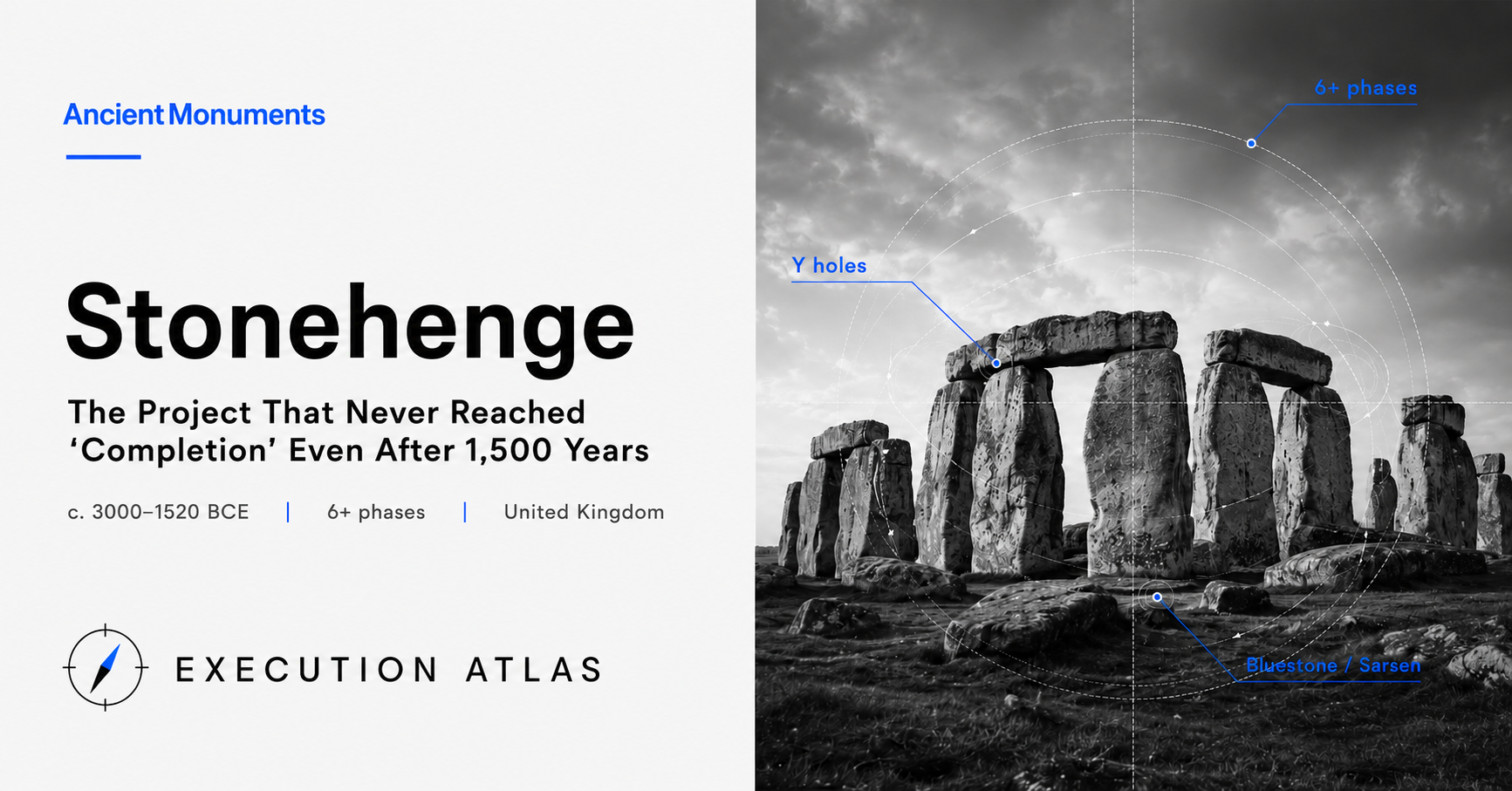
A ring of megaliths standing on the plain of Wiltshire, England. 51.51° N, 0.13° W. A circle 110 meters across.
Not every stone at Stonehenge is still standing. Some that once stood on the site now lie fallen. Excavation has shown that more than 80 major stones were brought in and placed across several phases. The largest weighs 25 tons; even the lightest is 2 tons. From around 3000 BC to 2000 BC — across the 1,500 years that carried the Neolithic into the Bronze Age — something kept remaking this place.
Mission
Around 3100 BC, a decision was made to build something here. The first thing built was an earthwork henge — a ring-shaped bank dug up out of the ground. About 110 meters across. Fifty-six pits (the Aubrey Holes) were dug in a circle.
What for? That, even now, is unknown.
A burial ground? An astronomical instrument? A ritual site? Archaeologists’ estimates differ. Either way, the original project definition was never written down. Neolithic people had no writing.
Around 3000 BC, it is thought that timber posts or early bluestones were set into the Aubrey Holes. There is no proof. It is only inferred from traces.
What matters is that this spot was “revised,” “remade,” and “added to” again and again. It was not finished in a single build. Multiple generations, at different times and (probably) for different purposes, kept working the same place.
Over 1,500 years there are thought to have been more than six phases. The last was around 1520 BC. And the place went on being used afterward — to this day, more than 5,000 years.
Design
Around 2500 BC came a turning point. What had been earth and timber turned to stone.
Bluestone — a stone with a reddish-purple cast, quarried in the Preseli Hills of Wales. About 225 km (140 miles) in a straight line; roughly 240 km (150 miles) along a route combining sea and land. Two to five tons each. Several dozen were carried to this place.
Then larger stones appeared. Sarsen — a whitish silcrete, brought from local quarries 30 to 180 km away. Twenty tons each, up to 25 tons. Several dozen were set in place.
The circular space that began as an earthwork henge was “painted over” with these stones. Without destroying the existing structure, new circles were added inside it — an outer sarsen ring, an inner bluestone ring. Concentric circles laid out with geometric precision.
But there is no notion of “completion.” In the final phase (around 1520 BC), the Y and Z Holes were dug on the outside. Were they trying to add a new ring, or was the aim something else? Of any work after that, there is no trace.
Execution
How did they move the bluestones from Wales?
No one witnessed a method we can be sure of. The archaeologists’ best reconstruction goes like this.
The stone is set on logs, and a team of four or five drags on ropes to roll it forward, throwing their whole weight against 2 to 5 tons, advancing through the mud at perhaps 2 km a day. For 240 km, that is 120 days — four months. Repeat it for dozens of stones. A large-scale haulage operation involving hundreds of people.
There were stretches across water, too. Load the stone onto a boat, run south along the coast, and bring it back ashore. Reading waves and currents, handling the boat, the technique of loading and unloading — Neolithic people had such skills.
The sarsens were the same. From 30 to 180 km away, drag a 20-ton stone; some exceed 30 tons.
To “execute” work on this scale required organization — concentrating hundreds of laborers on a single purpose for months. Sourcing food, reassigning workers, tracking progress.
Because it was an age without records, we do not know how that “organization” functioned. But working back from the result, there must have been some kind of director and laborers who followed the orders.
People
Stonehenge has no “individual genius” like the Roeblings, father and son, of the Brooklyn Bridge.
No one’s name survives. Who directed it? Who designed it? Where was the center of decision? All of it is a mystery.
And yet they must have existed. Over 1,500 years, multiple generations held knowledge concentrated on this one spot. They knew there were “sacred stones” in the Preseli Hills of Wales. They knew how to move those stones all the way here. They knew the design of the several circular arrangements.
If they existed, then the leaders of multiple tribes kept committing people and resources to a stone haul that might take decades — which means they held enough influence and conviction to believe that judgment was “right.”
In an age without written records, how was knowledge passed on?
The likely answer is “ritual” and “practice.” Regular pilgrimage to the Preseli Hills kept the perception of them as sacred alive. Regular rites and ceremonies at Stonehenge held the spot as a “sacred place.” The work of moving and placing the stones must have included an apprentice-style learning, the technique remembered in the body and handed down.
Through that “wordless inheritance,” knowledge was kept from being lost across many generations.
Legacy
What is Stonehenge now?
Archaeologists line up several theories. An astronomical instrument — the midsummer sunrise is seen through the Heel Stone, and the midwinter sunset falls along a particular axis. Did it work as a device for reading the seasons?
A burial ground — many human remains have been excavated from the surrounding site. In an age that can be called Neolithic or Bronze Age, this spot was a sacred place to bury the dead.
A ritual center — a place where people gathered from far away to perform shared ceremonies. A joining point for tribes and groups.
Today’s archaeological consensus is that it held “several purposes at once.” Their balance shifted by era. Early on, burial; in the middle, astronomical observation; later, ritual symbolism — each came to the foreground in turn.
The 1,500-year history of remaking is also a history of evolving use.
The record after 1520 BC is unknown. Even when the Roman Empire ruled Britain, whether Stonehenge was left alone or kept in use is unproven. From the medieval period on, Europeans recognized it as an “ancient ruin” and made it an object of mystery.
Today, Stonehenge is a UNESCO World Heritage site that receives more than a million visitors a year. Its purpose is tourism. Across 5,000 years, the use has changed again and again.
Learnings
Two insights can be drawn from Stonehenge.
Continuity in a project with no “finish”
For 1,500 years, Stonehenge was never completed. Even after the last phase, the work stopped for some reason. But it was not “abandoned.” The place is still in use today.
Modern projects aim at “completion.” From groundbreaking to handover, there is a deadline. But ultra-long-term infrastructure — Ise Shrine, the Roman aqueducts — has no notion of “completion.” Instead, it is designed on the premise of “continuous renovation” and “regular renewal.”
Perhaps Stonehenge was conceived from the start as one of those “projects that never end.” At the very least, that is what the result has become.
The difficulty of “completing” something, and the possibility of “continuing” it — where the watershed between them lies is the sharing of intent across generations. If the leaders of the many generations who kept remaking Stonehenge held not the goal of “finishing it” but the goal of “keeping this place sacred,” then the project runs on without end.
Carrying a vision forward in an age without writing
The decision to seek stone as far away as Wales, 240 km off — why was that decision held across multiple generations?
In an age without written records, a vision is held only through physical objects and ritual. The Preseli stones themselves speak of the sacred site’s existence. The arrangement of Stonehenge’s stones expresses the design intent. Regular ceremonies keep confirming its importance.
Inheritance that does not rely on records is fragile. Break it once and the knowledge is lost. Yet in Stonehenge’s case, it was not lost — from 3000 BC to now, more than 5,000 years.
Most modern projects rely on documentation: specifications, drawings, manuals. But those assume “someone reads and understands them.” Put the other way: once the readers are gone, the knowledge dies.
Stonehenge’s mode of inheritance — the handing down of bodily skill, the regular practice of ritual, the pilgrimage to a sacred site — may instead point to another possibility for how modern projects carry on. Not perfect documentation, but “practical repetition,” is what keeps knowledge alive.
Sources
- “A timeline of Stonehenge,” English Heritage (https://www.english-heritage.org.uk/visit/places/stonehenge/history-and-stories/timeline/) — the phasing from the earthwork henge to the Y and Z Holes
- “How was Stonehenge built?,” British Museum (https://www.britishmuseum.org/blog/how-was-stonehenge-built) — the construction methods and the weights of the stones
- “Stonehenge ‘bluestone’ quarries confirmed 140 miles away in Wales,” UCL News (https://www.ucl.ac.uk/news/2015/dec/stonehenge-bluestone-quarries-confirmed-140-miles-away-wales) — the identification of the Preseli quarries and the haulage distance
- “Solving the Riddle of Stonehenge’s Construction,” HISTORY (https://www.history.com/articles/solving-the-riddle-of-stonehenges-construction) — the reconstructed transport and raising of the stones
- “Building Stonehenge,” English Heritage (https://www.english-heritage.org.uk/visit/places/stonehenge/history-and-stories/building-stonehenge/) — the sarsen and bluestone arrangement
- “Timeline: Stonehenge,” World History Encyclopedia (https://www.worldhistory.org/timeline/stonehenge/) — the chronology across phases
- “Stonehenge,” Wikipedia (https://en.wikipedia.org/wiki/Stonehenge) — the overall overview, the astronomical alignments, and the later history