
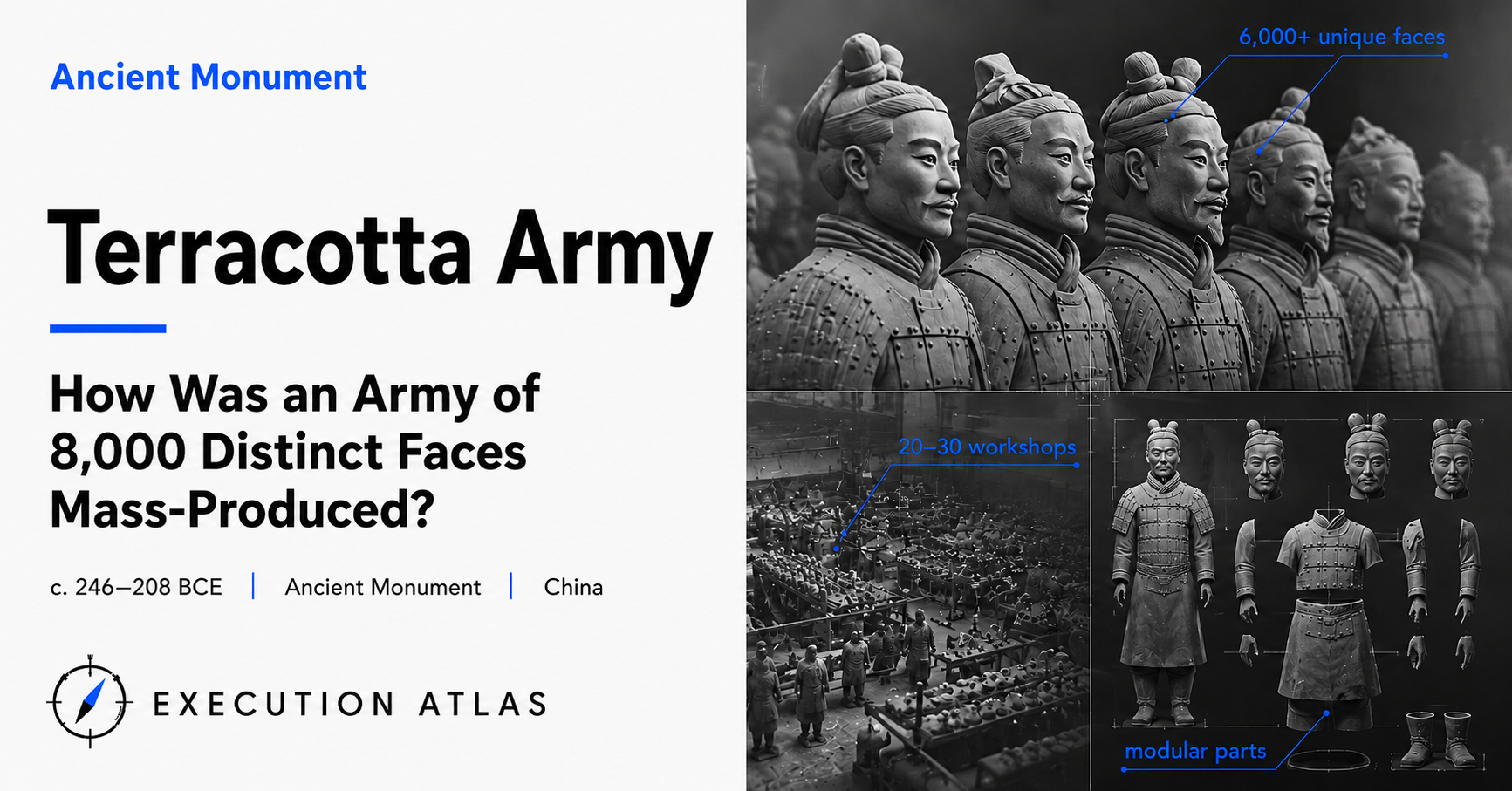
More than 8,000 life-sized warriors. Clay soldiers 1.8 m tall and 200 kg each, still standing after 2,200 years. The Terracotta Army, buried with the mausoleum of the First Emperor of Qin.
Until local farmers dug into it in 1974, everyone had forgotten it was there. The underground palace recorded in the Records of the Grand Historian turned out to be real. Even the line about “rivers” made of mercury has been borne out by surface surveys.
Thirty-eight years. 700,000 workers. Many small workshops manufactured parts independently and assembled them at a central point. An ancient “mass-production system,” run in the 3rd century BC.
After the First Emperor died, his successors finished the project. Power changed hands, and the organization kept moving.
Mission
In 246 BC, Ying Zheng became king of Qin at the age of thirteen. He decided to build his tomb at the northern foot of Mount Li.
In 221 BC he unified the six warring states into a single realm. The Warring States period was over. For the first time, the whole territory was governed as one unit called “Qin,” and he gave himself a new title: First Emperor of Qin.
By the moment of unification, the tomb had already been under construction for more than fifteen years. What began as a young king’s wish had swollen into a symbol of power over an entire empire.
In the worldview of ancient China, rank and power carried over after death. A king remained a king in the afterlife and still had to command troops. That is why thousands of soldier figures were needed. Infantry with spears. Archers. Cavalry on horseback. Charioteers driving their teams. Warriors gripping bronze swords. The armor each one wears follows a different pattern by rank and role.
The scale and precision of this “afterlife army” accelerated after unification. Pre-unification plans probably called for a few hundred figures. That grew to more than 8,000.
Design
Qin could manufacture an army of this size because of the “standardization and division of labor” it had built up during the wars of unification.
Before unification, in the armed competition with rival states, Qin had developed systems for mass-producing weapons and armor. Guilds of smiths standardized swords and spears and made them in parallel across several workshops. Each craftsman made a different part, and the parts were assembled later. That same system was repurposed for the Terracotta Army.
Qin’s bureaucracy set up many small pottery workshops in the area between its capital region and Lintong — an estimated 20 to 30 independent workshops. Each specialized in an assigned part: heads in one, torsos in another, legs, arms, armor, caps, weapons.
The dimensions of each part were managed tightly from the center. Tolerances were only a few centimeters. On a body 1.8 m tall, a height error of more than 3 cm meant the parts would not join at assembly. Standardization that precise.
The chancellor Li Si led the design. He had experience organizing the bureaucracy under Lü Buwei, and after unification he became known as the embodiment of Legalist thought. He created the small-seal script, unified the laws and the system of weights and measures, and drove the standardization of administration across the country. It was this man who also specified the manufacturing regime for the tomb.
Execution
In 1974, farmers near Xi’an were digging a well when they struck yellow shards of pottery. The Terracotta Army.
The surveys that followed slowly revealed the structure of the project from the artifacts themselves.
Each workshop left small differences in style. A head made in workshop A and one made in workshop B differ in the carving of the face — the cut of the eyes, the shape of the nose, the form of the ears. You can feel that independent craftsmen worked their own hands freely within a shared standard.
And yet the 8,000 figures are never the same. Each one’s expression differs. The way the cap sits, the way the armor is worn, the stance — all vary. More than 6,000 are completely unique.
No other ancient society achieved standardized mass production while preserving this much diversity.
There were production lines for the parts. Each workshop is estimated to have produced several hundred heads a month. After forming, the pieces were dried and fired. Kiln-temperature control is nearly a matter of guesswork; the Kaogongji, which compiled Western Zhou pottery knowledge, records firing methods, but the Qin potters were likely still finding the optimal temperature by trial and error.
Assembly happened in a separate place. Dedicated assembly areas were set up along the sides of the pits. Parts were gathered and fixed with a clay-based bonding agent. After assembly, the whole figure was painted — pigments of lead-bearing red, green, and gold. Traces of that color survive in places even today, after more than two thousand years underground.
The schedule ran 38 years, from the First Emperor’s accession in 246 BC to his death in 210 BC. Because the wars of unification fall inside that span, the years that could be devoted to the tomb itself were the roughly eighteen after unification. The principal figures were made in that window.
The workforce was 700,000. That is the total mobilized at a single point in time for Qin, not a cumulative count. With Qin’s whole population estimated at 12 million, about 6% of the population was working on the tomb at once. In the language of modern project management, the “person-months” run into the millions — an enormous investment.
No wages were paid. This was corvée — forced labor. Low-status people, convicts, prisoners of war, and laborers presented by regional lords. Records say they rotated month by month. Each gang had an overseer who reported on progress.
The death rate was low for an ancient society. To hold down outbreaks of disease, physicians were stationed at the work sites. Food was issued from state granaries on a priority basis. Precisely because Qin had just completed unification, the nation’s stockpiles and distribution network were functioning.
People
The First Emperor must have been involved in the broad conception of his tomb, but it is not recorded. What Sima Qian, author of the Records of the Grand Historian, set down is only the view from among his officials.
Chancellor Li Si. The statesman who underpinned Qin’s unification. As chief minister he led the unification of laws and the building of administration under the emperor. He created the small-seal script, unified law and measurement, and oversaw the architectural design of the tomb. He destroyed the six states and governed through a system of commanderies and counties — and at the same time built the organizational system of the tomb. For him, the tomb was likely an extension of governance.
Zhang Han, the shaofu official and military commander, served as the top executive of the construction, handling the day-to-day supervision of the work.
The First Emperor died in 210 BC, at the age of 49.
Immediately after, his son Fusu was to inherit the imperial position and become the overall head of the tomb work. But the eunuch Zhao Gao launched a conspiracy. He forged a will, drove Fusu to suicide, and placed the younger son Huhai on the throne.
The new emperor was Qin Er Shi, the First Emperor’s youngest son, recorded as lacking judgment in decisions. Yet this emperor threw everything into completing his father’s tomb.
From 210 BC to 208 BC — in just three years — he carried out the burial of the warriors and the completion of the tomb complex, at a pace beyond the original construction plan. Why Qin Er Shi fixed on this work is unclear. One reading is filial devotion to his father. Another is that the eunuchs, to keep their grip on power, wanted to raise their legitimacy by showing a mega-project brought to completion.
Qin Er Shi killed himself in 207 BC. Qin collapsed within two years. The tomb was finished; the emperor was not.
Power changed hands, and the project still reached completion. The case shows how far the power of the bureaucracy did not depend on the person of the emperor.
Legacy
208 BC. The burial of the Terracotta Army and the completion of the tomb complex.
The Qin that followed was short-lived. Amid the chaos of Qin Er Shi’s rule, revolts broke out across the country, and Qin fell in 207 BC. The existence of the tomb stayed in the record, but its contents gradually turned into legend. Was the “river of mercury” in the Records of the Grand Historian a flourish to display the emperor’s power, or a real technique? For 2,000 years it remained a mystery.
Until 1974. A farmer’s well.
Excavation after the discovery brought up more than 6,000 warriors from Pit 1 alone. Pits 2 and 3 have also been reported. Together they exceed 8,000. But only part has been excavated; the underground palace itself has never been dug.
The reason is mercury. The Records of the Grand Historian was telling the truth. A 2015 three-dimensional mapping survey found that mercury concentrations inside the underground palace are distributed in the pattern of China’s four great rivers — the Yellow, the Yangtze, the Pearl, and the Huai. A river of mercury. It may have symbolized the rivers of the “empire” the First Emperor would rule in the afterlife.
Excavating would yield academic value, but once dug it cannot be undone, and the high mercury concentration inside threatens the health of the workers. For these combined reasons, the excavation plan remains indefinitely postponed.
The empire the First Emperor built fell in 36 years. But the Terracotta Army survived. Once a ruler’s ambition is translated into concrete matter and an organizational system, it can outlast the ruler himself for as long as that matter exists.
Learnings
Two insights from this project carry over to modern project management.
1. Standardization and diversity at once
What Qin achieved was mass production through standardized parts while preserving the individuality of each product.
In modern software and hardware, holding both at once is the hard part. Microservice architecture develops small independent modules — workshops — in parallel and integrates them. Docker, Kubernetes, CI/CD pipelines: in essence, these have the same structure as Qin’s warrior-manufacturing system.
Each team develops a component independently while the overall standards — interfaces, schemas, communication protocols — stay unified. On top of that, each team is free to customize its internal implementation. The more than 6,000 completely unique warriors follow the same principle.
2. Succession of power and project continuity
The First Emperor died without seeing his tomb finished. Even so, the project was completed.
In modern startups and projects, when the founder or PM changes, the vision can waver. But in the Qin case, the bureaucracy carried the project forward. What made that handover possible was Li Si’s detailed design specifications and the institutionalization of the workshops.
A project that leans on the personal charisma of a CEO or PM stalls when the leader changes. But when process and organizational structure are established, the work keeps moving even after a change at the top. Qin Er Shi almost certainly did not understand the internal specifications of the Terracotta Army. Yet by reading his officials’ reports and simply making decisions, the work was completed.
Today, document-driven development, OKRs, and white-boxing of process are the mechanisms that keep power from becoming personalized and secure the continuity of a project.
Sources
- Nikkei, “8,000 figures, every face and outfit different — the secret of the Terracotta Army’s mass production” (https://www.nikkei.com/article/DGXMZO72460120R00C21A6000000/) — the scale of the figures, the uniqueness of the faces, the division of labor across workshops
- Kusanomido, “The mystery of the ‘river of mercury’ in the First Emperor’s tomb” (https://kusanomido.com/study/history/chinese/china/101369/) — the mercury survey and the four-rivers distribution
- World Heritage Mania, “China’s World Heritage site: the Mausoleum of the First Qin Emperor and the Terracotta Army pits” (https://worldheritage-mania.com/heritage-mausoleum-of-first-qin-emperor/) — the structure of the pits and the excavation status
- Wikipedia, “Mausoleum of the First Qin Emperor / Terracotta Army” (https://en.wikipedia.org/wiki/Terracotta_Army) — the construction timeline, the workforce figures, the roles of Li Si and the succession crisis
- National Geographic, “China 2,200 years ago: what is the Terracotta Army?” (https://natgeo.nikkeibp.co.jp/atcl/photo/stories/21/052000031/) — the manufacturing process and the painted finish