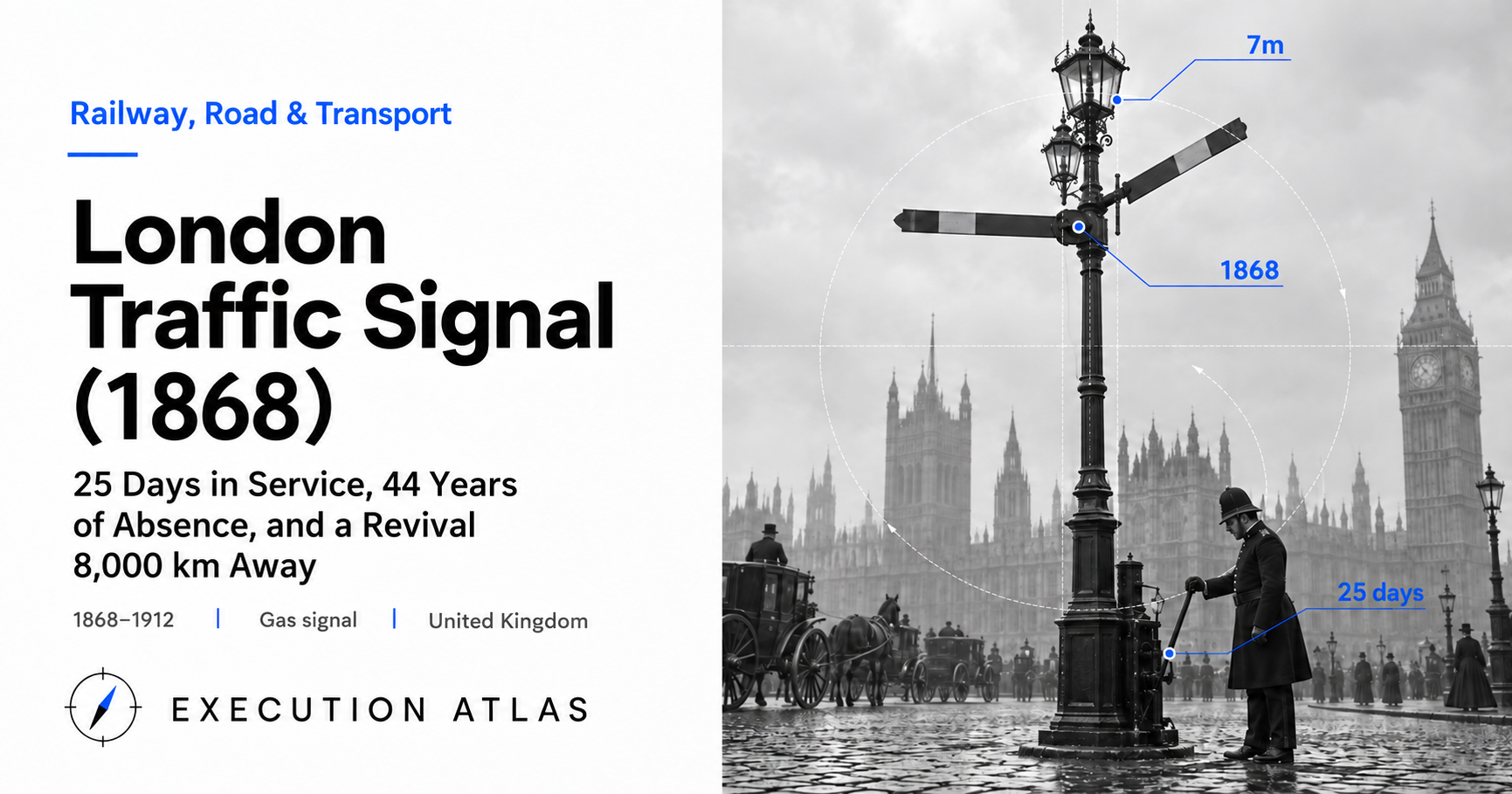
The world’s first traffic signal stood in front of the Houses of Parliament in London on December 9, 1868. It was a gas-lit device, roughly 7 meters tall, operated manually by a police officer pulling a lever.
Three weeks later, on January 2, 1869, the signal exploded from a gas leak. The officer on duty suffered severe facial burns, and for more than 40 years afterward, traffic signals vanished from Britain entirely.
The same concept was revived in 1912, 8,000 kilometers from London, when an obscure police officer in Salt Lake City, USA, rebuilt it in electric form. London’s one year — pioneering the world’s first while losing its grip on what came next. This article tells the story of that one year.
Mission: In 1866, 1,102 People Died on London’s Streets
London in the mid-19th century had a population of roughly 3 million — the largest city in the world at the time. At the center of currency, trade, and technology as the victor of the Industrial Revolution, the streets of Westminster saw hackney carriages, omnibuses, private coaches, carts, pedestrian laborers, and livestock all sharing the same road.
No signals. No signs. Virtually no traffic rules. Police officers standing at intersections directing by hand gesture were the only form of control, and only at major junctions at that.
In 1866, 1,102 people died on these streets, and 1,334 were injured. Per year.
This was not accident — it was daily life. For Londoners of the day, crossing the road carried something close to the danger a modern person would feel crossing a motorway. That same year, Parliament debated a traffic control bill for the City district. It had become that serious a social problem.
That year, a 38-year-old man serving as Traffic Superintendent at South Eastern Railway sent a proposal to the Metropolitan Police Commissioner, Sir Richard Mayne.
“Just as semaphore signals have reduced accidents on the railways, introducing visual signals on roads would allow traffic to be controlled without relying on officers’ hand gestures.”
The sender’s name was John Peake Knight — the first person to work out, at the level of industrial implementation, the idea of bringing railway signals into the city streets.
Design: Transplanting the Railway Signal, with Gas Lamps Added
Knight’s proposal modeled itself on what he used every day at work.
The semaphore signal. A horizontal arm on top of a post: horizontal meant “stop,” angled downward meant “go.” Simple but highly visible, readable by a steam locomotive driver from a distance. This system was tested by Charles Hutton Gregory at New Cross station on the London and Croydon Railway in 1841, and adopted by Knight’s own employer, South Eastern Railway, in the following years. For Knight, it was simply the infrastructure around him.
His design did not stop at merely planting a railway signal at an intersection. There was the problem of nighttime visibility. London was foggy, and gas lamps were still the dominant form of street lighting. The movement of an arm alone would not be readable after dark.
So Knight decided to incorporate gas lamps at the tip of the arm. Two lamps fitted with red and green colored glass would convey the signal by color at night. Drawing supply from the city’s gas pipe network would allow 24-hour operation.
Semaphore arm by day, gas lamps by night. This redundancy was the key design decision — and simultaneously, the key vulnerability.
The structure was a single post, roughly 22 feet (about 7 meters) tall, with two arms extending left and right. A gas pipe ran up through the interior of the post to the lamps. Operation was done by a police officer standing at the base, manually pulling a lever to switch the arm’s angle.
Simple, a straightforward translation of railway signal thinking to the road. One of the best design options buildable with 1868 technology. But between railway and road, there were boundary conditions Knight had not fully reckoned with.
Execution: From Installation to Explosion, 25 Days
The signal was erected on December 9, 1868, at the three-way junction where Bridge Street, Great George Street, and Parliament Street meet in Westminster — directly in front of the Houses of Parliament, one of the busiest intersections in London.
On the first day, citizens came out of curiosity to see the device. The Times called it “an ingenious contrivance.” The arm moved slowly, and by night the lamps glowed red and green. An officer stood a little back from the center of the intersection and pulled the lever.
The first two weeks, it worked well enough.
The trouble started around the end of December. A small leak began at one of the gas pipe joints. The gas piping technology of the era was, by modern standards, fairly crude — leaks were a routine occurrence on the gas street-light network under London’s roads. That gas was accumulating inside the enclosed space of the post’s interior went unnoticed.
January 2, 1869. On a winter London morning, the officer on point duty pulled the lever as usual. The gas pooled inside the post caught on the lamp’s flame.
The explosion was instantaneous. The post burst apart, engulfing the officer in fire. He suffered severe burns to his face and hands. His name cannot be confirmed in most sources, but Metropolitan Police records note he required extended medical leave.
The Metropolitan Police suspended operations immediately. Repairs were considered, but aversion to taking on new liability for danger was strong within the police, and there was political pressure to avoid criticism from Parliament and the public. Operations were completely halted before the end of 1869, and the signal was removed in 1870.
Twenty-five days from installation to explosion. About one year from suspension to removal. The world’s first traffic signal’s operational life was, in effect, over in three weeks.
People: The 38-Year-Old Railway Man and the Predecessor Who Brought Signals to His Workplace
Tracing Knight’s career reveals why he invented the traffic signal.
Born in 1828 in Nottingham, central England. He left Nottingham High School at 12 and began his railway career as a parcel clerk at Derby station. By 20, he was Traffic Manager for the London to Brighton railway; by 25, Superintendent at South Eastern Railway. At 40, he was a mid-level figure in railway management.
One of the tools he used daily at work was the semaphore signal. The man who brought that railway signal to South Eastern Railway was a civil engineer named Charles Hutton Gregory. Gregory tested it at New Cross in 1841 and put it into service at Knight’s employer between 1842 and 1843. Knight was not Gregory’s direct pupil, but the fact that all the main signals at his workplace traced back to Gregory’s semaphore system matters.
When the 38-year-old Knight sent his proposal to the Metropolitan Police Commissioner, what was in his mind must have been the view from his own workplace. The semaphore post across the platform, trains stopping and moving in response to the arm’s movement. Accidents reduced. Put the same mechanism at a city intersection, the same effect should follow.
That logic was correct. But railway signals ran on ropes and levers, not electricity. Powered light sources had not yet been invented. So he had no choice but to use gas lamps. On that single point, Knight’s vision hit the wall of its era.
Records on the injured officer are thin. Neither his name nor what became of him appears in detailed surviving documents. A Metropolitan Police statement referenced in a January 1869 parliamentary answer summarized the police position as: “This device is not, at the present stage, suited to London’s streets.”
Knight himself continued working in the railway industry after the accident, dying in 1886 at 58. His grave is at Brompton Cemetery. A commemorative plaque in Westminster reads: “The railway engineer who proposed the world’s first traffic signal.” The story of the signal that was removed after exploding is not written there.
Legacy: 44 Years, 8,000 Kilometers, and Three Colors
After Knight’s failure, Britain endured a long silence. Through the 1870s, 1880s, 1890s, and into the early 1900s, London’s traffic control reverted to nothing but police hand signals.
The signal revived somewhere in the world in 1912.
In Salt Lake City, Utah, USA, a police officer named Lester Wire put red and green two-color lamps in a wooden box and stood it at the intersection of Main Street and 200 South, drawing power from a nearby trolley wire. Citizens called it “Wire’s bird cage” and mostly ignored it at first.
This was one of the earliest examples of an electric traffic signal — 44 years after Knight’s gas-lit version, on a patch of land roughly 8,000 kilometers from London.
Two years later, on August 5, 1914, an electric signal designed by James Hoge was commercially installed at Euclid Avenue and East 105th Street in Cleveland, Ohio. Often cited as “the first permanent electric traffic signal,” this is frequently called the starting point of modern traffic signals.
Six years after that, on October 20, 1920, a police officer named William Potts erected a red-yellow-green three-color, four-direction signal at Woodward Avenue and Fort Street in Detroit, Michigan. The idea of inserting yellow came from the three-lamp railway signal system. Fifty-two years after Knight attempted the translation from railway to road, the lineage was completed in Detroit.
All modern traffic signals are direct descendants of this three-color system. There are estimated to be more than 3 million signals operating in the world today, and every one of them carries the thinking of Knight and those who followed him.
Britain’s lost 44 years, measured as a lead in implementation, were 44 years during which that lead moved to America. Knight’s vision was correct; it simply needed to wait for the implementation environment to catch up. When the era catches up, it always comes back.
Lessons: “Failure of Vision” or “Failure of Implementation Environment”?
Knight’s signal failed. But it was not a failure of vision.
When we analyze project failures, we usually make the failure itself the object of analysis. What went wrong, who was responsible, which decision, if changed, might have saved it. This view is necessary, but stopping there prevents learning from the failure.
In Knight’s case, breaking down the failure reveals two layers.
The first is the implementation environment. In 1868, electric lighting did not exist; gas was the only powered light source available. Gas was not used in the enclosed signal systems on railways. Trapping flammable gas inside an enclosed post and stationing an operator directly beneath it was a concept absent from railway signals. Here, Knight miscounted the “diff in implicit assumptions.”
The second is the vision. The underlying logic — translating railway signals to roads — did not break. In 1912 the electric version was revived; in 1920 the three-color system was completed; 100 years later the same vision is still in use. The vision was proven, 44 years later, on another continent.
Separating failure into “failure of vision” and “failure of implementation environment” shows that the latter always returns once the era catches up. The former never returns.
This is also a practical framework for the people who end a project. After the decision to withdraw, do you discard that vision, or let it sleep? If you can count up the trajectory of technology development and the maturity of industrial infrastructure, you can get a rough estimate of when it can return. If Knight’s grave had read “wait 44 years,” Britain might not have lost the lead.
There is a second lesson. Safety accidents destroy trust far beyond what the numbers suggest.
One officer was injured in the explosion; no deaths occurred. Yet Britain kept traffic signals off its streets for 40 years. The cause was identifiable (gas leak) and the fix was actionable (improved piping, redesigned housing) — yet this accident was more than sufficient grounds for withdrawal.
Whether or not you have a story ready on the day of the accident — “the cause is identifiable and the fix is actionable” — determines the lifespan of a new product. The Metropolitan Police in London on January 2, 1869, did not have that story. Perhaps could not have had it.
Knight’s vision was revived on another continent, 44 years later. By then, London had largely forgotten his failure. The world takes these roundabout routes sometimes.
Sources
- Graces Guide, “John Peake Knight” (https://www.gracesguide.co.uk/John_Peake_Knight) — inventor’s biography and railway career details
- Wikipedia, “J. P. Knight” (https://en.wikipedia.org/wiki/J._P._Knight) — birth and death years, position at South Eastern Railway
- The Royal Parks, “John Peake Knight (1828-1886)” (https://www.royalparks.org.uk/visit/parks/brompton-cemetery/famous-graves-burials/john-peake-knight-1828-1886) — grave at Brompton Cemetery and biographical summary
- SICE, “The traffic light: 150 years of history” (https://www.sice.com/en/insigths/the-traffic-light-150-years-of-history/) — installation location, mechanism, and explosion accident details
- LYT, “Who Invented Traffic Lights? The Story of John Peake Knight” (https://lyt.ai/blog/on-the-road/who-invented-traffic-lights/) — 1866 road fatality/injury figures, motivation for the proposal
- History Hit, “Where Were the World’s First Traffic Lights?” (https://www.historyhit.com/1868-first-traffic-light/) — December 9, 1868 installation date, mechanism, officer injured
- Smithsonian Magazine, “When the Street Light First Came to London, Disaster Ensued” (https://www.smithsonianmag.com/history/when-street-light-first-came-london-disaster-ensued-180970965/) — accident details and appearance of the signal
- Londonist, “Here’s What The World’s First Traffic Lights, In Westminster, Looked Like” (https://londonist.com/london/history/here-s-what-the-world-s-first-traffic-lights-in-westminster-looked-like) — location of Westminster commemorative plaque
- Ferrovial’s blog, “The origin of traffic light” (https://blog.ferrovial.com/en/2019/02/traffic-light-origin/) — accident date, height of 22 feet, officer injuries
- WorldAtlas, “The First Traffic Light In The United States” (https://www.worldatlas.com/places/the-first-traffic-light-in-the-united-states.html) — 1912 Lester Wire, Salt Lake City revival
- HISTORY, “First electric traffic signal installed | August 5, 1914” (https://www.history.com/this-day-in-history/august-5/first-electric-traffic-signal-installed) — 1914 Cleveland electric signal, James Hoge
- The Henry Ford, “First Tri-Color, Four-Directional Traffic Signal, 1920” (https://www.thehenryford.org/collections-and-research/digital-collections/artifact/227457) — 1920 Detroit three-color four-direction signal, William Potts
- Wikipedia, “Railway semaphore signal” (https://en.wikipedia.org/wiki/Railway_semaphore_signal) — Charles Hutton Gregory’s 1841 New Cross experiment and adoption at South Eastern Railway