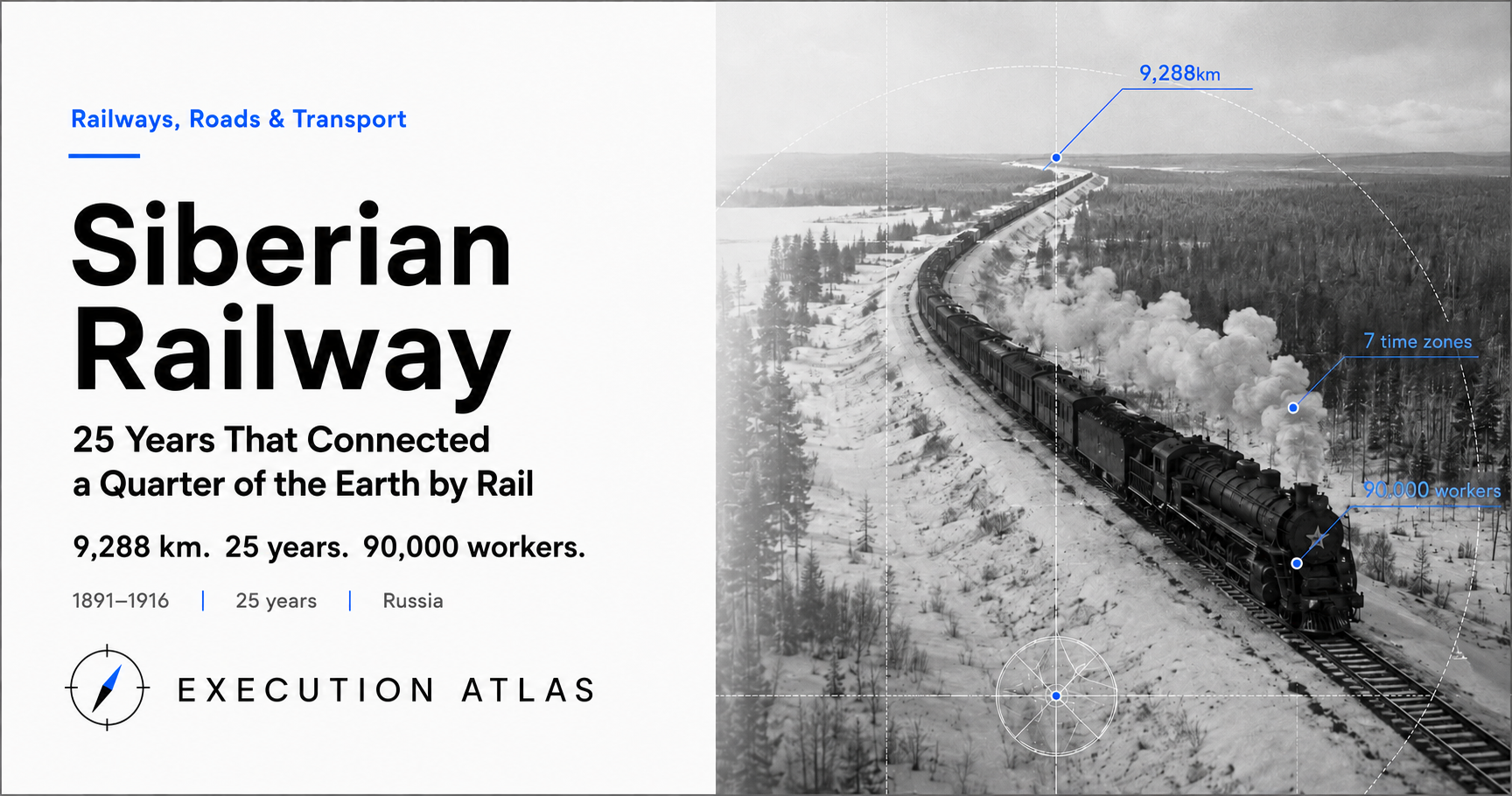
9,288 km. 25 years. 90,000 workers. 1.4 billion rubles.
A single rail line from Moscow to Vladivostok, punching through seven time zones. Roughly the same straight-line distance as Tokyo to London. About a quarter of the Earth’s circumference.
Earthwork moved: 100 million cubic meters. Sleepers laid: 12 million. Total rail weight: over 1 million tons. All by hand. Shovels, axes, pickaxes, and saws.
Before construction began in 1891, 500,000 people had migrated to Siberia over 30 years. After the railway opened, 5 million arrived in 23 years. A tenfold increase.
Mission: The Tsar’s Impatience
In 1886, Tsar Alexander III lamented.
“The government has done nothing to satisfy the needs of this rich, but neglected region.”
Siberia was vast. Several times the size of European Russia. Rich in resources. Empty of people. Britain and Japan were pressing in from the east. Without developing Siberia and securing the Pacific coast, the empire would lose its eastern half.
On March 9, 1891, an imperial decree was issued. Build a railway across Siberia.
The concept had existed since the 1850s. Governor-General Muravyov-Amursky had seized the Amur River basin and laid the groundwork for Far Eastern expansion. Everyone knew a railway was needed. For 40 years, no one started building.
Economic rationality didn’t drive the decision. Geopolitics did. Laying rail across Siberia was not an investment. It was a statement of national will.
On May 31, 1891, a groundbreaking ceremony was held in Vladivostok. Tsarevich Nicholas, the future Nicholas II, shoveled earth with his own hands. He was 23. No one knew this young man would later abdicate during the Russian Revolution, and that his entire family would be executed by firing squad.
Design: Six Sections and Three Gambles
The man who drove the design was Sergei Witte. A 43-year-old Georgian who became Minister of Finance in 1892.
Witte’s background was unusual. After studying mathematics at university, he joined a railway company, rising through the ranks to become traffic chief of the Odessa Railroad. He knew from the ground up that railways build nations.
Witte started by building an organization. The “Siberian Railway Committee.” By securing the Tsar’s direct approval, he bypassed local administrators and accelerated decision-making. Rather than reforming the bureaucracy head-on, he routed around it.
The design decisions came down to three.
Parallel construction of six sections. The West Siberian, Ussuri, Central Siberian, Trans-Baikal, Circum-Baikal, and Amur lines. The full length was split into six segments, with construction starting simultaneously from both ends. Each section had a strict completion deadline, and Witte pressured any site that fell behind.
The second decision was cost reduction. Lower-grade materials, narrower foundations, less ballast, lighter rails, wider sleeper spacing. Steel bridges replaced with timber. Witte’s estimate put total costs at 2.5 billion rubles. Roughly 15% of the empire’s annual expenditure, sustained for a decade. Funding came from French loans and bond issues. The shortfall was covered by printing money and stoking inflation.
The third decision was single-track design. The entire line would be single track. It halved the cost. Thirteen years later, that decision would cost the empire a war.
One more decision concerned scope. A route entirely within Russian territory meant unavoidable construction challenges along the Amur River. In 1896, Witte secured rights from the Qing dynasty to build a railway across Manchuria. The Chinese Eastern Railway. Far shorter than the all-Russian route. Faster to complete. But the tracks ran through another country’s territory.
Execution: Lake Baikal, Then War
The Plains and Forests
The first section completed was the West Siberian line. Chelyabinsk to Novonikolayevsk (now Novosibirsk). Started in 1892, finished in 1896. Flat steppe terrain where the main challenge was bridging major rivers. Track advanced at roughly 740 km per year. Fast even by modern standards.
The Ussuri line cut through dense forest. Vladivostok to Khabarovsk. Started in 1891, finished in 1897. Labor was short. Korean and Chinese migrant workers were hired, and convicts were pressed into service.
The Central Siberian and Trans-Baikal sections were also completed by the late 1890s. Up to this point, everything was on schedule.
”The Golden Buckle”
The problem was Lake Baikal.
The world’s deepest lake. 1,600 m deep, 640 km long. Sitting 60 km east of Irkutsk, the tracks could not go around it.
The stopgap until the bypass railway was finished was primitive. In summer, ferries carried the trains across the lake. In winter, tracks were laid on the frozen surface.
Construction of the Circum-Baikal Railway began in 1899. Thirty-nine tunnels were blasted through 84 km of shoreline. Granite, gneiss, gabbro. Solid rock walls plunging straight into the water, with no flat ground for a roadbed. Workers carved into cliffs, bored tunnels, and bridged ravines. All materials were delivered by water. Barges in summer, horse sledges on ice in winter.
Construction cost roughly 130,000 rubles per kilometer. Four to five times the other sections. This 84 km stretch alone consumed 52.5 million rubles.
To accelerate the work, Italian and Armenian stonemasons were brought in. Combined with Russian, Polish, and British laborers, up to 13,500 workers occupied the lakeside cliffs at peak.
The section would later be called “the golden buckle of the Great Siberian Way” and “a museum of Russian engineering thought.”
The Russo-Japanese War and the Limits of Single Track
In February 1904, the Russo-Japanese War began.
The Circum-Baikal Railway was still unfinished. Troops and supplies had to cross on makeshift ice tracks. Trains broke through the ice and sank.
The Circum-Baikal line finally opened in September 1904, during the war. Transport Minister Khilkov drove the last spike into a sleeper with his own hands. He was 69.
But the real problem lay beyond Lake Baikal.
The Trans-Siberian was single track. Only 6 to 13 trains could run per day. Westbound trains carrying the wounded and eastbound trains carrying reinforcements could not pass each other. They waited at stations.
Russia could not concentrate its forces. Japan had shorter supply lines and held the logistical advantage. Port Arthur fell, Mukden was lost, and the Baltic Fleet was annihilated at Tsushima.
An empire that had laid 9,288 km of track lost a war because that track couldn’t carry enough. The single-track design chosen to cut costs became a fatal bottleneck in wartime.
The Manchurian Shortcut Comes Due
After the Russo-Japanese War, another design decision backfired.
The Chinese Eastern Railway ran through Manchuria. The Treaty of Portsmouth transferred southern Manchurian railway rights to Japan. The risk of relying on a route through foreign territory became reality.
Russia resumed construction of the Amur line. Started in 1908. A route through the mountains along the Amur River, entirely within Russian territory. The price of choosing the “shortcut” through foreign soil: an additional 8 years and enormous extra costs.
”The Miracle of the Amur”
The final obstacle on the Amur line was the Khabarovsk Bridge.
Designed by bridge engineer Lavr Proskuryakov. Total length: 2,590 m. Eighteen spans. 17,800 tons of steel. The longest bridge in Imperial Russia. Budget: 13.5 million rubles. Planned duration: 26 months. Construction began in July 1913.
One year later, World War I broke out.
The steel girders were manufactured in Warsaw and shipped by sea to Khabarovsk. In autumn 1914, a merchant ship carrying the final two spans was sunk by the German cruiser SMS Emden in the Indian Ocean. More than a year of delay.
On October 5, 1916, the Khabarovsk Bridge was completed. The Trans-Siberian Railway, running entirely through Russian territory, was finally open end to end. Twenty-five years after groundbreaking. The original plan had been ten.
The bridge now appears on Russia’s 5,000-ruble banknote.
People: A Railwayman and the Prince Who Shoveled Coal
Sergei Witte (1849-1915)
Witte was appointed Minister of Transport in February 1892, then moved to Minister of Finance that August. Knowing the railway firsthand before controlling the treasury gave him the leverage to run the project through the Siberian Railway Committee as a single command.
He set strict deadlines for each section and pressed any site that fell behind. In the Siberian wilderness, where work stopped entirely in winter, he sustained a pace of 740 km per year. From financing to diplomatic negotiations (securing construction rights for the Chinese Eastern Railway), nothing moved without Witte.
It came at a cost. He sacrificed quality to hold the schedule. Lighter rails, timber bridges, insufficient ballast. Between “finish fast” and “build to last,” Witte chose the former, again and again.
He was dismissed as Finance Minister in 1903. After Russia’s defeat in the Russo-Japanese War, he was tasked with negotiating the Treaty of Portsmouth. He succeeded, and was rewarded with the mocking title “Count Half-Sakhalin.”
Prince Mikhail Khilkov (1834-1909)
Khilkov was born into a princely family. At 23, he traveled to North America and entered an American railway company as a common laborer. He started as a fireman, then rose to assistant engineer, locomotive driver, and head of the rolling stock division. A Russian prince shoveling coal in America.
In Liverpool, England, he worked as an assembler in a steam engine factory. He learned how locomotives work with his hands.
After returning to Russia, he became Minister of Transport (1895). Just as the most difficult section, the Circum-Baikal Railway, was about to begin. He brought American-style equipment and practical improvements like gradient reduction to the construction sites.
On the day the Circum-Baikal Railway opened in September 1904, 69-year-old Khilkov drove the last spike himself. Not by signing a document. By hammering a spike into a sleeper.
Lavr Proskuryakov (1858-1926)
A bridge engineer who graduated from the St. Petersburg Institute of Railway Engineers in 1884. His Krasnoyarsk Bridge over the Yenisei River won the gold medal at the 1900 Paris Exposition.
For the Khabarovsk Bridge, he designed angled surfaces on the upstream side of each pier to handle ice pressure on the Amur River. When ice struck, the load would deflect rather than hit the pier head-on. Building a bridge over a Siberian river means surviving not just the current, but annual freeze and thaw cycles.
Legacy: The Railway That Moved Five Million People
Before the railway, Siberia was a penal colony.
From 1860 to 1890, roughly 500,000 peasants migrated to Siberia over 30 years. After the railway opened, about 5 million settlers arrived in 23 years, from 1891 to 1914. Annual migration nearly doubled: 88,000 per year from 1896 to 1904, then 174,000 from 1905 to 1914.
The government offered free land to settlers. Novosibirsk, Tomsk, and Irkutsk began growing into cities. Cultivated land in western Siberia’s black earth belt doubled, and from 1896 to 1913, an annual average of 501,932 tons of grain was exported from Siberia.
The time horizon for measuring a railway’s value is long.
Historian Christian Wolmar called it “a failure built for narrow political reasons.” Critics pointed out that settlement barely extended beyond 30 miles (48 km) of the track.
A century later, the Trans-Siberian carries 30% of Russia’s export-related freight. As the only transportation artery crossing Siberia, it continues to underpin Moscow’s control over the Russian Far East.
Learnings: Every Compromise Was a Bet on the Future
Planned: 10 years. Actual: 25 years. Cost: roughly double the original estimate. Analyze the gap, and a strange structure emerges.
All three of Witte’s design decisions backfired. Single-track design collapsed logistics in the Russo-Japanese War. The Manchurian shortcut forced construction of the Amur line after the war. Quality cuts left a maintenance debt that lasted into the 1920s.
Yet without those same three decisions, the Trans-Siberian Railway would never have been completed. Double track would have doubled the cost. An all-Russian route would have extended the timeline even further due to the Amur River’s brutal terrain. Higher-quality materials would have exhausted the French loans. A railway that doesn’t exist is less useful than a low-quality one.
Every one of Witte’s compromises was a bet that a particular future would not arrive.
Single track was a bet that no major war would come. The Manchurian route was a bet that relations with the Qing dynasty would remain stable. Quality cuts were a bet that the railway would never bear wartime loads. All three were rational choices under constraint. To complete the project within what the empire’s treasury could bear, Witte had no option but to accept risks against the future.
Thirteen years later, he lost all three bets.
The single-track bottleneck became one cause of defeat in the Russo-Japanese War. Loss of the Manchurian route forced eight additional years of construction on the Amur line. Full remediation of quality defects did not end until the 1920s. The cost of losing exceeded what the bets had saved by a wide margin.
There were also decisions that were not bets. Parallel construction of six sections was an effective schedule compression strategy regardless of what future arrived. The Siberian Railway Committee functioned as an accelerator that bypassed Imperial Russia’s bureaucracy, independent of circumstances. These were not decisions that accepted risk. They were structurally sound design choices.
The lesson is not “never compromise.” Under constraint, compromise is unavoidable. The question is whether you know what you’re betting on. Witte may have known. But when the bill for his bets would arrive was not something even he could choose.
Sources
- Trans-Siberian Railway - Wikipedia — Overview, timeline, and construction section details
- Trans-Siberian Railroad - Library of Congress — Witte’s role, Siberian Railway Committee, basis for 10-year planned duration
- Trans-Siberian Railroad - Britannica — Construction overview and section completion dates
- Completion of the Trans-Siberian Railroad - EBSCO Research — Cost overruns (roughly double original estimate), planned timeline, completion history
- Circum-Baikal Railway - Wikipedia — Construction costs, tunnel count, and workforce for the Baikal section
- Khabarovsk Bridge - Wikipedia — Bridge design, timeline, and the SMS Emden sinking
- Mikhail Khilkov - Wikipedia — Khilkov’s biography and railway career in North America
- Sergei Witte - Wikipedia — Witte’s career, Transport Minister to Finance Minister appointment dates
- Sergei Witte - Britannica — Witte’s education and role at Odessa Railroad
- Why was the Trans-Siberian Railway built - Russia Beyond — Construction background, Russian perspective (JP Only)
- Trans-Siberian Railway - Sekaishi no Mado — Overview and Russo-Japanese War context (JP Only)