500 hours per minute. 2.5 billion MAU. 2,500 petabytes.
On February 14, 2005, Chad Hurley, Steve Chen, and Jawed Karim registered YouTube.com as a video dating site. The launch date was chosen to coincide with Valentine’s Day. The concept was “Tune In, Hook Up” — women would upload profile videos, men would reply. Four months later, not a single video had been submitted. They paid women $20 via Craigslist to post videos. Still zero.
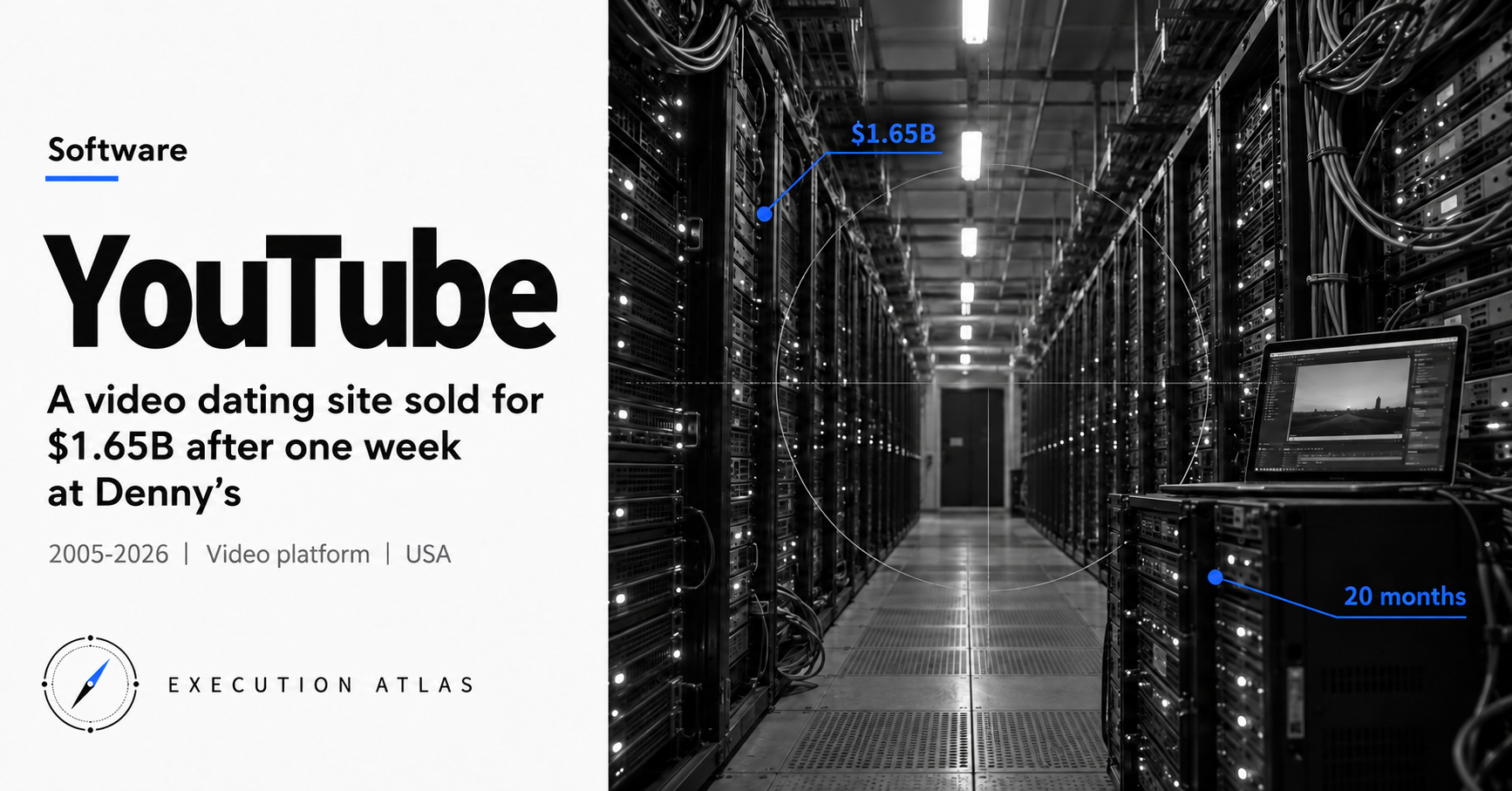
Twenty months later, Google bought YouTube for $1.65 billion. At the time, it was Google’s largest acquisition ever. Negotiations, including meals at Denny’s in Palo Alto, wrapped up in a week.
This project never worked as planned from the moment it began.
Mission
In early 2005, there was almost no way to watch video on the web.
High-definition video meant downloading a file directly from a homepage, then launching QuickTime or RealPlayer to play it. Uploading was even more painful — hosting a video file on a personal site could blow through a server’s bandwidth allowance, triggering a warning email from the hosting company. Video existed in the 2004 web, built from photos and text, like an unpaved back road.
Hurley, Chen, and Karim were all early PayPal employees. They had capital from the eBay acquisition and hands-on experience building the “network effects” that made PayPal work. They wanted to replicate the structure of PayPal — which had bet on peer-to-peer payments rather than business-to-business — but for video.
The first hypothesis was video dating. As Karim told USA Today in 2006, all three had noticed that footage of both the Janet Jackson wardrobe malfunction at the 2004 Super Bowl halftime show and the December 2004 Indian Ocean tsunami was nowhere to be found online. That became their shared conviction: there was no place on the internet to share video. Implementation took a different turn. Hurley handled design, Chen built the backend, Karim wrote initial features, and on Valentine’s Day they registered the domain as “Tune In, Hook Up.”
Women didn’t come.
What showed up instead: dog videos, wedding videos, pet hamster videos. Male users had started using the site for their own purposes. Within a few months, the three made a decision. They dropped the “video dating site” spec and rebuilt it as a platform where anyone could share any video. On April 23, Karim uploaded a 19-second test video called “Me at the zoo” — just Karim himself talking in front of the elephants at the San Diego Zoo.
The requirements document had already been rewritten by this point.
Design
After the pivot, three principles shaped the design.
First: video would not be trapped inside the site. Hurley prioritized an “embed player” that let anyone paste a video into their own blog or MySpace page. The concept came from PayPal’s payment button — a small snippet of code anyone could drop into any site, which then became an advertisement for YouTube. The design shifted from “go to YouTube to watch” to “YouTube video finds you wherever you are.”
Second: minimize friction for uploaders. Watch without signing up. Upload within 30 seconds of registering. Server-side format conversion handled automatically. After upload, videos were auto-converted to Flash Video (.flv) and played back via Flash in the browser. There was no unified video playback environment on the web at the time; Flash was the exception that worked in every browser.
Third: build for scale from the start. That decision backfired immediately.
In the months after the pivot, traffic grew exponentially. Daily uploads exceeded 20,000; within a year, 25 million videos had accumulated. The bottleneck wasn’t the number of servers — it was bandwidth. Video delivery is rate-limited by bits per second, not CPU cycles. As Chen later recalled on a Sequoia Capital podcast:
“The building’s on fire, basically.”
Monthly bills jumped from tens of thousands of dollars to the million-dollar range. Sequoia’s $3.5M Series A in November 2005 wasn’t enough; six months later a $8M Series B (with Artis Ventures joining) was necessary. Total: $11.5M, much of it burning on bandwidth, not servers.
The three had not accounted, at design time, for the structure where “more users means approaching bankruptcy.”
Execution
In 2006, YouTube rewrote every growth metric.
By July 2006: 100 million video views per day. By end of 2006, an estimated 60% of all online video traffic was flowing through YouTube. Monthly infrastructure costs had swelled to $1–2M. Hurley and Chen themselves saw that a standalone advertising business reaching profitability was “not a numbers game they could win.”
Competing services existed. Google had launched its own Google Video one month before YouTube, in January 2005. Metacafe (2003), Vimeo (2004), Veoh, iFilm, Yahoo Video, MySpace Video — YouTube wasn’t the only place to upload video.
The difference came from the design of the layer users actually touched. Google Video required human review after upload, with days of waiting before publication. YouTube published immediately. Google Video deleted content suspected of copyright violations and bet on selling premium videos for a fee. YouTube effectively tolerated MTV and variety show clips flowing through, limiting its response to handling DMCA takedown notices as they came in. Google Video showed view counts only to the uploader; YouTube showed them to everyone and offered sorting by popularity. And then there was the embed player. Where Google Video defaulted to playback on its own site, YouTube handed out a small snippet of code that let videos play on MySpace pages and blogs. The video servers lived at YouTube; the viewing traffic grew on other people’s pages.
Even when the same video was hosted on multiple sites, people went to YouTube. Google’s willingness to spend $1.65B reflects the judgment that “Google Video couldn’t win this.”
Acquisition offers started arriving. Yahoo, Microsoft, News Corp, and Google.
Negotiations concentrated in the first week of October. By the accounts of those involved, Hurley and Chen met with Eric Schmidt, Larry Page, and Sergey Brin in alternating sessions at Denny’s in Palo Alto, hammering out the final terms over those tables. A 24-hour family restaurant near Stanford — where the leadership of a 20-month-old startup and an 8-year-old search company sat together in the small hours of the morning.
On October 9, 2006, Google announced the acquisition: $1.65 billion in an all-stock deal, the largest in Google’s history. At the time of announcement, YouTube had approximately 65 employees. That’s $25M per person.
At the press conference, Schmidt compared Hurley and Chen to Page and Brin. The founding team would remain at Google, with YouTube operating as a standalone brand.
The numbers lay out the gap between original plan and outcome:
- Intended business model: video dating site (paid matching)
- Actual business model: advertising (only viable after Google AdSense integration post-acquisition)
- Intended fundraising scale: a few million from Sequoia
- Actual fundraising: $11.5M in Series A/B, then $1.65B in acquisition
- Intended operating period: indefinite
- Actual independent operating period: 20 months
The gap between plan and result was not caused by technical failure or organizational failure. It came from everyone noticing that the original plan wasn’t working, and feeling no hesitation about rewriting it. If they had kept building a dating site, YouTube would not have existed in 2006.
People
Chad Hurley was born in January 1977, 29 at the time of acquisition. A designer who studied fine arts at Indiana University of Pennsylvania, he designed the PayPal logo. His specialty was graphic design and UI; he shaped the embed button’s form and the sharing flow.
Steve Chen was born in August 1978 in Taipei, Taiwan, emigrating to the U.S. at age 8 and growing up in Arlington Heights, Illinois. He was 28 at acquisition. He left the University of Illinois Urbana-Champaign’s computer science program without graduating to join PayPal, and wrote most of YouTube’s backend. The “building’s on fire” quote is his.
Jawed Karim was born in October 1979 in Merseburg, East Germany — his father Bangladeshi, his mother German. The family crossed from East to West Germany in 1981, and in 1992, when Karim was 12, they moved to Saint Paul, Minnesota. He was 26 at acquisition. He uploaded “Me at the zoo” but had enrolled in a Stanford master’s program shortly after the founding and was not involved in day-to-day operations by the time of the acquisition. He received 137,443 shares, worth roughly $64 million at Google’s stock price.
Roelof Botha was a Sequoia Capital partner and former PayPal CFO. He made introductions for the three founders, inside and outside the company, and led the Series A/B investment decisions. The PayPal alumni community was later called the “PayPal Mafia” — Elon Musk, Peter Thiel, Max Levchin, Reid Hoffman, Hurley, Chen, Karim, and Botha all came out of the same company.
Eric Schmidt was 51 at the time of acquisition, having become Google CEO in 2001 after a stint as Novell CEO. In the acquisition negotiations, he prioritized market position in the video category over YouTube’s future revenue model. At the press conference, he compared Hurley and Chen to Page and Brin. He has since said publicly that roughly $1B of the $1.65B was “a premium to keep it away from competitors” — the acquisition was a strategic move to lock up the video category, not simply a revenue calculation.
Cristos Goodrow doesn’t appear in the founding story. Five years after the acquisition, in September 2011, he — as lead of YouTube’s search and recommendation team — sent the leadership team a single email.
“All other things being equal, our goal is to increase [video] watch time.”
At that point, YouTube’s algorithm ranked by click count. Thumbnails that got clicks dominated; titles became an arms race of hyperbole; short sensational clips had structural advantage. Goodrow’s proposal: replace the metric with watch time. Videos that got clicks but went unwatched would be penalized; videos people stayed with would be recommended.
Six months later, in March 2012, the Watch Time algorithm went live. Creator reaction was divided. Short-form channels lost ground; mid-length, educational, and gaming channels rose. Combined with the fact that videos over 10 minutes qualified for more ad slots, YouTube’s average video length increased. The soil in which the creator economy took root was this algorithm change.
Legacy
Twenty years after the acquisition, YouTube continues to change the unit of its numbers.
500 hours of video uploaded per minute. Converted to daily terms: 720,000 hours, 82 years of video arriving in a single day. 1 billion hours viewed globally per day. Monthly active users exceed 2.5 billion — roughly one third of Earth’s population. Estimated total storage: 2,500 petabytes, with 1 PB of new capacity added every hour. That’s equivalent to 4,000 racks of data center expansion per year, or 12 data halls.
On the revenue side, video advertising has grown to roughly one-tenth of Google’s total business. Multiple analysts called $1.65B “too expensive” at the time of acquisition; 2024 annual ad revenue alone exceeds that figure several times over.
Technical legacy remains as well.
Content ID went live in early 2008, while the Viacom lawsuit was still in progress. Rights holders register fingerprints of their audio and video; when a user uploads a clip, it’s automatically matched against the database. Matches trigger deletion, blocking, or monetization — with ad revenue flowing to the rights holder at a negotiated rate. Viacom’s lawsuit, filed in March 2007, targeted the $1B-plus in damages from past illegal uploads; once Content ID was running from 2008 onward, Viacom itself lost the basis for claiming ongoing damages. The district court ruled for YouTube in a summary judgment in June 2010; the case settled in 2014 with no money changing hands.
The legal interpretation of DMCA Safe Harbor — that platform operators who comply with takedown notices are protected — was effectively established as precedent by this litigation. Facebook, Twitter, TikTok, Instagram, Reddit: most of today’s UGC platforms operate under the same legal umbrella.
The Watch Time algorithm made “time watched” a primary metric across the advertising industry. Netflix and TikTok confirmed the shift from different directions, and the platform evaluation axis moved from “Views” to “Time.”
Lesson: Make the Root Fix While the Lawsuit Is Still Running
YouTube survived under Google not because of the $1.65B acquisition itself. It survived because of the single move made in the year and a half that followed: Content ID.
In March 2007, Viacom sued Google and YouTube for over $1 billion in damages. The claim: clips from The Daily Show, South Park, and MTV were being distributed illegally on YouTube. A research firm Viacom hired found approximately 160,000 such clips on the platform.
Google’s response operated on two floors.
On the ground floor: assert DMCA Safe Harbor in court. As long as the platform operates a “notice and take down” system, the platform operator bears no liability. This defense was the standard playbook for the internet industry at the time.
On the second floor: a different project was underway. Development of Content ID was accelerated, and it launched in early 2008. While the lawsuit was still in progress, while the verdict was nowhere in sight, Google deployed a technical solution that made “the basis for the lawsuit a thing of the past.”
The legal implications were significant.
Illegal uploads before Content ID could potentially be the damages Viacom was claiming. After Content ID, since Viacom could use deletion or monetization options themselves, they could no longer argue that “Google wasn’t doing anything about it.” The longer the lawsuit dragged on, the more Viacom’s claimable period was pushed into the past, and the narrower the dispute itself became. The district court ruled for YouTube in a June 2010 summary judgment; the final 2014 settlement involved no money.
A company in the same category, at the same time, lost a similar lawsuit: Napster. The P2P music service that started in 1999 was defeated in a suit brought by MGM Records and others in 2001 and shut down. Napster’s approach was “handle each takedown notice as it arrives,” with no technical move to “prevent it structurally.” The lawsuit’s reach extended to the present and future, and the business became structurally unable to continue.
Running a defensive legal strategy and an aggressive technical deployment simultaneously. Doing the work that pushes the lawsuit into “a dispute about the past” — while the lawsuit itself is ongoing.
That is the real value of Content ID.
The same structure of decision-making exists outside the software industry. In the middle of receiving customer complaints about a quality problem, simultaneously deploying a process improvement that kills the root cause. In the middle of a regulatory investigation into a data breach, introducing a system that makes the same type of breach structurally impossible. The judgment to not separate defensive and offensive tactics — to run them overlapping in the same period — is, in the long run, what determines survival probability.
When a lawsuit is running, most organizations concentrate resources on defense. Few can simultaneously run the offense that narrows the scope of the other side’s claims. YouTube’s greatest win was not being sold to Google. It was the move made after the sale that decided the platform’s future.
Does your organization have an ongoing dispute right now? Can you start today the work that turns that dispute into a past problem one year from now?
Sources
- Sequoia Capital, “Crucible Moments — YouTube ft. Steve Chen” (https://sequoiacap.com/podcast/crucible-moments-youtube). Steve Chen’s firsthand account of the bandwidth crisis and pivot.
- Wikipedia, “YouTube” (https://en.wikipedia.org/wiki/YouTube). Overview of founding, acquisition, and litigation.
- Britannica, “YouTube” (https://www.britannica.com/topic/YouTube). Early traffic statistics and acquisition background.
- TechCrunch, “Google Has Acquired YouTube” (https://techcrunch.com/2006/10/09/google-has-acquired-youtube/). Acquisition announcement, October 9, 2006.
- Fast Company, “Pit bulls, rats, and 2 circling sharks: The inside story of Google buying YouTube” (https://www.fastcompany.com/91408036/youtube-google-acquisition-2006-steve-chen-eric-schmidt-ate-tv-oral-history). Oral history of the acquisition negotiations.
- EFF, “Viacom v. YouTube” (https://www.eff.org/cases/viacom-v-youtube). Legal significance of DMCA Safe Harbor and the lawsuit.
- Wikipedia, “Viacom International Inc. v. YouTube, Inc.” (https://en.wikipedia.org/wiki/Viacom_International_Inc._v._YouTube,_Inc.). Litigation timeline and ruling.
- Time Business, “How Google Beat Viacom in the Landmark YouTube Copyright Case — Again” (https://business.time.com/2013/04/19/how-google-beat-viacom-in-the-landmark-youtube-copyright-case-again/). Content ID timing and impact on litigation.
- SearchEngineWatch, “YouTube Algorithm Change: ‘Time Watched’ Key to Higher Video Search Rankings” (https://searchenginewatch.com/2012/10/22/youtube-algorithm-change-time-watched-key-to-higher-video-search-rankings/). The 2012 Watch Time algorithm transition.
- Yahoo Finance, “The ‘terrifying’ moment in 2012 when YouTube changed its entire philosophy” (https://finance.yahoo.com/news/terrifying-moment-2012-youtube-changed-120123634.html). Cristos Goodrow’s email and the internal debate.
- NBCNews, “Google buys YouTube for $1.65 billion” (https://www.nbcnews.com/news/amp/wbna15196982). Acquisition coverage and Schmidt’s statements.
- Googlesystem, “Why Is YouTube More Popular Than Google Video?” (http://googlesystem.blogspot.com/2006/08/why-is-youtube-more-popular-than.html). Feature and operational comparison of YouTube vs. Google Video in 2006.
- Wikipedia, “Timeline of online video” (https://en.wikipedia.org/wiki/Timeline_of_online_video). Launch years and lineage of concurrent video-sharing services.