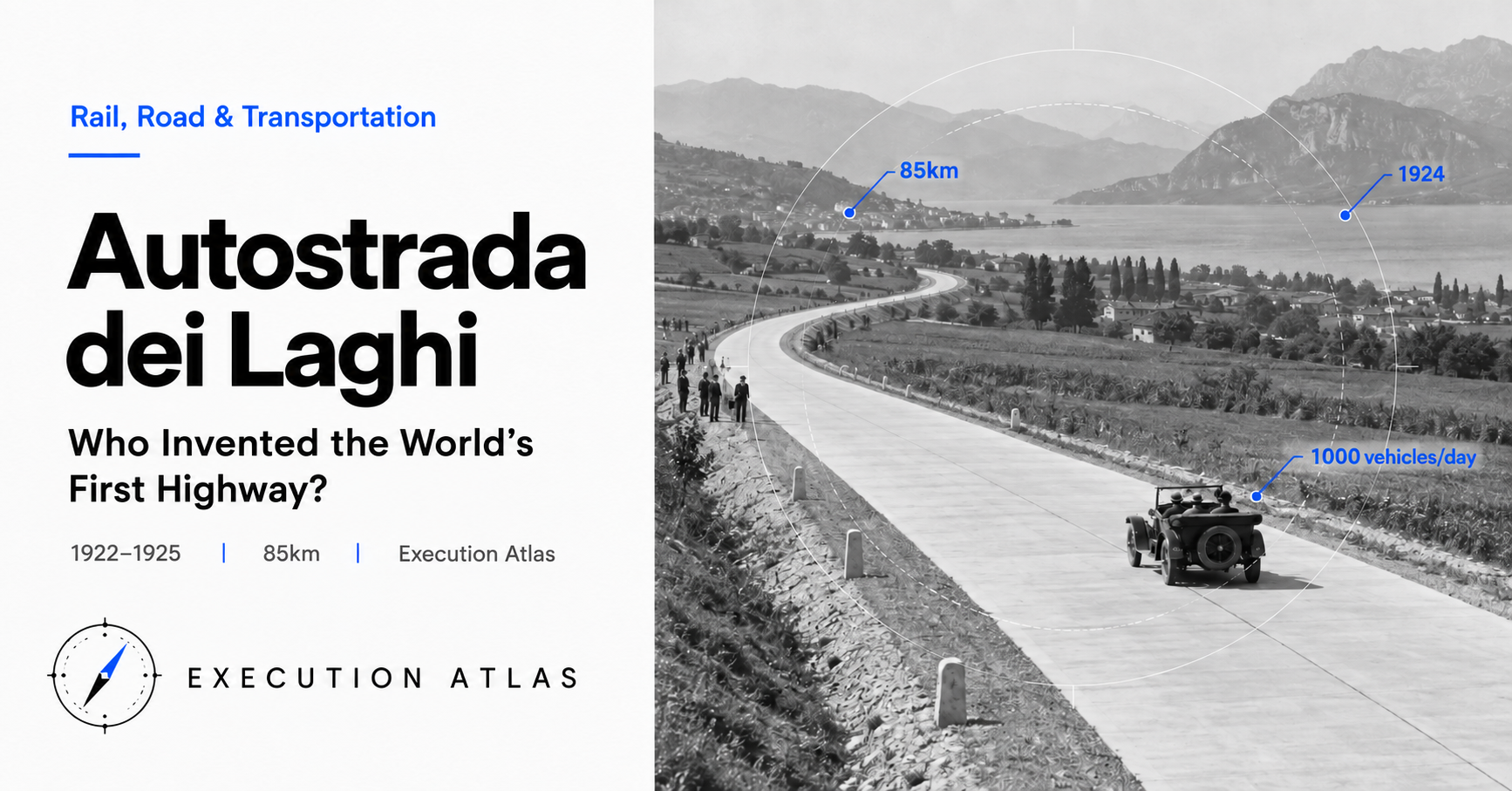
In 1922, an Italian engineer coined the word “autostrada.”
Three years later, an 85-km road exclusively for automobiles opened north of Milan. No carts, no bicycles, no pedestrians. The world’s first road designed for a single type of vehicle.
The Milan–Varese section cost 90 million lire to build. Not one lira came from the public treasury. Puricelli founded a private company to finance construction and recover costs through tolls. Projected traffic: 1,000 vehicles per day. By 1938, actual traffic had doubled.
From the same invention came the 1932 Autobahn and the 1956 US Federal Aid Highway Act. These 85 kilometres fixed the skeleton on which all motorisation of the modern world would ride.
But the name of the man who designed it was erased from history books for decades after the war.
Mission: The Age When Horses and Cars Shared the Same Road
In the early 1920s, the roads of northern Italy were shared by automobiles, horse-drawn carts, bicycles, and pedestrians on the same cobblestones. Fiat’s vehicle output was expanding rapidly from the ten-thousand-unit mark of the previous year, and a growing wealthy class around Milan was acquiring private cars. Yet the roads remained nineteenth-century.
From Milan to Lake Maggiore was roughly 60 km as the crow flies. Driving the existing roads meant slowing behind a cart, swerving around cyclists, and tangling with pedestrians in village squares. On the few stretches where speed was possible, the surface quickly crumbled under the weight of automobiles.
The problem was not that roads were bad. It was that the definition of a road had not yet incorporated the automobile.
Piero Puricelli, aged 39, reframed the question. Rather than improving existing roads, could he build a road exclusively for automobiles — for a single type of vehicle — without relying on the public treasury?
Three requirements: the complete exclusion of pedestrians, carts, and bicycles; the elimination of at-grade intersections; and recovery of costs through tolls.
In 1921, Puricelli obtained from the Ministry of Public Works the world’s first concession for a public motorway. One year later, the word he wrote into official documents became the subject of this article.
Autostrada. “A road for automobiles alone.”
Design: A Word, Tolls, and a Single Lane
Puricelli’s design decisions can be distilled to three. All three became the DNA of motorway infrastructure across the following century.
The first was the invention of a word. In a 1922 official document, he created the legal and administrative category “autostrada.” No such classification existed in existing road law. The party that creates the category gets to write the requirements. “Prohibition of non-automotive traffic.” “No at-grade intersections.” “Tolled.” These conditions were embedded in the definition of autostrada — not as improvements to an existing category, but as a new one.
The second was the funding model. Puricelli established the Società Anonima Autostrade, an entity to construct and operate the road while recovering costs through tolls. The treasury would cover only a partial subsidy. It was a mechanism to launch unprecedented infrastructure without waiting for government decision-making. The closest precedent in Europe at the time was certain British toll bridges. The very idea of charging tolls on a road was itself an experiment.
The third was a minimal specification. Two single lanes, one in each direction, for the entire route. No median barrier. The concept of an interchange did not yet exist at this stage. Curves were gentle enough to allow speed, at-grade crossings were eliminated, and the surface used high-strength concrete of the era. But the width was narrow. Projected traffic: 1,000 vehicles per day. That estimate would matter later.
Puricelli was also the man who had led the construction of the Monza Circuit. In September 1922 — the same year the Milan–Varese concession was being set in motion — Monza, which he had designed and overseen, was completed. It went from groundbreaking to opening in 110 days. One of the world’s earliest permanent motor racing circuits. He was a man who had learned through practice — on a racetrack — what high-speed vehicles demand of a surface and a road’s geometry.
Holding an experimental ground was probably his greatest weapon. He knew the relationship between speed and road not from textbooks but from his hands.
Execution: Three Years from Groundbreaking, Through a Change of Government
26 March 1923: the groundbreaking ceremony for the Milan–Varese section. Mussolini himself swung “the first pickaxe.” He had been in power for less than six months. The Fascist regime co-opted Puricelli’s vision as a national propaganda vehicle. Yet the private concession structure was maintained. Political capital was borrowed; ownership was not surrendered.
Construction was completed in three years. Groundbreaking in 1923; Milan–Varese opened in September 1924; Lainate–Como and Gallarate–Sesto Calende followed in 1925, completing the full network.
By modern standards, three years is fast. Acquisition of rights-of-way, laying reinforced concrete pavement, and building grade-separated overpasses to eliminate at-grade intersections — each had almost no precedent. For the Torino–Milano section Puricelli later recorded an average of 2,000 workers per day, but precise labour figures for Milan–Varese do not survive.
The 90-million-lire construction cost was not extraordinary on the scale of Italy’s national budget, which ran to billions of lire per year. Part of the reason it could be kept moderate was precisely that it carried no treasury burden. Raising private capital required a project that could turn a profit at its launch scale. Puricelli drew the line at “break-even at 1,000 vehicles per day” and designed to that.
21 September 1924: the opening ceremony. King Vittorio Emanuele III personally drove a Lancia Trikappa through the opening ribbon. A king driving the “new kind of road” himself sent an unambiguous message to the public: this was not an extension of the old highway. It was infrastructure of a different category.
After opening, traffic came in at roughly the projected 1,000 vehicles per day. It did not stop there.
By 1938, traffic exceeded 2,000 per day — double the design figure, fourteen years after opening. This coincided exactly with the onset of mass motorisation in Italy, and the growth curve of traffic mirrored that of small car penetration, exemplified by the Fiat 500 Topolino.
The projection was right. It was so right it caused a lane shortage.
People: The 39-Year-Old Count of Lomagna
Piero Puricelli (1883–1951). Civil engineer, entrepreneur, later Count of Lomagna.
He invented the autostrada at 39. The year before he had completed the Monza Circuit; three years before that he had lectured at the Politecnico di Milano. He started out in road contracting, took over the family business, and became both manager and engineer. He played all three roles — engineer, entrepreneur, inventor — simultaneously.
What made him remarkable was not the physical design of “a new kind of road.” It was the three lines that defined “autostrada” in a 1922 official document. The institution came before the physics. Physics is determined by the thickness of concrete and the gradient of a slope; institutions are determined by words. He put himself in a position where he could write the words.
In the interwar period he was known across borders. In 1925 — just as Milan–Laghi had finished its full opening — Puricelli announced a vision for a Pan-European motorway network: autostrade connecting Paris, Berlin, and Rome. At a time when the only physical example was 85 km long, he was projecting a continental network.
In 1933, Hitler — newly in power — personally invited Puricelli. Fritz Todt, freshly appointed as Inspector General of German Roads, was present. Hitler wanted to absorb Puricelli’s thinking on motorway networks for the Autobahn programme.
An odd drama unfolded. Todt and Puricelli clashed sharply over design philosophy. Neither side would yield, and the dispute reportedly came close to becoming a diplomatic issue between Hitler and Mussolini — two engineers’ struggle for primacy moving two dictators.
Puricelli thereafter distanced himself from the Autobahn project. By prioritising his relationship with the Mussolini government, his international recognition as inventor was buried for decades. The words “autobahn” and “highway” spread across the world; “autostrada” remained the name of its birthplace.
He died in 1951, aged 68. Puricelli’s name sat in the margins of history books until the 100th anniversary in 2024 brought worldwide reappraisal.
Legacy: 100 Years Shaped by 85 Kilometres
Eight years after Milan–Laghi opened, Germany’s first Autobahn — the Bonn–Cologne section — opened in 1932. The lineage of design philosophy clearly flows from Italy to Germany. Puricelli’s 1925 vision of a pan-European network materialised in Germany as a scaled-down version.
From 1935 onward, the Nazi regime expanded the Autobahn network aggressively, completing 3,859 km before the war. Italy invented the category; Germany scaled it.
In 1956, the US Federal Aid Highway Act was signed. Eisenhower, who as Supreme Allied Commander had driven across Europe and been struck by the Autobahn’s mobility, repeatedly recounted that experience as President. Italy → Germany → United States: a chain of influence. The invention that began with 85 km became 77,000 km in the second half of the twentieth century.
Meanwhile, Italy modernised Milan–Laghi into the A8 (Autostrada dei Laghi) and A9 (Lainate–Como–Chiasso) after the war. The two single lanes became multi-lane; toll plazas were automated; Autostrade S.p.A. (later Atlantia / ASPI) grew into a vast operator of the national network. Puricelli’s concession entity connects in a direct line to the private infrastructure operators of a century later.
In August 2018, the Morandi Bridge in Genoa collapsed, killing 43. The operator was ASPI — an extension of the private concession network that began with the Autostrada dei Laghi. The thinking of “build fast and cheap” was inverted a century later into the question of “was it maintained cheaply enough?”
21 September 2024: the centenary ceremony was held at Lainate. Puricelli’s name received a formal national reappraisal.
Lesson: In a New Category, the Word Comes First
When you look at Milan–Laghi as a construction project, the story shrinks: 85 km, three years, 90 million lire. Large for a public works project, but not the kind of scale that reshapes a century.
But when you see it as the invention of a category, the story changes.
What Puricelli did was not first to build a physical road. He first created a legal and administrative category. Three lines defining “autostrada” in a 1922 official document. A classification that did not exist in existing road law. A classification that did not exist in any existing budget line. Which is why he also had to simultaneously invent a new funding model: the concession. Create the category, and the requirements, the funding, and the law are all pulled toward that definition.
This is not a story about roads.
“Container orchestration” before Kubernetes, “smartphone” before the iPhone, “vacation rental” before Airbnb, “streaming service” before Netflix — in each case the invention of the category preceded the physical artefact. The party that defines the category gets to write what that category must satisfy. Everyone else is forced to design toward that definition.
The paradox of Puricelli’s invention is that he himself could not hold that primacy for long. The 1933 confrontation with Hitler and Todt — his refusal to be absorbed into German leadership — took him off the Autobahn project. As a result, “autobahn” and “highway” spread across the world, and “autostrada” ended as the name of its birthplace.
The inventor of a category does not necessarily keep control of it. When the next generation of mega-projects overtakes the original in scale, the inventor’s name disappears. Puricelli’s centenary reappraisal was the work of recovering it from that erasure.
One more thing: the single-lane design of Milan–Laghi. The projected 1,000 vehicles per day was doubled within 14 years, and the single-lane design brought chronic congestion and expensive multi-laning costs decades later. The demand for a new category cannot be read from linear extrapolation. The more successful the invention, the sooner the initial design becomes obsolete.
This is not a failure. Without starting with a single lane, the private funding could not have built 85 km in three years. “Obsolescence through success” is close to a structural fate for any project that launches a new category.
When you are creating a new category, the heart of the project is not the construction — it is the word. First put yourself in a position to write the definition. Then, with full awareness, watch others replace that definition with their own at scale.
That, in its entirety, was the invention of the autostrada.
Sources
- Autostrada A8 (Italy) - Wikipedia — Current status of Milan–Varese, opening date, completion dates by section
- Piero Puricelli - Wikipedia — Puricelli’s biography, Monza Circuit, title of Count, year of death
- Autostrada dei Laghi - Wikipedia (it) — Groundbreaking and opening dates, 90-million-lire cost, projected 1,000 vehicles/day, 1938 doubling
- Italy’s First Motorway - We Build Value — 1922 coinage of “autostrada,” establishment of the concession system
- FIRSTonline: September 21, 1924 — Centenary coverage, opening ceremony, concession design philosophy
- Italienkompass: Der Streit um die Erfindung der Autobahn — Puricelli–Todt–Hitler meeting, the dispute over who invented the motorway
- Motor Web Museum: The Milano–Laghi by Piero Puricelli — Groundbreaking ceremony, Lainate interchange, Mussolini’s ceremonial digging
- Italian American Herald: An Italian builder of racetracks — Continuity of design philosophy between Monza Circuit and autostrada
- Expressway - Wikipedia (ja) — The debate over the world’s first motorway, comparison with the Long Island Motor Parkway