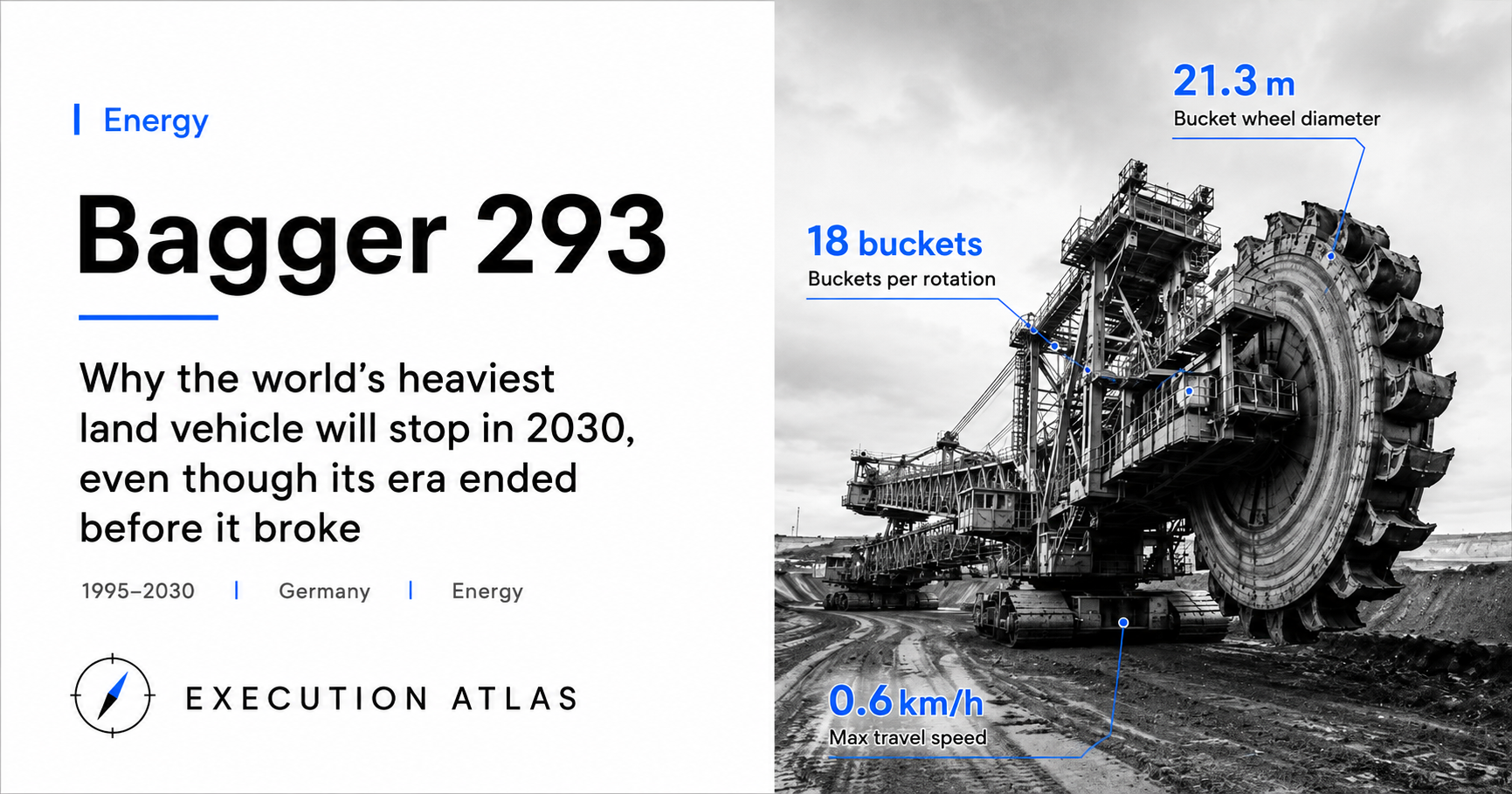
96 meters tall. 225 meters long. 14,200 metric tons. Guinness World Record: “heaviest land vehicle.”
In western Germany, in the state of North Rhine-Westphalia, there is a vast pit in a place called Hambach. At its bottom, the heaviest moving thing on earth is at work. It looks like a 30-story building with arms, digging 240,000 cubic meters of earth every day and feeding it into conveyor belts. Five people run it.
Its name is Bagger 293. It has been in operation since 1995. Before it uses up its design life, the lignite mine it works in is scheduled to close in 2030.
Mission: The “Walking Plant” That Open-Cast Mining Needed
Postwar West Germany turned to lignite as its primary energy source.
Below the Rhine basin lies one of the world’s richest lignite deposits. Its quality is inferior to hard coal — energy content roughly half. But dig and it comes out. No import risk. Through the Cold War, Germany kept choosing lignite as the backbone of its energy security.
Lignite doesn’t sit deep underground. It forms in layers tens to hundreds of meters from the surface. That means the mining method is open-cast, not tunneling. You strip an entire hillside away, remove all the overlying soil and rock — the overburden — and only then reach the coal seam.
Hambach’s seam is up to 100 meters thick. The deepest point of excavation reaches 500 meters below the surface, 299 meters below sea level. The ratio of overburden to coal is roughly 6 to 1. For every ton of lignite extracted, more than six tons of earth must move. Extracting tens of thousands of tons of lignite a day means moving soil at several times that rate.
Dump trucks and shovels can’t keep up. 240,000 cubic meters of earth need to flow continuously onto conveyor belts each day — the equivalent of 10,000 ten-ton trucks, every day. The digging location shifts daily.
The answer was simple machine logic. Mount countless buckets on a rotating wheel, press it against the ground, and feed what it cuts onto a conveyor behind it. A Bucket-Wheel Excavator, or BWE — a plant that walks the edge of the pit.
Size was determined by two constraints: reaching the coal seam at the bottom and reaching the surface at the top. A single wheel trying to cut through all the overburden in between naturally grows to tens of meters tall. Bagger 293 swelled to 96 meters simply because Hambach’s geology demanded exactly those dimensions.
Design: Moving 14,200 Tons Across Open Ground
The weight problem is a ground-sinking problem.
A single crane would bog down a surface that could swallow it. Here, something thirty thousand times heavier had to stand — and move — on ground saturated with groundwater and loose gravel, with no pavement in sight.
Three constraints shaped the design.
First: continuous excavation. The bucket wheel was never meant to stop. Each electric start and stop costs time and money. Run it 24 hours a day, 365 days a year, as close to continuously as possible.
Second: negotiate with the ground. 14,200 tons had to be spread across as much surface as possible. Bagger 293’s lower running gear spans 26 meters wide. Its 12 crawler tracks move independently, maximizing contact area and reducing ground pressure to a few kilograms per square centimeter — roughly the same as a passenger car tire. A walking modern sculpture.
Third: move under its own power. The pit edge retreats daily. Laying new rail track every time wasn’t viable. So the machine walks, pressing its own weight into the ground. Top speed: 0.6 km/h — one-tenth of a human walking pace. That’s enough to keep pace with an excavation face retreating by a few meters each day.
The energy source followed logically.
Not diesel — electricity. 16.56 MW drawn from an external connection; close to the instantaneous power demand of 30,000 households. No fuel logistics, but a long power cable always trailing the machine. Heat, exhaust, and vibration from internal combustion disappear, and the maintenance burden drops by an order of magnitude.
Then modularization. No means of transporting 14,200 tons in one piece exists on earth. From the beginning, the design assumed on-site assembly. Steel sections were sized to fit on trucks and rail cars, then assembled on-site with lines of large cranes, layer by layer. Construction took roughly ten years. Planning started around 1985; completion came in 1995.
Bagger 293 wasn’t designed from scratch. Its sibling, Bagger 288, entered service in 1978 — 13,500 tons, 96 meters tall, nearly identical proportions, one generation earlier. Bagger 293 was designed as the SRs 8000 type. Its bucket wheel is 21.3 meters in diameter and carries 18 buckets, each about 15 cubic meters. Rotation speed: 2 to 5 revolutions per minute.
Every kilometer the predecessor’s crawlers traveled, every seam the predecessor’s wheel cut, every reason the predecessor’s electric drive never stopped — all of it fed into this machine.
Execution: Assembled at an East German Works
TAKRAF was a heavy-industry combine of the German Democratic Republic — a state-owned enterprise based in Leipzig, responsible for machinery exports. German reunification in 1990 ended that structure. The organization was broken apart and restructured, eventually absorbed into the lineage of western heavy industry through connections with Krupp.
Bagger 293 was built through that upheaval.
The order came in the 1980s from Rheinbraun (now RWE Power AG), the operator of lignite mines in the Rhine region. Design was handled by TAKRAF’s engineers. Concrete manufacturing began around 1985, continued through reunification in 1990, and assembly proceeded at the Hambach site. After nearly ten years of construction, operations began in 1995.
Cost: approximately $100 million USD. A bargain for the world’s largest machine. For comparison, a 16-car Shinkansen trainset costs roughly ¥4.5 billion — about the same order.
The schedule held. Cost overruns were modest. Rare for a project of this scale. Both TAKRAF and Krupp had built multiple bucket-wheel excavators of similar scale in the same era. Bagger 288 (Krupp, 1978) stood as the direct reference class. This was a serial build, not a one-off — and that made the difference.
Assembly happened at the pit edge. Not completed elsewhere then moved — built in place from day one. Cranes in sequence, modules stacked from the bottom up, the wheel section lifted last. The moment it was finished, it could walk.
The bucket wheel: 21.3 meters across. Picture a Ferris wheel with 18 shovels bolted to its rim, advancing at 0.6 km/h while spinning 2 to 5 times a minute, shearing through overburden. The cut material falls through a chute inside the wheel onto an internal belt, which hands it off to a surface conveyor system stretching tens of kilometers. Excavated earth rides straight to the backfill zone.
240,000 cubic meters a day.
If the number resists imagination, think of Tokyo Dome — roughly 1.24 million cubic meters. Bagger 293 moves through one of those every five days.
People: The Engineers Who Don’t Appear in Headlines
Klaus Dieter Bartsch is credited as the lead engineer of Bagger 293. Manfred Kuhn handled mechanical engineering.
In English-language sources, those are essentially the only names. German trade journals and company histories likely hold richer accounts, but this article’s research couldn’t get there. Bagger 293 wasn’t made by a single genius. TAKRAF as an institution — carrying everything built up through Bagger 288 and before — made the next machine. The operating crews of one generation fed back into the design teams of the next. Designers corrected the next drawings from watching on-site assembly. The world’s heaviest land vehicle was produced by decades of continuous heavy-industry accumulation.
The client, RWE Power (formerly Rheinbraun), was equally central.
RWE is one of Germany’s largest utilities and ran the lignite mining business end-to-end. Permitting for Hambach began in 1974, operations started in 1978, and the first lignite was extracted on January 17, 1984. By 1995, when Bagger 293 entered service, Hambach was already an active mine with more than a decade of operation behind it. RWE had planned from the start how many giant BWEs to deploy and when to replace them. Bagger 293 was one item in that long-range plan.
Legacy: The Sibling’s 22 Kilometers, and the 2030 Ending
Bagger 293 has worked Hambach for more than 30 years since 1995.
The story of its sibling, Bagger 288, fills in what that kind of machine actually does.
In February 2001, Bagger 288 finished its work at Hambach. It had exhausted its assigned section. The next site was Garzweiler, 22 kilometers away.
13,500 tons moved under their own power.
Over three weeks, Bagger 288 walked at roughly 1 km/h across 22 kilometers. Along the way, it crossed Autobahn A61, the Erft River, and a railway line. To ford the river, large steel pipes were laid across the channel to maintain flow, then covered with rock and gravel to form a road surface, with additional matting for asphalt protection. Where rare vegetation stood, specialist turf was laid to distribute the machine’s weight. The move cost approximately 15 million Deutschmarks. Seventy people.
The design premise is right there.
Of three options — fix it in place, disassemble and transport, walk it — TAKRAF and RWE chose to walk. They traded the risk of having a one-of-a-kind machine anchored to a single location for the risk of managing a move every time. Instead of fixing it, they planned the route each time: Autobahn managers, river authorities, rail operators, municipalities, farmers — everyone coordinated. In exchange for that complexity, the machine stayed in service for more than 40 years.
Bagger 293 operates under the same premise. It retreats by a few meters each day along the Hambach pit edge, shearing through hundreds of meters of overburden on a slope. Thirty years of movement are written into the pit’s own topography.
Then Hambach ends in 2030.
In the late 2010s, German climate policy shifted. In 2018, a plan to clear the Hambach Forest — an old-growth area standing in the proposed expansion zone — triggered large-scale protests. In October of that year, the Cologne Administrative Court ordered a temporary injunction against the clearing. In early 2020, the federal government agreed to remove the Hambach Forest from the mining footprint; RWE halted the clearing.
In 2020, the German Bundestag legislated a phased coal exit. Hambach’s lignite operations end by 2030. Bagger 293 will almost certainly cease operations well short of its original design life.
The machine isn’t broken. The design hasn’t failed. The earth to be dug is still there.
Society simply decided, first, that the digging should stop.
Lessons
Bagger 293 showed how far “don’t break it” engineering can go.
No stops. No overhauls. Keep moving. 240,000 cubic meters a day, roughly 70 Tokyo Domes’ worth of earth per year. Thirty years of that. Five crew. Under $100 million. A machine that dug a vast hole for the cost of two Shinkansen trainsets.
The conservatism of its design was total. Replicate the mechanisms proven in Bagger 288. Kill heat and exhaust with electric drive. Walk on any ground with crawlers. Modularize and assemble on-site. Optimized entirely for longevity.
And that optimization is precisely what turned against it.
When the design was drawn in the 1980s, virtually no one imagined Germany would decide to exit lignite mining by 2030. Under the Cold War, lignite was the pillar of energy security — it would be mined for another half-century at least. Climate change as a major political agenda didn’t arrive until the late 1990s. No fault on the designers’ part.
But the larger the infrastructure, the more the variables outside the designer’s awareness — climate policy, energy transition, public opinion — end up determining the machine’s working life. Bagger 293’s physical lifespan outran what society was willing to allow.
A machine has three lifespans: technical, economic, and social. The shortest one is the actual lifespan.
Twentieth-century heavy industry optimized for technical lifespan. “Don’t break it” at the top, combined with “can be repaired,” “can be modified,” “can be moved.” Bagger 293 is the furthest expression of that philosophy.
Entering the 21st century, the social lifespan runs out first with increasing regularity. Public opinion on nuclear power. Carbon pricing on coal plants. Environmental re-assessment of dams. Political and social variables that no one anticipated at design time compress operating periods faster than technical age.
The question to ask when designing is no longer only “how long will it physically run?”
“How long will society permit it to run?” has to carry equal weight. An impossible question for a 1980s designer. An unavoidable one for anyone planning large infrastructure today.
Bagger 293 will dig at the bottom of Hambach for a few more years.
Then, most likely, it will be dismantled, or preserved as a museum piece. The world’s heaviest land vehicle will stand with its weight resting in the ground, overtaken by the ethics of a different century.
Sources
- Wikipedia “Bagger 293” (https://en.wikipedia.org/wiki/Bagger_293): dimensions, weight, operators, engineers, construction period
- Wikipedia “Bagger 288” (https://en.wikipedia.org/wiki/Bagger_288): sibling’s 22 km self-propelled relocation (2001, 3 weeks, 15 million DM, 70 personnel)
- Wikipedia “Hambach surface mine” (https://en.wikipedia.org/wiki/Hambach_surface_mine): mine history (permitting 1974, operations 1978, first extraction January 17, 1984), 2030 coal exit
- Wikipedia “Bucket-wheel excavator” (https://en.wikipedia.org/wiki/Bucket-wheel_excavator): BWE history and largest-machine lineage
- Equipment World “World’s Largest Land Vehicle is an Excavator Called Bagger 293” (https://www.equipmentworld.com/construction-equipment/heavy-equipment/excavators/article/15736194/worlds-largest-land-vehicle-is-an-excavator-called-bagger-293): 240,000 m³/day capacity, 5-person crew, 16.56 MW power draw
- Sibo Bushings “Bagger 293: A Giant of Mining Machines” (https://www.sibo.eu/en/bagger-293/): 21.3 m wheel diameter, 18 buckets, 15 m³ each
- Global Energy Monitor “Hambach Coal Mine” (https://www.gem.wiki/Hambach_Coal_Mine): RWE operations and coal-exit plan
- HandWiki “Engineering:Bagger 293” (https://handwiki.org/wiki/Engineering:Bagger_293): SRs 8000 classification, 12 crawlers, 26 m undercarriage width