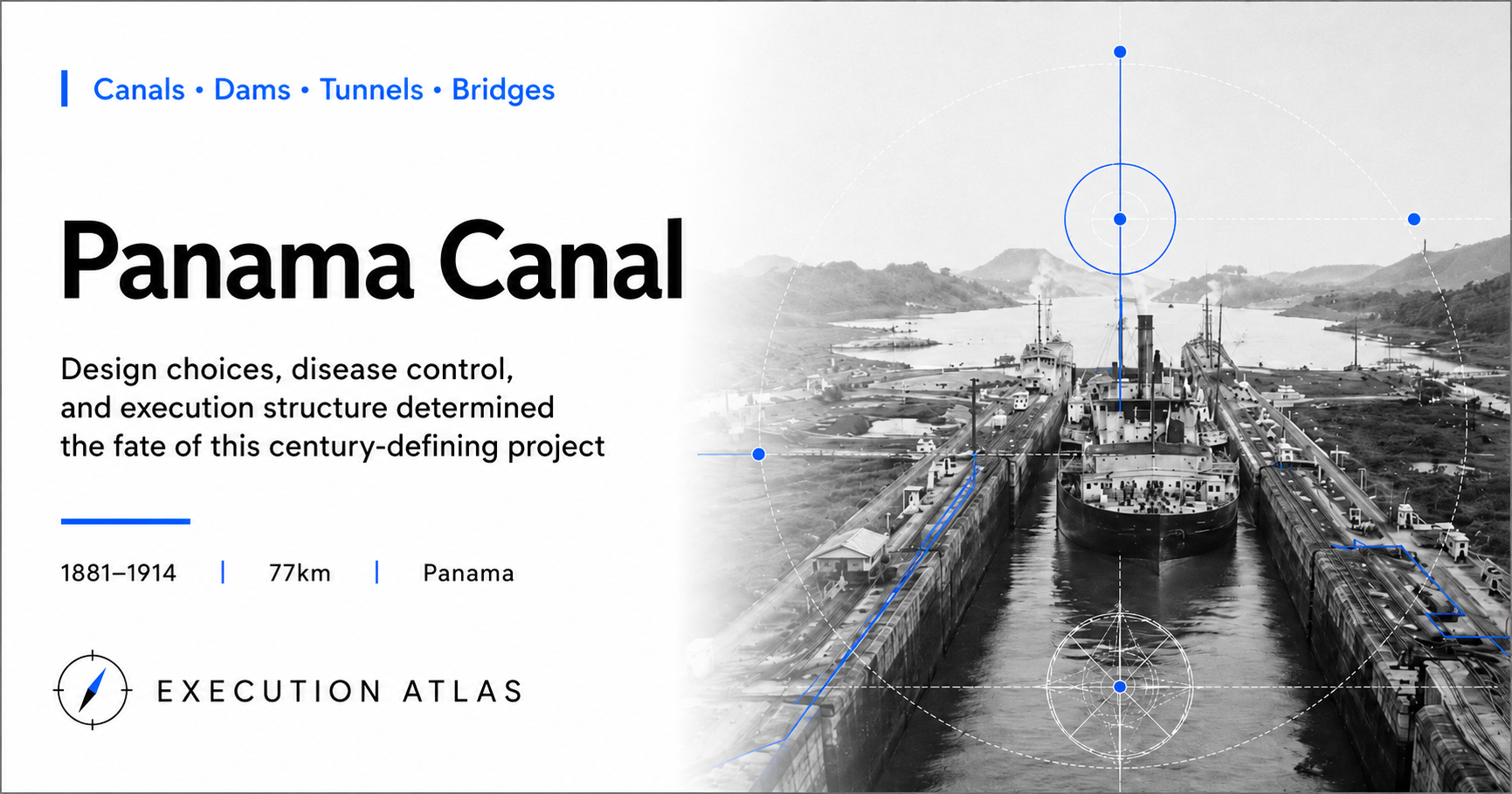
77 km. 33 years. 27,000 lives. $375 million.
A canal connecting the Pacific and Atlantic. Going around South America: 15,000 km. Crossing the Isthmus of Panama: 77 km. Two countries spent 33 years and 27,000 people died to close that gap.
The first country failed. The second learned from the mountain of bodies the first left behind.
Mission: The Hero of Suez, Age 74
May 1879, Paris. An international congress of 136 delegates voted to build a canal across the Isthmus of Panama. The chairman was Ferdinand de Lesseps, 74 years old.
Lesseps was a diplomat, not an engineer. But he had built the Suez Canal. In 1869, he cut 193 km through the Egyptian desert, linking the Red Sea and the Mediterranean. He held the title “Le Grand Français” — the Great Frenchman — and was an international hero.
Lesseps chose a sea-level design. Keep the water surface at ocean height, let ships pass straight through. Suez had worked that way.
Panama was not Suez.
Suez was flat desert. Panama had a Continental Divide. The Chagres River — wild and unpredictable. Rainfall exceeding 2,500 mm per year. Dense jungle. And mosquitoes.
Construction began January 1, 1881. Nine-tenths of the workforce were Black laborers recruited from the West Indies. At peak, about 40,000.
Malaria and yellow fever killed them. At the time, the link between mosquitoes and these diseases had not been scientifically established. The French believed the cause was “miasma” — bad air. Water pans placed under hospital bedposts to keep off insects, decorative waterways around flower beds — they were building mosquito breeding grounds with their own hands.
In September 1884, 654 workers fell to yellow fever in a single month from a force of 18,000. The death rate ran at 240 per thousand per year. Over eight years, an estimated 20,000 to 22,000 died.
On February 4, 1889, the Compagnie Universelle du Canal Interoceanique went bankrupt. Total spent: $287 million (roughly $10 billion in today’s money). Eight hundred thousand French investors lost their savings. Progress: about 40%. At the Culebra Cut — the highest point on the Continental Divide — the summit had been lowered from 64 m to 59 m. Five meters in eight years.
In 1892, the Panama Scandal broke. The canal company had bribed politicians to maintain investor confidence. 104 legislators implicated. The largest financial corruption scandal of the 19th century. The Lesseps — father and son — were convicted of fraud. Ferdinand, senile and broken, never served his sentence. He died in 1894 at 89.
Design: The Digging Is the Least Thing of All
In 1904, the United States took over. It bought the rights from the New Panama Canal Company for $40 million and paid Panama $10 million.
The first chief engineer, John Wallace, quit after a year. The second, John Frank Stevens, arrived in 1905. Age 52. A railroad engineer. In 1889, he had discovered Marias Pass in Montana at -40 degrees — the lowest crossing of the Rocky Mountains.
Stevens’s first act: he stopped digging.
Instead, he built warehouses, machine shops, ports, housing, schools, and churches. “The digging is the least thing of all.” Logistics, living conditions, rail systems for hauling spoil — without infrastructure, America would repeat France’s failure.
Then Stevens made his critical judgment. After seeing the Chagres River in flood, he declared a sea-level canal “an entirely untenable proposition.” Rather than excavating the Divide down to sea level, he proposed damming the Chagres to create an artificial lake, lifting ships 26 meters through locks, sending them across the lake, and lowering them on the other side. A lock canal.
In January 1906, an American engineering panel recommended the sea-level design, 8 to 5. Stevens fought back before Congress with statistics and maps. On June 21, the Senate voted for the lock canal, 36 to 31. A narrow margin. What Lesseps had proven over eight years — that cutting the Divide to sea level was beyond reach — Stevens confronted directly.
Another design decision. Disease control. Army surgeon William Gorgas was appointed chief sanitary officer. By 1901, the mosquito transmission of yellow fever had been scientifically confirmed. When the French retreated in 1889, that knowledge did not yet exist.
Gorgas spread oil on standing water, built drainage, deployed 700,000 gallons of oil and 124,000 gallons of larvicide. He installed window screens, quarantined patients, mobilized 4,000 sanitation workers, and dispensed a ton of quinine per year across 21 dispensaries.
The canal commission initially dismissed Gorgas’s demands as “outlandish” and twice recommended his removal. “Keep that crazy mosquito theory to yourself.” When Gorgas requested $1 million, he received $50,000.
President Roosevelt consulted the dean of Johns Hopkins Medical School, who replied that no one was more qualified. The policy changed. “Give Gorgas what he wants.”
By the end of 1905, yellow fever deaths had dropped to zero. Malaria mortality fell from 11.59 per thousand to 1.23.
Execution: 68 Steam Shovels, 27,000 Tons of Dynamite
In 1907, Stevens abruptly resigned. He sent Roosevelt a six-page letter from Culebra, stating he was “not anxious to continue in service.” The reasons remain unclear. His salary of $30,000 was less than half what he could earn in the private sector — an estimated $100,000 per year in lost income. Perhaps, with the design settled, the construction held no interest.
Roosevelt was furious. “Stevens must get out at once.” He chose a military successor — one who could not resign. Colonel George Washington Goethals, age 49. Army Corps of Engineers.
Goethals never wore his uniform in Panama. He was sensitive to the debate over military versus civilian authority. Instead, he toured work sites in a yellow rail car nicknamed the “Yellow Peril” and held “Sunday Court” every week — an open session where any of the 45,000 workers could bring grievances directly to him. No barriers of nationality or race.
The Culebra Cut
The largest single operation was the Culebra Cut (later renamed Gaillard Cut). Thirteen kilometers through the Continental Divide. The summit had to come down from 59 m to 12 m above sea level.
In March 1909, 68 steam shovels operated simultaneously. Six thousand men worked the Cut. One hundred sixty trainloads of spoil hauled away each day. Twenty-seven thousand metric tons of dynamite. Four hundred thousand pounds of explosives per month. More than 600 blasts a day.
Landslides fought back. Over 100 occurred between 1907 and 1914. The Cucaracha Slide of October 1907: 500,000 cubic yards. In 1912, 50 acres of the east bank collapsed — 7 million cubic yards of additional excavation. They dug and the mountain came back. Landslides alone accounted for 25% of total excavation.
May 20, 1913. Steam shovels #222 and #230 met at the bottom of the Cut, 12 meters above sea level. The Continental Divide was severed.
Gatun Dam
The Gatun Dam, built to impound the Chagres River, was the world’s largest earth dam at completion. Base width: 820 m. Height: 32 m. Length: 2,300 m. Seventeen million cubic meters of material.
Behind it, Gatun Lake was born. 425 square kilometers — the world’s largest artificial lake at the time. Elevation: 26 m. Ships would be lifted by locks to this lake, cross it, and descend on the other side. The dam eliminated over 65 km of excavation.
The Locks
Each lock chamber: 33.5 m wide, 305 m long, 22 m deep. Water per lockage: approximately 100,000 cubic meters. A chamber fills in 8 minutes. Gates open and close in 1 minute 48 seconds.
Gold Roll and Silver Roll
Workers were divided into two payroll systems. Gold Roll: white workers, mostly American. Paid in U.S. gold dollars with housing, paid leave, and medical care. Silver Roll: primarily Black Caribbean workers. Ten cents an hour — half the white wage. Segregated post offices, dining halls, even building entrances.
The most dangerous work — setting dynamite, blasting — fell to Silver Roll workers. “They carried all their belongings with them to the site, understanding their relatively low odds of a safe return.”
At peak, 45,000 to 57,000 workers. Seventy-five to eighty percent Caribbean. About 20,000 from Barbados alone. Ninety-plus nationalities. During the American era, 5,609 died. Of those, 350 white, 4,500 Black. The Black death rate was ten times the white rate.
Opening
August 15, 1914. The SS Ancon made the first official transit of the Panama Canal. Nine hours. Two hundred dignitaries aboard.
A grand ceremony had been planned, but World War I had broken out that same month. The celebration was a quiet local affair. Goethals followed the Ancon’s progress by railroad.
Six months ahead of schedule. $23 million under budget. No graft or corruption found.
People: Four Roles
Lesseps was a diplomat. He began Panama at 74, never questioning his Suez playbook. It is easy to say he failed to see the difference between desert and jungle. But in 1881, the mosquito theory did not exist, and data proving a sea-level canal impossible was insufficient. Lesseps’s failure was a compound of missing information and unexamined success.
Stevens was a railroad engineer. He saw the site, changed the design, persuaded Congress, and backed Gorgas. “The digging is the least thing of all.” Then, with the design fixed, he left. Years later, Goethals himself said: “Stevens was one of the greatest engineers who ever lived, and the Panama Canal is his greatest monument.”
Gorgas was an army doctor. Twice recommended for removal, his budget slashed to one-twentieth of his request, he kept killing mosquitoes. “If you fall back upon old methods of sanitation, you will fail, just as the French failed. If you back Dr. Gorgas and let him make his campaign against mosquitoes, you get your canal.” That warning moved Roosevelt.
Goethals was a soldier. He led 45,000 workers, heard grievances every Sunday, and finished six months early, under budget. “Successfully to accomplish any task it is necessary not only that you should give it the best there is in you, but that you should obtain for it the best there is in those under your guidance.”
France bet on a single hero. America divided the roles. Designer, sanitation chief, construction manager. Stevens designed. Gorgas kept people alive. Goethals built it.
Legacy: Still Being Updated After 100 Years
The Panama Canal opened on August 15, 1914, and reshaped global shipping. The route from New York to San Francisco was shortened by roughly 15,000 km.
On September 7, 1977, President Carter and Panamanian General Torrijos signed the Panama Canal Treaty. At noon on December 31, 1999, control was transferred to Panama.
On June 26, 2016, the expansion was completed. New lock dimensions: 55 m wide, 427 m long. Maximum ship size increased from 5,000 TEU to 14,000 TEU. Cost: $5.25 billion. Water-saving basins recycle 60% of lockage water. Over a century old, the infrastructure continues to be upgraded.
In 2023, Panama recorded its lowest rainfall in over 140 years. Gatun Lake hit record lows. Daily transits were cut from the normal 36–38 to just 18. Ships waited weeks; some paid millions to jump the queue. Annual transits fell 29% to 9,936. Climate change is imposing new constraints on infrastructure built 110 years ago.
Today, approximately 13,000 to 14,000 ships transit annually. Annual revenue: roughly $5.7 billion. Net profit: $4.1 billion. Four to six percent of world trade passes through these 77 km.
Learnings: The One Who Changed the Premises Won
The difference between France and America was not talent.
When France failed in 1889, the mosquito theory was not yet established. Data proving a sea-level canal impossible was insufficient. In Lesseps’s era, the information needed to make the right decisions simply did not exist.
When America succeeded from 1904 to 1914, the mosquito theory was settled science. France’s eight years had proven the limits of the sea-level approach. America stood on knowledge produced at the cost of 20,000 lives and $287 million.
But having the information was not enough. Gorgas held the correct knowledge and was twice recommended for removal. Stevens made the right design call and was outvoted 8 to 5 by the engineering panel. The right answer loses to organizational dynamics. Had Roosevelt not brought in outside medical authority to protect Gorgas, America would have met the same fate as France.
What Stevens did, at its core, was change the premises. No amount of refining estimates within the sea-level framework would make Panama’s mountains disappear. The moment he switched to a lock canal, the Chagres River turned from obstacle to asset. Stopping excavation on his first day to build infrastructure was the same instinct. Not “how do we dig” but “what do we set up before we dig.”
Can you learn correctly from a predecessor’s failure? Can you question your own premises? Can you protect the right expert’s voice from organizational pressure?
Sources
- Panama Canal - Wikipedia
- History of the Panama Canal - Wikipedia
- David McCullough, The Path Between the Seas (Simon & Schuster, 1977)
- PBS American Experience “Panama Canal”
- Health measures during the construction of the Panama Canal - Wikipedia
- Panama Canal Authority
- History.com “Building the Panama Canal”
- Smithsonian “Happy Birthday, Panama Canal”