
January 4, 2010. Opening day.
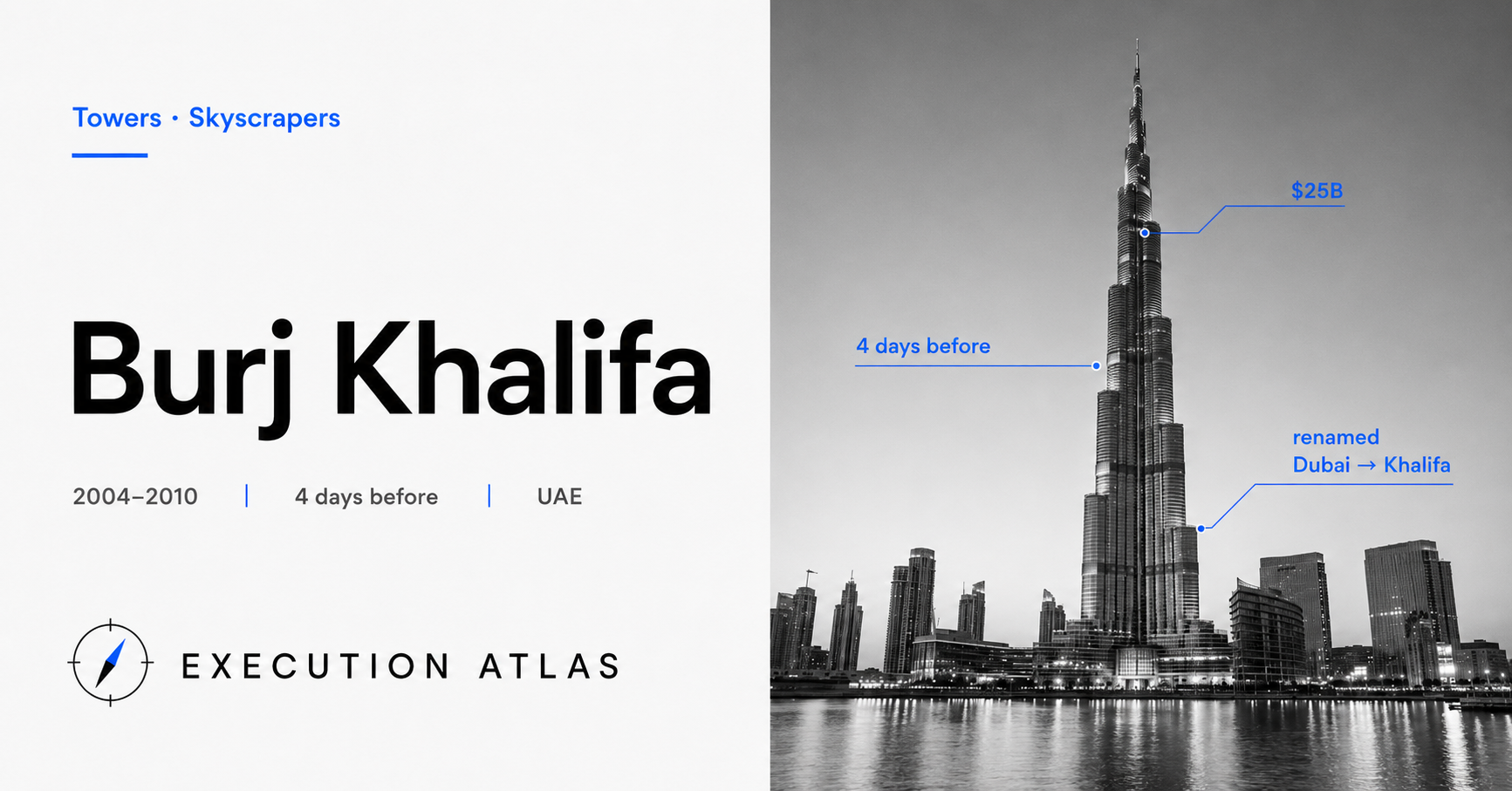
828 meters above ground. 163 floors. The tallest structure on earth. Four days before the ceremony, the building got a new name. Burj Dubai became Burj Khalifa. Burj Dubai had been the official name as recently as a month prior. No reason was given publicly, but everyone involved understood: Sheikh Khalifa bin Zayed, ruler of Abu Dhabi, had just lent Dubai $25 billion.
Construction broke ground on January 12, 2004, and the exterior was completed in October 2009. They built 828 meters in just under six years. World records in concrete pumping above 600 meters, a Y-shaped floor plan with a buttressed core structural system, the world’s fastest elevators. As an engineering and logistics story, it was nearly perfect.
What was not perfect: on opening day, roughly 80 percent of the upper floors were empty.
Mission: Pack a Post-Oil Symbol Into a Single Building
In 2003, Dubai was trying to escape oil.
The emirate’s proven reserves were already declining. Most of the UAE’s oil lay under Abu Dhabi, and by the early 2000s Dubai’s petroleum revenue had shrunk to a few percent of GDP. Sheikh Mohammed bin Rashid had decided to run Dubai on tourism and finance. The plan called for a single building — the world’s tallest — as the symbol of that transformation. Mohamed Alabbar, chairman of Emaar Properties, became the project’s driving force.
The brief was simple. Be the tallest. Stay standing. Open on time.
“World’s tallest” is not just a numbers game. The record at the time was Malaysia’s Petronas Towers at 452 meters, with Taipei 101 in Taiwan (508 meters) nearing completion for a 2004 opening. The goal was not merely to surpass them, but to surpass them by enough that the record could not easily be broken. The target height was revised upward several times during design. The final figure: 828 meters, more than 300 meters above the next-tallest building. The record had to be carried beyond the reach of any plausible competitor.
Structural and architectural design went to Skidmore, Owings & Merrill (SOM) in Chicago. Lead architect: Adrian Smith. Structural engineer: Bill Baker. Smith had designed the Jin Mao Tower in Shanghai and Trump Tower in Chicago — a veteran of the supertall world, then around 60 years old. Baker had been developing the “buttressed core” structural concept across earlier high-rise projects and brought it to full expression here.
The construction joint venture brought together Samsung C&T (South Korea), Arabtec (UAE), and BESIX (Belgium). Samsung C&T effectively ran the construction schedule — the firm had built its supertall credentials on Taipei 101 and the Petronas Towers.
Design: A Flower Engineered to Shed Wind
At 828 meters, wind loads become a more fundamental engineering challenge than the building’s own weight. As a tower rises, wind induces sway, vibration fatigues occupants, and cyclic loading accumulates in the structure. The question is not whether wind acts on the building but how to prevent the building from resonating with it.
Baker’s answer was the Y-shaped plan.
Three wings radiate from a central hexagonal core. The designers described it as inspired by a local desert flower, Hymenocallis, but the engineering logic drove the choice. The three wings brace one another, creating torsional stiffness. Together with the hexagonal core they form the buttressed core system; as the wings step back at successively higher floors, the cross-section tapers in a helical silhouette.
This shape has two effects. One is visual drama — from below, the tower appears to narrow and dissolve into the sky. The other is aerodynamic: because the cross-section changes floor by floor, wind cannot lock onto a consistent face and generate coherent vortex shedding. Wind tunnel testing refined the setback positions. The result was roughly a 25 percent reduction in wind loads from the original design.
The Y-shaped plan also bought design flexibility. Smith’s team revised the target height upward repeatedly as they sought an unassailable record margin. The buttressed core can be extended vertically without redesigning from scratch — each wing simply continues. And the fact that each wing functions as a self-contained residential zone matched Dubai’s commercial logic of stacking hotel, residences, and office space at different heights.
Above floor 156, the structure changes. Concrete in the inner core gives way to a structural steel frame, supporting the spire — space that almost no one inhabits. The end of the building as a habitable space and the pursuit of height as a symbol are physically separated at floor 156.
Execution: 600 Meters of Concrete, $4 a Day
The construction site peaked in 2007. Twelve thousand workers per day, most of them migrant laborers from South Asia.
The central technical challenge was concrete. In a mid-rise building, pumping liquid concrete upward through pipes is standard. But at heights above 600 meters, the weight of the concrete column in the pipe alone exceeds 25 tons. Conventional pumps cannot push against that load.
The construction team co-developed a new pump with Germany’s Putzmeister — the BSA 14000 SHP-D, rated at 630 horsepower. It drove concrete up to 606 meters in a single push. The concrete took 40 minutes to travel from ground level to the casting point at floor 156. Dubai’s outdoor temperature reaches nearly 50°C in summer. If setting began in transit, the pipe would solidify and everything would stop. Ice was mixed into the concrete formulation and pours were scheduled at night to slow hydration.
The elevators set records of their own — a top speed of 10 m/s (36 km/h), the world’s longest travel distance. But that performance represented a technology that barely cleared the bar. Running a single elevator car from ground to the top floor was not feasible because rope weight at that span becomes excessive. The solution was a sky lobby transfer system: passengers ride one car to an intermediate lobby and change to another for the upper floors.
The construction numbers in aggregate: 22 million man-hours. 330,000 cubic meters of concrete. 31,400 tons of reinforcing steel. At peak pace, the structure rose one floor every three days. The original schedule called for completion between 2008 and 2009; the exterior finished in October 2009, within that window.
The schedule achievement rested on an extreme compression of labor costs. Migrant workers from South Asia were reported to earn roughly $4 per day, working 12-hour days six days a week. Passport confiscation by employers was a common practice. In October 2007, approximately 4,000 workers were arrested during protests demanding higher wages and better conditions; most were held for six months and then deported. The official death toll from construction accidents is one — a fall from floor 157. Whether one death over six years represents extraordinary safety or underreporting is not a question the official record answers.
The stated construction cost of $1.5 billion for the building itself reflects almost none of these labor costs in any meaningful market sense. The portion of the story that never appears in the ledger was the largest single factor in keeping the world’s tallest building within budget.
People: The Name Changed Four Days Before Opening
September 2009. One year after Lehman. Dubai World — a government-linked conglomerate — was approaching default on $80 billion in debt. Dubai had borrowed heavily in foreign currency; the contraction of global credit markets revealed the gap all at once.
Four months to opening. Completion was no longer in doubt. What came after completion was.
Residential units in the upper floors had barely sold. Tourists and the office tenants that were supposed to fill the Financial Centre floors were not moving in the middle of a recession.
On December 14, 2009, Abu Dhabi provided an emergency $10 billion credit line to Dubai, enough to cover Dubai World’s immediate interest payments. By year’s end the total commitment from Abu Dhabi and the federal government had reached an estimated $25 billion.
In the final week of December, the Dubai government notified Emaar. On opening day, the building’s name would change. Burj Dubai would become Burj Khalifa. Khalifa is the given name of Sheikh Khalifa bin Zayed Al Nahyan, the UAE president and ruler of Abu Dhabi. The reason was never officially stated; the world’s press described it as gratitude for the bailout.
For Sheikh Mohammed, the renaming was likely neither humiliation nor simple concession. Abu Dhabi’s rescue ended Dubai’s financial independence for a moment, but it reinforced the coherence of the UAE as a union. The fact that the world’s tallest building now bore an Abu Dhabi ruler’s name post-hoc redefined the project — from a Dubai solo venture into a UAE national achievement.
At the opening ceremony, Emaar chairman Mohamed Alabbar said: “We are very proud to open the world’s tallest building today.” He did not mention the name change.
Bill Baker, the structural engineer, described the buttressed core this way: “It works because the three wings act together. They brace each other against twist and lateral force.” As structural engineering, that is a technical statement. As a description of Dubai and Abu Dhabi’s relationship in that moment, it lands differently.
Legacy: The Double Edge of “World’s Tallest” as a KPI
By early 2011, vacancy in Burj Khalifa’s upper floors was estimated above 80 percent.
The world’s tallest building generated the world’s biggest crowds. Admission to the “At the Top” observation deck sold briskly, and the tourist transformation of Downtown Dubai outpaced projections. Residential and commercial cash flows, however, fell well short of projections for more than five years after opening.
Dubai’s broader recovery came somewhat earlier. Using Abu Dhabi’s rescue funds as a foundation, Dubai rebuilt its position as a hub for tourism, logistics, and finance. By around 2014, the property market had recovered and Burj Khalifa’s vacancies began to close. Through the 2020s, as supertall projects worldwide accumulated delays — most notably the Jeddah Tower in Saudi Arabia, which broke ground in 2008 and has repeatedly stalled — Burj Khalifa held its record for over a decade without a credible challenger.
By early 2025, fifteen years after opening, occupancy had recovered to 85–90 percent. One-bedroom annual rents run AED 150,000–180,000 (approximately $41,000–$49,000). Residential sale transactions in 2024 totaled AED 467.1 million. The residential KPI eventually converged with projections — roughly 12 to 15 years behind schedule.
Recovery was led not by residential income but by tourism. “At the Top” draws roughly 1.8 million visitors per year; entrance fee revenue is estimated at $150–$190 million annually. Operating costs run $15–20 million per year. At that margin, the observation deck alone can retire the $1.5 billion construction cost in approximately a decade. In the late 2010s, Emaar publicly considered securitizing the observation deck’s future cash flows. Tourism income became the primary support for the building’s own balance sheet.
The world’s tallest title was won. But the path to winning it was not what the 2004 projections described. The recovery came first through tourism and national brand — a different KPI set — rather than through the residential and lease income that was the original financial rationale.
On the technical side, the numbers tracked closely. Schedule delivered within the planned window. Cost settled near $1.5 billion. The structural system performed to design, cutting wind loads by 25 percent. What went wrong was on the demand side — external conditions that the project’s internal plan had no mechanism to control.
Lessons
Burj Khalifa is a project that delivered its schedule and missed its market.
Project managers estimate two categories of things. The first is internal: schedule, cost, technical specifications. These are controllable through iteration and process discipline. Samsung C&T executed them over six years. The second is external: market conditions, demand, exchange rates, politics. These resist reliable prediction over the long spans that supertall projects require. Whether units would sell, whether tourists would come, whether tenants would pay — in 2004, predicting the 2010 market was close to a coin flip.
The problem was that the plan did not distinguish between these two. The construction schedule, the sales plan, and the financial recovery model were packaged into a single “plan” and approved together. The former was written as though it would hold; the latter was written the same way. In practice, only the former held.
When external estimates fail, the project owner faces two options: exit the project, or accept a rescue. Exit means the end of the ambition. A rescue means the end of independence. Dubai chose rescue. The price was the building’s name.
There is a second structure here. Recovering from a crisis is not only a matter of physical or financial repair. It requires a narrative rewrite at the same time. The moment Burj Dubai became Burj Khalifa, the project was redefined — from Dubai’s solo ambition to a UAE national project. The negative fact of being rescued by Abu Dhabi was overwritten by a positive story: the UAE came together to build the world’s tallest building. The renaming was not a physical change. It was a change of narrative.
The 828-meter building remains the world’s tallest, more than fifteen years after opening. The engineering victory is not in question. And the fact that the only path to the opening ceremony ran through a renaming is also part of the same record.
Projects that aim for a global superlative cannot be completed by internal planning alone. When external conditions move, the question is whether you have someone to hand your name to. That, too, is part of the design — and it is what this project left as its most durable lesson.
Sources
- Skidmore, Owings & Merrill, “Burj Khalifa Project Overview” — structural design, Y-shaped plan and buttressed core
- “Burj Khalifa — Wikipedia (English)” (https://en.wikipedia.org/wiki/Burj_Khalifa) — construction overview, participants, floor program, renaming, migrant worker conditions
- ArchEyes, “Burj Khalifa by SOM: Engineering the World’s Tallest Skyscraper” (https://archeyes.com/burj-khalifa-by-som-engineering-the-worlds-tallest-skyscraper/) — design philosophy of Y-shaped plan and buttressed core
- Pumps & Systems, “Concrete Pumps Reach Record-Breaking Heights at Burj Khalifa” (https://www.pumpsandsystems.com/concrete-pumps-reach-record-breaking-heights-burj-khalifa) — 606-meter concrete pump record, Putzmeister BSA 14000 SHP-D development
- The Globe and Mail, “Dubai’s Burj Khalifa: Built out of opulence; named for its saviour” (https://www.theglobeandmail.com/report-on-business/dubais-burj-khalifa-built-out-of-opulence-named-for-its-saviour/article1208413/) — 2009 financial crisis, Abu Dhabi bailout, renaming
- The Argonaut, “Constructing Power: The Exploitation of Migrant Construction Workers in the UAE” (https://the-argonaut.com/comment-4/2023/1/2/constructing-power-the-exploitation-of-migrant-construction-workers-in-the-uae) — South Asian migrant worker conditions, 2007 protest incident
- ICC Building Safety Journal, “A Tall Adventure: The Burj Khalifa” (https://www.iccsafe.org/building-safety-journal/bsj-technical/a-tall-adventure-the-burj-khalifa-the-worlds-tallest-structure/) — elevator technology and structural engineering detail
- AGBI, “Burj Khalifa at 15: Ups and downs of the world’s tallest skyscraper” (https://www.agbi.com/real-estate/2025/01/burj-khalifa-at-15-ups-and-downs-of-the-worlds-tallest-skyscraper/) — 2024–2025 occupancy, rent, and price-per-square-foot data
- Khaleej Times, “Burj Khalifa turns 15: How much it costs to rent a home” (https://www.khaleejtimes.com/uae/burj-khalifa-turns-15-how-much-it-costs-to-rent-a-home-at-the-worlds-tallest-building-in-dubai) — residential prices and transaction volume fifteen years after opening
- Gulf Business, “Dubai’s Emaar mulling sale of Burj Khalifa observation deck” (https://gulfbusiness.com/dubais-emaar-mulling-sale-burj-khalifa-observation-deck-report/) — observation deck annual revenue scale and securitization discussions