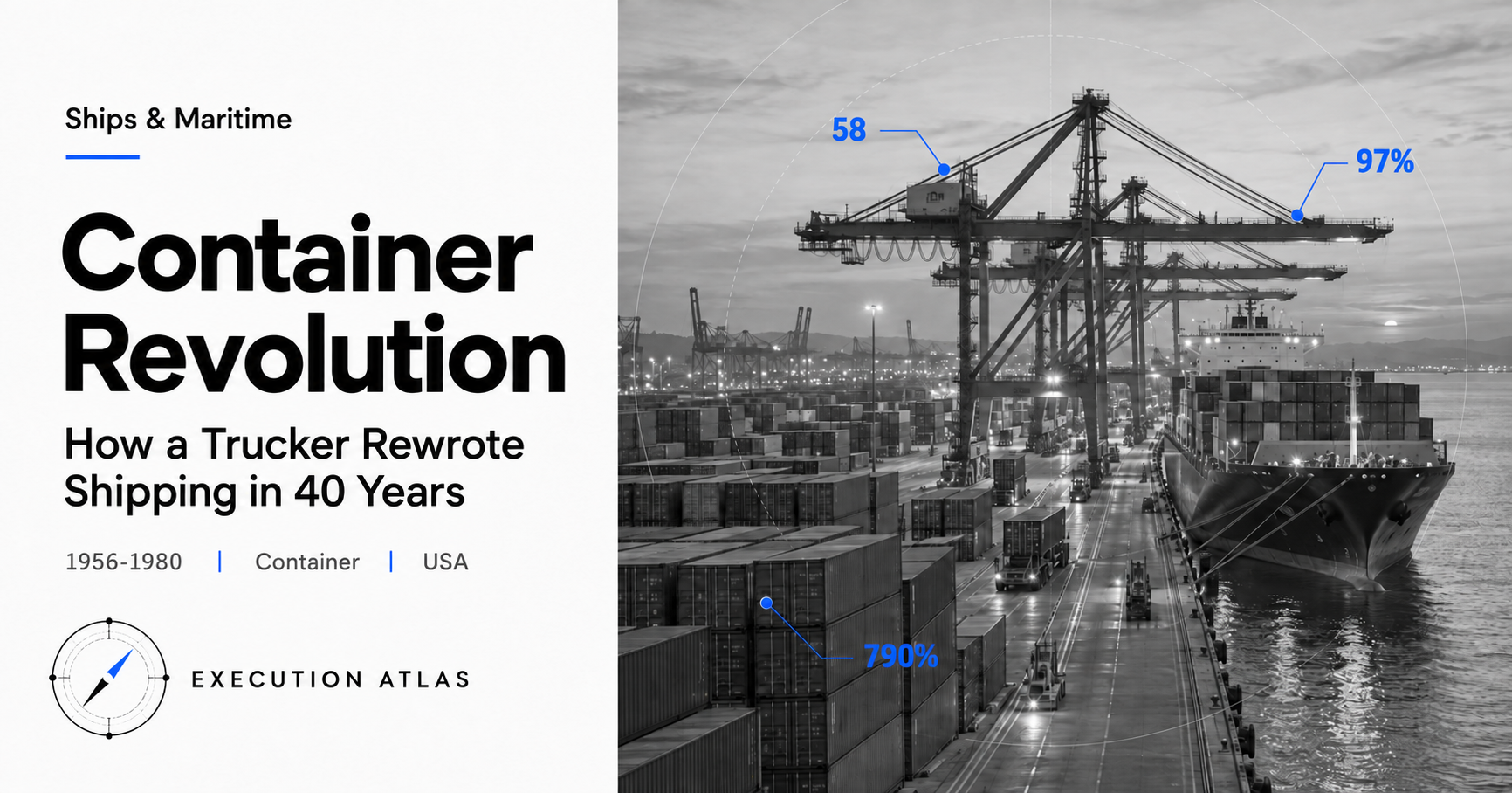
On the morning of April 26, 1956, at Port Newark, New Jersey, fifty-eight 35-foot metal boxes stood lined up on the deck of the SS Ideal X — a surplus World War II tanker that had been converted for the occasion. It took eight hours to load them all, and then the ship headed for Houston.
Below deck sat the usual 15,000 tons of crude oil. The experiment was on top.
Loading the same volume of break-bulk cargo at a traditional port cost $5.83 per ton at the time. The Ideal X’s loading cost that day: 16 cents per ton. A roughly 97% reduction.
Forty years later, more than nine-tenths of the world’s general cargo would move inside that kind of box.
The man behind it was not a shipping executive. He was Malcolm McLean, a 42-year-old former truck driver from North Carolina.
Mission: Why Ships Waited at Port
In the mid-1950s, a cargo ship arriving at a major U.S. port typically took three weeks from arrival to departure. Ships spent more time moored at the pier than sailing the ocean.
Longshoremen lifted barrels, crates, bags, and steel beams one by one by crane and lowered them into cargo holds. Inside the hold, separate teams repacked the pieces like a puzzle, filling every gap. Loading alone took days; unloading took days more. This was break-bulk cargo — a method that had persisted for centuries.
The cost structure was transparent: handling (loading and unloading at port) accounted for 60 to 70 percent of total ocean freight costs. The time a ship actually spent at sea explained only about 30 percent of shipping costs.
McLean watched all of this from the trucking side.
In 1937, as a young driver, he had stood at a New Jersey wharf with a load of cotton from North Carolina. He handed it off to longshoremen, then waited while it was stowed in the hold. “Why can’t we just put the whole trailer on the ship?” He told this story repeatedly for decades — the original idea, fully formed.
By 1954, McLean Trucking ranked eighth in U.S. trucking by revenue and third by net profit. He had succeeded domestically. But his attention had shifted to the enormous waste happening at the port.
Starting a shipping business meant owning a shipping company. And owning one meant the Interstate Commerce Commission’s rules prohibited simultaneously holding a trucking company.
The requirement was clear: take cargo loaded on a truck, skip the unloading at port, transfer it directly onto the ship, and deliver it by truck again at the destination. No manual handling. No repacking.
The problem was that the “box” that would make this possible did not exist anywhere on earth.
Design: Four Constraints
McLean’s design decisions can be grouped into four, across different periods. Each was a choice with no way back.
The first was selling his core business. In 1955, to get around the ICC rules, he sold his company for $6 million (roughly $58 million today). He used the proceeds to acquire Waterman Steamship for $22 million. He borrowed from banks and cut off his retreat. McLean Trucking survived under new ownership, but McLean himself was permanently banned from the trucking industry. The rule that prohibited dual ownership forced an all-or-nothing choice.
The second was the physical design of the box. McLean brought Keith Tantlinger to Pan-Atlantic Steamship (Waterman’s subsidiary) as chief engineer. Tantlinger was 36 at the time and had been VP of engineering at Brown Industries, a trailer manufacturer in Spokane, Washington. The concept: remove the axles and wheels from a truck trailer and handle it as a standalone, stackable metal box — one that could be grabbed by a crane and locked to a ship.
Tantlinger invented the corner casting (a cast metal block at each of the eight corners) and the twist lock (a rotating locking mechanism). Each corner of the box had a slotted casting, and inserting a twist lock and rotating 90 degrees locked containers together when stacked. Ships to containers, containers to containers, containers to trailers — all connection points handled by the same fitting.
A Lego-block structure, scaled up to 20-ton steel boxes.
The third was handling the patent. Tantlinger convinced McLean not to hold the corner casting and twist lock patents exclusively — instead, to open them to the industry. The reasoning was simple: if other companies couldn’t build compatible fittings, no container ports, container trains, or competing routes would emerge. A fragmented market would prevent Sea-Land itself from recouping its investment.
McLean agreed. The patents were placed in the public domain. This decision became the technical foundation that, ten years later, led ISO 668 (1968) to adopt the corner casting and twist lock as world standards.
The fourth was modifying the ship. Spacers for containers were welded to the deck of the Ideal X, a T2 tanker from Waterman’s wartime fleet. Not a full conversion — the priority was creating a “moving proof of concept.” In parallel, six of Waterman’s C-2 freighters were fully converted — their cargo holds rebuilt as container cells. The Gateway City, launched in 1957, became the world’s first full containership.
It was not an experiment for its own sake. The eight hours on Ideal X existed to prove the economics to the investors who would fund the next conversion.
Execution: Making the Round Trip Pay
From 1957 through the early 1960s, Sea-Land Service (renamed from Pan-Atlantic in 1960) expanded routes along the U.S. East Coast and Puerto Rico. But profitability on its own was difficult.
Container ships only make money when both legs of the voyage are loaded. Ship industrial goods outbound, and if there isn’t equal cargo to ship back, the return voyage runs empty. The cost of sailing an empty ship has to be absorbed by the outbound fare.
In 1965, the U.S. Army was struggling to supply its forces in Vietnam. Ground troops were growing by 17,000 per month. Each infantry battalion (830 soldiers) required 451 tons of materiel. Existing sea transport was backed up; the docks at Saigon and Cam Ranh Bay were choked with ships waiting to unload.
Army logistics chief Frank S. Besson Jr. looked into containerization. Sea-Land was authorized to submit a proposal in 1965, and in March 1967 won a $70 million contract. Sea-Land installed dockside cranes at Cam Ranh Bay itself. Military supplies from the continental U.S. arrived in containers, offloaded directly, and connected to rail and truck.
This solved the return-trip problem. Empty containers from Cam Ranh Bay were rerouted to Yokohama and Kobe in Japan. Japan at that time was in the midst of explosive growth in consumer electronics, textiles, and machinery exports. The return voyage filled up with Japanese goods headed to the United States.
The Pacific round trip finally made economic sense — military traffic outbound, Japanese export cargo inbound. In 1971, 30 percent of Sea-Land’s revenue came from Vietnam-related contracts. In spring 1966, three companies ran containership routes from the U.S.; by June 1967, sixty did.
Longshoremen fought back hard throughout this process. Freddy Fields, a New York ILA official, publicly said about the Ideal X’s maiden voyage: “I’d like to sink that ship.” Long strikes on both coasts followed, and their pressure slowed the pace of containerization.
The compromise took shape gradually. On the West Coast, the 1960 Mechanization and Modernization Agreement (M&M) accepted mechanization in exchange for long-term employment and income guarantees for existing workers. The East Coast reached a similar framework in 1966. The collision with incumbent interests was resolved through cash compensation and stretched timelines.
A problem solved not by technology, but by contracts.
People: The Trucker at 42
Malcolm Purcell McLean (1913–2001). Son of a general-store owner in Maxton, North Carolina.
After high school he worked at a gas station. At 22, in 1935, he bought a used truck and started a hauling business. By 1954, McLean Trucking had grown to eighth place in national trucking revenue and third in net profit. He bought his first shipping company at 42.
Throughout his life, he never tried to become a ship’s engineer. The internal workings of cargo holds, load balancing, engine efficiency — he left that to the technical staff he hired, including Tantlinger.
He understood his role as standing “between modes.” The several days between a truck dropping cargo and a ship’s hold being loaded. The hours between a ship arriving and freight reaching the railroad. He was there to eliminate the friction at those points — through fitting specifications and contract design.
Throughout his life, he spoke little in public. The most widely quoted line attributed to him:
A ship earns money only at sea.
Shorten time in port. Standardize the fitting. Open the patent. Secure return cargo. Everything reduces to this single line. Not faster ships, but eliminating the time ships stood still.
In 1969, he sold Sea-Land to R.J. Reynolds (the tobacco company) for approximately $530 million. He was 56. His entrepreneurial career should have ended there.
But in 1978, at 65, he came back — buying United States Lines and returning to shipping. In the early 1980s, betting on high fuel prices following the second oil shock, he ordered twelve Econship vessels: low-speed, large, fuel-efficient, each 4,258 TEU at the time one of the largest classes in the world.
The premise collapsed. Between 1985 and 1986, oil prices fell sharply, and the relative advantage of slow ships disappeared. Customers moved to faster competitors. On November 24, 1986, McLean Industries filed for Chapter 11 — one of the largest bankruptcies in shipping history.
The inventor of the container revolution was beaten by container ship economics.
McLean died on May 25, 2001. Industry records note that Sea-Land descendant containerships around the world blew their horns simultaneously at noon that day in tribute.
Legacy: One Box Drove 80% of Trade Growth
In 1968, the International Organization for Standardization issued ISO 668: lengths of 20 and 40 feet, width of 8 feet, height of 8.5 feet, corner casting and twist lock dimensions. The physical specifications McLean and Tantlinger had baked in a decade earlier became the world standard, unchanged.
The volume of one 20-foot container became the unit called TEU (Twenty-foot Equivalent Unit), and all subsequent ocean shipping is counted in TEUs.
The numbers shifted with brutal force. In 1959, U.S. ports handled 0.627 tons per worker-hour. By 1976, the same ports were handling 4,234 tons per worker-hour — roughly 6,700 times as much. Ship time in port fell from three weeks to 18 hours, roughly a 28-to-1 improvement. Demand for longshoremen dropped by over 90% compared to the 1960s.
Global container throughput went from 0.8 million TEU in 1970 to 36 million in 1980 to 237 million in 2000. About 60 times in 20 years. About 300 times in 30 years.
A 2014 econometric study by Bernhofen and colleagues reported that containerization explained 790% of the growth in world trade between 1970 and 1990. GATT/WTO tariff reductions explained 285%; all other trade facilitation measures combined, 45%. In the twenty years after ISO 668, containers were the single biggest driver of global trade growth — not tariffs, not currency systems.
The side effects were severe. In the early 1950s, the Port of New York handled a third of U.S. maritime traffic. The moment McLean couldn’t find port space in New York and set up across the river in Newark, New Jersey, New York’s locational advantage vanished. Between 1967 and 1976, the number of factories in New York City fell by a quarter; manufacturing employment fell by a third.
Containers did not simply become more convenient. Ports connected to the container network and ports left off it separated into two different economic worlds.
Rotterdam, Singapore, Hong Kong, Busan, Shanghai — places that had not been major ports rushed to build container facilities and became hubs. London, New York, Liverpool — traditional major ports that lacked room to expand near historic city centers declined.
The container reshaped ships. And then it redrew the economic map of cities.
Lesson: Open the Pipe, Win the Network
There are several lessons to draw from McLean and the container revolution, but the sharpest is the decision around 1959–60 to place the corner casting and twist lock patents in the public domain.
At that point, Sea-Land was barely starting to extend its routes. Holding the patents exclusively would have prevented other companies from building compatible fittings. Sea-Land’s containers would only fit Sea-Land’s ships — a closed system. Short-term competitive advantage would be protected.
Tantlinger and McLean chose the opposite. Open the patents to the industry. Other companies could now build containerships. Other ports could install cranes that grabbed the same fittings. Trucking and rail could design chassis around the same dimensions.
Why give up the monopoly? Because a container is infrastructure that has no value alone. If only Sea-Land had it, but the arriving port had no crane, and the truck chassis at that port had mismatched dimensions, the container couldn’t leave the ship.
The value of infrastructure is determined by the number of others it connects to. A container connected to nothing is just a metal box. The more tightly the patent is guarded, the fewer connections exist, and the less the original investment can be recovered.
The same structure repeated many times in the late twentieth and early twenty-first centuries. TCP/IP made no patent claims and became the standard. USB published its specification and spread. QR codes became a world standard because Denso Wave chose not to enforce its patent. When the “pipe” is open, the adjacent businesses that run on top of the pipe are the ones that profit.
Whether what you are selling is a product that has standalone value, or infrastructure that only has value when connected to others — that is the question to ask first.
If it is infrastructure, open it. Kill the monopoly instinct first. The profit lies in the layer that runs on top of that infrastructure.
The layer that ran on top of McLean’s container was not Sea-Land — it was Japan’s consumer electronics makers, South Korea’s automakers, and China’s manufacturing sector. McLean himself was beaten by the Econship and went bankrupt in the late 1980s. The infrastructure he invented became the platform on which other nations’ industries rode to reshape world trade.
The inventor doesn’t always capture all the fruit of the invention. But if the monopoly is never released, the fruit would never have grown at all.
There is a second lesson in the Econship bankruptcy. In the 1980s, McLean ordered twelve vessels on the premise that oil prices would stay high. That premise failed within a few years. When you bet the design of an entire business on a single future value of one external variable, every asset in the business becomes worthless the moment that variable’s scenario turns.
The man who succeeded in the container revolution failed in container ship economics. Both live inside the same person.
He opened the pipe to change the world, and bet on one external variable to bankrupt himself.
The lesson lies in seeing both at the same time.
Sources
- Marc Levinson, The Box: How the Shipping Container Made the World Smaller and the World Economy Bigger (Princeton University Press, 2006/2016) — port labor, New York Port decline, Vietnam logistics, Econship bankruptcy details
- Bernhofen, El-Sahli & Kneller, “Estimating the effects of the container revolution on world trade” (GWU IIEP, 2014) — econometric result attributing 790% of 1970–90 world trade growth to containerization
- Malcom McLean — Wikipedia — biography, business chronology, USL bankruptcy
- Keith Tantlinger — Wikipedia — fitting and twist lock invention, patent release
- Ideal X — Port Houston — April 26, 1956 maiden voyage, 58 containers, 8-hour loading
- SeaLand — Wikipedia — Pan-Atlantic to Sea-Land name change, sale to R.J. Reynolds
- The Geography of Transport Systems: Ideal X 1956 — Ideal X technical specifications and 15.7 cents/ton cost figure
- ISO 668 — Wikipedia — 1968 standard, 20/40-foot dimensions
- World Container Throughput, 1980–2024 (Port Economics) — TEU time series data
- Frank S. Besson Jr. — Wikipedia — Vietnam-era Army logistics doctrine and containerization adoption