On the morning of January 10, 1954, BOAC Flight 781 lifted off from Rome’s Ciampino Airport. Captain Alan Gibson, age 31, was one of BOAC’s youngest captains and the man entrusted with the most advanced jet airliner in British aviation history. Thirty-five passengers and crew aboard. Destination: London Heathrow.
About twenty-five minutes after takeoff, climbing through clouds at 27,000 feet, the final transmission to air traffic control broke off mid-sentence.
“George How Jig to George Yoke Peter, do you read…”
The aircraft disintegrated in mid-air and fell into the Tyrrhenian Sea off the island of Elba. All aboard died. The wreckage was recovered by Italian Navy salvage vessels from the seabed at seventy meters. The ceiling of the fuselage had been torn open.
Three months later, on April 8, South African Airways Flight 201 took off from the same Rome airport and broke apart in nearly identical fashion near Stromboli at nearly the same altitude. All twenty-one aboard died.
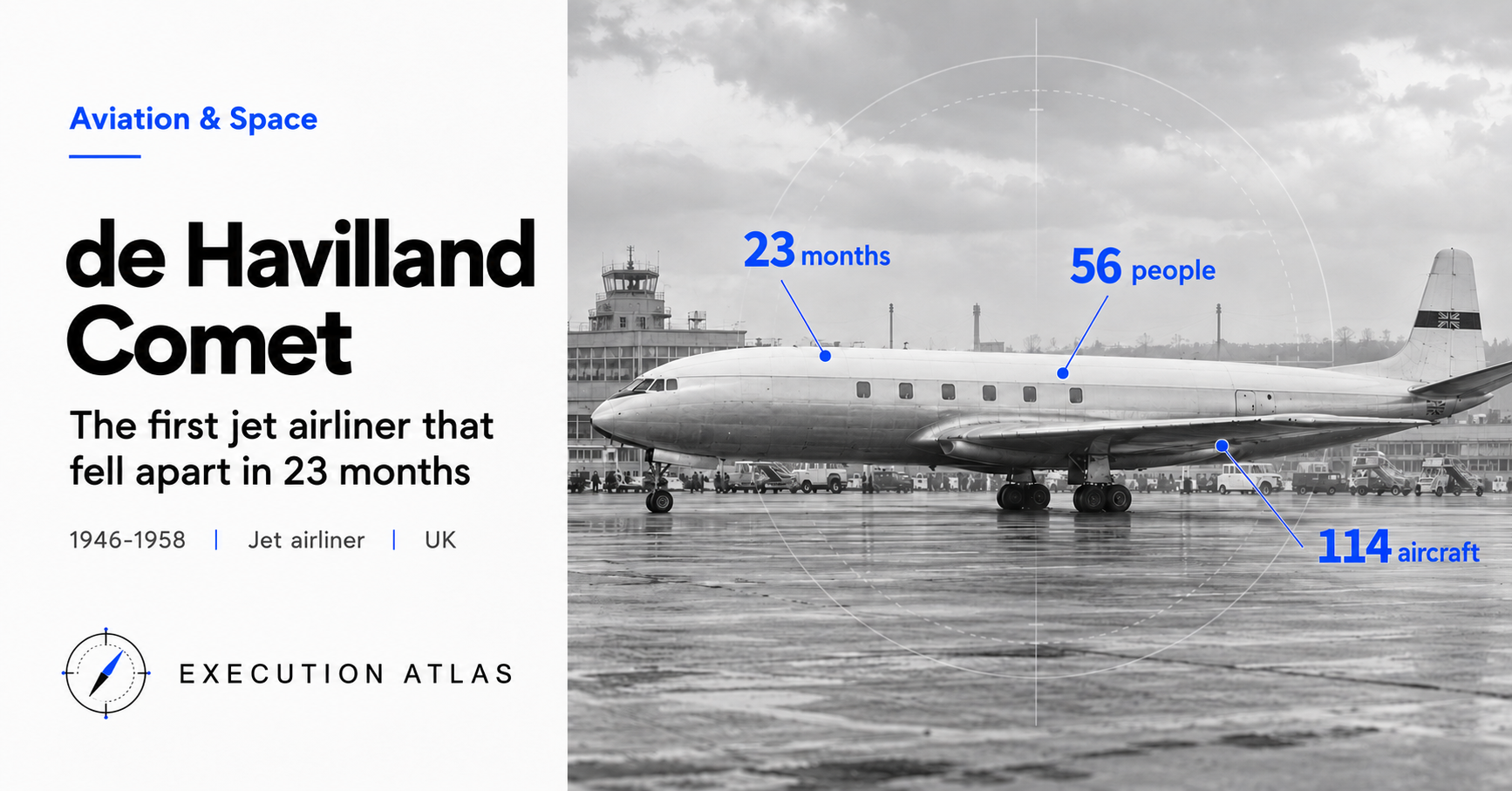
Fifty-six people.
Both aircraft were the de Havilland DH.106 Comet 1 — the world’s first commercial jet airliner, which had entered service in May 1952 amid British claims that the jet age belonged to them. It lasted twenty-three months.
The Comet had passed every certification test of the era. It survived static pressure testing at 2.5 times design pressure, received the Certificate of Airworthiness from the Air Registration Board, and entered scheduled BOAC service. The test standards were “the most current in the industry.”
Those test standards had never accounted for a failure mode called metal fatigue.
Mission: Why the Comet Was Built
Turn the clock back to 1943. In the middle of World War II, Britain was debating how to rebuild its postwar aviation industry.
The Brabazon Committee. Established in 1943 on Prime Minister Churchill’s directive, the committee classified postwar civil aircraft requirements into five types. Type IV was “a jet-propelled transatlantic mail aircraft.”
At the time, jet engines were barely proven in military service. Whittle’s turbojet had first flown in 1941; Germany’s Messerschmitt Me 262 entered combat in 1942. Civilian application was uncharted territory.
Britain’s bet was “first-mover advantage in technology.”
America had the Douglas DC-6 and Lockheed L-049 Constellation — overwhelming dominance in the postwar civil aviation market through long-range piston-engine airliners. British aircraft couldn’t compete.
The answer: win the next generation. With jets.
The contract went to the de Havilland Aircraft Company, a mid-size manufacturer that had distinguished itself with the Mosquito fighter-bomber during the war. It also had its own engine, the Ghost turbojet.
In requirements language, the specification read: a passenger aircraft flying at roughly twice the speed of existing piston aircraft (800 km/h), cruising at 35,000 feet in the stratosphere, quieter and smoother than propeller aircraft. Capacity: 36 passengers. Role: long-haul routes linking Commonwealth territories.
The primary customer was BOAC — British Overseas Airways Corporation, the state-owned carrier with the British government as shareholder. A formal order was placed in December 1945; an initial proposal of twenty-five aircraft was reduced to ten at contract.
It was a state-backed project, a symbol of British aviation’s postwar renaissance.
Design: How It Was Engineered
Chief designer Ronald Bishop, age 45, had made his name with the Mosquito. The equation he had to solve was evident from the requirements themselves.
High-altitude flight. Jet engines are most efficient at altitude. At 35,000 feet, atmospheric pressure is about one-quarter that at sea level, which means a pressurized cabin is essential. But pressurized cabins had seen only limited military use; there was almost no precedent for their sustained application in long-haul commercial aviation.
Bishop’s decision was to set the pressure differential at 2.75 psi (approximately 0.19 atmospheres) — maintaining a semi-sea-level environment inside the cabin by holding pressure against the thinner air outside. This became the structural core of the design.
Then the windows.
The Comet’s cabin windows were large, gently rounded rectangular openings — roughly 50 centimeters on the long axis and 30 centimeters wide. This was the standard shape for aircraft at the time, and the ability to offer passengers a view was a selling point.
Circular windows were considered. But circular windows offered narrower views and created structural complications with the fuselage’s circular frames. Rectangular windows made for cleaner design and better passenger experience. And “large rectangular windows can withstand pressurization” was the accepted engineering wisdom of the day.
Here lies a critical design fork.
The inner corners of rectangular windows concentrate stress. The sharper the corner, the more intense the concentration; the more rounded, the less. This had been in structural mechanics textbooks since the 1920s. The Comet’s windows did have rounded corners, and the theoretical stress concentration factor was approximately 2.5 times.
At the design stage, this was considered “conservative.” Static load tests at twice and three times design pressure confirmed the structure wouldn’t fail.
What was missing was “repeated pressurization.”
A pressurized cabin pressurizes at each takeoff and depressurizes at each landing. Flying several segments per day, that accumulates to thousands of cycles per year. That this repeated loading could cause metal fatigue at stress-concentration points — a phenomenon already understood in railway rails and steam locomotive axles by 1950 — had simply not been seriously applied to aircraft.
The certification standard required: apply 2.5 times design pressure via water pressure once to the pressurized fuselage, and confirm it does not fail. The Comet passed. As per industry standard.
A software engineer might recognize this pattern. “Unit tests passed for peak load, but endurance testing wasn’t in the requirements.” The industry-standard quality gate didn’t cover the real failure mode.
Execution: What Happened
On July 27, 1949, prototype G-5-1 lifted off from Hatfield Aerodrome. Chief test pilot John Cunningham was at the controls. The first flight lasted thirty-one minutes without incident.
From there to commercial service in May 1952, almost everything went to plan.
BOAC flight crew type training began in 1950; trial operations in 1951; the Air Registration Board issued the Certificate of Airworthiness in January 1952.
On May 2, 1952, BOAC G-ALYP “Yoke Peter” departed London Heathrow and arrived in Johannesburg. The world’s first commercial jet passenger service. A route that had taken four days on piston aircraft now took twenty-three hours.
In the first year of operations, more than 30,000 passengers flew. The Comet dominated international press coverage as “the pride of Britain.” In June 1953, for the coronation of Queen Elizabeth, BOAC expanded Comet 1 operations to fifteen world routes: Singapore, Tokyo, Sydney, Havana.
One year into service, the first warning came.
On May 2, 1953, BOAC G-ALYV broke apart shortly after takeoff from Calcutta. All forty-three aboard died. The accident occurred while climbing through a monsoon storm, and the investigation report concluded “structural failure due to severe turbulence.”
This was a misattribution. The real cause — metal fatigue originating from the window frames — would only become clear later. The investigating team had no hypothesis called metal fatigue. The storm was the evidence.
Operations continued.
Eight months later, on January 10, 1954, Yoke Peter fell into the sea off Elba. Thirty-five dead.
BOAC voluntarily grounded the entire fleet. Cause unknown. The Air Ministry investigation began. De Havilland pursued multiple hypotheses — control system failure, engine trouble, sabotage — and applied modifications across roughly fifty items.
Then, ten weeks after Yoke Peter, they resumed operations at the end of March.
“Modified against all possibilities” was the official position. The fact that no root cause had been identified was papered over with precautionary fixes.
This is a familiar pattern in software operations. After an unexplained outage, “patch everything that might be causing it and reopen.” Pressure to restore user impact wins out while root cause analysis is still incomplete.
Exactly two weeks after resuming service, on April 8, South African Airways Flight 201 departed the same Rome airport and fell off Stromboli. Twenty-one dead. Nearly identical altitude, nearly identical flight time, nearly identical mid-air breakup pattern.
There was no longer any defense.
On April 12, the Air Ministry revoked the Certificate of Airworthiness and all Comet 1s were grounded worldwide.
Twenty-three months since entering commercial service. Less than two years from glory to the ground.
Yoke Uncle in the Water Tank
Determining the cause fell to Dr. Arnold Hall, who led the investigation team at the Royal Aircraft Establishment (RAE) at Farnborough. His team’s approach was unprecedented in aviation engineering at the time.
They would submerge an actual Comet 1 — G-ALYU, “Yoke Uncle” — in a giant water tank.
Inside the tank, the fuselage would be pressurized to 2.75 psi and then depressurized, replicating the pressurization cycles of actual flight operations — using water pressure. The reason for water: pressurizing with air and then causing failure would scatter debris dangerously. Water would release pressure immediately on failure.
At a rate of two cycles per minute, day and night, the pressurization continued.
At 3,060 cycles, a crack propagated from the corner of a forward port cabin window. The crack advanced rapidly and the fuselage split wide open — the equivalent of several thousand takeoff-and-landing cycles in actual service.
The fatigue had progressed far faster than desk calculations predicted. The stress concentration at the inner corners of the rectangular windows was not merely the theoretical 2.5-times amplification; the actual damage to the metal’s structure was far more severe.
Dr. Hall’s report was published in February 1955. The cause: metal fatigue at stress-concentration points at the corners of windows and antenna apertures. Pressurization cycles from each takeoff and landing were generating fatigue cracks far sooner than theoretical prediction had suggested.
The failure mode invisible to static load testing had been made visible in a water tank.
People: Who Led It
Ronald Bishop was born in London in 1903. His father was an architect. Bishop himself joined de Havilland as a draughtsman in 1921 and taught himself into the role of designer. The man who designed the Mosquito fighter-bomber in 1936 — delivering the paradox of a wooden aircraft faster than metal ones — was one of British aviation’s luminaries.
Design responsibility for the Comet was his. He was forty-three when design began in 1946.
After the accidents, Bishop was not held personally accountable but stepped back from the front line. He later reflected:
“With the engineering knowledge available to us at the time, we were doing the right thing. But the knowledge wasn’t enough.”
Responsibility lay not with the individual but with the industry’s state of knowledge overall — his own assessment.
The other central figure: Sir Geoffrey de Havilland, the company’s founder. Born in 1882, he was already sixty-three in 1946, with the management front line handed to his sons.
His eldest son, Geoffrey de Havilland Jr., died on September 27, 1946, when the DH.108 “Swallow” broke apart during a high-speed test flight. Structural failure near Mach 0.88. The son was thirty-six.
The father watched the Comet’s design proceed after burying him. Another son, John de Havilland, had also died in 1943, aged twenty-four, in a mid-air collision during a Mosquito test flight. The founder who had lost two sons in aircraft accidents was the man who sent the jet age’s first civil aircraft into the world.
His sons’ deaths gave him firsthand knowledge of structural failure at jet-speed regimes. But the Comet’s accident cause was not transonic aerodynamics — it was the pressurization cycles repeating at low speed on every takeoff and landing. Not “speed,” which the father had learned to fear, but “frequency” that killed.
Arnold Hall, thirty-six years old, led the investigation. A structural engineer from Imperial College, he had just taken over as Director of RAE in 1951. The Comet accidents would become the defining work of his career.
The decision to use the water tank was his. “Apply time and resources relentlessly until the cause can be determined.” The British government and BOAC wanted to resume operations urgently — anxious about losing international competitiveness in aviation.
Hall did not yield. After the second accident in April 1954, he insisted the Certificate of Airworthiness not be reissued until the cause was positively identified. For roughly a year until the water tank results were in, the Comet 1 did not fly.
BOAC’s then-chief executive Basil Smallpeace later wrote:
“Hall’s patience preserved the credibility of the British aviation industry. Had we resumed immediately, the third accident would have destroyed everything.”
The paradox: the decision to prioritize cause identification ultimately protected long-term trust. By surrendering short-term momentum.
Legacy: What It Left Behind
The metal fatigue mechanism revealed by the water tank testing was published globally in 1955 — a decision by the British Air Ministry.
Technical secrecy was an option. Publishing Britain’s own aviation industry failure would hand competitive advantage to rivals. And it did.
Boeing test pilot Alvin “Tex” Johnston wrote: “Months before the Comet’s tragic vulnerability became public knowledge, Boeing engineers had already specified considerably thicker aluminum skins.” Boeing had anticipated the hazard in advance. But once the Comet accident details were published, Boeing 707’s structural testing regime was tightened by another degree.
The Douglas DC-8 similarly incorporated fatigue testing. Both adopted circular windows.
The British Air Ministry proposed amending certification requirements to mandate metal fatigue testing, and the International Civil Aviation Organisation (ICAO) adopted the proposal. From 1958 onward, pressure-cycle fatigue testing equivalent to the water tank method became a mandatory element of commercial aircraft type certification.
This is the greatest legacy the Comet left the world: it rewrote aviation engineering’s design philosophy.
De Havilland itself converted the Comet 2 and 3 programs for military use, and redesigned the civil variant as the Comet 4 — reinforced fuselage, circular windows, revised pressure differential. First flight in April 1958; delivered to BOAC in September 1958.
On October 4, 1958, BOAC Comet 4 (G-APDB) completed the first jet transatlantic crossing between London and New York — three weeks before Pan American’s Boeing 707 entered service. Britain recovered the honor of “first jet crossing of the Atlantic.”
But it was the last victory.
The Comet 4 was outclassed by the 707 and DC-8 in range and seat count, and was no commercial match. Comet 4 production totaled 76 aircraft; all variants together, 114. The contemporary 707 produced 1,010; the DC-8, 556.
Ratios of nine-to-one and five-to-one. Britain had taken the honor of the technical pioneer, but commercial leadership had passed entirely to America.
British aviation went on to produce the VC-10, Trident, and BAC 1-11, but none could defeat the American aircraft. By the 1970s Britain had effectively withdrawn from civilian aircraft development and merged into the pan-European Airbus program.
The Comet’s tragedy was the turning point at which Britain lost its competitive standing in aviation. And simultaneously the turning point at which metal fatigue as a failure mode became common knowledge in global aviation engineering.
Two turning points from the same airframe.
Lessons: When the Aircraft That Passed Every Industry Standard Falls After Two Years
Look at the Comet project through conventional project management metrics.
Schedule: design began 1946, commercial service 1952. Six years, on plan. Cost: no significant overruns. Quality: passed every certification test of the era, received the Air Registration Board Certificate of Airworthiness.
By textbook measures, all A’s. And it was retired in twenty-three months, ending in fifty-six deaths and Britain’s long-term defeat in aviation.
What went wrong?
The “industry-standard quality gate” of certification testing did not incorporate the real failure mode. The static load test at 2.5 times design pressure was a standard inherited from piston-engine pressurization design. Jet aircraft undergo more pressurization cycles per day and operate at greater differential pressure. But the testing standard, unchanged, was applied to jet aircraft certification without modification.
Industry standards are built from past known failure modes. A pioneer stepping into new technical territory must anticipate failure modes not yet in the standard — or deliver them to users before reaching the ground.
This is not specific to aircraft.
Software unit tests, integration tests, system tests — all pass, then production falls over. Load testing designed around “peak request count” misses the failure mode: “memory leak over twenty-four hours at peak load.” Quality gates built from past failures can’t catch new patterns of failure.
New drug Phase I through Phase III clinical trials — then post-marketing surveillance finds a long-term side effect that only emerges after years of use. “Months of trials” cannot catch the failure modes of “years of administration.”
Security audits — products certified against known vulnerability standards are broken by new attack vectors. The standard looks at the past. Attackers look at the future.
The underlying structure is the same. Industry-standard quality gates are tools for closing known failure modes, not instruments for detecting unknown ones. “Passed the standard” does not mean “is safe.”
The second lesson from the Comet is the risk of “reopen on estimated fixes after an unexplained failure.”
After the Yoke Peter accident in January 1954, with no root cause identified, BOAC and de Havilland applied fifty items of modification and resumed operations at the end of March. “All possibilities addressed” was the rallying phrase. In April, the second accident occurred.
This pattern repeats in software operations and incident response. Resume after a failure you can’t explain, with precautionary fixes. When it recurs, the damage is greater than the first time. The label “already fixed” makes the loss of trust deeper.
A final note on the British government’s decision: in 1955, the choice of whether to publish the metal fatigue testing details globally or hold them domestically. Choosing publication helped Boeing 707 and DC-8 succeed. It contributed to Britain’s commercial defeat.
But viewed long-term, publication preserved Britain’s authority in aviation engineering as “the nation that wrote the textbook on metal fatigue.” Had they concealed it, the same accident would have recurred in another country, and Britain would have become “the nation that hid its failure.”
Concealment preserves short-term competitive advantage, but collapses when the second accident happens elsewhere. Publication benefits competitors, but protects the industry’s shared trust. Disclosing or concealing failure information always sits in this trade-off.
One final question.
Among the products you’re reporting today as “passing all industry-standard tests” — is there a test built from past failure modes that cannot yet detect a new failure mode the industry doesn’t yet know about? In a technical domain you’ve entered as a pioneer, who is anticipating the risks that haven’t yet become the standard?
Certification tests do not guarantee no crash two years from now.
Sources
- De Havilland Comet - Wikipedia — Development history, design, accidents, redesign into Comet 4
- BOAC Flight 781 - Wikipedia — January 1954 Elba accident (Yoke Peter) details
- South African Airways Flight 201 - Wikipedia — April 1954 Stromboli accident (Yoke Yoke) details
- De Havilland DH-106 Comet 1 - FAA Lessons Learned — FAA official lessons database, causal chain of successive accidents
- How Square Windows Killed the First Jet Airliner - Migflug — Metal fatigue mechanism and water tank testing
- The Reason for Round Windows: The De Havilland Comet - BYU Design Review — Engineering explanation of stress concentration and window geometry
- Comet Enters Service - RAF Museum — 1952 commercial service entry
- Ronald Eric Bishop - Wikipedia — Chief designer Ronald Bishop’s biography
- The Comet, the 707, and the disaster that shaped the Jet Age - New Atlas — Comparison with Boeing 707 design philosophy
- Recollections of how BOAC’s Comet won the transatlantic jet race - FlightGlobal — 1958 first transatlantic jet service details