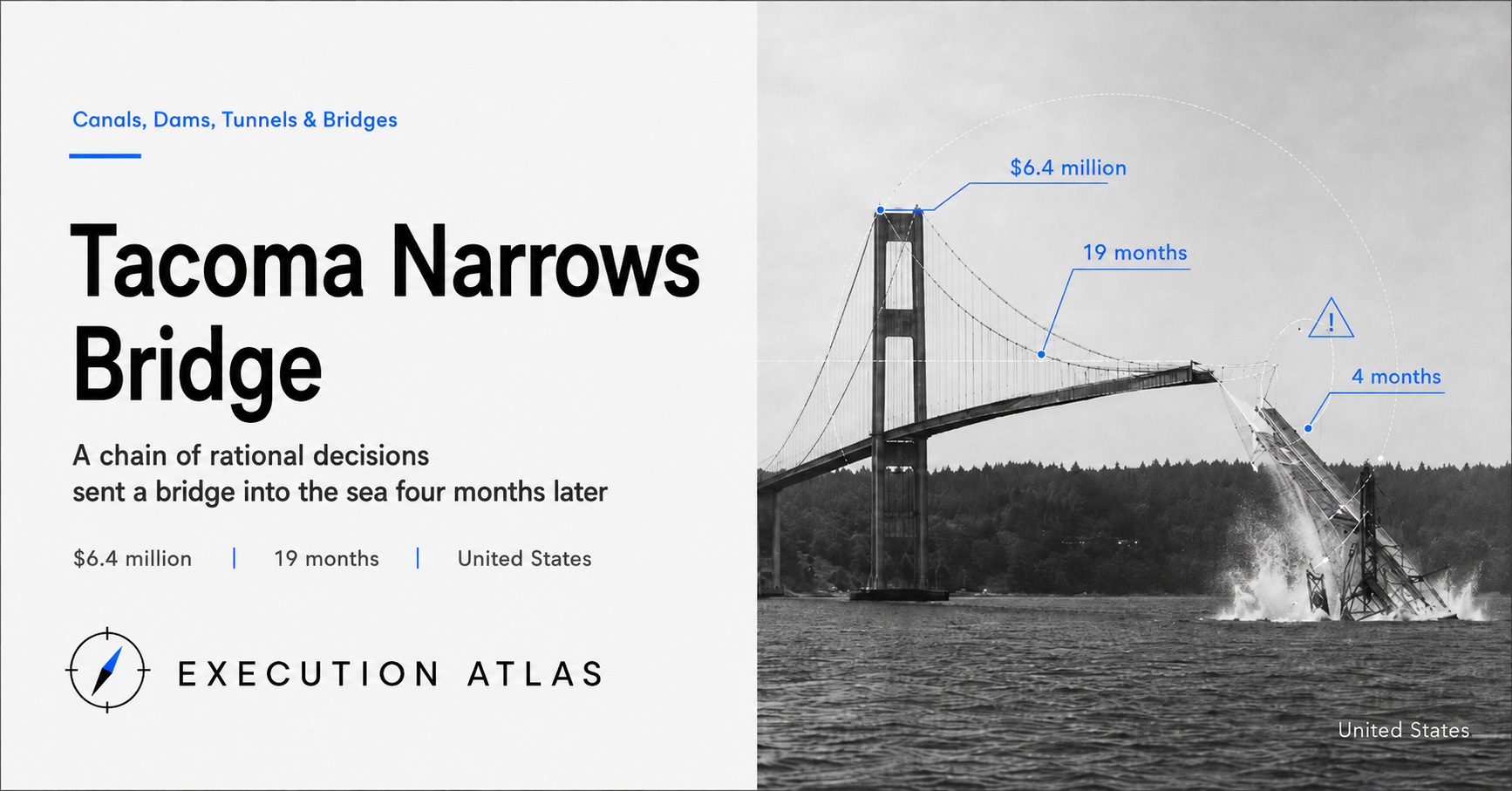
Main span: 853 meters. Girder depth: 2.4 meters. Depth-to-span ratio: 1:350. Width-to-span ratio: 72:1.
The Golden Gate Bridge: depth-to-span 1:168, width-to-span 47:1. Tacoma was twice as thin and half again as narrow. The third-longest suspension bridge in America, and by far the thinnest and narrowest ever built.
Budget: $6.4 million. Schedule: 19 months. Both on target.
Service life: 4 months and 7 days.
Mission: Fifty Years of Waiting for a Bridge
A ferry route connected Tacoma, Washington, to the Kitsap Peninsula. The Tacoma Narrows of Puget Sound: roughly 1.6 km wide, about 46 meters deep. In 1889, the Northern Pacific Railroad proposed a bridge. The idea sat for half a century.
In 1937, the Washington State Legislature established a toll bridge authority and appropriated $5,000 for a feasibility study. Clark Eldridge, the state’s bridge engineer, drew up the design. A 25-foot-deep open truss to support the deck. Wind passes through. Estimated cost: $11 million.
The state applied to the federal Public Works Administration for funding. The PWA came back with two conditions. Cut the cost. Hire an outside consultant with a national reputation in suspension bridge design.
Leon Moisseiff was summoned from New York.
Design: Deflection Theory, Taken to the Limit
Moisseiff was born in 1872 in Riga, Latvia. A Jewish family. He emigrated at 19, driven by political activism, and studied civil engineering at Columbia. He loved American freedom enough to name one of his daughters Liberty.
For 30 years, he had consulted on virtually every major suspension bridge in America. The Manhattan Bridge (1909) made his name. The Benjamin Franklin Bridge (1926) and the Golden Gate (1937) followed. His weapon was deflection theory.
A suspension bridge cable deflects under load. That deflection distributes force, reducing what the deck girder has to carry. So the girder can be thinner. Lighter. The longer the bridge, the more the cable absorbs, the thinner the girder can go. In theory.
Moisseiff looked at Eldridge’s design and said: drop the girder from 25 feet to 8. No need for trusses. Solid plate girders will do. Cost: $6.4 million.
| Item | Eldridge’s design | Moisseiff’s design |
|---|---|---|
| Girder | 25 ft deep open truss | 8 ft deep solid plate girder |
| Wind behavior | Passes through truss | Hits plate |
| Estimated cost | $11 million | $6.4 million |
A 42% reduction. Eldridge’s department protested: “fundamentally unsound.” A 25-foot open truss lets wind pass through the deck. An 8-foot solid plate catches it.
Moisseiff’s reputation and a 42% cost cut outweighed the protest. PWA grants of $2.88 million and RFC loans of $3.52 million, totaling $6.4 million, were set in motion. Design fees: $139,868. Two and a half percent of construction cost.
Moisseiff called it “the most beautiful bridge in the world.”
Execution: Galloping Gertie
Groundbreaking: November 23, 1938. Pacific Bridge Company held the main contract. Bethlehem Steel handled the superstructure. The Narrows ran about 46 meters deep, with tidal currents exceeding 13 km/h, surging four times a day.
Nineteen months to completion. Within the $6.4 million budget. The project scorecard had textbook numbers.
The trouble started during construction.
May 1940. As concrete was being poured on the roadway, the deck began to undulate. Amplitude: several feet. Workers chewed lemons to fight seasickness. One of the “boomers,” veteran ironworkers who drifted from bridge site to bridge site across the country, gave her a name. Galloping Gertie.
June 27, carpenter Fred Wilde fell 12 feet and died. The only fatality during construction. The next day, a painter fell off the bridge and survived.
July 1, opening day. The oscillation became a tourist attraction. Thrill-seekers drove across on purpose. A car visible on the far side would vanish into a trough, then reappear. A nearby bank put up a sign: “As safe as the Tacoma Bridge.”
Professor F.B. Farquharson of the University of Washington had been concerned before opening. He ran wind tunnel tests on a 1:200 scale model and proposed cutting holes in the deck to let wind through. Rejected. It would cause permanent damage to the bridge.
November 1, 1940. Tie-down cables snapped in high winds. Repaired.
November 7 arrived.
People: Four Hours on November 7
Early morning. A southwest wind swept through the Tacoma Narrows, striking the plate girders broadside.
7:30 AM. Wind: 38 mph. The bridge began its familiar vertical oscillation, 2 to 5 feet. The usual Gertie.
8:30 AM. Eldridge drove across. Milder than the usual undulation, he judged. He returned to his office a mile away.
9:30 AM. Wind climbed to 42 mph.
9:45 AM. Farquharson arrived after an hour’s drive from Seattle. Camera and stopwatch in hand.
Around 10:00 AM, the vertical heaving shifted, suddenly, to torsion.
The roadway twisted, rising on alternating sides. A motion Farquharson had never seen. Six or more streetlamp poles snapped. The deck tilted up to roughly 35 degrees. The amplitude kept growing.
Barney Elliott and Harbine Monroe, who ran a camera shop in Tacoma, arrived with a 16mm Bell & Howell and Kodachrome film. The state had contracted them to document construction. Elliott shot from the center of the bridge. Monroe filmed from the left side.
Leonard Coatsworth’s car was stranded near the middle of the main span. News editor for the Tacoma News Tribune. His daughter’s dog Tubby was in the back seat. Coatsworth crawled to safety on hands and knees.
Farquharson went back for the dog. He walked along the nodal line of the twisting deck, the axis that doesn’t rotate, and reached the car. He opened the door. Tubby, shaking with fear, bit his finger.
The rescue failed.
10:30 AM. The first roadway panel fell 195 feet into the strait.
11:02 AM. A 600-foot section of the main span collapsed.
11:10 AM. It was over.
Farquharson was the last person off the bridge. He walked back to the toll plaza in his tie and trench coat, pipe in hand. His stopwatch held the final vibration data. Frequency: 12 cycles per minute. Period: 5 seconds.
Coatsworth’s hands were too bloody to type. He dictated his story. “The most terrifying thing is that within a few hours I must tell my daughter that her dog is dead.” He received $814.40 in compensation for the car and the dog.
Elliott and Monroe’s film was duplicated by Paramount Pictures in 35mm black-and-white and screened in theaters across the country. Shot at 16 fps, it was played back at 24 fps, meaning generations of engineering students analyzed the collapse at 50% faster than reality. In 1998, the Library of Congress added it to the National Film Registry. It is ranked alongside the Zapruder film of the Kennedy assassination.
Legacy: Putting Bridges Inside Wind Tunnels
An investigation committee was formed. Othmar Ammann, designer of the George Washington Bridge. Theodore von Kármán, aerodynamicist at Caltech. Glenn Woodruff.
The committee did not establish a definitive cause. But later research revealed something critical: the bridge did not fail from resonance. The wind’s frequency did not match the bridge’s natural frequency. What killed it was aeroelastic flutter. The plate girders behaved like aircraft wings, generating lift. As they tilted, airflow shifted, tilting them further. Negative damping. A self-reinforcing loop.
In the 1930s, aeronautical engineers had published papers on the aerodynamic effects of wind on bridges. They argued that bridge models should be tested in wind tunnels. The bridge engineering community never read them. Two fields, living in separate worlds.
Charles E. Andrew, who led the replacement bridge design, commissioned wind tunnel tests from Farquharson. Over $88,000 went into building a 1:50 scale model and blasting it with wind from every angle. A model with open-grating slots in the roadway and open-truss girders virtually eliminated torsional vibration.
The new bridge had 33-foot-deep open trusses. More than four times the old bridge’s 8-foot plate girders. Towers stood 58 feet taller and 21 feet wider. Cable diameter: from 17.5 inches to 20.25. Wind passed through. Construction took 29 months, ten longer than the original’s 19. Its nickname: Sturdy Gertie. October 14, 1950, opening day.
In essence, a return to the “solid, expensive design” Eldridge had drawn in the first place.
The shockwave traveled worldwide. The Bronx-Whitestone Bridge was retrofitted with trusses. The Golden Gate’s stiffening trusses were reinforced. Wind tunnel testing became a mandatory step in designing every long-span suspension bridge on earth.
Moisseiff died on September 3, 1943. He was 71. He had suffered a heart attack in 1935; his health had been declining before the collapse. His son testified that the bridge’s failure hastened his father’s death. In 1947, ASCE created an award in his name. The Moisseiff Award. Given annually for outstanding papers in structural design.
Eldridge was captured by the Japanese military in late 1941 while serving with the Navy in Guam. Three years and nine months as a prisoner of war. After repatriation, he lived to see the replacement bridge open in 1950, its design assessed as “close to what Eldridge originally proposed.” He died in 1990.
The wreckage of the old bridge remains on the seabed, one of the world’s largest artificial reefs. It is listed on the National Register of Historic Places.
Learnings
Eldridge’s design: $11 million. Moisseiff’s: $6.4 million. A 42% cut. A cost review brought in a consultant, who offered a cheaper alternative, and the cheaper option was chosen. Normal organizational decision-making.
But what Eldridge had secured with a 25-foot truss, Moisseiff replaced with an 8-foot plate. A structure that let wind through became a structure that caught wind. What was cut was not tons of steel. It was the safety margin against wind. What you cut is visible. What you lose may not be.
Deflection theory was correct. For static loads. Dynamic interaction with wind lay outside its scope. Aeronautical engineers had been writing about aerodynamic effects on bridges since the 1930s. Bridge engineers never read the papers. The danger is not that a theory is wrong, but that risk lives in the territory a theory does not cover. The boundary between disciplines creates blind spots.
Eldridge’s department flagged the design as “fundamentally unsound.” Oscillation was reported during construction. Farquharson proposed modifications. Three warnings. All three were processed within the organization, and the bridge opened on schedule. The people who raised the alarm existed. A theoretical framework to explain why the alarm mattered did not.
$6.4 million. 19 months. On budget. On schedule. Every decision was rational within the knowledge system of the time.
A chain of rational decisions can drop a bridge into the ocean four months later.
Sources
- Richard Scott, In the Wake of Tacoma: Suspension Bridges and the Quest for Aerodynamic Stability (ASCE Press, 2001)
- Washington State DOT, “Tacoma Narrows Bridge History” (https://wsdot.wa.gov/tnbhistory/)
- K. Yusuf Billah, Robert H. Scanlan, “Resonance, Tacoma Narrows bridge failure, and undergraduate physics textbooks,” American Journal of Physics, 1991 (https://courses.washington.edu/cee517/scanlanTN.pdf)
- ASCE, “Tacoma Narrows Bridges,” Historic Landmarks (https://www.asce.org/about-civil-engineering/history-and-heritage/historic-landmarks/tacoma-narrows-bridges/)
- Library of Congress, National Film Registry (https://www.loc.gov/programs/national-film-preservation-board/film-registry/)
- HistoryLink.org, “Tacoma Narrows Bridge collapses on November 7, 1940” (https://www.historylink.org/file/5048)
- Grit City Magazine, “Searching for Tubby: The Tacoma Narrows Bridge Collapse’s Only Victim,” 2018 (https://gritcitymag.com/2018/11/searching-for-tubby-the-tacoma-narrows-bridge-collapses-only-victim/)