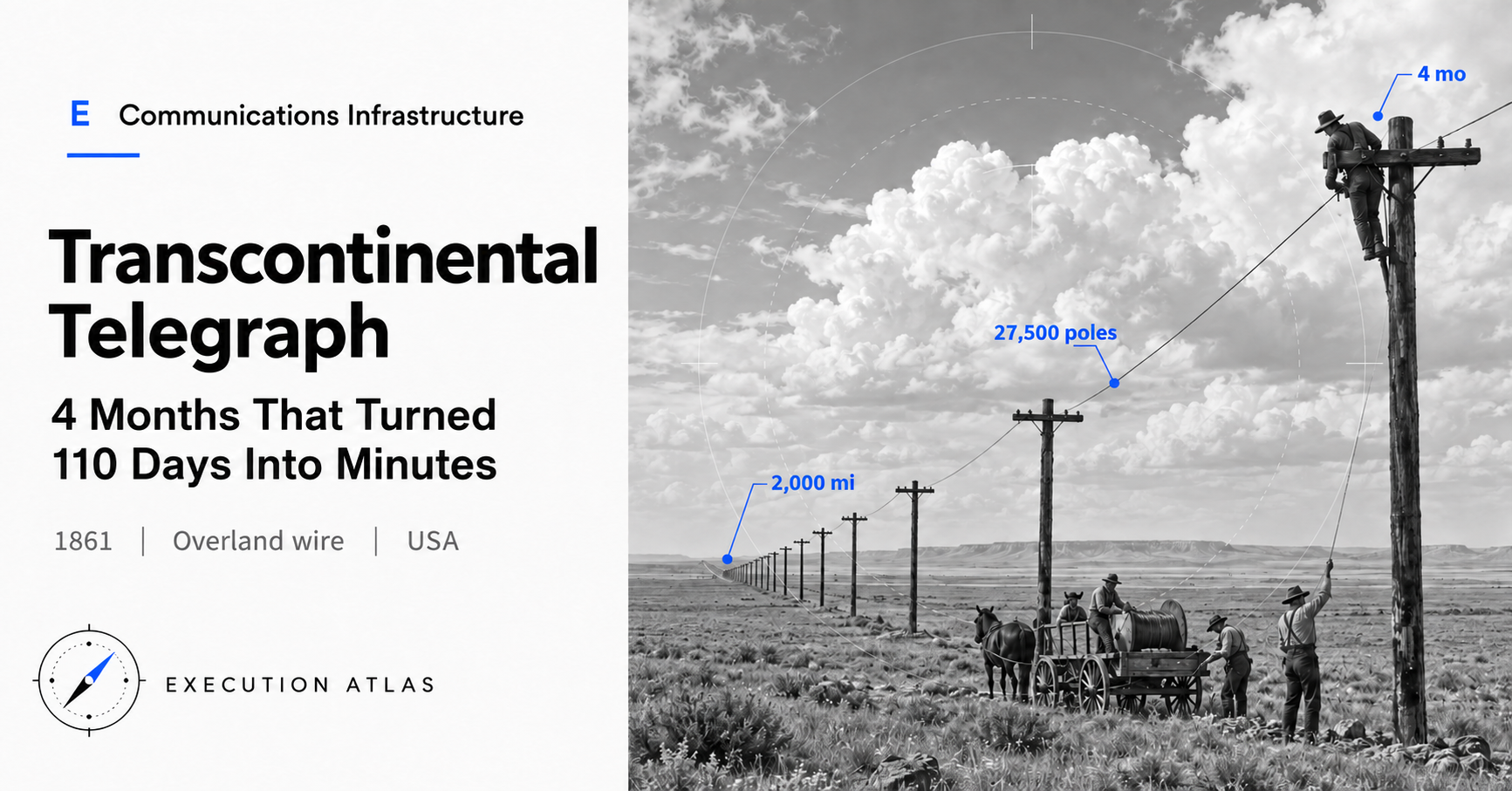
27,500 wooden poles. 2,000 miles of single-strand iron wire. 400 men and 500 mules. Construction time: under four months.
In 1841, news of President Harrison’s death took 110 days to reach Los Angeles. On October 24, 1861, the day after two lines joined in Salt Lake City, California Chief Justice Stephen J. Field sent a message directly from San Francisco to Lincoln in Washington, D.C. The transmission took minutes.
Two days later, Pony Express officially ceased operations. It had been in business for 19 months.
Mission: Why Run Wire West in a Year of Civil War?
On June 16, 1860, the Pacific Telegraph Act cleared Congress. The federal government would grant subsidies of $40,000 per year for 10 years — up to $400,000 total — to any company that laid telegraph lines west of the Mississippi, along with the right to build across public lands. Awards would go through competitive bidding.
Only one company bid. Western Union’s Hiram Sibley. Everyone else wrote off the West. Desert and mountain ranges, territories with sparse records, no clear timber supply. Forty thousand dollars a year couldn’t pencil out.
Sibley ran a different calculation. He wasn’t looking at the subsidy amount — he was looking at the monopoly rates once the line opened. Connect the coasts with zero competition, and you set your own prices. The sole bid wasn’t a losing proposition; it was a monopoly license acquisition.
On April 12, 1861, before dawn, the bombardment of Fort Sumter began. Thirty-four hours later, Major Robert Anderson surrendered the fort. The Civil War had started. Sibley worried about California’s loyalties from his Western vantage point. Would it secede? Southern sympathizers in Los Angeles had begun raising their voices. The California legislature had resolved to remain in the Union, but maintaining that loyalty across a 110-day information gap was hard.
The war looked like a reason to halt the project. Congress might cut the subsidy. Labor and supplies would go east for military needs.
Sibley read it the opposite way. Infrastructure that kept the West inside the Union was infrastructure Congress would never cut. They’d accelerate it.
On July 4, Independence Day, Edward Creighton’s crew planted the first pole in a prairie outside Omaha.
Design: Meet in Salt Lake City
Sibley and Jeptha Wade divided the project between two companies.
Pacific Telegraph Company, running west from Omaha. Superintendent: Edward Creighton. The previous winter, he had scouted the candidate route alone on horseback — Omaha, Fort Kearney, Fort Laramie, South Pass, Salt Lake City — confirming in person where timber could be had, where fodder was available, where water could be found.
Overland Telegraph Company, running east from Carson City. Superintendent: James Gamble. A veteran who had already strung telegraph lines across California.
The connection point was Salt Lake City. Responsibility was divided at a single geographic point. You had to get there before the other side could meet you. The design eliminated any room for waiting on your counterpart.
The transcontinental railroad would follow the same pattern eight years later, in 1869 at Promontory Summit with the Golden Spike. The concept of parallel construction teams and a physical meeting point was tested first with telegraph wire, not rail.
Unlike the railroad, telegraph construction required no earthworks. No grades, no curves. Wire needed only tension calculations to span a valley. Dig a hole, plant a pole, attach a glass insulator, string the wire. The work was closer to assembly than civil engineering. That simplicity made four months possible.
Execution: Plant Poles, Negotiate with Tribes
Creighton’s crew moved with over 100 wagons, 400 workers, and 500 head of oxen and mules. Gamble’s western side was roughly the same scale. More than 800 men in total were converging simultaneously on a single line.
Timber procurement was the biggest problem. Across the prairie sections, there was nothing close to serviceable pole timber.
In the spring of 1861, Creighton had stopped in Salt Lake City and negotiated a separate commercial contract with Brigham Young. Latter-day Saint timber crews would supply poles from Utah for the westward-running sections. This was a commercial arrangement, not a political negotiation. For Young, it was also a chance to build economic ties with the federal government.
Relations with Native tribes were handled separately.
James Street reached a peace maintenance agreement with Shoshone chief Sho-kup: as long as Shoshone people were treated fairly, they would protect the telegraph line. Several Native Americans were hired as workers, paid in food and clothing. In Gamble’s own records, he wrote that building good relations was the best investment in protecting the line.
Relations with the Sioux were different. In the summer of 1861, west of Omaha, a Sioux party cut the line. The wire was iron, not copper, but it served as bracelet material. The sense that this was federal military infrastructure hadn’t registered yet — the feeling was closer to finding useful metal. The construction side responded with physical patrol patrols. Not everyone was brought to the same table. Terms offered varied with each party.
With Young: a commercial contract. With the Shoshone: a political agreement. With the Sioux: patrols. Local negotiations were never forced into a single mold.
Through the summer, the eastern crew advanced roughly five miles a day on average, sometimes ten. Poles were set at an average spacing of 116 meters. Where wire had to span a valley, tension and support height were adjusted on site. Workers dug holes during the day, set poles, and strung wire the next morning. Communication started the day the wire went up. Omaha and the advancing western front were always connected by line.
Worth noting the schedule against plan: the Pacific Telegraph Act was a ten-year contract. Nobody expected the line in four months. The actual result — from groundbreaking to connection — was under four months, roughly 3% of the contract window. Thirty-three times faster than the envelope.
Three factors converged to explain the compression.
First, the installation target was scalar. One wire. No need for the precise geological engineering that railroad demanded. Second, simultaneous east-west construction with an agreed meeting point eliminated waiting on each other. Third, Sibley pre-funded equipment and labor from Western Union’s operating capital. He moved before the subsidy payments arrived.
On October 18, Creighton’s side reached Salt Lake City. That same day, Young sent the first eastbound message on the line: “Utah has not seceded but is firm for the constitution and laws of our once happy country.”
On October 24, Gamble’s western end connected at Salt Lake City. The 2,000-mile single-strand line from Omaha to Sacramento was physically one wire.
The next day, October 25, Field sent a dispatch from San Francisco to Lincoln — the West would remain in the Union. Lincoln’s reply quoted the same scripture Morse had sent on his first transmission between Washington and Baltimore in 1844: “What hath God wrought?”
On October 26, Pony Express officially shut down. Nineteen months of operation. Two days after the line opened.
People: Hiram Sibley, Entrepreneur at 54
Hiram Sibley was born in New York State in 1807 and was 54 in 1861. Not young. From tanner to shoemaker to sheriff to regional telegraph company officer, he founded the New York and Mississippi Valley Printing Telegraph Company in 1851. In 1856, he consolidated telegraph companies east of the Mississippi under the Western Union name. He was the architect of that consolidation.
On the transcontinental telegraph bid, he overrode skeptics within his own board. The West won’t pay. You can’t string copper through the desert. You can’t cross tribal territories. The objections were many. Sibley pushed back with two arguments: the expected value of monopoly, and the political tailwind of wartime.
Edward Creighton was born in Ohio in 1820 and was 41 in 1861. Catholic, Irish-American. In his youth he worked construction on canals, then shifted to telegraph engineering. In the winter of 1860, he scouted the route alone on horseback from Omaha to Salt Lake City. One man’s solo ride past 40 effectively set the four-month timeline for the following year. After the line opened, he founded a bank in Omaha and invested in mines and railroads. He died at 54 in 1874. His estate, through the will of his widow Mary Lucretia, funded the founding of Creighton University in 1878. The wealth from the transcontinental telegraph in the West was its seed capital.
James Gamble was the western superintendent. A practitioner who had strung everything from submarine cables to overhead lines across California, he was strong on field management including tribal negotiations. The records he left about relations with Native Americans are notably careful for a white construction superintendent of that era.
Brigham Young was born in 1801 and was 60 in 1861. Second President of the Church of Jesus Christ of Latter-day Saints and the effective top authority of Utah Territory. Relations with the federal government had been strained since the Utah War (1857–58). His decision to cooperate with the telegraph was a practical move to build economic ties with Washington and dispel any suspicion of secessionist leanings. His first message on October 18 was a calculated political statement.
Stephen J. Field was born in 1816 and was 45 in 1861. California’s Chief Justice. In 1863, Lincoln would appoint him to the U.S. Supreme Court. His first transcontinental message on October 25 became a remembered moment in his career. What he communicated was a prediction: that the new communications link would keep the western states in the Union.
Legacy: The Elimination of the Information Gap — and the Industries It Destroyed
Pony Express shut down. Nineteen months of operation. Closing two days after the line opened means the business model never incorporated the speed at which telegraph construction could actually move. The competitor wasn’t a rival courier — it was a wire not yet strung.
The newspaper industry changed overnight. After November 1861, the New York Herald ran West Coast news on the same-day edition. Before that, stories from the West arrived by stagecoach and ship and were three weeks late as standard. California’s political movements, mining prices, the stirrings of Southern sympathizers — all of it became today’s news.
This was roughly when the Associated Press shared-wire network began operating in earnest. A single dispatch from New York went out simultaneously to member papers nationwide. The race for scoops shifted from geographic advantage to time advantage. What mattered was how fast you could react to the same information, not where you were.
The effect on wartime information flow was significant. Secretary of War Edwin Stanton managed battlefield intelligence via telegraph, and censorship of press dispatches fell under his authority. The model of the state controlling communications infrastructure during wartime became standard practice after 1861.
Back to the subsidy: the Pacific Telegraph Act funded $40,000 a year for ten years, capped at $400,000. Estimated construction costs exceeded $500,000. The subsidy alone ran short.
Opening-week rates: $1 per word. The Pacific Telegraph Act’s ceiling was 30 cents. Three-point-three times the limit. Customers paid anyway. There was no alternative. Stock price telegrams and war dispatches were the first major customers, and construction costs were recovered within a few years of opening. In 1869, Sibley stepped down from Western Union — exactly when the brand value of “the man who built the transcontinental telegraph” had fully appreciated. He moved on to railroad construction and farming in the Midwest and South.
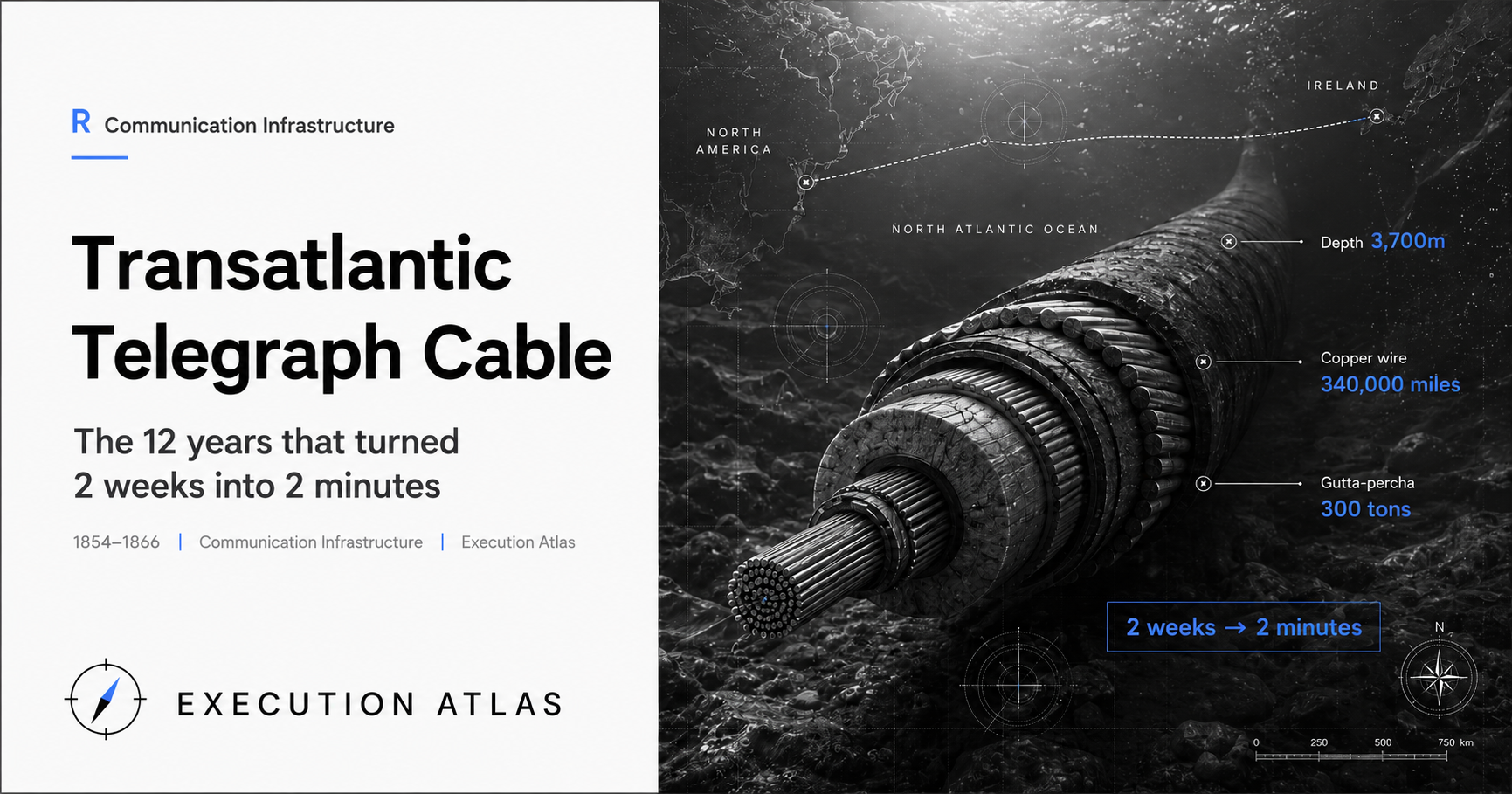
A second legacy: the groundwork for the next undersea cable. The Atlantic telegraph cable had succeeded briefly in 1858 before failing after three weeks; in 1866, it succeeded permanently. The proof that a continent could be spanned by wire became an investment argument for spanning the ocean. When Cyrus Field presented his cable project to London investors, he repeatedly cited the transcontinental telegraph’s success. If it worked across the Western desert, it could work across the Atlantic floor.
The line was paralleled with the completion of the transcontinental railroad in 1869, and through the 1870s multiple wires ran alongside one another. The single iron-strand wire of 1861 survives in no original form. But the design logic — parallel teams converging on a single geographic point, with a hard handoff — has repeated itself across infrastructure projects ever since.
Takeaway: When Information Speed Jumps by Orders of Magnitude, Adjacent Industries Disappear as a Side Effect
Read as a technology success story, the transcontinental telegraph is thin. Wire was strung, the line connected, things got faster. That’s the whole narrative.
What’s interesting is that this project never aimed to destroy Pony Express. The goal was a unified federal information infrastructure and a monopoly license over western communications. Pony Express’s collapse was a byproduct. A business that had grown fast over 19 months disappeared two days after the line opened.
When the speed of information transmission increases by an order of magnitude, every industry built on the old speed simultaneously loses its value. Fast horses, stagecoaches, regionally-monopolized newspapers, the intermediaries who carried Eastern price data west — all replaced at once. The side-effect destruction of industries is never what the builders intended. But it happens.
This applies directly to modern work. When you increase the speed, scale, or precision of what you offer by an order of magnitude, you simultaneously erase someone else’s business model. You didn’t intend it. It’s not in the business plan. But the backlash from the displaced side will come — from directions you didn’t anticipate.
The second lesson is Sibley’s monopoly-license read. A sole-bid project looks like a money-losing project. It’s also a project where you receive the entire expected value of a monopoly. The higher the entry cost, the longer the monopoly window stays open. The comparison isn’t the subsidy amount — it’s the expected value of exclusivity. Whether to bid in an uncontested tender is decided there.
Divide responsibility at a single geographic point. One agreement — “meet in Salt Lake City” — let the eastern and western crews run independently without waiting on each other. When a project runs across multiple teams, deciding where the outputs physically converge comes before progress tracking. If that point hasn’t been set, set it first.
On the evening of October 24, 1861, at the Salt Lake City telegraph office, the eastern crew and western crew did not meet in person. When the cables connected and confirmation signals came back from both ends, each crew learned of the completion from where they stood. Through the wire.
A design for convergence without meeting.
Sources
- Wikipedia, “First transcontinental telegraph” — general overview, construction timeline, tribal relations, post-opening monopoly rates (https://en.wikipedia.org/wiki/First_transcontinental_telegraph)
- Engineering and Technology History Wiki, “Milestones: Transcontinental Telegraph, 1861” — Pacific/Overland division structure, 27,500 poles, Salt Lake City connection (https://ethw.org/Milestones:Transcontinental_Telegraph,_1861)
- U.S. National Park Service, “The Transcontinental Telegraph” — Creighton crew scale, opening date, Pony Express shutdown (https://www.nps.gov/articles/000/the-transcontinental-telegraph.htm)
- Wikipedia, “Pacific Telegraph Act of 1860” — subsidy framework, public-land rights, rate ceiling (https://en.wikipedia.org/wiki/Pacific_Telegraph_Act_of_1860)
- Wikipedia, “Pacific Telegraph Company” — eastern company origins and Creighton’s route survey (https://en.wikipedia.org/wiki/Pacific_Telegraph_Company)
- Wikipedia, “Overland Telegraph Company” — western company origins and Gamble’s role (https://en.wikipedia.org/wiki/Overland_Telegraph_Company)
- History.com, “Western Union completes the first transcontinental telegraph line” — opening date and Pony Express shutdown (https://www.history.com/this-day-in-history/western-union-completes-the-first-transcontinental-telegraph-line)
- Library of Congress, “Today in History — October 24” — political significance of the opening and Lincoln dispatch (https://www.loc.gov/item/today-in-history/october-24/)
- WyoHistory.org, “The Telegraph Crosses Wyoming, 1861” — field operations and Creighton’s survey (https://www.wyohistory.org/encyclopedia/telegraph-crosses-wyoming-1861)
- Creighton University, “How Edward Creighton united a nation” — Creighton’s survey, Mormon cooperation, post-opening wealth (https://alumni.creighton.edu/news-events/news/edward-creighton-transcontinental-telegraph)
- Britannica, “Hiram Sibley” — Sibley’s entrepreneurial profile, Western Union consolidation (https://www.britannica.com/money/Hiram-Sibley)
- Utah state, “The Telegraph was the Information Highway of the 1860s” — Brigham Young’s full message text and early Utah communications (https://historytogo.utah.gov/telegraph/)