February 26, 2022. Mykhailo Fedorov, Ukraine’s Minister of Digital Transformation, posted a request on Twitter. Russian cyberattacks had disabled communication satellites. The recipient: Elon Musk.
Two days later, Starlink terminals arrived. USAID transported 5,000 units to Poland. President Zelenskyy later publicly praised it as “very effective.” A head of state, praising a private company’s service.
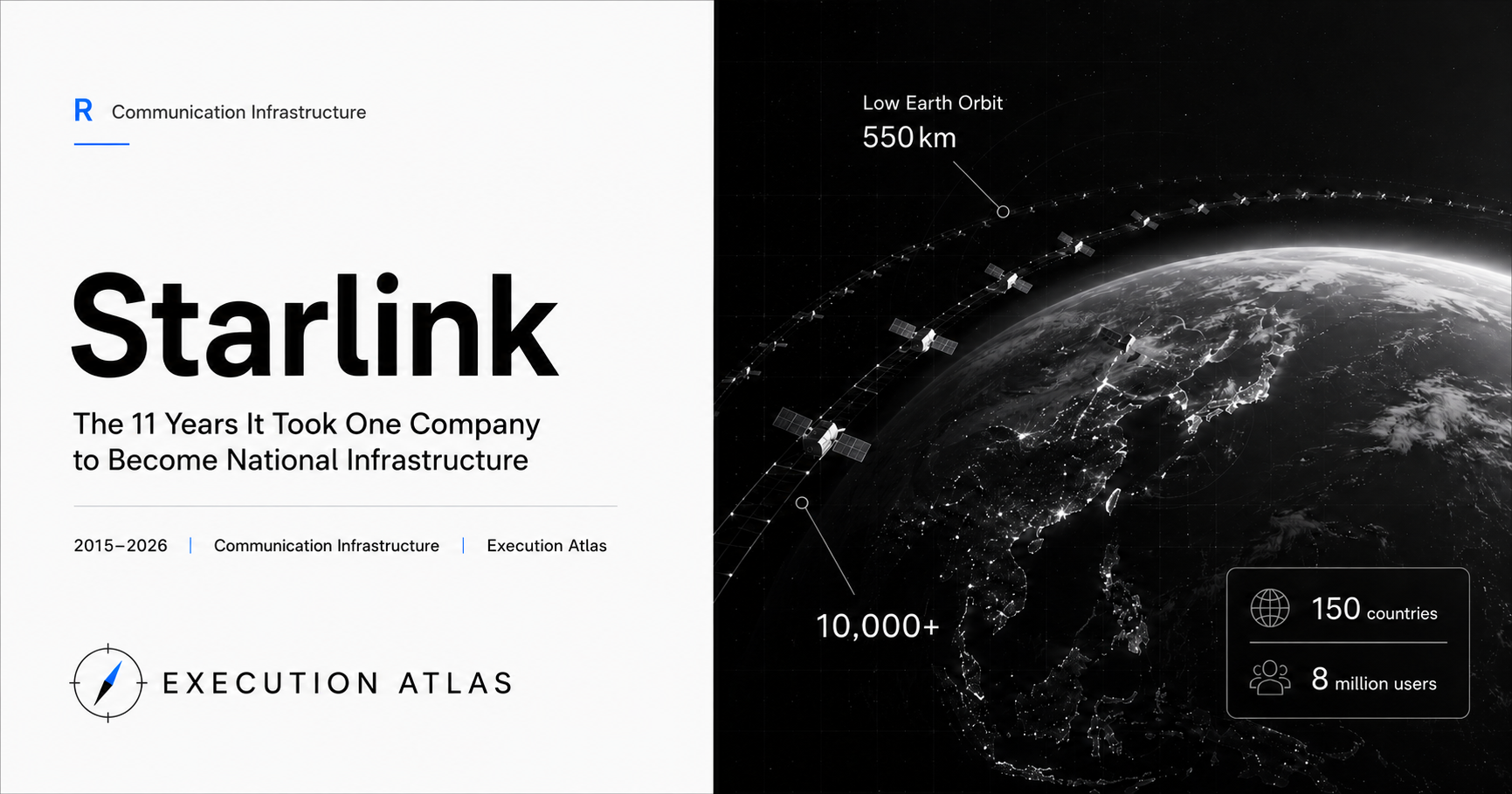
Over 10,000 satellites. 8 million users. 150 countries. 512 satellites launched in the first two months of 2026. Monthly average: 256. Revenue: $15 billion, profit margin: 60-80%.
11 years since the 2015 announcement. SpaceX built the largest satellite constellation in low Earth orbit and became a substitute for national infrastructure.
Mission: Internet for All Humanity
January 2015. A satellite development facility opened in Redmond, Washington. The day Elon Musk announced the Starlink project.
The goal was clear. Provide affordable, high-speed internet access to people worldwide. At the time, internet connectivity in developing countries and disaster areas was constrained by money and geography. Places unreached by terrestrial infrastructure stayed disconnected.
The plan started with 12,000 satellites and would eventually expand to 42,000. The then-largest Iridium satellite constellation had about 66 satellites. Over 600 times larger.
The concept originated in 2014. Musk and Greg Wyler planned “WorldVu,” a constellation of about 700 satellites. This would later evolve into Starlink.
Internet access for all humanity. Education in developing countries, emergency communications in disasters, elimination of geographical constraints. Infrastructure, and the equalization of access.
Design: The 550km Low Orbit Choice
Traditional communication satellites operated in geostationary orbit above 36,000km. Starlink chose low orbit at about 550km. One sixty-fifth the altitude of geostationary satellites.
This choice determined everything.
The advantage of low orbit is latency. Geostationary satellites take 300-600ms. Starlink: 20-40ms. Less than one-tenth. Because the physical distance light travels between ground and satellite is shorter. Fast enough for video conferencing and real-time communication.
The cost: number of satellites. In low orbit, each satellite covers a narrower area. Geostationary orbit can cover the entire Earth with 3 satellites. Low orbit requires thousands.
Another cost: satellite lifespan. In low orbit, atmospheric drag lowers the orbit, causing reentry in 5-10 years. Geostationary orbit lasts decades. Meaning new satellites must be launched continuously.
SpaceX reversed this constraint. Vertical integration.
Satellite design, manufacturing, rocket launches, infrastructure construction, service provision. All done in-house. Other companies separate satellite manufacturers, rocket companies, and service providers, requiring months of coordination. SpaceX completes everything internally. Launching their own satellites on their own rockets.
Falcon 9 reusable rockets destroyed the cost structure. Launch cost to low orbit: about $2,720 per kg. NASA’s Space Shuttle: about $54,500. One-twentieth.
Low orbit, massive satellites, short lifespan, vertical integration, reusable rockets. These combined to completely rewrite the economics of satellite communications.
Execution: The System That Enabled 256 Satellites Per Month
February 22, 2018. The first test satellites “Tintin A” and “Tintin B” launched. Mass: 400kg, orbital altitude: 511km. About 22 hours after launch, passing over Los Angeles, they transmitted “hello world.”
May 2019. Launched the first 60 satellites at once. Beginning of full deployment.
- Two consecutive launches in about 15 hours. 512 satellites placed in orbit in the first two months of the year. Monthly average: 256.
System design supports this productivity.
Redmond Satellite Factory
Satellites are standardized. Generations evolve from V1 to V3, but the basic design stays common. The Redmond factory runs the production line. Chips co-designed with STMicroelectronics (France, Italy), manufactured in France, Malta, and Malaysia.
The design improvement cycle is fast. January 2020: DarkSat (black-painted body) test launch. Countermeasure to reduce impact on astronomical observation. June same year: VisorSat (sunshade-equipped) launch. Learning from failures, immediately reflecting in next design. V3 satellites (significantly larger, increased communication capacity) scheduled to begin full operation from late 2026.
Power of Falcon 9 Reusability
SpaceX launches in parallel from multiple sites.
Falcon 9’s first-stage booster lands on offshore drone ships, gets refurbished, and flies again. This reusability cut launch costs to 1/20.
Other companies need months just to coordinate with a rocket provider. SpaceX loads finished satellites onto their own rockets and launches on their own schedule.
High-Speed Iteration
From Tintin A/B testing to full deployment: about 1 year. February 2018 to May 2019. Traditional satellite projects require years just for testing.
This speed is possible not because they tolerate failure, but because they have a system to learn from failure and immediately reflect it in the next design. Validate effects with DarkSat, improve with VisorSat, transition to next generation with V3.
256 per month. Competitor OneWeb “plans” 648 satellites. Starlink already “operates” over 10,000. Amazon Kuiper plans 3,236 and began full-scale launches in April 2025.
SpaceX runs a cycle of launching their own satellites on their own rockets. This cycle’s speed is what separates them from others.
Combat Deployment in Ukraine
February 26, 2022, immediately after the Russian invasion. Ukraine’s Minister of Digital Transformation Mykhailo Fedorov requested support from Musk on Twitter. ViaSat’s communication satellites had been disabled by cyberattacks.
Two days later, Starlink terminals began arriving. President Zelenskyy praised it as “very effective.” Ukrainian military communications relied on Starlink.
But in fall 2022, Starlink communications went dark in frontline areas. Reports indicated Musk used geofencing to restrict use in offensive military operations.
One company’s decision shaped the battlefield’s communication infrastructure.
People: A Woman from the Early Days
Gwynne Shotwell joined SpaceX in its early days in 2002. As VP of Business Development.
When she joined, SpaceX had no launched rockets and no customers. In 2006, she secured the COTS contract with NASA. $278 million. This contract saved SpaceX.
Falcon 1 had failed three consecutive times. Before the fourth succeeded, funding was running out. Shotwell’s contract kept SpaceX alive.
She is now SpaceX’s President and COO. Responsible for daily operations and company growth. In 2022, Shotwell also led negotiations for Starlink provision to Ukraine.
March 2024, at the SATELLITE 2024 conference, announced SpaceX would sell optical satellite communication terminals developed for Starlink. “We are excited to continue this journey with ST to deliver the next generation connectivity solutions,” Shotwell stated.
Elon Musk decided to provide service to Ukraine and simultaneously restricted military use through geofencing. One CEO’s call reshaped a warzone’s communication environment.
A woman who joined in the early days became COO of a company with a planned IPO valuation of $1.5 trillion. After Falcon 1 failed three times, she negotiated and secured a NASA contract, saving the company.
People create organizations, and organizations change the world.
Legacy: New Geopolitics
As of March 2026, approximately 8,648 satellites are operational. Over 10,000 exist in orbit. The largest satellite constellation in history.
8 million users. Providing service in 150 countries. 2025 revenue: approximately $15 billion. EBITDA (earnings before interest, taxes, depreciation, and amortization): $6-7 billion annually. Gross profit margin: 60-80%. Cash flow is already positive.
The planned IPO could achieve a valuation of $1.5 trillion (approximately 234 trillion yen).
The costs are real.
Impact on Astronomical Observation
When 12,000 satellites are complete, an estimated 200 will be visible in the night sky at any given time. 200 artificial stars visible to the naked eye.
June 3, 2019, the International Astronomical Union (IAU) expressed concerns. Lowell Observatory in Arizona reported cases where Starlink satellite light created numerous streaks in images during galaxy observation.
In 2022, IAU established the “Centre for Protection of the Dark and Quiet Sky from Satellite Constellation Interference.” Japan’s National Astronomical Observatory also expressed concerns in July 2019.
SpaceX attempted countermeasures with DarkSat and VisorSat. But has not achieved complete resolution. The conflict between “democratization of space” and “impact on science.” Internet access for all humanity versus the night sky as humanity’s common cultural heritage. Which takes priority?
Private Companies Becoming National Infrastructure
Ukraine showed what that looks like in practice.
President Zelenskyy officially praised a private company’s service. USAID covered terminal transportation costs. Public-private collaboration. Yet simultaneously, Musk’s geofencing decisions affected military operations. A single company’s decisions have geopolitical impact.
SpaceX anticipates 2026 revenue of $22-24 billion. Mostly Starlink’s contribution. A private company operates communication networks on a scale exceeding national infrastructure.
Competitor OneWeb plans 648 satellites, went bankrupt in 2020, rescued by UK and Indian governments. Amazon Kuiper plans 3,236, service launch scheduled for late 2025. Starlink already operates over 10,000 and serves 8 million users. The numbers speak for themselves.
Learnings: The Time Lag Between Regulation and Innovation
256 per month. 42,000-satellite plan. When technology moves at this speed, regulation cannot catch up.
International space utilization rules lag behind. Impact on astronomical observation, space debris issues, military use ethics. Before rules are established, facts on the ground accumulate. First movers create de facto standards.
Over 10,000 satellites already in orbit. A future with 200 constantly visible in the night sky is now unavoidable. Kessler Syndrome (cascading collision) risk exists, but low orbit means reentry in 5-10 years. Easier to manage than geostationary satellites. But unprecedented scale.
Technology moves faster than regulation. A single company’s decisions carry geopolitical weight. “Democratization of space” and “impact on science” collide.
In 11 years since the 2015 announcement, SpaceX built the largest infrastructure in low Earth orbit. A private company became a substitute for national infrastructure, and Ukraine’s president praised it as “very effective.”
By the time regulation catches up, the world has already changed.
Sources
- Starlink - Wikipedia
- スターリンク - Wikipedia (JP Only)
- スペースXが約15時間で2回連続打ち上げ 2026年早くもスターリンク衛星を合計512機軌道投入 - sorae (JP Only)
- スターリンク(Starlink)とは? 4万機以上の衛星計画、天体観測への影響を解説 - sorae (JP Only)
- 古くて新しい衛星インターネット、Starlinkが変えていく世界 - IIJ Engineers Blog (JP Only)
- 経済安全保障時代における先端的な民生技術と民主主義国の課題-スターリンクを事例として- - Asia Pacific Initiative (JP Only)
- ウクライナで証明された衛星インターネットの有効性 - Business Insider Japan (JP Only)
- スペースX「スターリンク」がウクライナで証明した宇宙・サイバー・電子戦での実力 - Foresight (JP Only)
- ウクライナでのスターリンク衛星サービス - Wikipedia (JP Only)
- SpaceXの急成長を支える3つの収益エンジン:2025年155億ドル達成への道筋 (JP Only)
- 通信衛星群による天文観測への悪影響についての懸念表明 - National Astronomical Observatory of Japan (JP Only)
- Starlink等の大規模衛星コンステレーションが天文観測に与える影響 - Cabinet Office (JP Only)
- Gwynne Shotwell - Wikipedia
- Read TIME’s Full Interview with SpaceX’s Gwynne Shotwell