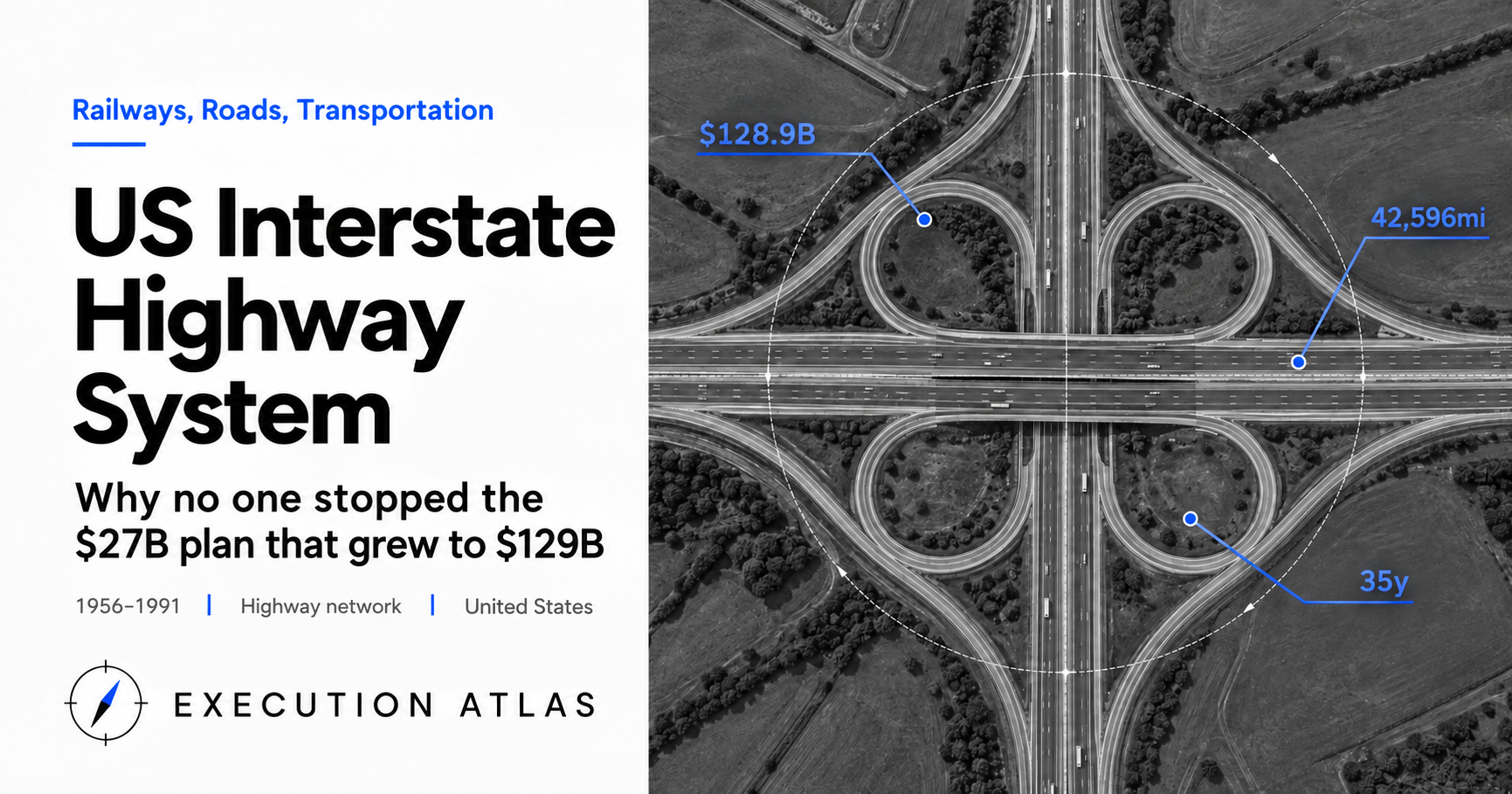
On June 29, 1956, President Eisenhower signed the National Interstate and Defense Highways Act. The plan: $27 billion, 40,000 miles, 13 years. The federal government would cover 90%, financed by a new 3-cent-per-gallon gasoline tax.
Almost every part of the plan turned out to be wrong.
The final mile of the initial network opened in September 1991 — 35 years after the signing. Final construction cost: $128.9 billion, roughly 4.8 times the original estimate. In 2016 dollars, a $192 billion plan had grown to $504 billion.
Yet over those 35 years, Congress never once shut the project down. In the 1960s, 123 protest movements rose up against urban freeways across the country. In the 1970s, inflation drained the trust fund dry three separate times. The money kept flowing regardless.
The mechanism that prevented any shutdown was buried not in the main highway bill, but in a companion statute passed the same day: the Highway Revenue Act of 1956.
Mission: The Mud of 1919 and the Autobahn of 1945
Eisenhower learned firsthand how bad American roads were 33 years before he became president.
In 1919, as an Army lieutenant, he joined the first transcontinental motor convoy from Washington, DC to San Francisco. The convoy had two purposes: to test whether military vehicles could move over long distances, and to promote the “good roads” movement. A supply brigade whose men couldn’t read contour lines on a map took two months to cross the country on the Lincoln Highway — the forerunner of today’s US-30.
What he actually traveled through was mud, gumbo clay, collapsing wooden bridges, roads too narrow, and unpaved stretches through sandstorms. He went to see whether the road network could move an army in a national emergency and came back with the answer: no.
Twenty-six years later, entering postwar Germany as Supreme Allied Commander, he saw the Autobahn. In his memoirs he wrote: “In the old Transcontinental Army convoy, I had thought about good two-lane highways. In Germany, I saw the wisdom of broader ribbons across the country.”
That is the personal story, not the policy story. The policy groundwork had been laid by someone else.
Thomas MacDonald became Chief of the Bureau of Public Roads in 1919 and held the same seat for 34 years until 1953. In 1939, he and his deputy Herbert Fairbank wrote a report, Toll Roads and Free Roads, concluding that transcontinental traffic volume was insufficient to sustain a toll network and proposing a 43,000-mile free highway system funded by gasoline taxes. The Federal-Aid Highway Act of 1944 codified 40,000 miles of a “National Highway System” based on that proposal — but appropriated no money.
When Eisenhower won the presidency in 1952, the blueprint had already existed for 17 years. What was missing was a story capable of getting $27 billion through Congress.
On July 12, 1954, Vice President Nixon announced the “Grand Plan” at a governors’ conference at Lake George: a $101 billion road program. That August, the Clay Committee was formed. Chaired by General Lucius Clay, its members included executives from AT&T and Bank of America. In just two months, the committee produced a package: $27 billion, 40,000 miles, 92.6% federal funding.
Nobody said aloud, “If we’d framed this as a transit convenience, it wouldn’t have lasted 13 years” — but the same logic was at work. The program was positioned not as economic infrastructure but as national defense in the context of the Cold War. The official name of the act: the National Interstate and Defense Highways Act.
Design: A Separate Law to Guarantee No Deficit
Eisenhower had one personal constraint. As a Republican president committed to balanced federal budgets, he could not sign a bill that increased the national debt. “If it means going into deficit to build the roads, I won’t sign it,” he told the cabinet directly.
The Clay Committee’s $27 billion figure and the “13-year completion” anchor alone weren’t enough to move the fiscal hawks in Congress. The first bill, which would have issued federal construction bonds, was rejected by both chambers in 1955.
The following year, the bill’s architecture was rebuilt. The main “Federal-Aid Highway Act” defined the construction program; the companion “Highway Revenue Act” defined the funding. The latter was the critical piece.
The Highway Revenue Act of 1956 created a federal tax of 3 cents per gallon of gasoline, along with a series of excise taxes on diesel, tires, and vehicle weight, and mandated that all revenue flow entirely into a dedicated trust account called the Highway Trust Fund. The fund was insulated from the general Treasury and could only be used for the federal share of Interstate construction and existing federal-aid road payments.
A user-fee trust fund. The people who drove the roads paid for their construction, a few cents at a time, every time they bought gasoline. Zero drawdown from the general federal budget. The structure financially reserved 13 years of construction costs while satisfying Eisenhower’s balanced-budget requirement.
Paired with this was the 90% federal / 10% state cost-sharing ratio. States had to put up 10% of their own money to receive federal funds. This capped frivolous state requests for unnecessary segments while giving every governor a headline — 90 cents of federal money flowing into their state for every 10 cents they spent. That structural incentive explains why governors’ conferences never turned against the project.
The “big vision” was national defense and the $101 billion Grand Plan. The “no-loss mechanism” was the Highway Revenue Act’s gasoline-tax trust fund.
The two passed as separate laws on the same day. That made Eisenhower’s signature possible and allowed the next 35 years of construction to run independently of Congress’s annual budget cycle.
Execution: 26% Over Budget by Year Two, Fund Runs Dry in Year Three
In 1956, the Bureau of Public Roads still didn’t have real construction costs. The Clay Committee’s $27 billion figure was based on MacDonald-era traffic data from 1944 — it did not account for the 1950s surge in car ownership or the spread of urban sprawl.
In January 1958, the Federal Road Administration published its first formal estimate, the Interstate Cost Estimate (ICE): $37.6 billion for 38,548 miles, with the federal share alone at $33.9 billion. That was 26% above the 1956 figure of $27 billion — and this was when only a few percent of the total had been paved.
In 1959, the Highway Trust Fund ran short for the first time. Gasoline tax revenue wasn’t keeping pace with construction contract spending. Eisenhower sent Congress a request to raise the gasoline tax by 1.5 cents. “To keep the 13-year completion promise, we need to raise the rate by 50%.” Congress trimmed the request to 1 cent, and in 1959 the gasoline tax rose from 3 cents to 4 cents.
That pattern repeated for the next 30 years. Whenever the trust fund neared empty, the gasoline tax went up by a small increment. Instead of going back for a new appropriation when the plan went off-rails, the user-fee rate was adjusted to keep the fund turning. The money never stopped flowing.
What actually slowed the schedule wasn’t money — it was the urban segments.
MacDonald’s 1944 vision had drawn the Interstate as an intercity network. In the 1950s, mayors who wanted to use federal money for urban renewal rewrote routes to cut through cities. Chicago’s Dan Ryan Expressway, New Orleans’ Claiborne Expressway, Baltimore’s I-70 — all plowed through Black and working-class neighborhoods. In planning documents, the demolitions were labeled “slum clearance” and looked rational on paper.
In the 1960s, the people who lived in those urban corridors began to push back. At its peak in the early 1960s, Interstate construction was demolishing 37,000 urban housing units per year. The majority of the displaced were Black households. One phrase from Freeway Revolt organizers has been preserved in the record: “white men’s roads through black men’s homes.”
A 1967–68 Department of Transportation survey counted 123 active disputes over urban freeway projects across the country. The Federal-Aid Highway Act of 1962 attached a “continuing comprehensive transportation planning” requirement — the 3C process — to federal aid for urban segments, forcing integration of state and city planning. The National Environmental Policy Act of 1969 and the Clean Air Act of 1970 added environmental impact assessments and air quality constraints. The average lead time from the start of public hearings to groundbreaking on urban segments stretched to roughly eight years.
The original 1969 completion target, then the revised 1972 target — neither held. The deadline slipped to 1978, and it was ultimately the opening of I-70 in September 1991 that allowed the initial network to be declared “complete.” Thirty-five years, $128.9 billion, 2.7 times the planned schedule and 4.8 times the planned cost.
People: 34 Years of Bureaucracy and Two Months of Committee Work
Ask who built the Interstate and you encounter an asymmetry in the number of names.
Thomas MacDonald served as Chief of the Bureau of Public Roads from 1919 to 1953 — 34 years in the same chair. He convened state road directors into AASHO (the American Association of State Highway Officials), defined the rules for federal aid, influenced personnel at state highway departments, and standardized traffic and accident statistics. His 1939 Toll Roads and Free Roads report committed the blueprint for a free highway network and the idea of gasoline-tax financing to paper. By the time the 1944 law codified the 40,000-mile figure, his work was essentially done.
General Lucius Clay led Eisenhower’s advisory committee from August to late October 1954 — roughly two months. Five members, all from the top of business or the military; no career highway administrators. They assembled the $27 billion, 40,000-mile, 92.6%-federal-share package and submitted it. The package flowed into the 1956 law essentially intact.
The decades of groundwork and the short burst of political momentum operated in two stages. Without 34 years of bureaucratic work to supply the blueprint, two months of committee work had nothing to fill. Without the committee’s political leverage, 34 years of blueprints would have sat on a shelf for another 17.
Francis V. du Pont cleared the path on the congressional side in parallel. After serving as Chief of the Bureau of Public Roads from 1953 to 1954 and then resigning to become an unpaid consultant, he appeared as the lead witness at congressional hearings to explain the Grand Plan. His father, T. Coleman du Pont, had spent roughly $3.9 million of his own money building the du Pont Highway across Delaware from 1911 to 1923 — a family tradition that made Francis a natural champion of federal highway construction.
Eisenhower himself, after signing in 1956, did not involve himself in individual route decisions or contract negotiations. He planted the political flag of “defense roads,” approved the financial structure of the Highway Trust Fund, and then stepped back as the program flowed to executing agencies and state governors. The president who warned in his 1961 farewell address of the military-industrial complex had, over the same term, launched a “highway-industrial complex” of comparable scale.
“In the old Transcontinental Army convoy, I had thought about good two-lane highways. In Germany, I saw the wisdom of broader ribbons across the country.”
That line appears in his postwar memoirs. Eisenhower himself traced the bill’s conceptual roots to the mud of 1919 and the Autobahn of 1945. It explains why the program’s center of gravity was “defense road” rather than “domestic infrastructure” — by drawing on the arc of his own life.
Legacy: 35 Years of Money That Drives the Next 70
When the initial network was declared “complete” in September 1991, the Interstate stood at 42,596 miles of open road (99.5% of the original plan), $128.9 billion in construction costs ($114.3 billion federal share), 35 years of total construction time — 2.7 times the scheduled duration and 4.8 times the projected cost.
On those numbers alone, classifying it as a project-management failure would not be wrong. Yet nearly every review treats the Interstate as “a successful large-scale public works project.” The reason the labels seem to cross is that the cost overruns converted into productivity.
The Federal Highway Administration’s calculations attribute roughly 25% of US productivity gains between 1950 and 1989 to the Interstate. An ARTBA (American Road & Transportation Builders Association) 2021 report estimated the Interstate’s current annual economic value at $742 billion and projected a real GDP reduction of $619.1 billion (3.9%) if the network were removed. Some private-sector analyses put the ROI at “$6 for every $1 invested in construction.”
The two-and-a-half times that $128.9 billion bought became the foundation supporting $742 billion in annual economic activity for the next 70 years. Measured as a return on initial investment, the project is, by a rough calculation, a success.
At the same time, the price the Freeway Revolt pointed to has also persisted. Urban highways that cut through city centers became the targets of removal campaigns in the 2020s. New York’s Sheridan Expressway, part of Rochester’s Inner Loop, New Orleans’ Claiborne Expressway — segments that sliced through Black neighborhoods in the 1960s are being brought back to grade 60 years later.
And the financial mechanism itself — the Highway Trust Fund — remained. The gasoline tax that started at 3 cents in 1956 climbed to 18.4 cents by 1993, and as of 2026 it has not been revised once since. The spread of electric and hybrid vehicles is beginning to erode the denominator of the user-fee model. The structure designed 70 years ago to make users pay for what they use is starting to distort under a changing pattern of use.
Even so, when Congress assembled $550 billion in new infrastructure spending under the 2021 Infrastructure Investment and Jobs Act, it built the increase on the framework of the Highway Trust Fund. The trust-fund vessel designed in 1956 still functions as the backbone of federal infrastructure finance seven decades later.
A project that ran 4.8 times over budget has lasted 70 years — sustained by the financial structure it laid beneath itself.
Lessons: Place a User-Fee Trust Fund Beneath the Big Vision
One lesson can be extracted from the Interstate.
To keep a multi-decade investment moving over ten-year timescales without stopping, you need to design a user-fee-based financial mechanism with the same weight as the main project plan — and keep it as a separate instrument.
Consider a world where the Federal-Aid Highway Act of 1956 existed but the Highway Revenue Act did not. The $27 billion in construction costs would have had to come from the general federal budget. The moment the first cost overrun became clear in 1959, Congress would have started cutting the construction budget in its annual appropriations. The pressure of 1960s Freeway Revolt opposition would have channeled into budget-reduction demands; 1970s inflation would have hit real budgets directly. Given that Eisenhower was a fiscal-balance true believer, he might well have refused to sign the bill in the first place.
What actually happened was different. The Highway Trust Fund automatically routed gasoline-tax revenue into the project and cut it off from the annual budget cycle. When the fund neared empty, raise the gasoline-tax rate by a cent and extend its life. Urban segments falling behind schedule didn’t stop the money. After growing to 2.7 times the planned duration and 4.8 times the planned cost, the project was structurally “unable to run out of money.”
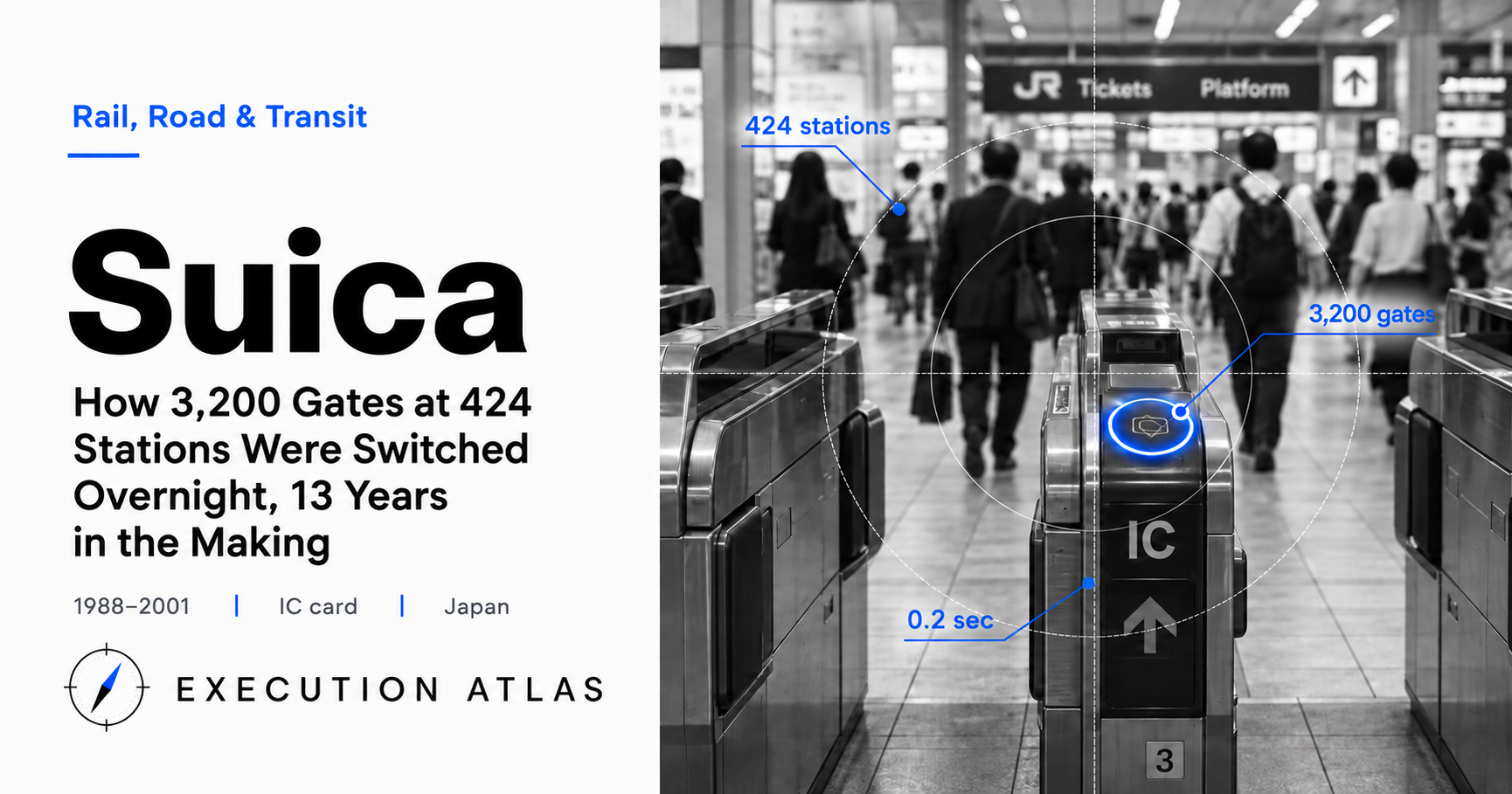
The structure is almost identical to how the Suica IC card system was sustained by Akio Shiibashi’s roadmap. Shiibashi calculated that recovering ¥100 billion through fare-use alone would take more than ten years, so from the start he drew a roadmap of staged expansion into e-money, mobile payments, and everyday purchases. The vision’s height prevented management from stopping it; accumulated user-fee revenue sustained the finances. Eisenhower’s Highway Trust Fund placed “national defense” on the vision side and “gasoline tax” on the financial side. The names of the engineers are different, but the structure is the same type.
The question to ask of your own project: when you’re asking an organization to carry a ten-year-plus investment, where is the financial mechanism that cuts the project loose from annual management approval? Have you, from the concept stage, wired in a separate contract — a device that automatically fills a fund as users engage with what you’ve built? Or are you running on vision alone?
Overruns are guaranteed. Whether a project that runs 2.7 times over schedule still runs for 70 years afterward is determined not by the main plan but by the design of the financial mechanism laid alongside it.
The single biggest reason the Interstate spent $128.9 billion over 35 years and still didn’t stop was one barely visible design decision made in 1956: passing a user-fee trust fund as a separate law.
Sources
- Federal Highway Administration, “Dwight D. Eisenhower System of Interstate and Defense Highways” series — primary sources on the Clay Committee, the 1956 Act, and the Grand Plan
- National Archives, “National Interstate and Defense Highways Act (1956)” — original text and background
- Eisenhower Presidential Library, “Interstate Highway System” — 1919 motor convoy records and Eisenhower’s own statements
- Richmond Fed, “When Interstates Paved the Way” (Econ Focus 2021 Q2-3) — $128.9B final cost, $504B (2016 dollars) conversion, 2.7× schedule overrun
- Eno Center for Transportation, “The First Time the Highway Trust Fund Went Broke” series — 1959 trust-fund shortfall and the politics of the gas-tax increase
- Raymond A. Mohl, “The Interstates and the Cities: Highways, Housing, and the Freeway Revolt” (PRRAC) — urban segments and the 1960s opposition, 37,000 units/year displacement figure
- WyoHistory, “Eisenhower’s 1919 Road Trip and the Interstate Highway System” — details of the 1919 motor convoy
- ARTBA, “Economic Impacts of Transportation Infrastructure” (2021 report) — $742B/year and $619.1B GDP reduction estimates
- FHWA, “The Greatest Decade 1956-1966” — early construction timeline and technical challenges
- Eno Center, “1939 Toll Roads and Free Roads Report” — content and significance of the MacDonald/Fairbank report
- Wikipedia, “Interstate Highway System” / “Federal-Aid Highway Act of 1956” / “Thomas Harris MacDonald” — timeline overview and biographical details