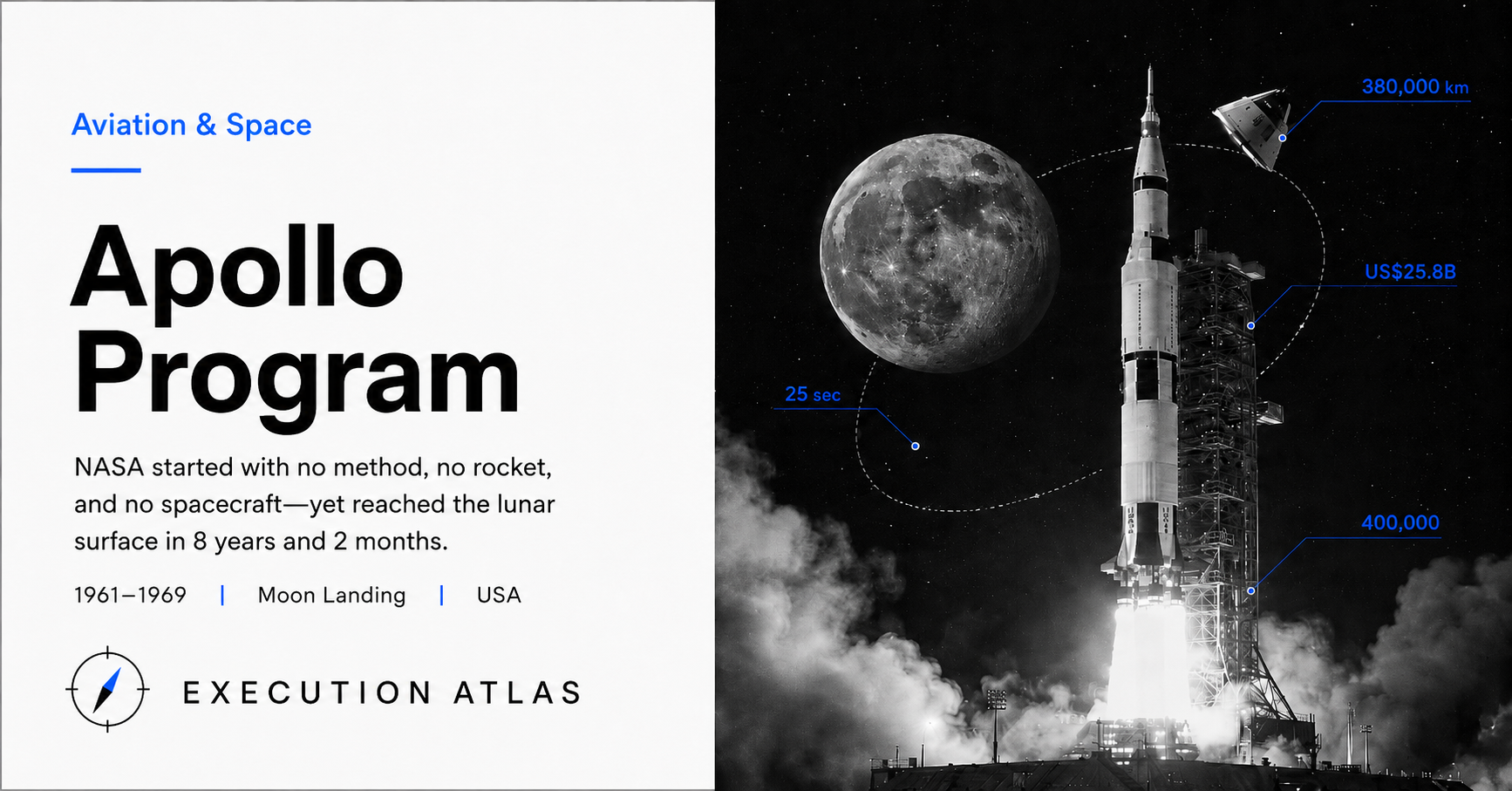
$25.8 billion. 400,000 people. 384,000 km to the Moon. Three days one way.
On May 25, 1961, President Kennedy addressed Congress. “I believe that this nation should commit itself to achieving the goal, before this decade is out, of landing a man on the moon and returning him safely to the earth.” At that point NASA had no method, no rocket, and no spacecraft to reach the Moon.
Eight years and two months later, on July 20, 1969, Apollo 11 touched down on the lunar surface. Twenty-five seconds of fuel remaining.
Mission
April 12, 1961. The Soviet Union’s Yuri Gagarin became the first human in space. 108 minutes in orbit.
May 5. Alan Shepard flew the first American spaceflight. A suborbital arc lasting 15 minutes.
May 25. Kennedy declared the Moon landing before Congress. NASA’s annual budget stood at $500 million. No organization even existed to study how to get to the Moon.
Why the Moon? Matching Gagarin required only an orbital flight. Kennedy and NASA Administrator James Webb chose a domain the Soviets had not yet entered. In Earth orbit, the Soviets held the lead. The Moon offered a level starting line.
September 1962. Kennedy spoke to 40,000 at Rice University. “We choose to go to the Moon in this decade and do the other things, not because they are easy, but because they are hard.” On the space budget, he added: $5.4 billion a year. “A staggering sum, though somewhat less than we pay for cigarettes and cigars every year.”
By 1966, NASA’s budget reached $5.9 billion. 4.4% of the federal budget. Twelve times the level when Kennedy made his declaration.
Design
How to get to the Moon. NASA had three options.
Direct ascent. A massive Nova rocket flies straight from Earth to the Moon and lands. The 50-foot-diameter rocket could not be launched from Cape Canaveral. Engineers considered carving a launch pad from a cliff face in Hawaii.
Earth orbit rendezvous. Multiple Saturn V launches assemble a spacecraft in Earth orbit before heading for the Moon. Wernher von Braun’s preferred approach.
Lunar orbit rendezvous (LOR). The mothership stays in lunar orbit while a small lander descends to the surface. No need to carry return fuel all the way down to the Moon.
LOR was championed by John Houbolt, an engineer at the Langley Research Center. He presented the concept at review after review, ignored each time. At a December 1960 meeting, colleague Max Faget attacked him openly. “His figures lie. He doesn’t know what he’s talking about.”
In November 1961, Houbolt, 42 years old, gambled his career. He bypassed the chain of command and sent a nine-page letter directly to NASA Associate Administrator Robert Seamans. “Somewhat as a voice in the wilderness.” LOR was the only viable path to the Moon, he argued.
Seamans read it. He directed Joseph Shea to reevaluate all three approaches. In June 1962, von Braun publicly declared his support for LOR. On July 11, NASA announced the adoption of lunar orbit rendezvous.
That decision locked in Apollo’s architecture. One Saturn V. Two spacecraft: a command module and a lunar module. Height: 111 meters. Mass: 2,970 tons. Thrust: 34.5 million newtons. Eighteen meters taller than the Statue of Liberty, five F-1 engines punching through the atmosphere.
LOR carried one more advantage no one foresaw at the design stage. The lunar module had its own independent life support system. Eight years later, that redundancy saved three lives on Apollo 13.
Execution
In the fall of 1963, George Mueller took over as head of the Office of Manned Space Flight. He looked at the schedule and was alarmed. Von Braun’s team had planned more than ten test flights for the Saturn V. First stage only. First and second stages. All stages. Incremental verification before any crewed flight. Under that plan, the Moon landing would slip to 1971.
On October 31, Mueller issued his official memo on “all-up testing.” Every stage would fire on the very first flight. A method borrowed from Air Force ballistic missile development.
Von Braun’s team pushed back hard. Testing all stages at once meant no way to isolate failures. The Saturn V was handbuilt, one vehicle at a time, not a mass-produced missile. They protested to Seamans, who replied: “Talk to George.”
Mueller’s logic: incremental testing distributes risk across many flights but does not reduce it. Better to find out sooner.
The decision was not unanimous. It passed because Mueller outranked von Braun.
January 27, 1967. Apollo 1. During a “plugs-out test” on the launch pad at Cape Canaveral, fire broke out inside the command module. Pure oxygen atmosphere. Flammable materials. An inward-opening hatch. Gus Grissom, Ed White, and Roger Chaffee died. Seventeen seconds from the first spark to the final transmission.
NASA grounded all crewed flights for 21 months. A review board dismantled the command module and implemented over 1,000 design changes. The pure oxygen atmosphere was eliminated. All materials were replaced with non-flammable alternatives. The hatch was redesigned to open outward. Wiring received protective sheathing. The program manager was replaced: Joseph Shea out, George Low in.
November 9, 1967. The first flight of the Saturn V. Apollo 4, uncrewed. All three stages fired simultaneously under the all-up testing philosophy. It worked.
Summer 1968. The lunar module was behind schedule. Low proposed a bold move: send the command module alone to orbit the Moon without a lander. Four months of preparation. In December, Apollo 8 became the first crewed mission to orbit the Moon. On Christmas Eve, three astronauts read from Genesis while circling the lunar far side.
July 20, 1969. The lunar module Eagle began its descent. At roughly 12,000 meters, an alarm no one had seen before lit up. 1202. The onboard computer was at processing capacity. In Houston’s Mission Control, 24-year-old Jack Garman checked a handwritten cheat sheet and relayed the answer to 26-year-old Steve Bales. Safe to continue if intermittent. Bales made the call. “Go.”
The planned landing site was a field of craters and boulders. Armstrong switched to manual control and flew horizontally for two minutes, searching for clear ground. In Mission Control, the fuel countdown continued. Sixty seconds. “We normally got that call at two minutes prior to landing, and we were still 100 feet up,” Aldrin recalled later.
With roughly 25 seconds of fuel remaining, Eagle settled onto the Sea of Tranquility.
People
James Webb was not an engineer. A career government administrator, 54 years old. When Kennedy appointed him NASA Administrator, his aerospace expertise was zero.
Webb’s arena was Congress. He secured over $5 billion in annual funding year after year, mediated between three rival NASA centers, and managed a contractor base of more than 20,000 firms. When Congress called for NASA’s dissolution after the Apollo 1 fire, Webb stepped forward and shielded the agency. He resigned in October 1968. Nine months before the Moon landing.
Mueller was the outsider from the Air Force. NASA’s culture was dominated by von Braun’s German school of rocketry: cautious, incremental, verify everything before moving to the next step. Mueller rewrote that culture from the inside. Of the all-up testing decision, he said years later: “It was not unanimous. By any measure, it was not.”
Houbolt watched the Apollo 11 landing from Mission Control in Houston. After Eagle confirmed touchdown, von Braun turned to face him.
“Thank you, John.”
Seven years after “His figures lie,” the man who had been attacked received thanks from the leader who had once opposed him.
Flight Director Gene Kranz told his controllers just before landing: “When we walk out of this room, whatever happens, we’re walking out as a team.”
Legacy
Six lunar landings. Twelve humans walked on the Moon. 382 kg of lunar samples returned. The Saturn V flew thirteen missions without a single payload loss.
600 million people worldwide watched the Apollo 11 landing on television.
After Apollo 12, viewership collapsed. Apollo 13 drew attention because of an oxygen tank explosion, but that was the exception. Missions 15 through 17 were far richer scientifically, yet public interest had already drifted away from the Moon. The originally planned missions 18, 19, and 20 were cancelled.
The moment the Cold War objective of “win the Moon race” was achieved, the project’s political reason for existence vanished. The most scientifically valuable missions received the least attention.
Kennedy never saw the landing. He was assassinated in Dallas in November 1963. Webb never saw it either. He resigned nine months before. The man who declared the goal and the man who defended the budget both left the project without witnessing its outcome.
Learnings: Distributing risk is not the same as reducing it
Von Braun’s test plan looked rational. Test the first stage alone. Then the first and second stages. Then all stages. If something fails, you can isolate the cause. Build confidence one safe step at a time.
Mueller questioned the premise. Distributing risk across ten test flights only reduces the risk per flight. It does not reduce total program risk. Each additional test extends the schedule, pushing the Moon landing to 1971. Kennedy’s deadline would be missed.
The Saturn V’s first flight fired all three stages at once. It succeeded. The third flight carried humans to lunar orbit. Von Braun later wrote: “It sounded reckless, but George Mueller’s reasoning was impeccable.”
The same pattern appears elsewhere.
Houbolt’s LOR approach accepted a “dangerous” operation: rendezvous in lunar orbit. By taking on that danger, a single rocket could reach the Moon. The “safer” alternatives, direct ascent and Earth orbit rendezvous, required a rocket too massive to build or multiple launches too complex to coordinate, neither achievable by the late 1960s.
The Apollo 1 fire caused a 21-month delay and over 1,000 design changes. A devastating loss in the short term. But without the fire, a crewed lunar landing would have been attempted in a command module with inadequate safety design. The disaster that delayed the program saved it.
Three cases, one common structure. Apollo’s challenge was not “how to make each step smaller” but “how to make the right call faster.” Incremental testing made risk feel manageable. But against a 1969 deadline, manageable-feeling risk became the greatest risk of all. Missing the deadline was itself the danger.
When you add more test cycles to your project, are you reducing risk? Or just distributing it?
Sources
- The Planetary Society, “How much did the Apollo program cost?” (https://www.planetary.org/space-policy/cost-of-apollo). Cost breakdown, annual trends, and inflation-adjusted figures
- NASA APPEL, “Snapshot from Apollo: The All-Up Testing Decision” (https://appel.nasa.gov/2010/02/25/ao_1-7_f_snapshot-html/). Mueller’s decision process and firsthand accounts
- NASA, “60 Years Ago: NASA Decides on Lunar Orbit Rendezvous” (https://www.nasa.gov/history/60-years-ago-nasa-decides-on-lunar-orbit-rendezvous-for-moon-landing/). LOR selection and comparison of three mission modes
- NPR, “Meet John Houbolt: He Figured Out How To Go To The Moon” (https://www.npr.org/2019/07/18/739934923/meet-john-houbolt-he-figured-out-how-to-go-to-the-moon-but-few-were-listening). Houbolt’s bypass of the chain of command
- NASA, “55 Years Ago: The Apollo 1 Fire and its Aftermath” (https://www.nasa.gov/history/55-years-ago-the-apollo-1-fire-and-its-aftermath/). Fire timeline and full scope of the redesign
- JFK Library, “Address at Rice University on the Nation’s Space Effort” (https://www.jfklibrary.org/learn/about-jfk/historic-speeches/address-at-rice-university-on-the-nations-space-effort). Full text of the Rice University speech
- Space.com, “Apollo 11’s Guidance Officer Remembers Moon Landing Drama” (https://www.space.com/apollo-11-guidance-officer-remembers-moon-landing-drama.html). The 1202 alarm and Bales’s call
- NASA History, “Apollo Program Budget Appropriations” (https://history.nasa.gov/SP-4029/Apollo_18-16_Apollo_Program_Budget_Appropriations.htm). Year-by-year budget allocation