The desk where I’m writing this will decay someday. Most things made of wood do. Rain falls, moisture seeps in, fibers come apart. That isn’t particularly sad. It’s just the nature of things.
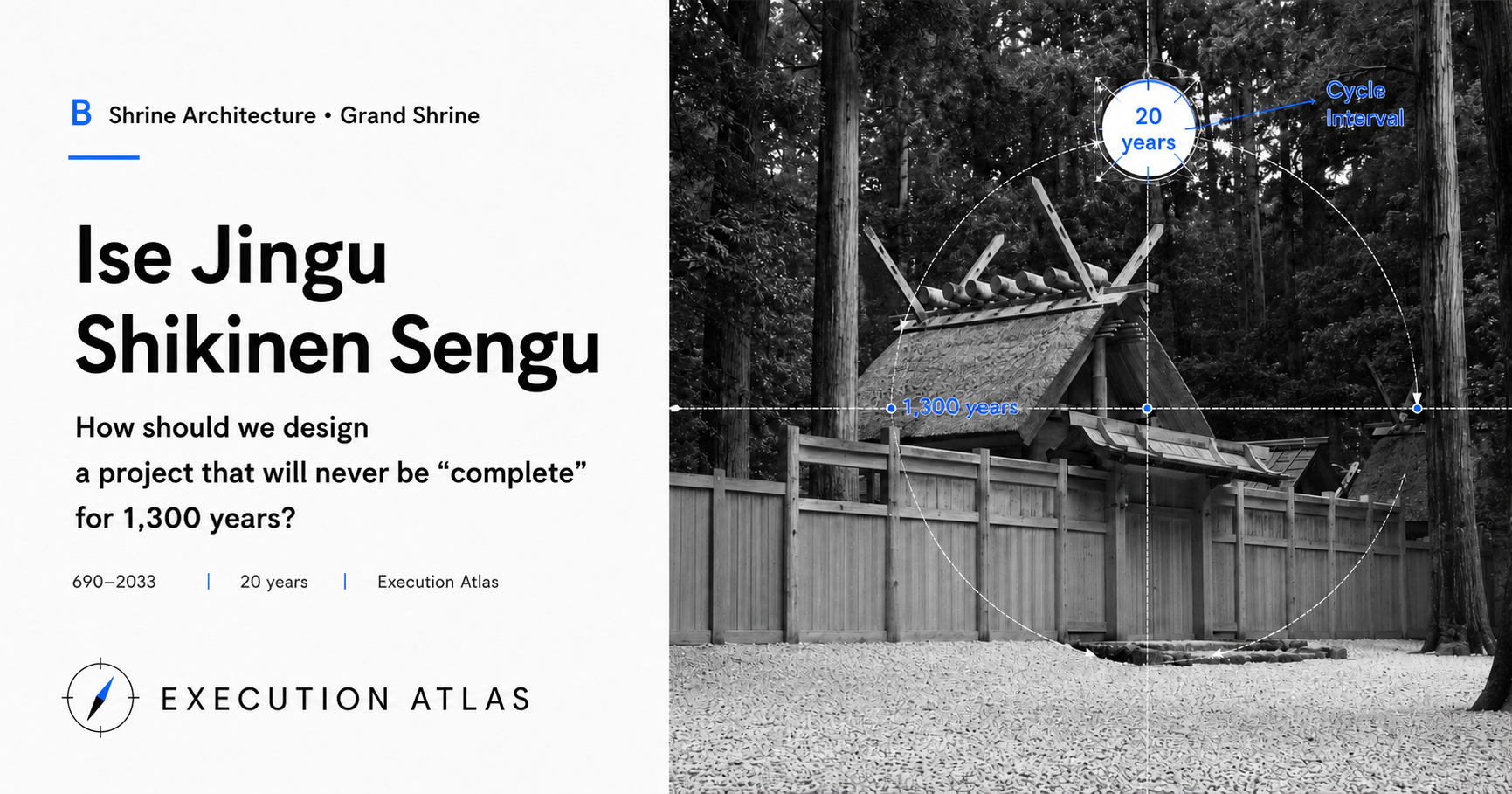
The people of Ise Grand Shrine understood this 1,300 years ago. And they reached a somewhat unusual conclusion. If it’s going to decay, tear it down before it does. Tear it down and build the exact same thing again.
65 buildings across the Inner and Outer Shrines. 10,000 Japanese cypress trees. 23,000 bundles of miscanthus thatch. 714 types of sacred treasures and garments, totaling 1,576 pieces. Once every 20 years, an identical complex is built on the adjacent lot, and the old one is dismantled. From 690 to 2013, 62 times. The 63rd is scheduled for 2033, and preparations have already begun.
Ordinary projects have a finish line. Ise Grand Shrine does not.
Mission: Why Rebuild?
The shrine buildings follow a style called yuiitsu shinmei-zukuri. The pillars are embedded directly into the ground. No foundation stones. Wood touches earth. Moisture from the soil slowly eats into the cypress. Twenty years is roughly how long cypress structural timber holds up under a thatched roof.
The first sengū was carried out in 690, during the reign of Empress Jitō. Emperor Tenmu had established the system; his wife, Empress Jitō, put it into practice. The husband drew the blueprint; the wife made it real. Since then, the cycle has repeated roughly every 20 years. There was a gap of about 120 years during the Sengoku period. The tradition was fully restored in 1585 and has continued unbroken since.
There is a word: tokowaka. Eternally young. By continually renewing the buildings, the power of the gods is kept fresh. It seems contradictory, but the religious ideal and the structural lifespan of the buildings converge on the same number: 20 years.
The fact that the tradition was revived after a 120-year hiatus says something about the nature of this project. For 120 years, someone could have said, “Let’s stop.” They didn’t.
Design: A 20-Year Human Development Cycle
The most ingenious part of the sengū’s design isn’t the architecture. It’s the people.
The 20-year cycle fits exactly three times into a craftsperson’s career. At 20, you join as an apprentice for the first time. At 40, you serve as a core member, bearing the technical load. At 60, you lead as master carpenter, overseeing the whole operation and teaching the next generation. One career, 60 years, three sengū. As if someone designed the cycle to fit the human lifespan. Maybe someone did.
After each sengū, about 30 of the roughly 160 artisans are retained as permanent staff. The rest are dismissed. 130 people simply leave. The remaining 30 spend the next 20 years honing their skills through repairs of smaller subsidiary shrines and training successors. A quiet, long stretch of time.
In the 15th year, timber processing for the next sengū begins. New artisans are recruited from across the country, and those 30 become their teachers. There are no manuals. The real project serves as the training device. What can only be learned by doing is learned by doing.
A note on the construction itself. No nails. No paint. Bare, unfinished wood. Power tools are prohibited within the shrine grounds. Everything is done with hand tools. A style traceable to the raised-floor granaries of the Yayoi period, reproduced by human hands for 1,300 years. The main pillars require Japanese cypress at least 400 years old. The ridge logs on top: 10 for the Inner Shrine, 9 for the Outer. The cut of the forked finials differs between the two. Every dimension, every protocol has been passed down orally.
The buildings are destroyed every 20 years. The skills are not. By destroying the buildings, they created a structure that preserves the skills.
Execution: 8 Years and 200 Years
Preparation begins 8 years before the sengū. Through 33 sequential rituals, the new shrine buildings are assembled one by one.
The first ceremony is the yamaguchi-sai. At the entrance to the sacred forest, they pray to the mountain god. May we cut the trees. The next, kimoto-sai, is held at night, closed to the public. A prayer to the spirit of the tree that will become the shin no mihashira.
The shin no mihashira is a pillar over two meters tall, set beneath the center of the main hall. Structurally, it supports nothing. It bears no load. It connects to neither beam nor girder. It exists purely as a vessel for the divine. Its erection takes place in the dead of night, seen by no one. A pillar that supports nothing, seen by no one. Yet without it, this building is not Ise Grand Shrine. Some things in the world are like that.
At the misoma-hajime-sai, the first cypress is felled using a traditional technique called mitsuo-giri. This tree becomes the mihishiro-gi, the container that will hold the sacred object. A tree becomes a vessel, and the vessel holds a god.
In the fourth year comes the okihiki gyōji. Citizens haul massive logs overland and by river to the shrine. At the 62nd sengū in 2013, some 226,000 people participated in the oshiraishi-mochi gyōji, carrying white stones to pave the new precinct. 226,000 people carrying white stones to a single site.
The final ceremony is the sengyo. The sacred object is moved from the old hall to the new. A nighttime ritual conducted only by torchlight. For 1,300 years, eight years of preparation lead to this single moment.
Of each 20-year cycle, the first 12 years are spent on repairs and training; the final 8 are the actual sengū process. Across 62 iterations, there is no record of the timeline significantly overrunning. Excluding the 120-year Sengoku interruption, the 20-year cycle has been kept with near-perfect precision. Repeat the same work 62 times, and uncertainty approaches zero.
There is another timescale. 200 years.
10,000 cypress trees. Roughly 8,500 cubic meters. Where do you source that much quality cypress? The shrine once relied on natural forests in Kiso, but the large trees were dwindling. In 1909, the shrine established its own forest reserve. In 1923, a 200-year forestry management plan was drawn up. A forest to ensure a stable supply of 200- to 300-year-old cypress. Plant trees, raise them for the sengū 200 years from now.
The sengū that uses the trees you planted will come more than 100 years after you die.
I think about that sometimes. You will never see the trees you planted reach maturity. Knowing this, you still dig the soil carefully, plant the seedling, water it. There are people who can do that.
At the 62nd sengū in 2013, timber from this reserve was used in significant quantities for the first time. About 25% of the total wood. The first self-sufficiency in roughly 700 years. 104 years after the reserve was established. The halfway point of a 200-year plan, yielding its first results. Halfway. 96 years to go.
People: A Nun, Two Warlords, and Nameless Craftspeople
Almost no individual names survive in the record of sengū. Even the names of master carpenters are often withheld. The bricks of the Great Wall of China bear their makers’ names. The construction gangs who built the pyramids had group names like “Drunkards of Khufu.” Ise Grand Shrine has none of that. Who built what is not recorded. That is the kind of place it is.
The names that do survive belong to those who ended the 120-year silence.
During the Sengoku period, sengū stopped. The last was the Outer Shrine in 1434 and the Inner Shrine in 1462. Five years later, the Ōnin War erupted. With the Muromachi shogunate in decline, the tax revenue that had funded sengū could no longer be collected, and shrine lands were encroached upon by feudal lords. The buildings fell into ruin. The Uji Bridge rotted away.
The people who brought it back were, unexpectedly, Buddhist nuns.
Three successive abbesses of Keikōin, a small convent, drove the revival. The first, Shuetsu, raised funds for the Uji Bridge reconstruction in 1491. The second, Seijun, secured approval from the imperial court and the Outer Shrine, solicited donations from feudal lords across the country, and in 1563, achieved the Outer Shrine sengū for the first time in 129 years.
The third, Shūyō, appealed directly to Oda Nobunaga. Nobunaga donated 3,000 kan, triple the 1,000 she had requested. He prepared an additional 16,000 kan in the Gifu Castle treasury and attached one condition: “Do not burden the peasants.” Construction began. Then Nobunaga was killed at Honnō-ji.
Shūyō turned next to Toyotomi Hideyoshi. Hideyoshi donated 250 pieces of gold. In 1585, both the Inner and Outer Shrine sengū were completed in the same year. The Inner Shrine, for the first time in 123 years. Nobunaga started it; Hideyoshi finished it. This precedent of simultaneous completion became the standard for all subsequent sengū.
Shinto’s most sacred ritual was revived by Buddhist nuns. During 120 years in which senior priests had merely submitted petitions to the court, the nuns of Keikōin walked across the country on their own feet, raised funds, and persuaded those in power. When a system breaks, the people who fix it come from outside the system. It’s always that way.
In the modern sengū, some 160 artisans are mobilized. Dyeing and weaving, lacquerwork, metalworking, woodworking, bamboo crafts, forging. The 714 types of sacred treasures include swords, bows, shields, horse tackle, musical instruments, and writing implements. A single sword concentrates the techniques of metalwork, lacquer, textile, and forging. All of it made new. Even though the set made 20 years ago is right there, everything is built again from zero.
When the sengū ends, only 30 remain. The next 20 years begin. No time to savor completion. The next cycle starts. Like a distance runner who, the instant they cross the finish line, is placed back at the start. Except they chose this.
Legacy: Preservation Through Destruction
Sengū harbors a contradiction. By ceaselessly destroying the old, it preserves the old.
The oldest surviving wooden structure is Hōryū-ji, over 1,300 years old. The buildings of Ise Grand Shrine are less than 20 years old. Yet the architectural style of Ise predates Hōryū-ji, reaching back to the Yayoi period. The buildings are new; the technique and the style are ancient.
There are two ways to preserve. Preserve the object, or preserve the craft. Hōryū-ji chose to preserve the object. Ise chose to preserve the craft. UNESCO World Heritage prioritizes the authenticity of “things.” Ise chose the authenticity of “skills.” This is not a question of which is right. There are simply two paths.
In the Meiji era, Interior Minister Yoshikawa and Imperial Household Minister Tanaka proposed to Emperor Meiji: with a concrete foundation, the buildings could last 200 years and save on timber. Emperor Meiji rejected the idea. What matters is rebuilding in plain wood every 20 years. Efficiency was probably not what he was thinking about. He knew there are things that efficiency cannot measure.
Dismantled timber is distributed to shrines across the country. The ridge-bearing pillars of the Inner Shrine become the torii of the Uji Bridge, and later the torii at Oiwake in Seki. The Outer Shrine’s pillars become the torii on the opposite side of the Uji Bridge, and then the torii at Shichiri-no-watashi in Kuwana. Destroyed, but never discarded. They live on in different forms.
The cost keeps rising. The 60th sengū in 1973: about ¥6 billion. The 61st in 1993: about ¥33 billion. The 62nd in 2013: ¥55 billion, funded by ¥33 billion from the shrine’s own revenue and ¥22 billion in donations. No government subsidies. After the war, GHQ’s Shinto Directive severed ties between state and shrine, and Ise became a private religious corporation. Everything since has been self-funded. The 63rd in 2033 may reach ¥100 billion.
The 200-year forest plan has a practical purpose: timber self-sufficiency. At the same time, it contains an embedded assumption that this project will still be running 200 years from now. No one knows what the world will look like in 200 years. They don’t know, but they plant trees anyway. That kind of trust is buried in this forest.
Learnings
The project that has lasted 1,300 years is the project that gave up on finishing 1,300 years ago.
A project that aims for completion has an ending. The moment it ends, decay begins. The building, the skills, the organization. Ise Grand Shrine, by perpetually deferring completion, incorporated decay itself into the design. Never finishing turned out to be the best method of preservation.
The 20-year cycle is simultaneously the lifespan of the building, the cycle of human development, the cycle of skills transmission, and the cycle of organizational renewal. Four functions embedded in a single number.
The 120-year Sengoku interruption also reveals the system’s vulnerability. Skills transmission that depends on oral tradition becomes difficult to restore when even one generation is lost. 120 years means at least two generations of rupture. That it was revived at all may be because the style was simple, or because fragmentary records survived. Or because, when the system broke, there were people outside the system who moved.
¥55 billion every 20 years, with no government subsidy, for 1,300 years. When you talk about project sustainability, there is probably no greater track record than this.
Most things we build will break. Software, organizations, relationships. But if you design for breakage from the start, breaking becomes not an ending but a beginning. Ise Grand Shrine has been proving this for 1,300 years.
Sources
- Ise Jingū Official Website (https://www.isejingu.or.jp/) (JP Only)
- Agency for Cultural Affairs, “Shikinen Sengū” cultural property records (JP Only)
- Jingū Shichō [Jingū Administration Office], Shikinen Sengū pamphlet series (JP Only)
- NHK Special, “Ise Jingū: The Eternal Forest” (JP Only)
- Ise Jingū Shikinen Sengū Commemoration, Okage Yokochō historical materials (JP Only)