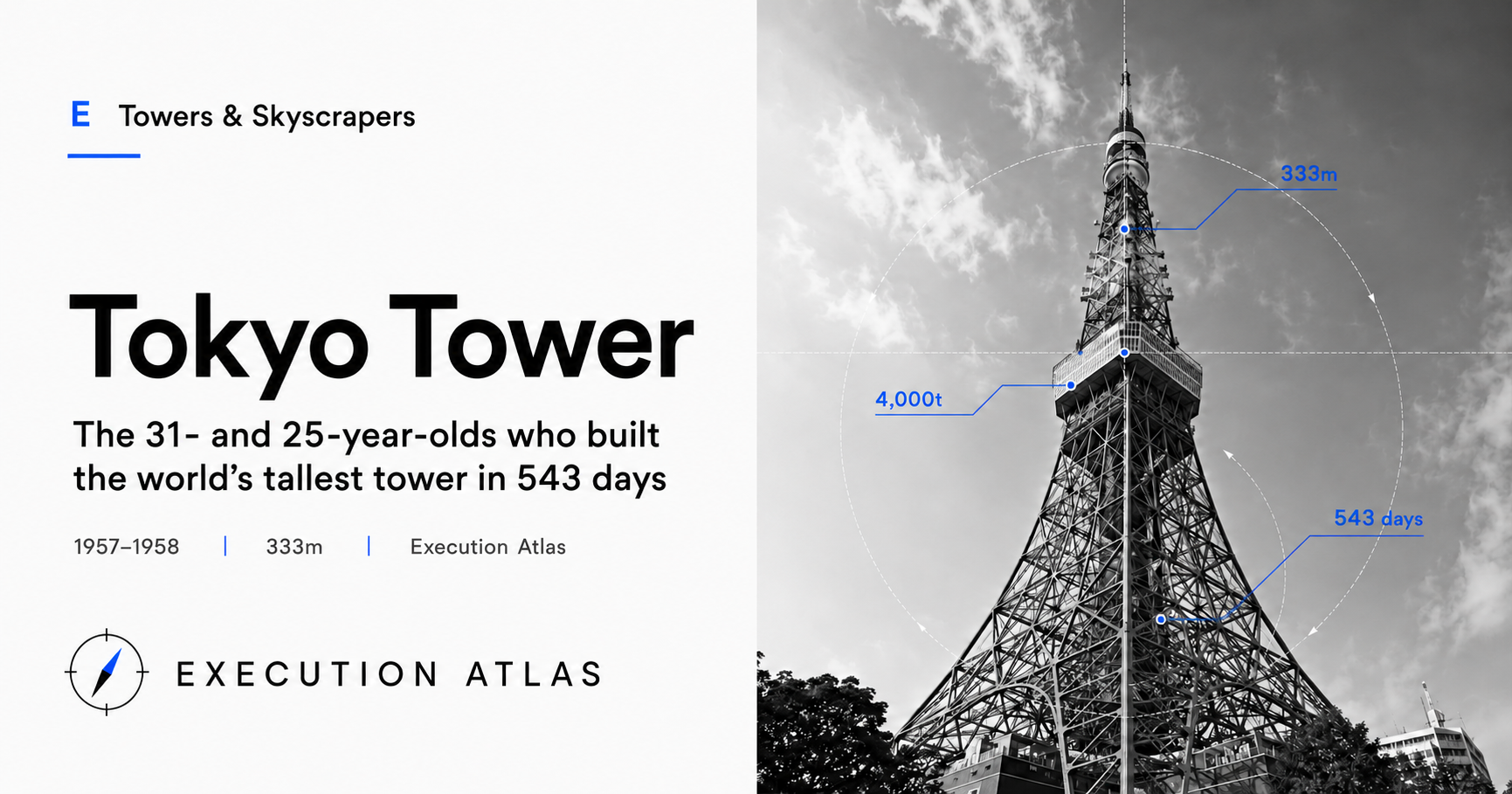
333 meters. 4,000 tons of steel. 543 days. 10,000 blueprints. 219,335 man-days.
The Eiffel Tower stands 312 meters tall and weighs 7,300 tons. Tokyo Tower is 21 meters taller and uses half the steel. There were no computers. No large cranes. No safety harnesses. In 1958, Japanese steeplejacks assembled it by hand.
Mission: A City Overrun by Towers
In 1953, NHK launched television broadcasting. The following year, Nippon TV and Radio Tokyo (now TBS) followed. Each network began erecting its own transmission tower, and Tokyo’s skyline started bristling with steel. It was like a village where everyone had started digging their own well.
Shigenori Hamada, Director of the Radio Regulatory Bureau at the Ministry of Posts, saw the problem. A tower of roughly 177 meters could only reach about 70 kilometers. Covering the entire Kanto region demanded something far taller. If every network built its own, the cityscape would be ruined.
A consolidated broadcast tower. One structure carrying signals for every television station. The idea began to take shape quietly.
Hisakichi Maeda caught wind of this plan through the Diet. Known as the “Newspaper King of Osaka,” Maeda was president of the Sankei Shimbun and a member of the House of Councillors. Together with Nobuhide Shikanai, he secured backing from the business community and incorporated Nihon Denpatō (Japan Radio Tower Co.) in May 1957.
Maeda set one condition. “If we’re going to build it, it must be the tallest in the world.” If it wouldn’t be the tallest, he wouldn’t build it. That was the kind of man he was.
Design: The Logic Behind 333 Meters
Radio engineers estimated that 380 meters was needed to cover all of Tokyo. But at 380 meters, antenna sway would be excessive. In a country of earthquakes and typhoons, a swaying antenna cannot produce stable signals. That was a matter of physics, not willpower.
The design went to Tachū Naitō, age 72. Known as the “Tower Doctor,” he had designed roughly 70 steel towers, including the Nagoya TV Tower and the second Tsūtenkaku in Osaka. He was Japan’s foremost authority on tower engineering. When Maeda came to him, Naitō replied: “Building towers is a fate assigned to me.” Fate. A 72-year-old structural engineer chose that word.
Naitō ran structural calculations repeatedly and arrived at 333 meters. Twenty-one meters above the Eiffel Tower’s 312. The tallest free-standing steel tower in the world at the time.
The design constraints were severe. It had to withstand an earthquake on the scale of the Great Kanto Earthquake and wind speeds of 90 meters per second. All this while using half the steel of the Eiffel Tower. A truss structure, assembling members in triangular formations, achieved both weight reduction and structural integrity.
The structural calculations took three months. The blueprints exceeded 10,000 sheets. All done by hand. The final review took place at Sōshisha, the former residence of playwright Shōyō Tsubouchi in Atami, managed by Waseda University. Naitō locked himself inside for three days, swimming through an ocean of numbers.
The project was a joint design by Nikken Sekkei. Takenaka Corporation handled construction. Shin Mitsubishi Heavy Industries and Matsuo Bridge produced the steel components. Miyaji Construction erected the tower frame. Naitō, Takenaka, and Miyaji had worked together before on the Nagoya TV Tower. This was not the first time they had teamed up. The significance of that comes later.
Execution: Playing Catch at 800 Degrees
June 29, 1957. Construction began. The planned schedule was 15 months. Additional TV channels were set to launch in 1959, and delay was not an option.
It actually took 543 days. Roughly 18 months. The structural completion of the tower body, reaching 333 meters, came on October 14, 1958, about 15.5 months after groundbreaking. Nearly on schedule. What caused the delay was the antenna. Typhoon season overlapped with construction, and the original plan to hoist the antenna through the tower’s interior was changed to lifting it from the outside. Final completion came on December 23, 1958. Construction had started before the design was finished; the blueprints were completed on July 15, after groundbreaking. The tower was built from drawings that were still being drawn.
More than 400 workers operated at full capacity every day, from 6 AM to 6 PM. No large cranes. Steel beams were hauled up by winch and human muscle. At heights above 200 meters, men stood on beams 30 centimeters wide. No railings. No nets. When the wind blew, the steel swayed. The men swayed with it.
Rivets binding the steel beams together were heated to 800 degrees Celsius until soft, then thrown by hand from below to the workers above. The upper workers caught them in buckets and hammered them into the columns. Lumps of iron at 800 degrees, thrown and caught by hand, 200 meters above the ground. Every single day.
For the steeplejacks, this tower was a special job. As the height climbed, Tokyo spread out beneath their feet. Beyond the Kanto Plain, Mount Fuji came into view. A vista no ordinary construction site could offer, and it changed every day. The standard daily wage for a steeplejack was 500 yen; on the tower job it was 750. But it wasn’t just about the money. The fact that they were building the tallest tower in the world shaped the atmosphere on site.
The higher the tower grew, the more onlookers gathered below. Office workers spreading their lunches in Shiba Park to watch. Children shouting encouragement. The steeplejacks knew they were being watched. Smoking cigarettes on steel beams 200 meters up, they could feel themselves changing the city’s skyline.
The steel included scrapped American tanks decommissioned after the Korean War. Tank armor is high-quality iron, and it became the material supporting Tokyo Tower’s strength. The wreckage of war was transformed into the skeleton of a peacetime landmark. The world performs that kind of strange conversion from time to time.
On June 30, 1958, one steeplejack was caught by a gust of wind at 61 meters and fell to his death. “Injuries and lunch are your own responsibility.” That was a saying in the steeplejack world at the time. One fatality in 543 days. For a major construction project of that era, the number was remarkably low. It still wasn’t zero.
People: Ages 72, 31, and 25
This project has a generational structure.
Tachū Naitō, the designer. Age 72. The culmination of a career spanning roughly 70 towers. The “Tower Doctor’s” final great work. The speed of producing 10,000 blueprints in three months is impossible without 50 years of accumulated expertise.
Masaaki Takeyama, construction superintendent. Age 31. Field commander for Miyaji Construction, responsible for the tower frame erection. He had earned his reputation on the NHK Matsuyama broadcasting tower. Colleagues described him as “the kind of person who stays calm and handles anything, no matter what happens.” Someone decided to entrust the world’s tallest steel tower to a 31-year-old, and there was a man who could answer that trust.
Gorō Kiryū, the steeplejack foreman. Age 25. The frontline leader who commanded the steeplejack crews. He directed 60 steeplejacks on steel beams 200 meters in the air.
72 for design judgment. 31 for project management. 25 for on-site execution. Each placed at the age best suited to the role. Experience where experience was needed. Youth where physical endurance and nerve were needed.
Kiryū had an arranged marriage meeting during construction. He held his wedding on December 24, the day after the tower was completed. A 25-year-old who had just built the world’s tallest tower, getting married the next day. Life has periods of that kind of density.
Legacy: Proof in the Ise Bay Typhoon
- The year after completion. Typhoon Vera, known in Japan as the Ise Bay Typhoon, made landfall. 5,098 people killed or missing. The worst meteorological disaster in Japan’s recorded history. Tokyo Tower did not move.
Naitō’s design specification: wind resistance to 90 meters per second. Numbers on paper, proven real in a single moment. The structural calculations he had checked over three locked days in Atami were correct. The hand calculations of a 72-year-old beat the typhoon.
Tokyo Tower carried Tokyo’s broadcast signals for 54 years. In 2012, Tokyo Skytree opened, and the role of primary digital broadcast tower transferred. Tokyo Tower became the backup.
In 2013, it was designated a Registered Tangible Cultural Property. Its role as a broadcast tower had receded, but 2.5 million visitors come every year. The role changes, but the tower remains.
Nihon Denpatō, the company Maeda founded, was separated from the Sankei Shimbun Group and continued under the Maeda family. Under its third president, a failed golf course development left 10 billion yen in debt, and the tower itself was nearly seized as collateral. A successful construction project does not guarantee a successful business. Those are entirely different kinds of difficulty.
Learnings
Naitō. Takenaka Corporation. Miyaji Construction. This team had worked together once before, on the Nagoya TV Tower.
One reason a tower of unprecedented scale could be built in 543 days is that the team wasn’t new. Technical skill alone doesn’t drive a project. When people who already know each other’s working styles team up, communication costs compress. Trust is the fact of having built something together before.
Korean War tanks became structural steel. Rather than simply accepting constraints, this project repeatedly converted constraints into resources. Not enough steel, so melt down tanks. No cranes, so throw by hand. A constraint, viewed differently, becomes material.
A 72-year-old designer, a 31-year-old site superintendent, a 25-year-old steeplejack foreman. Looking only at the ages, the lineup seems risky. But work backward from the capabilities each role demands, and it’s rational. Not everyone needs to be a seasoned veteran in their 40s. Staffing that discerns what needs experience and what needs youth creates the structure of a project.
Sources
- Tachū Naitō, Tō: Naitō Tachū to San-tō Monogatari [Tower: Tachū Naitō and the Story of Three Towers] (Shinchōsha) (JP Only)
- Tokyo Tower Official Website, “About Tokyo Tower” (https://www.tokyotower.co.jp/about/) (JP Only)
- NHK Archives, “Tokyo Tower Construction Record” (JP Only)
- Shoko Suzuki, “Tokyo Tower’s construction flow was insane from a PM perspective, so here’s an explainer,” note, 2018 (https://note.com/shokosuzuki/n/n5a9a44d6f067) (JP Only)
- Japan Meteorological Agency, Ise Bay Typhoon disaster record (JP Only)
- Agency for Cultural Affairs, National Cultural Properties Database, “Tokyo Tower” (JP Only)