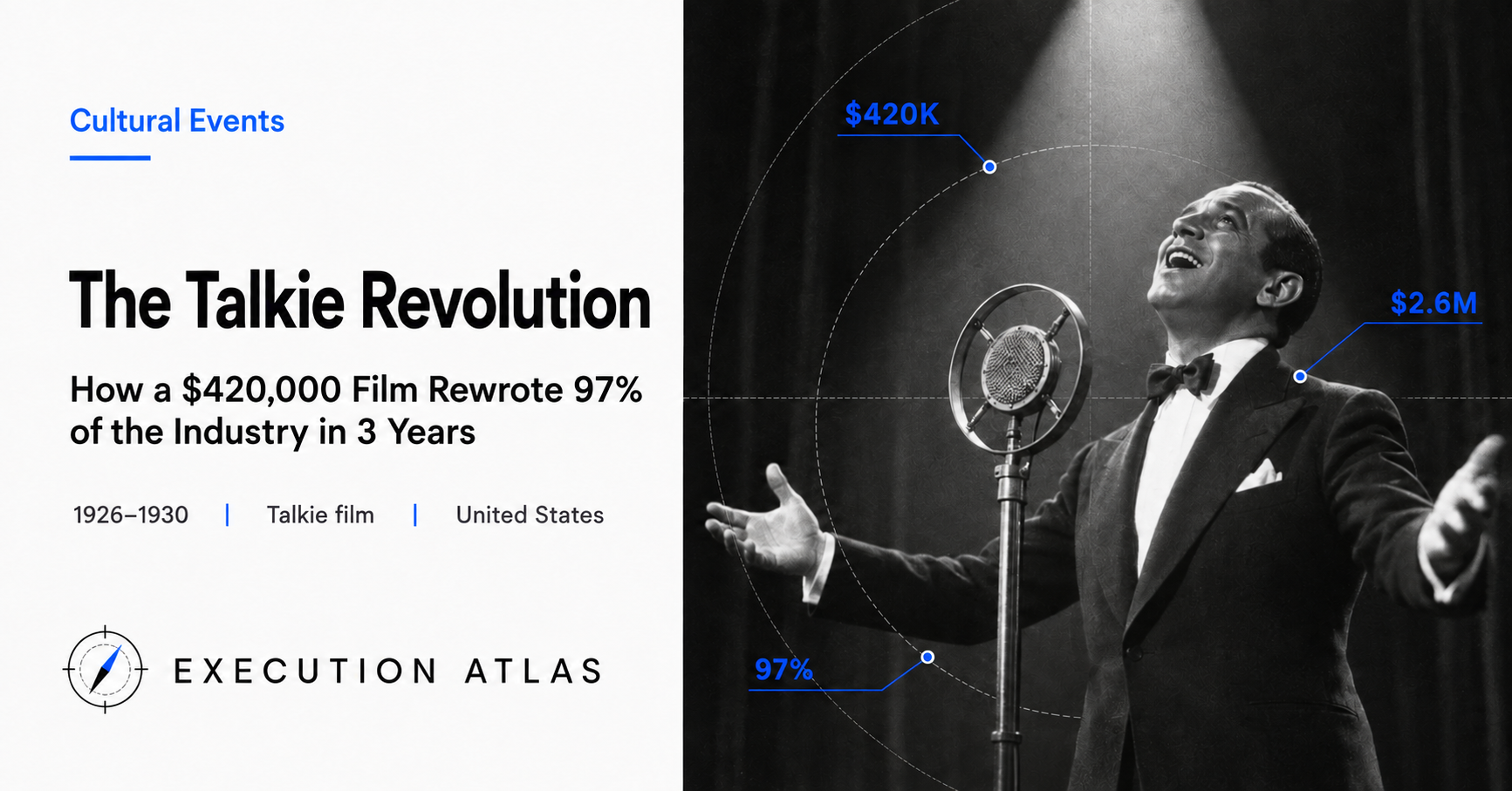
October 6, 1927. Warner’s Theatre, 52nd Street and Broadway, New York. Al Jolson, on screen, turned to the woman playing his mother and called out between songs:
“Wait a minute, wait a minute. You ain’t heard nothin’ yet.”
It was not in the script. An ad-lib. The audience rose from their seats. A man had spoken inside a motion picture. The synchronization was perfect. For the first time in a feature-length theatrical film, a performer’s live voice reached the house.
The day before — October 5, 1927 — one of the film’s producers, Sam Warner, had died at forty. Chronic sinusitis had spread into a brain abscess complicated by pneumonia. The third of the four Warner brothers, he had been the first to bet on the technology. He died the night before the premiere without seeing the sound era arrive. His three brothers stayed away from the New York opening to attend his funeral.
That one film set off a chain reaction: within three years, 97% of American pictures had sound. Thousands of theaters were rewired. Twenty-two thousand pit musicians lost their livelihoods. A generation of silent-era stars disappeared from Hollywood. The story of how an entire industry replaced itself — in three years — is the story of a project.
Mission: Why It Began
In February 1926, Warner Bros. posted a net loss of $333,413. At the purchasing power of the day, it was enough to sink a mid-sized company. The studio was close to insolvency.
Hollywood’s pecking order was fixed: Paramount, MGM (Loew’s), First National, Fox. Warner was a second-tier outfit with no theater chain, weak distribution, and a thin roster of contract players.
Around the same time, Bell Laboratories and Western Electric were shopping a technology — sound-on-disc synchronization. A 33⅓ rpm lacquer disc, recorded separately from the film, played back in mechanical linkage with the projector. Every major Hollywood studio turned it down.
The reasons were straightforward: synchronization was unreliable, audio quality was poor, the “prestige of live orchestras” that movie-house orchestras provided was unmatched, and the cost to retrofit a single theater ran from $9,000 to $25,000. Above all, the majors held enormous inventories of silent films and had hundreds of performers under contract. They had no incentive to destroy a working business to chase an unproven technology.
It was the correct call. Any executive in their position would have reached the same conclusion.
Warner Bros. grabbed the technology the others had passed on. Sam Warner saw Bell Labs’ demonstration and convinced his eldest brother Harry that it could transform theater attendance at its roots. Harry was skeptical about dialogue — “Who the hell wants to hear actors talk?” he is said to have remarked (though the accuracy of the quote is disputed). What Harry was betting on was a different value proposition: reproducing the sound of a full orchestra in every small-town theater that could never afford a live ensemble.
The requirements spec, such as it was, looked like this:
Reduce the music cost for theater operators while delivering the same-quality orchestral sound available only at top urban venues to rural movie houses. Differentiate on hardware quality and the brand of the ensemble.
Dialogue was not in that spec. The thing that moved the market entered the picture as an afterthought.
Design: How It Was Structured
Three constraints defined the project. First, time: with the studio near bankruptcy, there was no room for a years-long experiment. Second, irreversibility: once a theater was wired for sound-on-disc, it could not cheaply revert to silent exhibition. Third, uncertainty: every major studio had passed, which meant the industry’s collective expert judgment was “too early.”
The choice of which constraint to prioritize shaped every decision that followed.
On April 20, 1926, Warner incorporated the Vitaphone Corporation as a separate legal entity. The Western Electric license cost $800,000. Goldman Sachs was brought in to arrange financing.
The separate incorporation had a purpose. If the parent company went bankrupt, the Vitaphone technology would survive as an independent asset. If the technology investment failed, the parent could in theory shed the subsidiary. Financially conservative structure; strategically, an all-in bet — a hybrid construction.
On August 6, 1926, John Barrymore starred in Don Juan. Synchronized orchestral score and sound effects — no dialogue. The first product in the original plan, going after the “premium theater sound” market. It failed to recoup its production cost.
Over the six months from that August through January 1927, cumulative Vitaphone investment reached $1.57 million. The quarterly loss was $100,000. Harry Warner reported this to shareholders. A nearly-insolvent company was piling on more debt to double the bet.
In April 1927, Warner built the world’s first purpose-built sound stage. Filming on The Jazz Singer began in May.
Here the plan quietly shifted. The original concept foregrounded music synchronization, but Al Jolson — the top vaudeville star of the day — started ad-libbing on the set. Talking to audiences between numbers was his act. Speaking came naturally. The director kept the sound rolling.
The result: roughly one-third of the finished film contained synchronized dialogue. A feature that had not appeared in any specification got built in, fully.
Execution: How It Played Out
The Jazz Singer opened on October 6, 1927. Production budget: $422,000. Final gross: $2.6 million — a return of roughly 6.2 times, nearly ten times the average American film of the same period.
What hit harder than the numbers was the shock to the industry. The market had not responded to Harry’s bet on synchronized music. It responded to the dialogue Al Jolson had improvised in the background of Sam’s quiet encouragement. Audiences reacted to hearing a performer speak.
The major studios moved. MGM, cautious until then, pivoted in 1928 along with the rest of the industry. From that point, the entire sector accelerated.
In July 1928, Warner released Lights of New York — the first all-sound feature. Where The Jazz Singer had one-third dialogue, this film had none of the silence to lean on. One year, wall to wall.
That same year, RCA incorporated RCA Photophone Inc. The format was sound-on-film rather than sound-on-disc — an optical audio track burned directly onto the edge of the film strip, far simpler for theaters to operate. No separate disc to transport, no synchronization to maintain manually. Fox’s Movietone used the same principle.
From late 1928 into 1929, most of the industry converted from sound-on-disc to sound-on-film. Vitaphone had moved first, but it did not become the standard. By the end of 1930, most theaters were playing Movietone, Photophone, or generic optical soundtracks. Warner itself followed.
Being first with a technology does not guarantee setting the standard. What you can win is market position. In the three years from 1927 to 1930, Warner Bros. forced its way into the ranks of the major studios. The technology was obsolete within three years; the position remained.
The burden on the exhibition side was severe. The US had roughly 20,000 theaters at the time. Of those, several thousand had installed sound equipment by the end of 1929, at $9,000 to $25,000 per house — an industry-wide capital expenditure running into the hundreds of millions of dollars, much of it coming from outside the film business.
To recoup those conversion costs, theater owners discharged their pit orchestras. A fifteen-piece ensemble cost roughly $50,000 a year; a single sound installation paid back in under two years.
By the end of 1928, 26,000 theater musicians across the country were looking for work. By 1930, 22,000 had been displaced. In Washington, D.C. alone, more than 60% of theater musicians were replaced by recorded sound in the single year from 1930 to 1931.
In project-timeline terms: from the founding of Vitaphone in 1926 to the 97% conversion of the US industry in 1930 was roughly four years. Nobody involved thought it would go that fast. Warner’s original plan was clearly longer-term. The major-studio executives almost certainly imagined a ten-year transition.
The gap between plan and outcome came down to the tipping point. The accelerant was not music but dialogue. Live orchestras could be substituted — recorded music did the same job. Performers’ voices could not be substituted by anything that existed. Once audiences had heard a performer speak, there was no going back. A factor Warner had not planned for was the very thing that collapsed the schedule.
People: Who Led It
Sam Warner. Born 1887, died at forty. The third of the four brothers. The most technically oriented of the siblings, he had a deep interest in film sound equipment and recording technology. He was the one who went to the Bell Labs demonstration and brought the case to Harry. From 1926, chronic sinusitis worsened under the pressure of the Vitaphone project; infection spread to mastoiditis, osteomyelitis, and a subdural abscess. On October 5, 1927, he died of a brain abscess compounded by secondary pneumonia. His three brothers — Harry, Albert, and Jack — each held a domain (management, finance, production) but Sam had been the bridge between the technical and the operational. After Vitaphone, the studio’s technology strategy lost momentum. The slow migration from sound-on-disc to sound-on-film might have gone differently had he lived.
Harry Warner. Born 1881, the eldest brother, chief executive. He was skeptical of dialogue from the start; his bet was on music synchronization and the upgrading of the theater-going experience. By all accounts he never fully warmed to the idea of actors talking on screen. Even so, he made the final call to proceed after Sam’s pitch and then to double down after The Jazz Singer’s numbers came in. The story of a disciplined operator staking the company on his younger brother’s technical instinct — and winning.
Al Jolson. Star of The Jazz Singer, forty-one at the time. Top-billed in vaudeville, revue, and recordings; film was a sideline. His stage style was direct address — singing to the audience, speaking between numbers, treating the frame as a conversation. On set, he ad-libbed the way he would have on stage. His “you ain’t heard nothin’ yet” was unscripted. That unscripted line created the hinge of film history.
On the other side of the hinge stood John Gilbert. Born 1897, MGM’s biggest silent-era male star — billed as “The Great Lover” — he built his career in romantic leads opposite Greta Garbo.
The talkie era destroyed him. The then-current story was that his voice was too high-pitched for romantic roles. Later scholarship has largely retired that explanation. Evidence suggests his voice was adequate; his downfall is more credibly attributed to a personal feud with MGM president Louis B. Mayer, who reportedly despised Gilbert and used the talkie transition as cover to assign him deliberately second-rate scripts until the career collapsed on its own.
Gilbert died of a heart attack in 1936, aged thirty-eight. He remains in Hollywood history as a case study in how the lever of technological change can be operated as a management weapon.
He was not alone. Over those three years, a significant portion of the silent era’s top stars disappeared. Some — Mary Astor, Bebe Daniels — came back. Many retired in their thirties. The story was not about whose voice was bad; it was about what happened to the old generation’s asset value when an entire industrial structure replaced itself.
Legacy: What Remained
Three years of transformation, summarized.
By 1930, 97% of American films had sound. Production of new silent features had effectively ended. The majority of the country’s approximately 20,000 theaters had been wired for sound. Total industry capital expenditure ran to hundreds of millions of dollars — a non-trivial share of US GDP at the time — concentrated into a single sector over three years.
Twenty-two thousand pit musicians were unemployed. At the same time, demand for screenwriters, actors with stage training, sound engineers, and composers exploded. The labor market rewrote itself.
Warner Bros. went from near-bankruptcy to a founding member of the Big Five. In 1928, the studio acquired the Stanley theater chain and First National Pictures. By the 1930s it was a confirmed pillar of the studio system alongside Paramount, MGM, Fox, and RKO. A set of investment decisions made at the end of the 1920s determined its position for the rest of the century.
On the technology side, sound-on-disc never became the standard. Warner won the market position; the format lineage passed to Fox Movietone and RCA Photophone. Sound-on-film is the direct ancestor of the optical audio track that persisted through the analog era and into the early digital era. The pioneer’s technical asset was obsolete in three years.
Aesthetically, the visual grammar of silent cinema was lost. Silent films had compensated for the absence of sound with extraordinary visual density — somewhat heightened performance, emphasized facial expression, and a favoring of long, still wide shots. Post-talkie, cinema converged on the re-creation of everyday conversation. Silent film as an art form was a historical term within a decade.
As a byproduct, radio and cinema began to merge. Actors’ voices and radio announcers’ voices flowed through the same acoustic technology. American popular culture in the 1930s was built on that integration. Television in the 1950s, cable in the 1980s, internet video in the 2000s — all are extensions of the basic premise the talkie revolution established: deliver sound and image together.
Lessons: The Choice Only a Nearly-Bankrupt Company Could Make
The deepest lesson this project yields is not obvious: technologies that incumbent leaders reject may be precisely the ones worth betting on.
What makes the talkie transition interesting is not who had superior technology but the asymmetry of the decision problem. Between 1925 and 1926, Bell Labs’ sound-on-disc system was turned down by every major studio. Each of those studios held tens of millions of dollars in silent-film inventory and hundreds of players under contract. Protecting the value of those existing assets was the center of their decision-making.
Their judgment that it was “too early” was probably technically correct. Vitaphone in 1926 suffered frequent sync failures, and its audio quality was genuinely inferior to a live orchestra. The per-theater retrofit cost of $9,000–$25,000 was a real burden for anyone operating a large chain. Nobody wanted to take a loss.
The problem is that “too early” as a pure technical assessment and “too early” as a rationalization for protecting sunk costs are nearly indistinguishable from the inside. Experts cannot always tell the two apart in themselves.
What separated Warner from the majors was not a superior read on the technology. It was that Warner had almost nothing to protect. Few contract players, no theater chain, thin silent-film inventory. Nothing to lose means nothing shaping the discount rate on the decision. The company was close enough to bankruptcy that not betting was the riskier option.
The same structure recurs. Netflix betting on streaming while Blockbuster clung to the store. Apple releasing the iPhone while Nokia ran the handset market. Amazon launching Kindle while traditional publishers dominated print. In each case, the dominant player with the most to lose called it “too early” at the moment the challenger with less to protect moved in.
Turned around, the question is: what technologies is your company currently calling “too early”? Is the basis for that call a genuine technical evaluation, or is it the weight of existing assets on the decision? The two are spoken in the same language, which makes them hard to separate from inside. Separating them requires either an external vantage point or the deliberate exercise of imagining yourself in the position of someone who has nothing to protect.
A second lesson, less often noted: Warner ran its original hypothesis all the way through, discovered the hypothesis was wrong, and won anyway.
Harry bet on music synchronization for theater upgrades. The market responded to dialogue. The gap between the two was not visible before the project started — but it became visible once the project was running. And when it became visible, the company changed direction.
Had Warner insisted on “staying with the original plan” of music-only, the one-third dialogue in The Jazz Singer probably doesn’t happen. Had they waited until the dialogue opportunity was obvious before starting at all, they would never have built the experimental infrastructure that made it visible. The first-mover advantage in a disruptive technology is not predicting the correct answer before anyone else. It is being in position to see the answer as it emerges, and being able to turn toward it.
It was not accuracy of prediction that determined the outcome. It was the speed of learning while running.
Sam Warner never saw the pivot. He built the technical case, convinced his brother, constructed the sound stage, started the cameras. He died in a hospital bed before the market spoke. The film he set in motion opened the next morning in New York and rewrote Hollywood’s order.
Three years later, silent film was gone. Warner was a major studio. Twenty-two thousand musicians had lost their work. John Gilbert was dead at thirty-eight. When an entire industrial structure replaced itself, each person inside it experienced their own version of the transition. The world does this periodically.
Sources
- Wikipedia, “The Jazz Singer” — production budget $422,000, gross $2.6 million, premiere October 6 1927, Sam Warner’s death the previous day, Al Jolson’s ad-lib
- Wikipedia, “Vitaphone” — April 20 1926 incorporation, Western Electric license, sound-on-disc technology
- Wikipedia, “Introduction of Vitaphone Sound Pictures” — investment figures ($800,000 license, $3 million promotion), cumulative $1.57 million by January 1927, quarterly loss $100,000
- Wikipedia, “RCA Photophone” — 1928 founding, sound-on-film format, path to industry standard
- Britannica, “The Jazz Singer” — Alan Crosland, industry impact, Al Jolson background
- Britannica, “John Gilbert” — silent-star talkie-transition failure, Mayer feud, 1936 death
- Britannica, “How did silent films transition to movies with sound?” — overall transition, 1929–1930 adoption rates
- Encyclopedia.com, “Birth of the Talkies” — 75% by 1929, 97% by 1930, speed of transition
- Encyclopedia.com, “Battle of the Giants: ERPI and RCA Consolidate Sound” — sound-on-disc to sound-on-film conversion
- Encyclopedia.com, “Enticing the Audience: Warner Bros. and Vitaphone” — detailed investment figures, Harry Warner shareholder report
- Musicals101, “Film 1927–1930: Hollywood Learns to Sing” — industry timeline, Lights of New York (1928, first all-sound feature)
- Local 802 AFM, “Music History: Musicians vs. the Talkies” — 22,000 displaced musicians, $9,000–$15,000 per-theater retrofit, $50,000 annual orchestra cost, 60% DC replacement
- Library of Congress, “The Jazz Singer” (Ron Hutchinson essay) — National Film Registry context