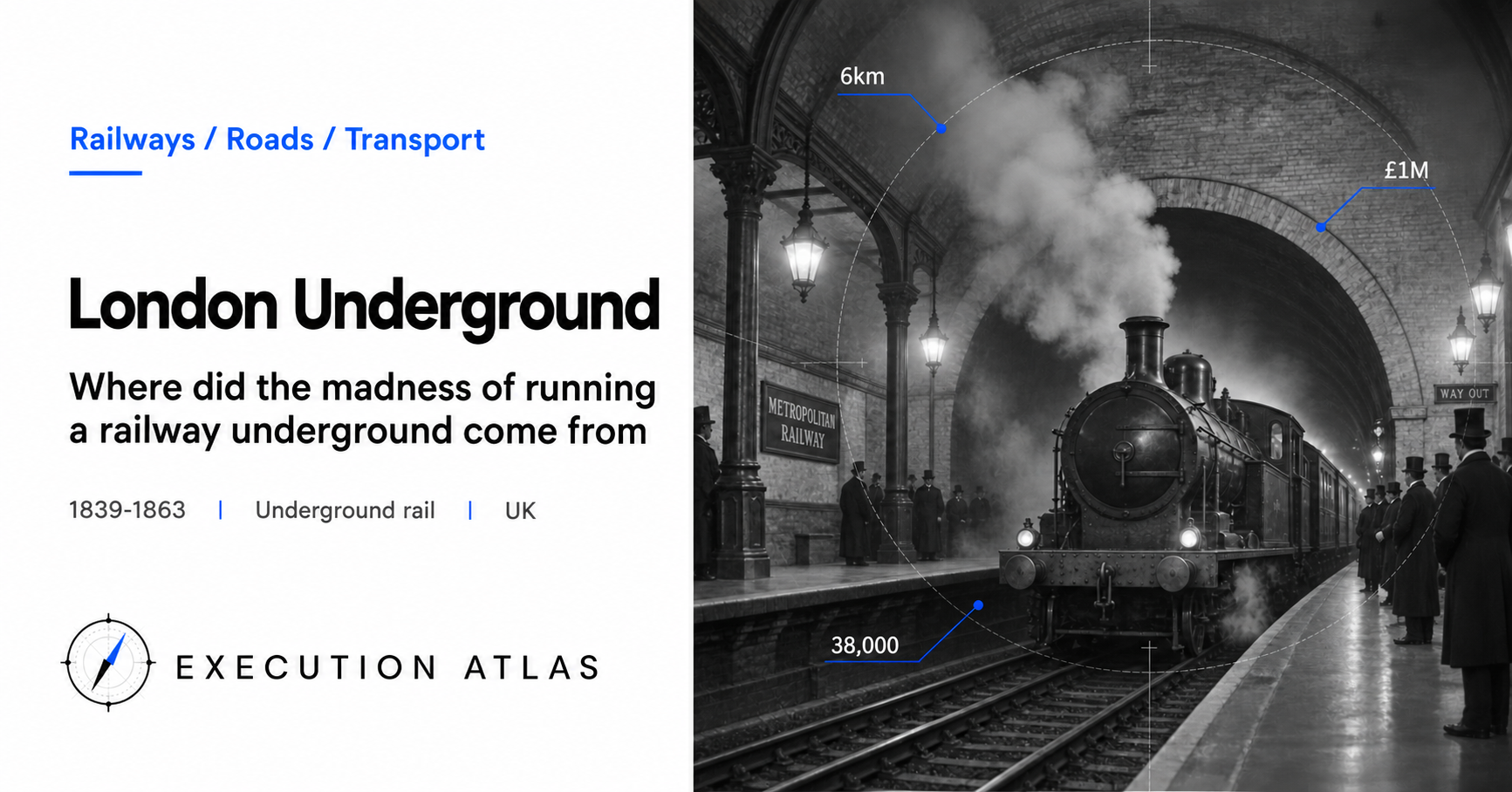
January 10, 1863. The Metropolitan Railway opened in London. The world’s first underground railway. Six kilometers. Seven stations.
Opening-day ridership: 38,000 passengers. By 8 a.m., the system was already past capacity. First-year ridership would reach 9.5 million.
The night before, a banquet for 700 guests was held at Farringdon Station. Formally dressed people dining underground. That scene alone captured everything essential about this project.
Mission
The first person to propose this idea was Charles Pearson, Solicitor to the City of London. From 1839 onward, he campaigned relentlessly for an underground railway.
His goal was not to solve traffic congestion.
What Pearson saw was the poverty concentrated in the center of London. His aim: enable the poor to relocate to the suburbs while giving them affordable rail access to the city. A social policy wearing the skin of a transport project. The true requirement was not to lay rails, but to change where people lived.
From 1839 to opening day: twenty-four years. Pearson died of dropsy on September 14, 1862 — roughly four months before the line opened.
Design
To run a railway underground, you first have to build underground.
The method chosen was Cut and Cover: dig up the road, lay the track, seal it with a brick vault. 140 million bricks were used.
The method was simple enough — so was the cost. While construction proceeded, central London’s main roads were severed. Building underground meant destroying surface life first. In 1862, a viaduct collapse near Ladbroke Grove killed six workers.
The other constraint was power. In 1863, the only available traction was the steam locomotive. What happens when you run a steam locomotive underground?
Sulfur-smelling smoke and soot particles fill the tunnel.
Every countermeasure was tried. Condensing pipes to return steam to water. Switching to lower-smoke coke. Ventilation shafts at intervals. None of it was enough. On opening day, one porter was hospitalized; a passenger lost consciousness.
“Grow a beard” was the official recommendation. Nose hair and whiskers as a filter.
There was a proposal to avoid steam altogether: “Fowler’s Ghost,” a fireless locomotive that stored pre-heated steam and ran without burning fuel. It nearly exploded on its first test run.
For twenty-seven years, the underground ran on smoke.
Execution
Parliament had approved a construction budget of £1,000,000 for the Metropolitan Railway Company. The company was incorporated in 1854, but actual construction did not begin until 1860 — six years spent on land acquisition and financing.
Construction itself took three years: groundbreaking in 1860, opening in January 1863. Viewed in isolation, the efficiency of the Cut and Cover method is remarkable. But include the preceding financing phase, and out of a twenty-four-year story, construction was active only in the final nine years. The project spent far more time becoming buildable than actually building.
The turning point came in 1890. The City & South London Railway opened. Three and a half miles. The world’s first deep-level electric underground railway.
It had originally been planned as cable traction — the same principle as San Francisco’s cable cars. Then the contractor went bankrupt.
Electric traction emerged as the alternative. The technology was still in its infancy. Mid-project, the entire propulsion system was redesigned from scratch — and this accident turned out to determine the future of the underground.
The smoke was gone.
But the early electric underground cars were small, and they had no windows. The designers reasoned that since you’re underground, there’s nothing to see. Passengers called them “padded cells.” The smoke problem was solved; in its place came something closer to claustrophobia.
People
Harry Beck. A draughtsman in the London Underground’s signal engineering department, where he spent his days drawing electrical circuit diagrams.
In 1931, between jobs, Beck submitted a proposal: a new map of the Underground. Until then, every tube map had been geographically accurate, reflecting true distances and bearings — but as the network expanded, it had become unreadable.
Beck’s approach was borrowed directly from circuit diagrams. Drop geographic accuracy. Draw every line as horizontal, vertical, or 45-degree diagonals. Space stations evenly. What passengers need to know is where to change trains, not how many miles separate each stop.
Management rejected it as too radical.
In 1932, 500 copies were distributed as a trial. The response was positive. In January 1933, 850,000 pocket copies were printed for the first two months alone. That March, 40×50-inch poster versions went up across the city.
Faithful representation of physical reality is not always the best design. Beck reorganized reality to match the passenger’s cognitive structure. A representational grammar from a completely different domain — electrical engineering — fundamentally transformed information design for urban transit.
Every subway map in the world now follows Beck’s grammar. New York, Tokyo, Moscow, Paris.
Legacy
Today, the London Underground spans 402 kilometers and 272 stations. Annual ridership: approximately 1.2 billion.
From Pearson’s 1839 concept, that is 187 years.
Steam to electric. Smoke-filled tunnels to a network navigated by Beck’s map.
38,000 on opening day. 1.2 billion a year now.
Learnings
What runs through this project is not a chain of intentional optimal solutions. It is a chain of moments in which contingency forced the optimal solution.
No one wanted steam locomotives. Condensing pipes, coke fuel, ventilation shafts — all were symptomatic treatments, not cures. For twenty-seven years the underground ran on steam because there was nothing else.
In 1890, the cable contractor for the City & South London Railway went bankrupt. The project must have been on the verge of collapse. Electric traction was adopted as a substitute, and became the standard for underground propulsion. Had they pushed through with cable, electrification would have been delayed by at least a decade. A contractor’s failure — itself a crisis — forced the optimal outcome.
Beck’s map follows the same pattern. A geographically accurate map was readable with three lines; with seven it became illegible. “Accuracy” and “usability” are different axes. Beck abandoned accuracy for usability. Management’s initial rejection was a rational judgment from the axis of accuracy.
What all three share is this structure: not a design selected in advance as optimal, but a design left standing by elimination of constraints — and that design turned out to be optimal. In practice, moments like these are more common than we admit.
Pearson did not live to see the opening. For twenty-four years, he insisted that a railway should run beneath the ground. His obsession pulled the idea of digging through the earth into reality. Technology alone doesn’t move. Capital alone doesn’t move. Someone who says “this must be done” for twenty-four years decides the reality of twenty-four years later in advance.
Sources
- London Transport Museum, “World’s first Underground” (https://www.ltmuseum.co.uk/visit/museum-guide/worlds-first-underground) — opening date, first-day and first-year ridership
- Institution of Civil Engineers, “London Underground: The World’s First Underground Railway” (https://www.ice.org.uk/what-is-civil-engineering/infrastructure-projects/london-underground) — Cut and Cover construction, technical history
- Wikipedia, “Metropolitan Railway” (https://en.wikipedia.org/wiki/Metropolitan_Railway) — £1,000,000 construction budget, timeline from incorporation to opening
- Wikipedia, “Charles Pearson” (https://en.wikipedia.org/wiki/Charles_Pearson) — advocacy from 1839, death on September 14, 1862
- Londonist, “Five Things You Didn’t Know About The First Underground Line” (https://londonist.com/2014/11/five-things-you-didnt-know-about-the-first-underground-line) — 1862 Ladbroke Grove viaduct collapse and six deaths
- History Hit, “From Steam to Electric: The Evolution of the Victorian London Underground Railway” (https://www.historyhit.com/city-south-london-railway-opens/) — 1890 City & South London Railway, contractor bankruptcy and electrification
- London Transport Museum, “Transforming the Tube map: Harry Beck’s iconic design” (https://www.ltmuseum.co.uk/collections/stories/design/transforming-tube-map-harry-becks-iconic-design) — Beck’s career and the 850,000-copy first print run of 1933