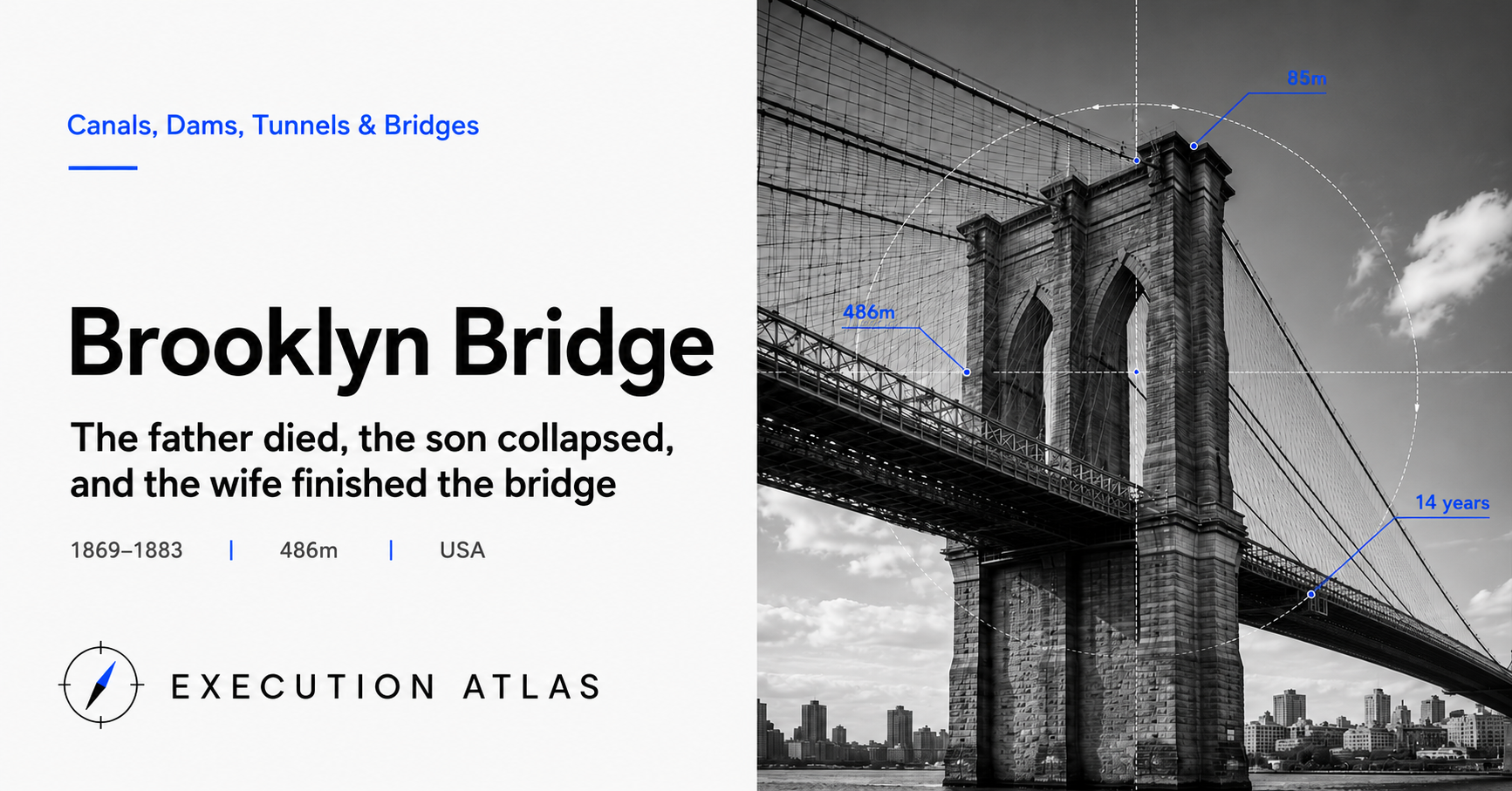
Main span 486 meters. Tower height 85 meters. The steel wire in the four cables stretches 14,060 miles, more than halfway around the earth. Opened in 1883, the world’s first suspension bridge hung from steel wire cables.
The designer died before groundbreaking. His successor was left partially paralyzed. The person who saw the project to completion held no formal engineering title. She was the engineer’s wife.
Original budget: $5 million. Final cost: $15.5 million. The construction bonds were not paid off until 1956, seventy-three years after opening day.
Mission: Cross the Frozen River
In the 1860s, the only way between Manhattan and Brooklyn was by ferry. When the East River froze in winter, there was no way across at all. The combined population of the two cities exceeded one million.
John A. Roebling was a Prussian-born civil engineer. He studied civil engineering at the Royal Polytechnic Institute in Berlin, emigrated to America in 1831 at age 25, and settled in Saxonburg, Pennsylvania. He made his fortune manufacturing wire rope. High-strength wire rope to replace cotton rope. This material made his suspension bridges possible.
Roebling built a suspension bridge carrying railroad traffic over Niagara Falls (1855) and completed the world’s longest main span of 1,057 feet in Cincinnati (1866). Between 1844 and 1869, he designed and built twelve structures.
In 1867, the New York State Legislature chartered the New York Bridge Company with $5 million in capital. Roebling was appointed chief engineer and proposed a suspension bridge with a main span of 1,595 feet (486 meters), far exceeding the world record. The design used cables made of bundled steel wire to suspend the bridge deck. Steel wire had never been used in bridge construction before.
Design: Sinking a Box to the Riverbed
Two stone towers, 85 meters tall, had to be built. The problem was the foundation. The tower bases had to rest on bedrock beneath the river.
The method was pneumatic caisson construction. A massive open-bottomed wooden box was sunk to the riverbed, and compressed air was pumped in to force out the water. Workers entered the box and excavated soil and rock. The laborers, called “sandhogs,” worked in air pressure more than double the normal atmosphere.
The Brooklyn-side caisson measured 168 by 102 feet (51 by 31 meters). Its ceiling was built from layers of one-foot-square timbers, eventually reaching 15 feet (4.6 meters) thick. The limestone and granite tower was stacked directly on top of this box. The tower’s own weight pushed the caisson down inch by inch. Digging below, stacking above. Two operations running simultaneously.
About 264 men worked inside the caisson each day. The total workforce numbered roughly 2,500.
What happens to the human body after prolonged work in compressed air? In 1870, no one knew for certain.
Execution: Three Engineers
The First: Death Before Groundbreaking
June 28, 1869. John Roebling was surveying at the Fulton Ferry slip when a docking ferry struck a fender rack. The impact drove a piling into his right foot, crushing it.
He was carried to his son Washington’s home in Brooklyn Heights. His toes were amputated without anesthesia. Roebling then refused all further medical treatment. Instead, he administered his own “water cure,” continuously pouring water over the wound.
Twenty-four days later, on July 22, he died of tetanus. Age 63.
A world authority in bridge engineering killed by a medical decision outside his expertise. Construction of the bridge had not yet begun.
The Second: The Price of Compressed Air
His son, Washington Roebling, took over as chief engineer. Age 32. He had studied civil engineering at Rensselaer Polytechnic Institute and served in the Civil War as an artillery officer, designing and building military suspension bridges. He knew his father’s plans down to every detail.
January 2, 1870. Construction began.
Washington supervised the caisson work in person. In December 1870, the first crisis hit. The ceiling timbers of the Brooklyn-side caisson caught fire. A worker’s candle ignited the wood, and the compressed air fed the flames five feet deep into the timber and more than 50 feet across. Thirty-eight fire hoses ran for five hours, pumping an estimated 1.35 million gallons. Washington stayed inside the caisson throughout. He was eventually carried out. Repairs took over two months.
The Manhattan-side caisson had to go deeper. Final depth: 78.5 feet (24 meters). Nearly double the Brooklyn side’s 44.5 feet (14 meters). The air pressure rose with it.
Washington entered and exited the compressed-air environment repeatedly. In 1872, after twelve consecutive hours of work, he collapsed from rapid decompression. Caisson disease. What we now call decompression sickness. Nitrogen gas formed bubbles in the bloodstream, destroying joints and nerves. Pain everywhere. Failing eyesight. Hearing loss. Partial paralysis spread through his body.
Caisson disease struck the workers one after another. The project physician, Dr. Andrew H. Smith, treated more than 110 severe cases. Smith was the one who gave the condition its name: “caisson disease.”
On April 22, 1872, German-born laborer John Myers finished his shift in the Manhattan-side caisson, surfaced, complained of stomach pain, went home, and died. The first caisson disease fatality during construction. Eight days later, Irish-born Patrick McKay died the same way. Within a month, Daniel Reardon followed.
All three died after reaching the surface.
Washington ordered the excavation stopped. The Manhattan-side tower had not reached its planned depth. It had not reached bedrock. The tower would stand on sand. But Washington estimated that continuing would produce over a hundred additional casualties.
He chose lives over design integrity.
Would the bridge hold on a sand foundation? Washington judged it would. 143 years later, the Manhattan tower still stands on sand.
The Third: The Engineer Without a Title
Washington could no longer leave his home on Columbia Heights. He spent his days watching the construction site through a telescope.
His wife, Emily Warren Roebling, became the sole link to the site. Eleventh of twelve children. Educated at Georgetown Visitation Convent. Her brother was Major General Gouverneur K. Warren, a Civil War hero. She met Washington at a soldiers’ ball at her brother’s headquarters in 1864.
Every day she received her husband’s instructions, went to the site, relayed them to the engineers, and handled negotiations with politicians and stakeholders. But you cannot build a bridge through a game of telephone.
Emily began to study. Higher mathematics. Catenary curve calculations. Stress analysis. Cable structures. Material strength. Her teacher was her husband. Eleven years. In time, she was conducting technical discussions in her own words and making decisions on site.
The ASCE (American Society of Civil Engineers) record states: “People believed Emily was the designer of the bridge.”
In 1882, the board of trustees considered removing Washington. The chief engineer would not come to the site; he should be replaced. Washington was convalescing in Newport, Rhode Island, and did not appear.
Emily acted. She secured the backing of the ASCE and read Washington’s statement at a meeting of the society. She was the first woman to address the organization from the podium. The board voted 10 to 7. Washington stayed.
Defective Wire
As cable spinning progressed, another crisis emerged. Wire supplier J. Lloyd Haigh had been committing fraud.
Washington had never trusted Haigh. He had ordered full inspection of every wire at the factory. In June 1878, Washington had inspectors secretly mark approved wire. The pile of rejected wire never grew. Haigh had been swapping approved wire for rejected wire at night, sending the approved coils back through inspection, and shipping the defective wire to the bridge.
An investigation of 80 rings found only 5 that met specifications. An estimated 221 tons of defective wire was already built into the bridge.
The board of trustees had selected Haigh themselves and refused to publicize the scandal. Washington’s response: add 150 wires to each cable to maintain the safety factor. The original design had provided six times the required strength, so even with the defective wire mixed in, the bridge retained a safety factor of five. Haigh later went bankrupt and was sent to Sing Sing prison for forgery.
The defective wire remains inside the bridge today.
People: Opening Day
May 24, 1883. The bridge opened.
The first person to cross was Emily. She rode in a new Victoria carriage with a live rooster on her lap. A symbol of victory. The workers on site rose to their feet and removed their hats.
The rooster was later stuffed and displayed in the Roebling family parlor.
President Chester A. Arthur and New York Governor Grover Cleveland (who would become president the following year) attended the official ceremony. A 70-piece band and 22 drummers marched, and 24 carriages carried government officials across the bridge.
Congressman Abram Hewitt praised Emily in his address, calling the bridge “an everlasting monument to the self-sacrificing devotion of a woman.”
On opening day, 150,000 people crossed the bridge. Within 24 hours, 250,000.
Six days later. Memorial Day. Crowds surged onto the wooden stairway on the Manhattan side. The day’s foot traffic totaled 97,224. One woman stumbled. Another woman screamed, “The bridge is falling!” Panic. Twelve people were crushed to death against the iron railings. Over 36 seriously injured. Pickpockets robbed the fallen. Workers cut through sections of the iron railing to pull victims free.
The bridge had not moved a single millimeter. People killed people.
Barnum had proposed an elephant procession at the opening, offering $5,000 in tolls. He was turned down. After the stampede, a public demonstration of structural safety became necessary.
On the night of May 17, 1884, Barnum walked 21 circus elephants and 17 camels across the bridge. Leading the procession was the white elephant Toung Taloung. Bringing up the rear, the six-ton African elephant Jumbo. The New York Times wrote that it was “as if Noah’s Ark were unloading on Long Island.”
Structural calculations had already proven the bridge safe. Design load: 18,700 tons. But numbers do not calm people. Only after elephants crossed did people believe the bridge.
Legacy: Someone Who Could Read the Blueprints
Construction deaths range from 21 to 40 depending on the source. No exact count survives. Assistant chief engineer C.C. Martin said: “We did not expect so many injuries and therefore did not keep a list.” Severe caisson disease cases exceeded 110. Nearly all were immigrant laborers.
Fourteen years. Budget overrun of 310%. The designer died before groundbreaking. His successor was left partially paralyzed.
After the bridge was completed, Emily continued to study. In 1899, at age 56, she completed the law program at New York University. Her paper, “A Wife’s Disabilities,” critiqued legal restrictions on women’s economic independence and won a $50 prize. She died of cancer in 1903 at age 59.
Washington lived to 89, carrying the aftereffects of caisson disease for the rest of his life. He died in 1926, forty-three years after the bridge opened. The half-paralyzed engineer outlived nearly everyone and saw his bridge stand.
John Roebling conceived it. Washington Roebling began it. Emily Roebling brought it to completion. The person who designed it and the person who finished it were different people. What connected them was a set of blueprints and someone who could read them.
Learnings
John Roebling did not die from a surveying accident. He died from his decision to refuse medical treatment and administer water therapy himself. The inventor of wire rope. The engineer who completed twelve structures. Success in his own field bred overconfidence in a field that was not his own.
Washington’s decision to halt excavation meant abandoning design integrity. A foundation that never reached bedrock. Specifications unmet. But the judgment he made after three consecutive deaths has been proven right for 143 years. A structure that stands is worth more than a perfect design.
Emily spent eleven years transforming herself from messenger to engineer. No formal education. No title. No authority. Yet she read a statement at an ASCE meeting, persuaded the board 10 to 7, and saw the bridge to completion. Her capability arrived before any institution recognized it.
When the wire fraud was discovered, Washington did not remove the defective material. He made the cables thicker to preserve the safety factor. Rather than halt the project in pursuit of perfection, he incorporated imperfection and moved forward. This was only possible because the original design had built in a sixfold safety margin. Margin exists for the unforeseeable.
The budget overran by 310%. Three different engineers led the project. Workers died. Defective wire remains inside the bridge to this day. And yet Brooklyn Bridge has been in daily use for 143 years.
Sources
- David McCullough, The Great Bridge: The Epic Story of the Building of the Brooklyn Bridge (Simon & Schuster, 1972)
- Britannica, “Brooklyn Bridge” (https://www.britannica.com/topic/Brooklyn-Bridge)
- Wikipedia, “Brooklyn Bridge” (https://en.wikipedia.org/wiki/Brooklyn_Bridge)
- HISTORY, “Construction of the Brooklyn Bridge Took 14 Years—And Multiple Lives” (https://www.history.com/articles/brooklyn-bridge-construction-deaths)
- HISTORY, “How Emily Roebling Saved the Brooklyn Bridge” (https://www.history.com/articles/brooklyn-bridge-emily-roebling)
- HISTORY, “Did 21 Elephants Really Stress-Test the Brooklyn Bridge?” (https://www.history.com/articles/brooklyn-bridge-elephant-procession-p-t-barnum-jumbo-1884)
- STRUCTURE Magazine, “Brooklyn Bridge, Part 2” (https://www.structuremag.org/article/brooklyn-bridge-part-2/)
- Red Hook WaterStories, “Brooklyn Wire Mill” (https://redhookwaterstories.org/items/show/1773)