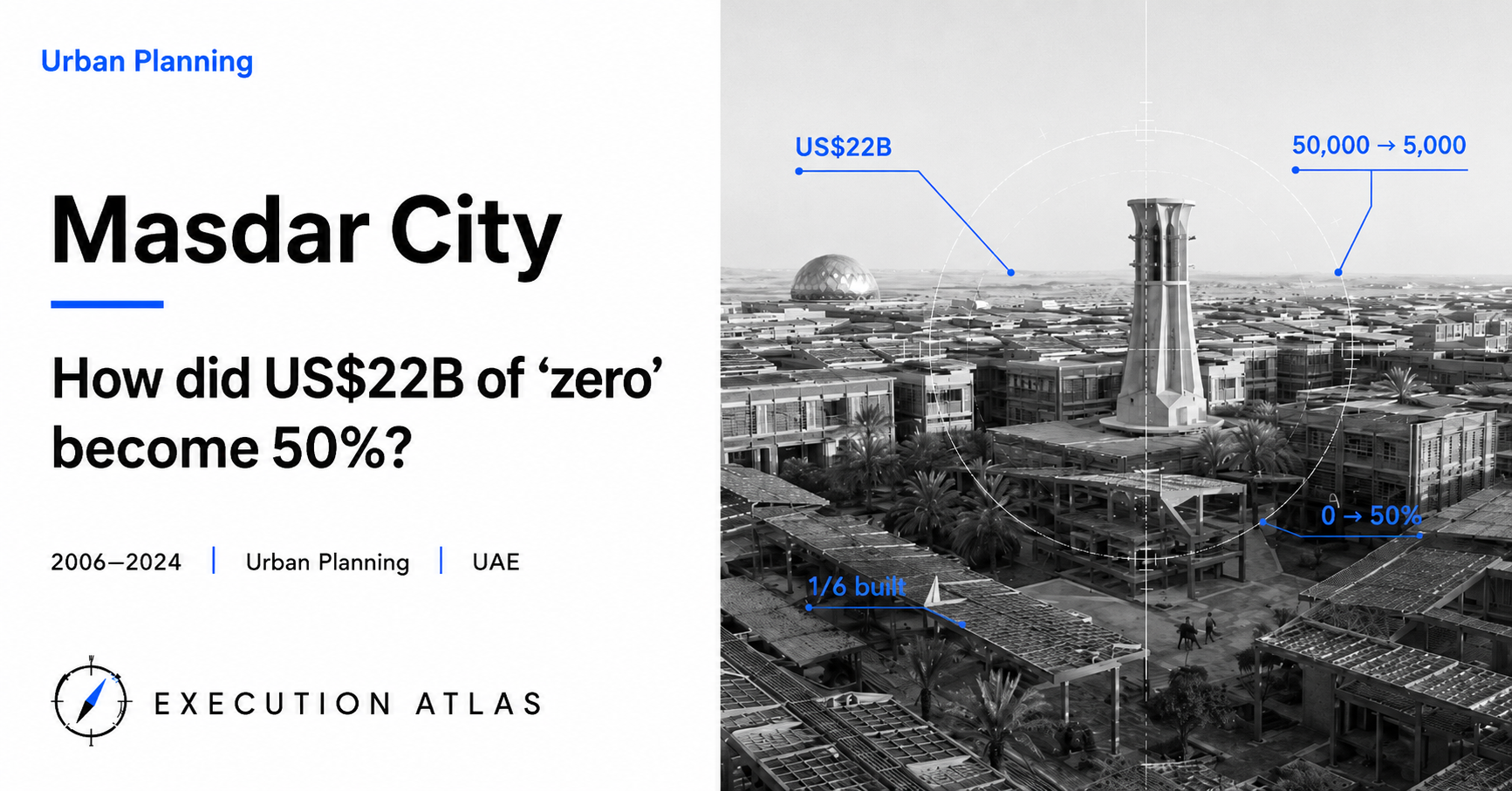
$22 billion. 50,000 people. Zero carbon. Zero waste.
In 2006, Abu Dhabi announced it would build a “perfect city” in the desert. No fossil fuels. No waste. No cars. Everything was “zero.”
By 2024, around 5,000 people lived there. One-tenth of the plan. Carbon neutrality: 50%. One-sixth of the planned area developed. The “zero” had vanished.
Mission: Before the Oil Runs Out
The UAE economy is built on oil. Over 30% of GDP comes from oil and natural gas. Oil is finite.
In 2006, the Abu Dhabi government founded Masdar (“source” in Arabic). A subsidiary of Mubadala Investment Company. The goal: decouple the economy from oil. Pivot to renewables and sustainable technology. Masdar City was meant to be the symbol of that pivot.
The CEO was Sultan Al Jaber. He was 33 at the time. An engineer from ADNOC (Abu Dhabi National Oil Company). An oil-company man building a post-oil city. That contradiction would grow much larger later.
“In 2006, investing in renewable energy was not an obvious choice. It was a brave one.” Al Jaber would say so in retrospect.
The numbers were specific. $22 billion total investment. 6 km² of land. 50,000 residents, 50,000 commuters. Target completion: 2016. A fully zero-carbon, zero-waste city in eight years.
A similar idea was unfolding in China at the same time. Shanghai’s Dongtan eco-city. A plan for a zero-carbon city of 500,000 on Chongming Island. Designed by Arup. But its political backer, Shanghai party secretary Chen Liangyu, was arrested for corruption, and the project disappeared by 2010. It never broke ground.
Masdar at least broke ground. Whether that was salvation or a trap becomes clear later.
Design: A City Seven Meters Above the Ground
The design went to Foster + Partners, led by Norman Foster. A globally renowned architectural firm.
Foster’s vision was bold. Build the entire city on a 7-meter podium. People walk above. No cars at ground level. Below the podium, driverless electric pods — Personal Rapid Transit, or PRT — would run. 3,000 driverless EVs. 85 to 100 stations. 135,000 trips per day.
The design referenced medieval Arab cities. Narrow alleys. Buildings limited to four or five stories. Direct sunlight would reach the street for only 30 to 45 minutes a day. The entire city was oriented along a northeast-southwest axis to capture cool nighttime breezes.
A 45-meter wind tower. A modern version of the traditional Arab “barjeel.” It captured cool upper-air winds and channeled them to street level. Sensors detected wind direction. Louvers opened and closed automatically. Street temperatures were designed to be 15 to 20°C below the surroundings.
PRT development went to 2getthere (Netherlands) and Zagato (Italy). Two- to six-seat pods. Routes guided by magnets embedded in the ground, with positions corrected by overhead wires. Lithium iron phosphate batteries, up to 60 km range.
There was another farsighted call. The Masdar Institute of Science and Technology. A graduate school built in partnership with MIT. They built the institute before the city. Master’s and doctoral programs in renewables and sustainability. 600 students would become Masdar City’s first residents by design. Even without a city, researchers would come.
The pilot plan assumed 50,000 people. PRT covering the whole city. Solar power for all electricity. Desalination for water. Zero waste. Every element rested on “perfect” as the baseline.
Execution: The Desert Eats the Blueprints
Construction began in February 2008.
Six months later, Lehman Brothers collapsed.
Abu Dhabi’s real estate market crashed. Mubadala’s investment capacity shrank dramatically. The $22 billion budget was cut to $18.7–19.8 billion. The completion target slipped from 2016 to 2025. “Zero carbon” was rewritten as “low carbon.”
But Lehman wasn’t the “cause.” It was the “exposure.” Even without the financial crisis, the plan had structural problems.
The Collapse of PRT
The PRT prototype began operating in 2010. Thirteen pods ran an 800-meter route between the Masdar Institute and the north parking lot. Technically, it worked.
But the desert doesn’t read the spec sheet.
2getthere had specified asphalt pavement. For stable magnetic tracking. Masdar chose recycled concrete instead. For environmental reasons. Tracking became unstable.
Sand jammed the door rails. In hindsight, sand getting into the doors of an outdoor vehicle in the desert is obvious.
Sensors stopped the pods when they detected birds. The operations manager explained: “If a bird enters this space, the PRT stops. It thinks it will hit the bird.” 2getthere had specified an enclosed tunnel with high walls. Masdar chose an open design.
And the biggest problem. The cost of the podium. Running PRT underground required building an undercroft beneath the entire city. Phase 1 actually built it, and the cost became clear. City-wide rollout was economically impossible.
In October 2010, the PRT expansion was cancelled. The same year the prototype began running.
From Phase 2 onward, the podium design was abandoned, switching to conventional ground-level construction. Foster’s “city seven meters above the ground” ended after one block.
Goals That Retreated in Stages
The retreat didn’t come all at once. It came in installments.
2010: Completion target pushed from 2016 to 2025. Budget cut 10–15%. “Zero carbon” → “low carbon.” 2016: Connected to the external power grid. Off-grid concept abandoned. Under 5% complete. 2023: Design manager Chris Wan admits: “We are not at net zero today. We are at around 50%.”
“Zero” became “low,” and “low” became “50%.” Cutting the goal in half took 17 years.
Missing Residents
A city designed for 50,000 residents had about 5,000 to 6,000 in 2024. Most were Masdar Institute students and researchers.
A Japan Research Institute analysis put it bluntly: “Students were forcibly housed there, but everyone fled.” AI-controlled room temperatures. Everything managed digitally. Nothing for residents to control themselves. A space optimized for technology wasn’t necessarily comfortable for humans.
The media called it a “green ghost town.” The “if you build it, they will come” assumption did not hold in the desert.
People: Oil and Renewables in the Same Face
Sultan Al Jaber is at the center of this story, and is the contradiction itself.
Masdar CEO. ADNOC CEO. COP28 president in 2023. Building a renewable city with oil profits. Chairing a climate conference while running an oil company. Critics called it “conflict of interest.” Defenders called it “realism.”
From Al Jaber’s perspective, it wasn’t a contradiction but a hedge. For an oil nation, renewables aren’t “post-oil” but a “post-oil portfolio.” Build the next revenue source while oil wealth still flows. But when oil prices drop, project budgets drop too. The structural fragility of depending on oil to escape oil never disappeared.
“Masdar didn’t ride the renewables wave. It made the wave.” Al Jaber’s words. Self-regard or defense.
Norman Foster’s design was beautiful as architecture. The wisdom of medieval Arab cities reinterpreted through modern technology, optimized for the desert climate. The 15 to 20°C cooling effect of the wind towers actually works. But the podium — a structural choice — did not scale economically. A successful prototype, a failed infrastructure. Between the architect’s vision and the project’s economics, an unbridgeable gap.
The most conspicuous absence is the residents. 5,000 in a city designed for 50,000. 95% empty seats. Foster + Partners associate partner Jürgen Hap defends it: “Masdar remains a compact, high-density mixed-use development.” “High density” requires people to be there.
Legacy: The City Failed, the Company Succeeded
Calling Masdar City a “failure” is easy. 10% of planned population. 1/6 of the area. 50% carbon neutrality. 0.4% PRT realization (13 of 3,000). Whichever number you pick, it’s far from the original plan.
But two things complicate the simple failure narrative.
First, attracting the IRENA (International Renewable Energy Agency) headquarters. In 2009, when the city did not yet exist, Al Jaber won the IRENA headquarters at the second preparatory committee meeting in Sharm El Sheikh, Egypt. The headquarters building was completed in 2015. A 32,000 m² complex. Even without the city being complete, an international organization’s flag flies there. Raising the “flag” before there was a “box” left Masdar City a reason to exist after the plan shrank.
Second, Masdar the company. The urban plan failed, but Masdar grew into one of the world’s largest renewable energy developers. Starting with one solar plant inside Masdar City in 2006, by the end of 2024 its renewable portfolio reached 51 GW. The Al Dhafra solar plant (2 GW) was the world’s largest single facility when completed. The 2030 target is 100 GW. Investment: $30–35 billion.
The project failed. The organization succeeded.
Technologies validated in Masdar City have been exported globally. 45-meter wind towers and passive cooling. Shading through narrow alleys. Passive design cutting energy consumption 40%. Rice University professor Ghinea: “These technologies invented in Masdar have become internationally recognized ideas.”
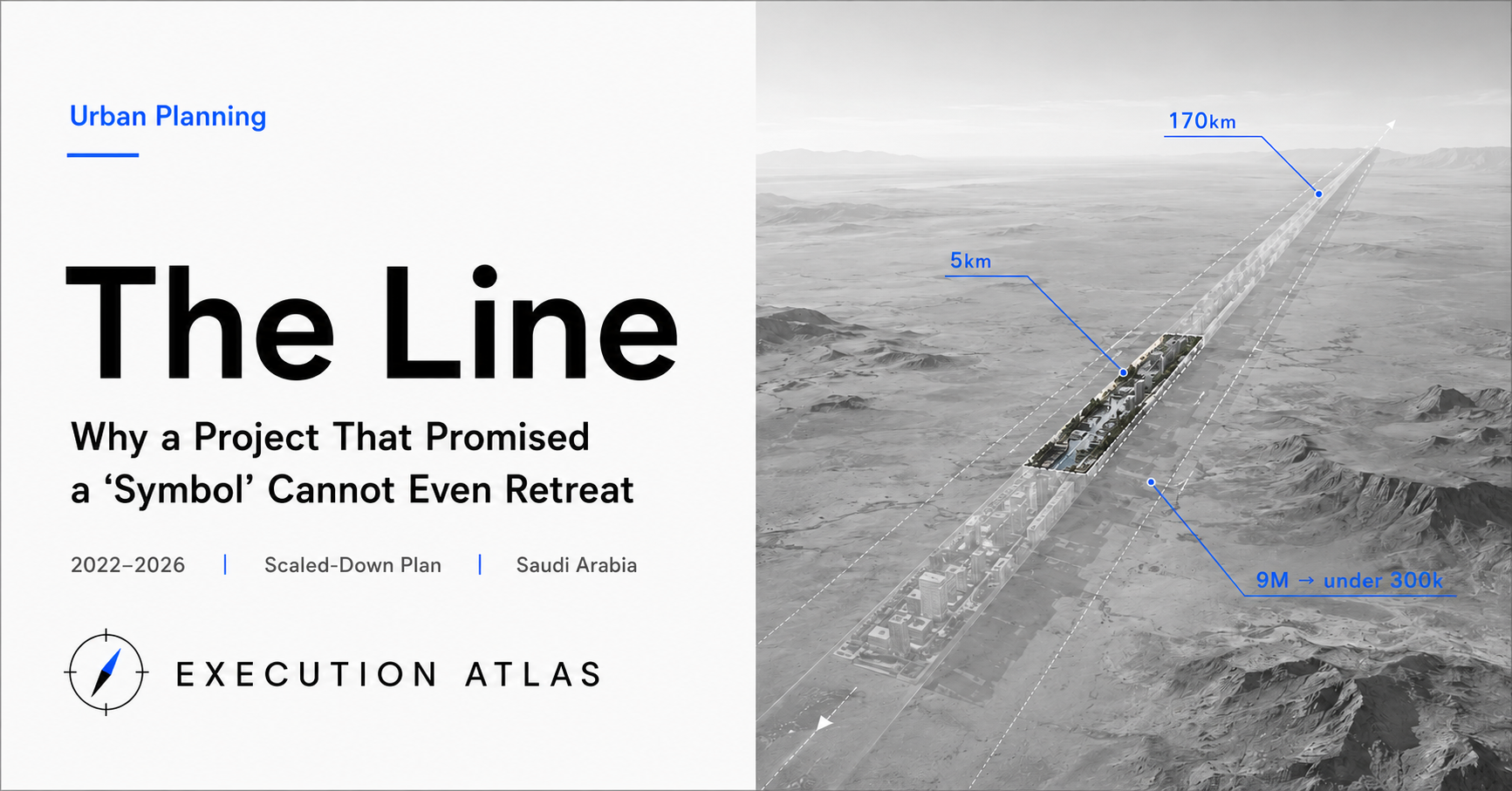
In the same Middle East, a larger experiment is underway. Saudi Arabia’s NEOM. $500 billion. 23 times Masdar’s budget. THE LINE, a 170 km linear city. Whether Masdar’s lessons inform NEOM remains to be seen.
Learnings: The Cost of “Zero”
The most important lesson of Masdar City is in the setting of “zero” as a goal.
Zero carbon. Zero waste. Zero emissions. As political slogans, they are powerful. They draw media attention, investor interest, international standing. When Al Jaber says he “made the wave,” he is talking about PR success.
But “zero” does not work as an engineering target.
Cutting energy consumption 80% and cutting it 100% are entirely different in cost. The last 20% costs more than the first 80%. The last 5% can cost more than the previous 95% combined. Masdar City cut building energy consumption 40% below the Abu Dhabi average. Water use, 54%. These are real achievements. But they didn’t reach “zero.” Because they didn’t reach “zero,” they were called “failure.”
If 40% reduction had been defined as “success,” the evaluation of Masdar City would be different.
PRT is the same structure expressed differently. Thirteen prototypes ran an 800-meter route. Technically successful. But scaling to 3,000 required building infrastructure beneath the entire city, at a non-viable cost. A prototype working and full-scale deployment are different questions. What 13 units should have validated was not “does it work” but “can it scale.”
And one more thing. Project success and organizational success run on different axes.
Masdar City has realized only 10% of the planned “city.” But Masdar the company has grown into a 51 GW renewables firm, one of the world’s largest developers. “Building a city” failed as a means, but “creating a post-oil economy” continued through another route. Even when a project doesn’t finish as planned, the organizations, technologies, and knowledge it produced can fulfill the original mission in another form.
“Zero” attracted attention, investment, and people. “Zero” made it impossible to achieve and made it “fail.” The same goal that birthed the project also killed it.
Sources
- Masdar City - Wikipedia
- Centre for Public Impact — Masdar City in Abu Dhabi
- The National — “Masdar City completion pushed back, but total cost falls”
- Singularity Hub — “Masdar City Abandons Transportation System of the Future”
- Limn — “An Expensive Toy” (PRT design technical analysis)
- urbanNext — “Masdar City: A Critical Retrospection”
- Bloomberg — “A Flawed Green City of the Future Holds a Secret to Taming Heat” (2023 reassessment)
- ScienceDirect — “Rethinking the future low-carbon city”
- Foster + Partners — Masdar City
- IRENA — “IRENA Opens Doors on New Permanent Headquarters”
- 日経BP — 「マスダール・シティ 当初計画は大幅な変更ながら再エネの世界拠点を目指す」 (JP Only)
- RIEF — 「ゼロ・カーボン都市マスダール・シティ 計画を大きく先延ばし」 (JP Only)
- AGBI — “Masdar City struggles to find contractors”
- Masdar — 20th Anniversary Press Release