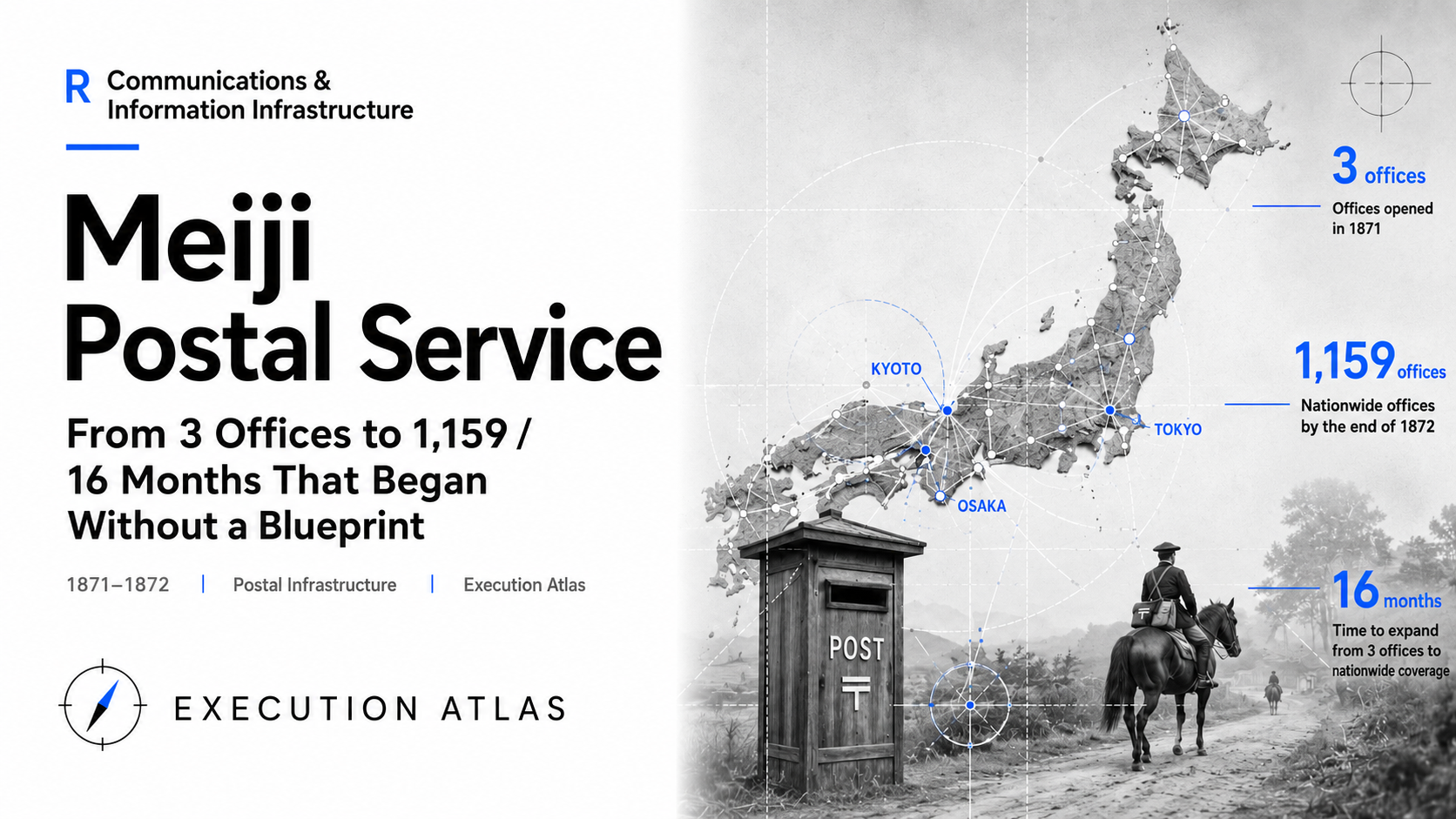
On March 1, 1871, modern postal service began in three cities: Tokyo, Kyoto, and Osaka.
Sixteen months later, 1,159 offices covered the nation. Mail volume: 570,000 letters in the first year, 2.51 million in the second, 10.55 million by the third.
The man who designed the system, Hisoka Maejima, was in London on opening day.
Mission
In the Edo period, the way to send a letter was by hikyaku — private courier.
Tokyo to Osaka by regular service cost one monme of silver. Roughly 150 yen in today’s value, which sounds cheap, except delivery could take 30 days. Express service: four ryō, about 40,000 yen. Priority express, guaranteed in three and a half days: eleven ryō. About 110,000 yen. A hundred and ten thousand yen for one letter. Not a system ordinary people could use.
Hikyaku served samurai and merchants. The idea of a peasant or townsman sending a letter barely existed.
In 1862, Nagasaki. American missionary Channing Williams showed Maejima a sealed letter with a stamp on it. Williams told him: “Communication serves the same role for a nation as blood does for the human body. Communication is the blood, and the postal system is the veins.”
Maejima was 27. It was the first time he had seen a postage stamp.
Eight years later, in 1870, Maejima was appointed vice-superintendent of postal administration. One day, reviewing government accounts, he noticed something. The payments to hikyaku operators for official mail were staggering. With that money, he could build an entirely new system.
Maejima stayed up all night drafting a proposal, then spent 20 days refining it into a detailed written brief. The core argument: “Establish a communication system accessible to everyone across the country. As a pilot, launch a daily postal service along the Tōkaidō highway, reaching Kyoto from Tokyo in 72 hours and Osaka in 78.”
The proposal was approved at a reform committee meeting chaired by Eiichi Shibusawa.
Design
The month after his proposal was approved, Maejima sailed for Britain. July 1870. His official mission was resolving a railroad bond issue, but he used every spare moment to study the postal system.
Britain had completed its postal reform 30 years earlier under Rowland Hill. The Penny Post of 1840. A flat rate of one penny delivered a letter anywhere in the country, regardless of distance. Prepaid. Stamped. This system had driven an explosion in mail volume.
What Maejima learned was not just the shape of the system. If you deliver to remote areas at a uniform rate, the private sector cannot make it profitable. State operation was the only option. This became the core of his design.
But the British model could not be transplanted directly to Japan. Britain had a railroad network. Japan did not. Britain had a literate civil society. Japan had just emerged from feudalism.
Maejima chose a hybrid. Principles and institutional design from the West. Physical delivery network from the Edo-period post-station system. The 53 stations of the Tōkaidō already had infrastructure for relaying people and cargo. No need to build from scratch.
One more design decision proved decisive. Don’t build post offices.
Constructing dedicated buildings across the country would have taken a decade. Maejima wrote in the founding decree: “For the time being, designate your own residence as the post office.”
He appointed local headmen and landowners as postal agents. Requirements: diligence, thorough knowledge of regulations, good character, and personal assets. Compensation was a modest stipend and quasi-official status. In practice, the agent had to be someone who could sustain themselves from their own business. Effectively volunteer work.
This model created speed. No waiting for construction. Find the right person, designate their home, and a post office exists the next day.
Maejima also designed the stamps. The Dragon stamps. Four denominations: 48 mon, 100 mon, 200 mon, 500 mon. The original design was a plum blossom, changed to a complex dragon motif to prevent counterfeiting. Engraver Ryokuzan Matsuda carved the plates, and 860,000 stamps were printed by opening day. 19.5 mm square. Still the smallest stamp in Japanese history.
Execution
March 1, 1871. Postal service began.
Hisoka Maejima was in London.
The man who ran the opening was Yuzuru Sugiura. Maejima’s deputy, the one who understood the vision and translated it into operations. He placed postal handling stations at 62 post-stations along the Tōkaidō and established postal offices in Tokyo, Kyoto, and Osaka. Three cities and 62 relay points. That was the formation on day one.
Delivery was carried out by kyakufu — foot couriers. Each carried a postal hamper on his back. Weight: roughly 11 kg. Distance per leg: about 20 km. Time: two hours. At the next station, the hamper was handed to the next runner. Human legs carried mail from Tokyo to Osaka in 78 hours.
Wooden collection boxes called shojō-atsume-bako were installed. Twelve in Tokyo, five in Kyoto, eight in Osaka. Each post-station had two boxes, one for each direction. Posted on each box: the government decree and “Instructions for Those Sending Letters.” People had to be told how to mail a letter. Almost no one knew what postal service was.
Maejima returned to Japan on September 25, 1871. After 14 months abroad, he stepped ashore at Yokohama. Days later, he was appointed superintendent of postal administration. The top of the postal bureaucracy.
The nationwide rollout began.
On July 1, 1872, over 1,000 offices opened simultaneously across the country. A postal network covering all of Japan except northern Hokkaido and the southwestern islands appeared in a single day. Sixteen months after opening. Three offices became 1,159.
The speed was made possible by the decision not to build. Homes of headmen and landowners across the nation became post offices overnight. Zero construction. All that was needed was selecting the right people, distributing the regulations, and installing collection boxes.
Mail volume tells the story. First year: 570,000 letters. Second year: 2.51 million. Third year: 10.55 million. Maejima’s original projection of 100 letters per day along the Tōkaidō was exceeded by orders of magnitude. The demand for sending letters had always been there. What was missing was the means.
In April 1873, a nationwide flat-rate system was introduced. Two sen per letter. Same price from Hokkaido to Kyushu, regardless of distance. In an era when hikyaku regular service cost the equivalent of 150 yen, two sen. The following month, private courier transport of letters was officially banned.
People
Hisoka Maejima. Born 1835, Echigo Province (present-day Niigata). He was 35 when he wrote the founding proposal.
In 1877, during the Satsuma Rebellion, Maejima was managing domestic affairs as a proxy for Toshimichi Ōkubo. He recorded that in one month, he slept in a futon only three nights. The other 27, he napped slumped over his desk. The founding period of the postal system was likely no different.
Maejima’s challenges were not limited to logistics. There were people to manage.
Hikyaku operators resisted. The government was trying to take away a livelihood that had lasted centuries. Maejima did not choose to crush them. He persuaded. The government would take over letter transport. But freight was still private-sector work. Could the hikyaku network and their runners shift to parcel delivery?
In 1872, hikyaku operators formed the Rikuun Moto-Gaisha. It became the predecessor of Nippon Express. Couriers displaced by the postal system survived as a logistics company. Not destruction but transformation. Maejima designed it that way.
He had enemies inside the government, too. Shigenori Hamaguchi, his predecessor in the postal administration, opposed nationalization. Maejima enlisted Shigenobu Ōkuma as an ally, had Hamaguchi removed, and took the superintendent’s seat himself. Without political skill, institutional design alone moved nothing.
One more fact. In 1873, foot couriers were issued pistols. Bandits had been attacking runners to steal the mail. Carrying a gun to deliver letters. That was the postal service in early Meiji Japan.
Legacy
Hisoka Maejima coined three words: yūbin (postal service), kitte (postage stamp), hagaki (postcard).
155 years have passed. Delivery shifted from runners to trucks, and paper letters face competition from email. But the words yūbin, kitte, and hagaki survive exactly as Maejima defined them. The system changed. The language did not.
The number of post offices grew from 179 in 1871 to 5,099 by 1881. A 28-fold increase in ten years. In 1877, Japan joined the Universal Postal Union and began international mail. It became one of the earliest modern postal systems in Asia.
The system ran at a loss from the start. Delivering to remote areas regardless of profitability was Maejima’s design principle. The government accepted the deficit as policy.
The model of using local notables’ homes as post offices persisted for roughly 135 years as the tokutei yūbin kyoku system, lasting until postal privatization. What Maejima wrote as “for the time being” became Japan’s permanent postal infrastructure. The provisional became permanent, and the permanent became tradition.
Hisoka Maejima’s portrait appears on the one-yen stamp. It is still in print.
Learnings: Don’t Build the Building
The reason 1,000 offices could open in 16 months is that no buildings were constructed. Designate a headman’s home, install a collection box, hand over the regulations. A post office is born. Had they waited for dedicated facilities, five years might not have been enough. The decision not to build created the speed.
While Maejima was in Britain, the system launched. Sugiura understood Maejima’s design and stood up the 62 Tōkaidō offices. When the design philosophy is shared, execution proceeds without the designer. The same structure appears at Sagrada Família, where Gaudí’s design principles have been carried forward for 144 years.
Maejima did not destroy the hikyaku operators. He took away letter transport but guided them toward freight, leading to the formation of Rikuun Moto-Gaisha. Their network lives on today as Nippon Express. Rather than eliminating an incumbent, he reassigned its function. Maejima designed it not as competitive displacement but as role conversion.
Sources
- Japan Post, “Hisoka Maejima” (https://www.japanpost.jp/corporate/milestone/founder/) (JP Only)
- Postal Museum, “Biography of Hisoka Maejima” (https://postalmuseum.jp/column/collection/maejima-history.html) (JP Only)
- Hisoka Maejima, Wikipedia (https://ja.wikipedia.org/wiki/%E5%89%8D%E5%B3%B6%E5%AF%86) (JP Only)
- Project Design Online, “Maejima — Father of Modern Post” (https://www.projectdesign.jp/201707/ningen/003735.php) (JP Only)
- National Postmasters Association (http://www.postmasters.jp/) (JP Only)
- National Archives of Japan, “Postal Founding Decree” (https://www.archives.go.jp/ayumi/kobetsu/m04_1871_01.html) (JP Only)