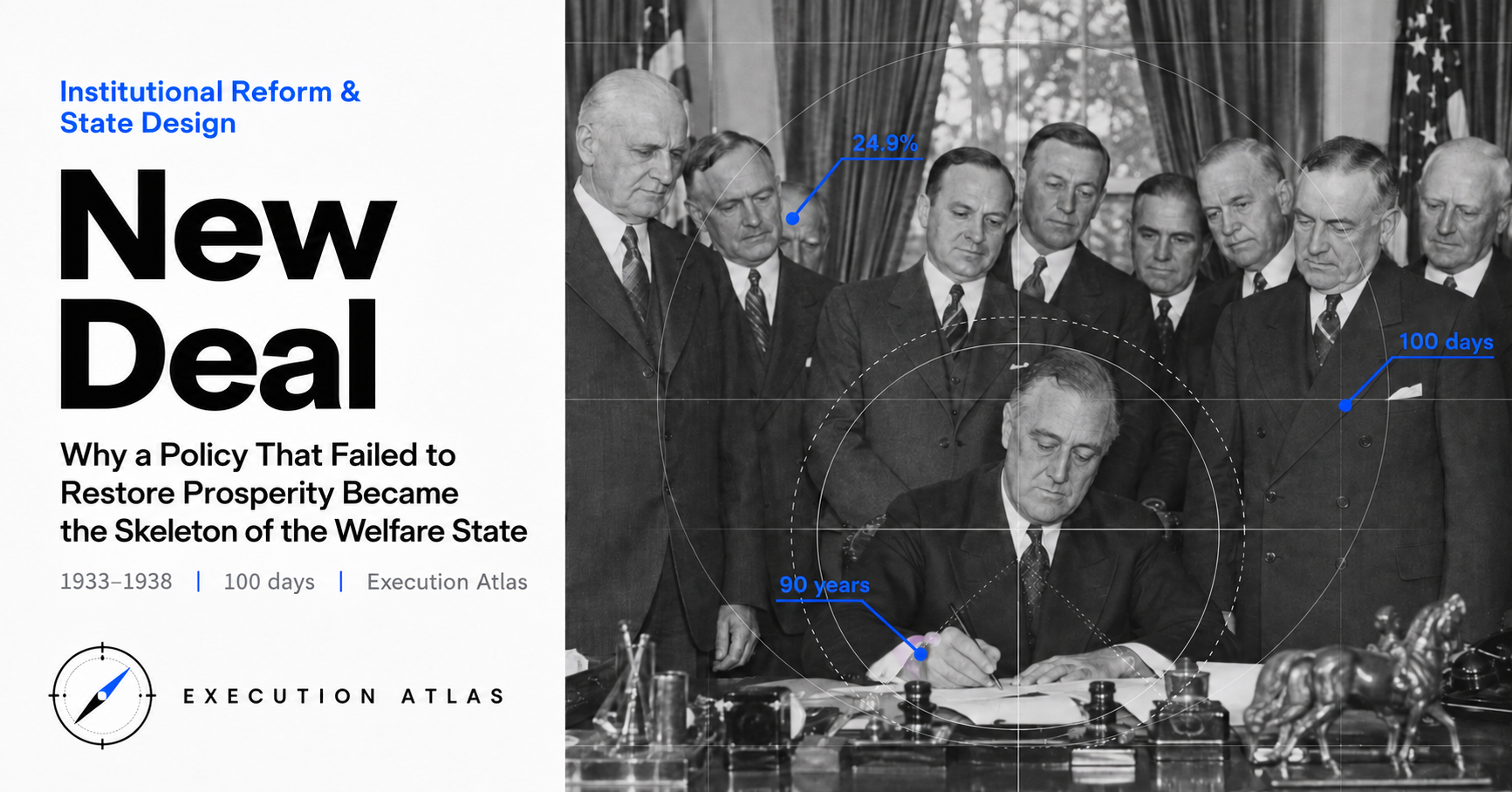
March 4, 1933, noon. Before the Capitol in Washington, D.C. Franklin Roosevelt stood at his inauguration wearing iron braces on both legs, his left arm supported by his son James. The president, unable to walk unassisted due to the effects of polio, had the day’s speech broadcast by radio across the nation.
“The only thing we have to fear is fear itself.”
Shortly after the speech, he called Congress into emergency session. On March 9, the Emergency Banking Act passed the House in 38 minutes. Only the cover sheet was distributed; House Banking Committee Chairman Henry Steagall read the bill’s text aloud. The Senate passed it 73 to 7 that evening. Roosevelt signed it the same day. Five days after taking office.
Over the next 100 days, he pushed 15 major bills through Congress. Banking, agriculture, industry, electricity, employment, housing, labor. The federal government intervened in almost every economic sector for the first time.
By June 16, 100 days later, the CCC (Civilian Conservation Corps), TVA (Tennessee Valley Authority), AAA (Agricultural Adjustment Act), NIRA (National Industrial Recovery Act), Glass-Steagall Act, FERA (Federal Emergency Relief Administration), and the Home Owners’ Loan Act — frameworks that would be debated for the next 90 years — had almost all been enacted in this period.
Over the following two terms and eight years, he added the Social Security Act, the Wagner Act, the Fair Labor Standards Act, the SEC (Securities and Exchange Commission), and the FDIC (Federal Deposit Insurance Corporation).
This is the bundle of policies known as the New Deal.
It was not a simple success story.
The unemployment rate fell from 24.9% in 1933 to 14.3% by 1937, but budget-balancing that year sent it back up to 19% the following year — the “Roosevelt Recession.” Full employment would ultimately wait until the wartime economy of 1941. The New Deal did not complete its short-term goal of full economic recovery.
Meanwhile, two of the pillars enacted during those 100 days — NIRA and AAA — were struck down by the Supreme Court as unconstitutional and vanished. Half of the flagship programs of the “First 100 Days” dissolved within three years.
Yet the Social Security Act, SEC, FDIC, and Wagner Act remain active institutions 90 years later. The livelihood of America’s elderly, the safety of bank deposits, and the legality of labor unions all rest on tracks laid by the New Deal nine decades ago.
The short-term economic targets were missed. The flagship programs were ruled unconstitutional. So why did the New Deal survive as an institution?
Breaking down this project reveals that designing “policies” and designing “institutions” are entirely different undertakings. What the New Deal left behind is a showcase of that distinction.
Mission: 25% Unemployment and the Declaration to “Try Something”
On March 4, 1933, the day of the inauguration, America stood in the following condition.
Unemployment: 24.9%. One in four workers had lost their jobs. Roughly 40% of banks nationwide were closed, and the financial system itself was on the verge of collapse from bank runs. Stock prices had fallen 89% from their October 1929 peak. Farm prices had halved compared to 1929, and 30% of farmers had received foreclosure notices. In 1932 alone, the Dust Bowl — massive soil erosion across the Midwest — had accelerated, sending 250,000 people fleeing westward.
Former President Herbert Hoover had maintained a position of “minimal government intervention” through this situation. The federal government would stay out of markets and leave poverty relief to local governments and private charity. That basic policy was upheld at the bottom of the Great Depression.
The result: in the 1932 election, Hoover was defeated 472 to 59 in the Electoral College. The mandate given to Roosevelt was not merely to “change presidents.” It was a mandate for the new premise itself — that the federal government would intervene in the economy.
During the campaign, at the Oglethorpe University commencement in May 1932, Roosevelt spoke words that would come to define the New Deal.
“The country needs and, unless I mistake its temper, the country demands bold, persistent experimentation. It is common sense to take a method and try it: If it fails, admit it frankly and try another. But above all, try something.”
Not the words a politician typically says. He was not pretending to know the answers. He declared he would try the next thing if he got it wrong.
This passage would be repeatedly quoted when later describing the true nature of the New Deal. The New Deal was not a unified economic theory. It began before Keynesian economics had spread (Keynes’s The General Theory of Employment, Interest and Money was published in 1936). No systematic alternative theory existed to counter the Republican orthodoxy of the gold standard, free markets, and small government.
Instead, there were just three goals: “Relief, Recovery, Reform.”
Relief meant immediate assistance for daily life — getting food to the hungry, giving work to those left destitute.
Recovery meant economic restoration — bringing production, employment, and prices back to pre-Depression levels.
Reform meant restructuring institutions — redesigning the frameworks of finance, labor, agriculture, and social security so a crisis of this scale could never happen again.
He declared in his inaugural address that all three would run simultaneously. Not to “restore” the crisis but to seize it as an opportunity to “rebuild” — a statement of intent.
This declaration was the launching pad for the 100-day legislative rush.
Design: Three Constraints and the Strategic Choice to “Institutionalize”
The operation of passing 15 bills in 100 days did not proceed from a pre-existing blueprint.
Roosevelt’s campaign platform contained no specific policy package called the New Deal. The phrase “new deal” itself first appeared as a metaphor in his nomination acceptance speech in July 1932, without accompanying details.
To run it in the field required simultaneously accommodating three constraints.
The first constraint was time. Bank closures were worsening by the day — by 40% of all banks. From March 4 onward, the window before the entire financial system came to a complete halt was probably less than a week. That is why he called Congress the day after the inaugural address. Banking rescue had to be the first priority.
The second constraint was the Constitution. The federal government’s authority to intervene directly in the economy was subject to interpretation of the Commerce Clause and the General Welfare Clause, and could be struck down by the Supreme Court at any time. In fact, in 1935, NIRA was struck down unanimously. In 1936, AAA fell 6 to 3. One could say the design had to assume that two pillars of the “First 100 Days” would dissolve in the courts within three years — though that is a retrospective assessment; at the time, staff did not anticipate the rulings.
The third constraint was federalism. The United States is a union of states. Education, policing, public health, and much of welfare fall under state authority. Even if the federal government decided to provide social security for all Americans, it would be empty if states didn’t implement the design. Southern Democrats wanted to maintain racial segregation. Making enemies of that bloc would collapse the Democratic majority in both chambers.
Against these three constraints, the New Deal ran three kinds of design in parallel.
The first was “immediate emergency response” — the Emergency Banking Act, FERA, CCC. Emergency first aid to restore normalcy, designed to serve their purpose and end within a few years.
The second was “experiments in industrial organization” — NIRA, AAA. Industry-wide cartels, agricultural production controls, working-hour regulations. Ambitious designs that had the government intervening in prices and output, but with a constitutional wall waiting. They kept calling it an “experiment” because these two were genuinely treated as experiments.
The third was “institutional creation” — the Social Security Act, the Wagner Act, the SEC, the FDIC. These came into their own in the Second New Deal (1935 onward). Agencies were created, automatic funding was attached, and beneficiary constituencies were generated. Code was embedded so these would keep running automatically even when the administration changed.
Whether the designers consciously distinguished these three types cannot be determined from the historical record. But as a result, only the third type survived 90 years.
The person who handled institutionalization was a woman who had partnered with Roosevelt before he took office.
Labor Secretary Frances Perkins. America’s first female cabinet member. When approached about the appointment, she presented Roosevelt with a list of demands: federal public works, prohibition of child labor, minimum wage and maximum working hours, unemployment insurance, old-age pensions, health insurance. “If you’re not willing to make these happen, I won’t accept,” she told him.
Roosevelt agreed to every item. Except for health insurance, Perkins would legislate nearly her entire list over the following 12 years as Labor Secretary.
The Social Security Act’s design team was the Committee on Economic Security (established 1934), chaired by Perkins. This committee designed old-age pensions and unemployment insurance in a federalism-compatible format of “state implementation plus federal contribution.” Benefits would be nationally uniform under federal auspices; funding would be collected automatically through payroll taxes on employers and workers. A mechanism designed to keep running without congressional approval even when administrations changed.
This was the design of an “institution.”
Execution: The 100-Day Legislative Rush and the Subsequent Stall
From March 9, when Congress convened, to June 16, when it adjourned — the 15 major bills enacted in those 100 days broke down as follows:
March 9: Emergency Banking Act. Federal control over bank closures and reopenings.
March 20: Economy Act. Attempted fiscal balance through cuts to federal salaries and veterans’ pensions.
March 22: Beer Tax Act. Groundwork for ending Prohibition.
March 31: Civilian Conservation Corps Act (CCC). Mobilized men aged 18-25 for reforestation and flood control.
April 19: Decision to abandon the gold standard.
May 12: Agricultural Adjustment Act (AAA) and Federal Emergency Relief Administration (FERA).
May 18: Tennessee Valley Authority Act (TVA).
May 27: Federal Securities Act. Disclosure requirements for securities issuances.
June 5: Abrogation of gold clauses.
June 13: Home Owners’ Loan Corporation Act (HOLC).
June 16: National Industrial Recovery Act (NIRA), Glass-Steagall Act, Farm Credit Act.
Congress passed nearly every bill Roosevelt sent up with minimal modification. In the same pattern as the opening Emergency Banking Act, deliberation was minimal and passage came the same day or the next — a rhythm that continued for 100 days.
Why this speed was possible can be explained by the concentration of political capital.
In the 1932 election, Democrats won 313 seats in the House (majority threshold: 218) and 59 seats in the Senate (majority threshold: 49). They could do almost anything short of amending the Constitution. Roosevelt’s own vote share was 57.4%, with 472 to 59 Electoral College votes. The mandate was overwhelming.
Simultaneously, the Republicans had been politically neutralized by being blamed for the Great Depression. Hoover-era policies had become synonymous with “doing nothing.” Opposing the New Deal wouldn’t win them votes.
And the media environment. Eight days after his inauguration, on March 12, Roosevelt broadcast the first “Fireside Chat.” On a Sunday night at 10 p.m., 60 million Americans listened on radio as he explained the banking rescue measures directly to the public in plain language. When closed banks reopened the next day, there was no bank run — instead, some people brought back the money they had withdrawn.
“The president speaking directly to the public” as a communication format was invented with this broadcast. Roosevelt went on to give 30 Fireside Chats during his presidency. Media design was synchronized with policy design.
When the 100 days ended, Roosevelt expanded his majority further in the 1934 midterms (322 House seats, 69 Senate seats). To that point, the wind was favorable.
The wind shifted on May 27, 1935 — a day called “Black Monday.”
The Supreme Court struck down NIRA unanimously in one of three rulings, along with several other New Deal measures. The grounds were primarily excessive delegation of legislative authority to the executive and overreach of federal intervention in interstate commerce. In January 1936, AAA was also ruled unconstitutional.
The two most ambitious pillars of the “First 100 Days” had been judicially dismantled within three years. Roosevelt was furious and publicly attacked the Supreme Court during the subsequent campaign.
His re-election in November 1936 was a landslide: 46 states, 523 to 8 in the Electoral College — one of the largest presidential victories in modern American history.
Riding that momentum, on February 5, 1937, Roosevelt announced the court-packing plan: for every justice over age 70, the president could appoint one additional justice. The existing nine-member court could grow to as many as fifteen. The actual aim was to neutralize aging, anti-New Deal justices.
This “court-packing” proposal was politically explosive. Even Democrats accused him of pursuing dictatorship. He couldn’t bring it to a Senate vote, and in July that year, Senate Majority Leader Joe Robinson — the bill’s last driving force, making individual visits to persuade wavering senators — died of a heart attack. With Robinson’s death, the bill died too.
Yet something strange had been happening during the debate.
One justice, Owen Roberts, had suddenly begun voting in favor of New Deal legislation starting in March 1937. West Coast Hotel v. Parrish (upholding Washington State’s minimum wage law). NLRB v. Jones & Laughlin Steel (upholding the Wagner Act’s constitutionality). The following year, Social Security was also upheld. Roberts’s change of heart was called the “switch in time that saved nine” — a phrase that included a nod to the court-packing bill’s intent to protect the nine-member bench.
The bill was dead. The court-packing plan had failed. But the Supreme Court had softened its stance, and subsequent New Deal legislation faced no more constitutional challenges. The actual objective was achieved in the immediate wake of a political defeat. Roosevelt later said of the court-packing defeat: “I lost the battle but won the war.”
Also in 1937, a separate economic stall occurred.
Seeing signs of recovery, Roosevelt pivoted to balancing the budget. In 1936, the full-employment payroll tax (the Social Security funding mechanism) had begun, and tight budget execution in the first half of 1937 coincided. Federal spending was cut from the previous year. The Federal Reserve also raised reserve requirements. The judgment was: “The crisis is over.”
By June 1938, unemployment had climbed back from 14.3% to 19%. Stock prices fell nearly 50%. Industrial production dropped by about one-third. This became known as the “Roosevelt Recession.”
By mid-1938, Roosevelt reversed course. He halted austerity and re-expanded the WPA budget. This experience would later be cited as empirical evidence for Keynesian economics — the lesson that premature austerity during recovery can kill the recovery was experimentally confirmed in the middle of the New Deal.
After that point, however, the New Deal-style legislative rush did not return. In the November 1938 midterms, Democrats lost 72 House seats, forming a coalition of Republicans and conservative Southern Democrats. From 1939 onward, major new legislation stopped passing. After the attack on Pearl Harbor in December 1941, the administration’s energy transferred completely to the war economy.
Full employment was ultimately achieved by war. The New Deal did not complete the goal of full economic recovery on its own.
People: The 51-Year-Old President in a Wheelchair and the Labor Secretary’s List
Roosevelt was born in 1882 — 51 years old when he took office. From an aristocratic Dutch family in the Hudson River Valley. Harvard University, Columbia Law School. New York State Senator, Assistant Secretary of the Navy under Wilson, 1920 vice-presidential candidate (defeated), Governor of New York. His political bloodline, education, and résumé were textbook upper-class establishment.
In 1921, at age 39, he contracted polio. He lost nearly all motor function from the waist down. From then on, in public he pretended he could stand and walk. He strapped iron braces to both legs and took a few steps leaning on those around him. Photographs of him in a wheelchair were deliberately avoided. Most Americans did not know the president couldn’t walk.
This concealment was officially termed the “Splendid Deception” — a decision made in an era of strong discrimination against disabled people, maintained by his staff and the press in a kind of collusion. When he toured New York giving speeches during his two terms as governor from 1929 to 1933, the appearances were carefully staged.
The Fireside Chats were also, in a way, the inverse technique of this concealment. Radio carries no images. The president’s voice reached directly into the homes of citizens. A president speaking while seated was indistinguishable from one speaking while standing.
The man who said at his inauguration “the only thing we have to fear is fear itself” had been individually negotiating with the fear of his own legs for the preceding 12 years.
Roosevelt’s inner circle assembled an unusual cast of characters.
Frances Perkins was born in 1880 — 52 years old at Roosevelt’s inauguration. Mount Holyoke College in Boston, Columbia University master’s degree. New York Consumers League, New York State Factory Investigating Commission, then state Industrial Commissioner under Governor Roosevelt. The 1911 Triangle Shirtwaist Factory fire — where 146 garment workers died — which she witnessed firsthand, became the origin point of her lifelong commitment to labor policy.
The list she presented to Roosevelt when she accepted the Labor Secretary position unfolded as follows:
CCC (March 1933), Public Works Administration PWA (June 1933), Social Security Act (August 1935), Works Progress Administration WPA (April 1935), Wagner Act (July 1935), Fair Labor Standards Act (June 1938, establishing minimum wage, maximum hours, and prohibition of child labor).
Over 12 years, she institutionalized nearly her entire list. Only health insurance failed to pass Congress. Federal health insurance for all Americans would wait 60 years after her resignation — until the Affordable Care Act (2010).
Harry Hopkins was born in 1890, aged 42 at inauguration. From a poor family in Iowa, a graduate of Grinnell College. He built his career in private charities in New York City and became Emergency Relief Administrator under Governor Roosevelt. He became FERA Director at inauguration, later WPA Director.
When Harry went to Congress to request the WPA budget, he asked for $4 billion — roughly $72 billion in modern terms. An unprecedented sum. When Congress asked, “Do you really need that much?” his recorded reply was: “Hunger is not debatable.” The request was approved at nearly the full amount.
Over its eight years of operation, WPA employed 8.5 million people, paved 650,000 miles of roads, built 125,000 public buildings, 75,000 bridges, 8,000 parks, and 800 airports. Peak employment was 3,334,594 in November 1938. The annual budget fluctuated around $1 billion after the initial $4 billion ask, with a cumulative total of about $10.5 billion. Harry had asked for the first-year amount only. Over eight years, the total expanded 2.6 times over.
One more figure, from outside: Keynes.
John Maynard Keynes met with Roosevelt for an hour in Washington in May 1934. At that point, he had not yet written The General Theory (published 1936). Nevertheless, he had repeatedly argued for the importance of government spending during the Depression through letters and articles. After the meeting, Roosevelt reportedly told aides: “He’s more of a mathematician than an economist.” The president was initially skeptical of Keynes as a theorist.
But after the 1937 austerity and the Roosevelt Recession, White House economic advisers gradually adopted Keynesian thinking. The 1938 course reversal was, in a sense, the result of an experimental test of Keynesian theory.
Legacy: Only What Was Institutionalized Still Runs 90 Years Later
Listing the programs called flagship New Deal programs as of 1939:
NIRA (unconstitutional 1935, abolished). AAA (unconstitutional 1936, continued under successor legislation). CCC (abolished 1942 during wartime). WPA (abolished 1943 as wartime economy made it unnecessary). PWA (abolished 1943). CWA (abolished early, in 1934). FERA (absorbed into WPA in 1935). HOLC (liquidated 1954).
Most of the showpiece programs of the “First 100 Days” were gone within 10 to 20 years. When the exigency passes, one-off programs disappear. One could say they served their role, but many left vacuums without successor programs to fill them.
On the other hand, what was created from 1935 onward is still running 90 years later.
Social Security (1935). Old-age pensions, unemployment insurance, and disability benefits for Americans. Currently 180 million enrolled; annual benefits total roughly $1.3 trillion.
FDIC (1933, part of the Glass-Steagall Act). Federal deposit insurance. All American bank deposits are still insured up to $250,000. Systemic bank runs have not occurred since 1933.
SEC (1934, Securities Exchange Act). Disclosure regulation for securities markets. Issuers still register with this agency today.
Wagner Act (1935). Legality of labor unions and collective bargaining rights. Union membership grew from roughly 3.7 million in 1933 to roughly 9 million in 1940 — the foundation of the subsequent labor law system.
Fair Labor Standards Act (1938). Minimum wage, maximum working hours, and prohibition of child labor. The institution itself remains active today; only the hourly wage figure and weekly hours have been updated.
What distinguishes what vanished in three years from what remained for 90?
First, whether it was made into a permanent agency. The Social Security Administration, SEC, FDIC, NLRB (National Labor Relations Board) — each was designed as an independent federal agency. Budget allocation goes through Congress every year, but abolishing the agency itself requires an act of Congress. A program can be stopped by executive will; an agency can only be stopped by changing the law.
Second, whether it was linked to automatic funding. Social Security is collected automatically through payroll taxes. FDIC runs automatically on bank insurance premiums. The SEC is funded by registration fees and penalties. Even when fiscal-balance debates arise, these run on autopilot.
Third, whether it generated beneficiary constituencies. The elderly receiving Social Security benefits. Depositors protected by FDIC insurance. Workers protected as union members. They resist the abolition of their institutions as voters. The institution itself generates the political interests that defend it.
Permanent agency status, automatic funding, beneficiary generation. Only what combined all three survived 90 years. One-off programs that simply received annual congressional appropriations disappeared when the times changed.
The interesting point here is that within the New Deal, teams that consciously designed “institutionalization” coexisted with teams that did not.
The Social Security Act team and the labor rights legislation team led by Perkins were clearly designing with “something that outlasts the administration” in mind. Perkins herself left a note after the Social Security signing ceremony: “This will last beyond my term.” Even the committee’s name — “Economic Security” — signaled the intent to create a permanent institution.
Hopkins’s FERA, WPA, and CWA, by contrast, were designed as emergency first aid — “something to eat today.” There was no intent to institutionalize them permanently. When the crisis ends, so does the role. And that is exactly how they ended.
In other words, within the New Deal, the design of “policies” and the design of “institutions” were both running simultaneously. The difference between the two was explicitly understood. The division of labor was rational.
As a result, the “policy” part vanished with the end of the New Deal, and the “institution” part is still running 90 years later.
Viewed from a modern context, this separation becomes even more interesting.
During the 2008 financial crisis, the U.S. government passed the Emergency Economic Stabilization Act (TARP) — $700 billion in bank bailouts. It was recouped within five years, ending roughly at a profit. That was a classic “policy.” When its role ended, it disappeared.
On the other hand, the Dodd-Frank Act (2010), passed after the same crisis, established the Financial Stability Oversight Council (FSOC) and the Consumer Financial Protection Bureau (CFPB) and substantially strengthened capital requirements for major financial institutions. Parts were diluted under the Trump administration, but the agencies themselves remain. That was “institution” design.
The 2020-21 COVID response had the same structure. The CARES Act and the American Rescue Plan were $1.9 trillion in fiscal stimulus — surpassing WPA in scale — but most of it was one-off programs that finished executing within two or three years. With the economy recovered, all that remains is in the fiscal deficit. That was the “policy” part. At the same time, there were discussions about permanently expanding Social Security benefits and making the Child Tax Credit permanent — but those did not pass. The attempt to create an “institution” part failed.
The mid-2020s “Green New Deal” also inherits only the name; most of its implementation consists of bundles of subsidies and tax credits. It does not involve creating new, permanent, institutionalized agencies. As a design, it is closer to CCC and WPA than to TVA or FDIC. When the times change and the demand fades, it will quietly disappear.
What the New Deal left 90 years ago is a design textbook on the separation of policy and institution. At the same time, it is a showcase of the fact that choosing one or the other determines what is left for future generations.
Lesson: Is Your Project a Policy or an Institution?
Whether to call the New Deal a “success” or a “failure” depends on what metric you choose.
By the short-term economic target, it failed. Unemployment never fully recovered; the 1937 austerity drove it back up; full employment ultimately waited for the war economy.
Even looking at the flagship programs of the “First 100 Days,” success and failure are mixed. NIRA and AAA were ruled unconstitutional and vanished; WPA and CCC were dissolved with the wartime economy; no successor programs filled the vacuums they left.
As political combat, court-packing was a frontal defeat, and major new legislation stopped after 1938.
On the other hand, the institutions of the “Reform” pillar — Social Security, SEC, FDIC, the Wagner Act, the Fair Labor Standards Act — are still running 90 years later. The basic frameworks of financial regulation, labor rights, and social security became something entirely different from pre-New Deal America. The shift of the United States from a “small government” country to a “welfare state” was accomplished in these five to six years.
The short-term economy was not saved, but the system was rewritten.
What made this separation possible was that within the administration, the team designing “policies” and the team designing “institutions” were operating from different design philosophies simultaneously. During the period when both designs coexisted, the administration distinguished between them. The institution-building team was operating on a time horizon that extended beyond the administration.
Translated into modern language, the distinction can be stated as follows.
A “policy” is work that maximizes KPIs within the current term or fiscal year — fiscal stimulus, campaigns, crisis response. These all belong to the policy side. Policies are built with the expectation of disappearing. That is why they are light and fast.
An “institution” is work that creates a mechanism that successors and future administrations keep running automatically — creating agencies, automating funding, generating beneficiary constituencies. The time horizon is 10, 30, 100 years. It takes time to design, and every revision accumulates political cost. But once completed, it runs even after its creators are gone.
Even working in the same organization, with the same budget, on the same problem, these two are fundamentally different. If the designers themselves are not conscious of which they are designing, things built intending to be policies disappear with a change in administration, while things built intending to be institutions become too complex to launch.
This is not limited to government.
Most projects within companies also belong to the “policy” side. This quarter’s sales campaign. Next year’s product release. A three-year plan. When the person in charge transfers, management turns over, or the budget is restructured, they disappear. That is not inherently bad. Policies fulfill their role by disappearing.
The problem arises when “institution” work is run on the budget and schedule of a “policy.” You’re supposed to build a permanent organization but are asked for this-quarter impact metrics. You should attach automatic funding but instead face annual budget reviews. You should generate a beneficiary constituency but are only explaining to internal stakeholders. When any of the three is missing, that work drifts toward “policy” and disappears.
Internal performance evaluation systems, labor unions, compliance bodies, standardization committees, retirement plans, training programs — these are inherently “institutions.” They must function beyond organizational generations to have meaning. Yet most organizations treat them as “this quarter’s investment decisions.” When the responsible person transfers, they hollow out. They disappear in restructurings. What disappears in this way is absent in the next crisis, regenerating pain.
The New Deal has been running this separation experiment for 90 years on our behalf.
The three-part kit for institutionalization — permanent agency status, automatic funding, beneficiary generation — changes names but transplants into any organization. A permanent responsible department. Funding design that does not depend on internal budgets. A clear stakeholder alignment with defined beneficiaries. Embed these three into the initial design, and the work keeps running even when the responsible person is gone. Leave them out, and the work stops when the responsible person leaves.
Is your project a policy, or an institution?
If you intend to build a policy, include how it ends in the design. Design the practice of closing cleanly when the role is done, without leaving unnecessary cost. Harry Hopkins’s $4 billion was spent on the premise it would become $0 after eight years.
If you intend to build an institution, embed the mechanism for running without the responsible person into the design from the start. Frances Perkins’s Social Security Act is still functioning not just after her departure but 60 years after her death.
Same budget, same timeframe, same problem — but one disappears in five years, while the other remains for 90. The difference lies in the consciousness at design time.
Sources
- Wikipedia “New Deal” (https://en.wikipedia.org/wiki/New_Deal) — overall timeline, major legislation, spending scale.
- Britannica “New Deal” (https://www.britannica.com/event/New-Deal) — the 3R (Relief/Recovery/Reform) concept, overall positioning.
- History.com “Fast Facts on the First 100 Days” (https://www.history.com/articles/fast-facts-on-the-first-100-days) — 15 major bills passed in 100 days.
- Miller Center “Franklin D. Roosevelt: Domestic Affairs” (https://millercenter.org/president/fdroosevelt/domestic-affairs) — Roosevelt’s policy decisions and roles of advisers.
- Wikipedia “Works Progress Administration” (https://en.wikipedia.org/wiki/Works_Progress_Administration) — WPA employment scale, spending, peak employment of 3.3 million, 650,000 miles of roads, Harry Hopkins’s $4 billion request.
- History.com “Works Progress Administration” (https://www.history.com/articles/works-progress-administration) — WPA employment figures and construction results for roads, bridges, and airports.
- History.com “Civilian Conservation Corps” (https://www.history.com/articles/civilian-conservation-corps) — CCC mobilization of 3 million, 3.5 billion trees planted.
- Wikipedia “Social Security Act” (https://en.wikipedia.org/wiki/Social_Security_Act) — signing on August 14, 1935; Frances Perkins’s role; state implementation plus federal contribution design.
- Roosevelt Institute “What Is the Social Security Act?” (https://rooseveltinstitute.org/blog/what-is-the-social-security-act/) — Social Security Act’s design background and legacy through the present.
- National Archives “Tennessee Valley Authority Act (1933)” (https://www.archives.gov/milestone-documents/tennessee-valley-authority-act) — TVA establishment and purpose.
- History.com “Tennessee Valley Authority” (https://www.history.com/articles/tennessee-valley-authority-new-deal-progress-controversy) — how TVA power costs came to be 30% below the national average.
- Wikipedia “Judicial Procedures Reform Bill of 1937” (https://en.wikipedia.org/wiki/Judicial_Procedures_Reform_Bill_of_1937) — court-packing plan history and failure.
- Supreme Court Historical Society “FDR & The Court Packing Controversy” (https://supremecourthistory.org/films/fdr-courtpacking-controversy-full-script/) — Owen Roberts’s “switch in time that saved nine.”
- Wikipedia “Recession of 1937–1938” (https://en.wikipedia.org/wiki/Recession_of_1937%E2%80%931938) — unemployment trends and causes of the Roosevelt Recession.
- Number Analytics “The Lasting Legacy of the New Deal” (https://www.numberanalytics.com/blog/new-deal-lasting-legacy) — union membership trends and long-term impact.