
In 338 BC, a man was fleeing the capital of Qin.
Night fell. He stopped at an inn. The innkeeper said: “By Lord Shang’s strict orders, we cannot lodge anyone without a travel permit.”
The man was Shang Yang himself. His own law had sealed his own escape.
“Alas, how far the harm of my laws has reached.” Shang Yang sighed.
The system this man designed transformed Qin from a “barbarian state” into the most powerful kingdom of the Warring States in 21 years. The reformer was executed. But the reform survived. A hundred and thirty years later, Qin unified China.
Mission: The State That Lost with Ten-to-One Odds
389 BC. The Battle of Yingjin. Qin marched 500,000 soldiers to reclaim the Hexi region. Wei’s general Wu Qi met them with 50,000.
Qin was crushed. Outnumbered ten to one, and still lost.
That single battle defined Qin’s position. Hexi fell to Wei. Qin was no longer invited to the alliances of the Central Plains lords. “No different from barbarians.” A backwater on the western frontier. That was Qin.
In 362 BC, the Battle of Shaoliang. Duke Xian of Qin captured Wei’s chancellor Gongshu Cuo, but died the same year.
Ying Quliang took the throne at age 21. He would be known as Duke Xiao.
The young ruler’s first act was issuing the “Decree Seeking Talent.” Any man from any state who could make Qin strong was welcome. The man who came was Shang Yang.
Shang Yang was born into the ruling house of Wei state and had studied Legalist philosophy under Chancellor Gongshu Cuo of Wei. After Gongshu Cuo’s death, he found no place in Wei and answered Qin’s call. Through the eunuch Jing Jian, he secured an audience with Duke Xiao.
In their first meeting, Shang Yang spoke of the “Way of the Emperors.” The governance of ancient sage-kings. Duke Xiao dozed off. Next, the “Way of the Kings.” Governance through benevolence and righteousness. Same reaction.
Third meeting. Shang Yang spoke of the “Way of the Hegemon.” Ruling through law and power.
Duke Xiao unconsciously leaned forward.
Design: Dismantling Blood Ties, Rebuilding with Law
With Duke Xiao’s trust, Shang Yang set out to redesign Qin’s society from its foundations. In 359 BC, he began drafting reforms. The old ministers Gan Long and Du Zhi opposed him: “Ancient institutions should not be changed.”
Shang Yang replied: “There is no single way to govern. One need not follow the ancients to benefit the state.”
Duke Xiao backed Shang Yang. The opposition was dismissed. From here, the redesign of an entire nation began in two phases.
First Reform (356 BC): Changing the Unit of Society
Qin was a clan-based society. Extended families bound by blood were the basic social unit, and clan heads controlled both land and people. Under this structure, no law could reach the bottom. If a clan head said “we do things our own way,” that was the end of it.
Shang Yang started by changing the basic unit of society itself.
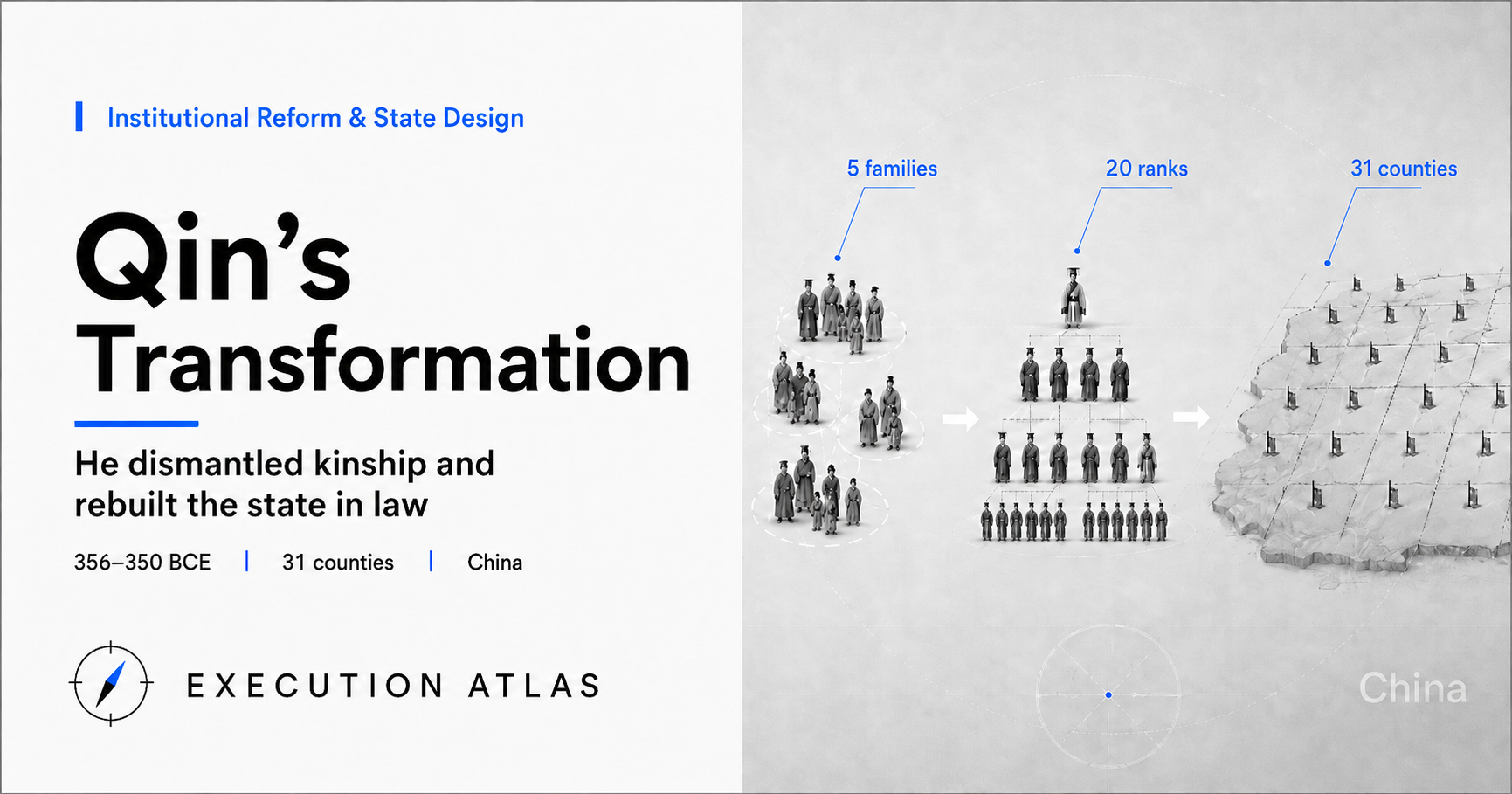
First, the “Order of Separate Households.” Any family with two or more adult sons was forced to split into separate households. Refuse, and your tax doubled. A law that broke extended families into nuclear ones. It severed clan bonds physically, allowing the state to track individuals directly.
Next, the shiwu system. Five households formed a wu, ten formed a shi. With a standard family of five, a wu was roughly 25 people, a shi about 50. These groups bore collective responsibility. If someone in the group committed a crime and no one reported it, everyone received the same punishment. Report a crime, and you earned the same merit as taking an enemy’s head on the battlefield.
Clans bound by blood were dissolved. Strangers from five families were reassembled into a single unit. Shared surveillance and shared liability created a channel through which state law reached individuals directly.
One more: the military merit rank system. Qin already had a 20-tier nobility, but Shang Yang made it purely merit-based. Bloodline was irrelevant. Take one enemy head on the battlefield, rise one rank. One rank earned you one qing of farmland, one plot for a house, one servant. Conversely, even royalty without military merit were stripped of noble status.
Dismantle blood ties. Track individuals through law. Determine rank by results. The First Reform did all three at once.
Second Reform (350 BC): Replacing the Administrative Apparatus
After changing the unit of society in the First Reform, Shang Yang waited six years before reforming the administrative structure.
He moved the capital to Xianyang. The old capital Yueyang was entrenched with vested interests of the old aristocracy. Moving to a new capital physically severed their influence.
He divided the entire state into 31 counties (some sources say 41), each governed by a magistrate and vice-magistrate appointed from the center. Hereditary feudal lordship was abolished and replaced with centralized bureaucratic governance. The county system, with governors dispatched from the capital, began here.
He standardized weights and measures. A bronze measuring vessel called the “Shang Yang Bronze Square Sheng” was established as the standard for all commerce and taxation throughout Qin. This became the prototype for the empire-wide standardization that the First Emperor would implement 130 years later.
The sequence mattered. First, organize people with the shiwu system. Motivate them with military merit ranks. Only after the state could track every person down to the village level did Shang Yang replace the administrative apparatus. Reverse the order, and it fails. Send a magistrate to a county where residents still obey only their clan head, and governance exists only on paper.
The Man Who Bought a Nation for 50 Gold
The new laws were drafted but not yet promulgated. Shang Yang had one concern.
The people did not trust the government. Whatever the government decreed, they assumed it would not be enforced. Past governments had broken too many promises. Stack new laws on top of that distrust, and no one would comply.
Shang Yang erected a wooden pole, roughly seven meters tall, at the south gate of the capital. He posted a notice: “Carry this pole to the north gate, and receive 10 gold.”
Nobody moved. Too suspicious.
“50 gold.” He raised the reward. Days later, one man finally carried the pole.
Shang Yang paid him 50 gold on the spot. Roughly $30,000 in today’s value. For carrying a pole.
This government keeps its word. That fact spread across Qin. He bought the nation’s trust for the cost of 50 gold.
He promulgated the new laws.
Execution: Ten Years of Silence, Then Transformation
Immediately after enactment, the new laws did not work. Public resentment erupted. The old aristocracy resisted. No results.
Shang Yang did not waver. “Action born of doubt earns no fame; enterprise born of doubt yields no result.” He counseled Duke Xiao with these words and did not change the laws.
The turning point came with the incident of the crown prince.
Duke Xiao’s heir, Ying Si (later King Huiwen), broke the law. Under the shiwu system, even a crown prince was not exempt. But punishing the prince would destroy Shang Yang’s relationship with Duke Xiao. It would mean harming the future ruler of the state.
Shang Yang punished the prince’s two tutors instead. Gongzi Qian had his nose cut off. Gongsun Jia was branded with tattoos. While claiming “equality before the law,” he created the most critical exception.
The effect was immediate. If even the crown prince’s tutors could be punished, no one else could expect to escape. Every person in Qin understood this. Compliance with the law surged.
But the bill for that decision would arrive 20 years later.
Ten years passed after enactment. The Records of the Grand Historian records: “After ten years, the people of Qin rejoiced greatly. Nothing dropped on the road was picked up. There were no bandits in the mountains. Every household was well-provided.”
It took ten years for the system to change behavior. Enacting a system takes a day. Changing how people act takes half a generation.
In 354 BC, while Wei was fighting Zhao, Qin seized the Hexi region. In 340 BC, Shang Yang led Qin’s army to a decisive defeat of Wei, which formally ceded Hexi. The state that had lost with ten-to-one odds reclaimed its lost territory from the same enemy.
Wei moved its capital from Anyi east to Daliang. It could no longer withstand Qin’s pressure.
People: The Man with Three Faces
Shang Yang. Born circa 390 BC. He was 31 when the reforms began in 359 BC.
He carried three names. His birth name was Gongsun Yang. As a member of Wei’s ruling house, he was also called Wei Yang. After being enfeoffed with 15 towns in the Shang region, he became Shang Yang. Each name marked a different chapter of his life.
The episode of pitching to Duke Xiao three times reveals the man’s nature. Speaking of the Way of Emperors and the Way of Kings was a test of the duke’s character. Some scholars believe he intended to propose the Way of the Hegemon from the start. He read the room and adjusted the pitch. Not an idealist. A thoroughgoing pragmatist.
Duke Xiao. Born 381 BC. Took the throne at 21.
He lost his father on the battlefield and inherited a state dismissed as barbarian. That he could issue a call for talent open to any nationality speaks to his youth and desperation. For 20 years, he backed Shang Yang against aristocratic opposition without wavering once. Reform requires not just a reformer, but someone in power who protects the reformer.
In 338 BC, Duke Xiao died.
The crown prince Ying Si took the throne as King Huiwen. The boy whose tutor’s nose had been cut off 20 years ago was now king of Qin.
Gongzi Qian, the man who had lost his nose, and Gongsun Jia accused Shang Yang of treason. Shang Yang fled the capital into the night.
He tried to stay at an inn. He was refused. By his own law.
He tried to escape to Wei. Wei denied him entry. Wei had not forgotten how Shang Yang had deceived their prince Gongshu Ang to win a battle.
Cornered, Shang Yang raised troops in his fief of Shang, but was defeated by Qin’s army and killed in battle. His corpse was torn apart by chariots. He was 52.
Legacy: The Reformer Was Killed. The Reform Was Not.
King Huiwen hated Shang Yang. He had the man who disfigured his tutor torn apart by chariots. He exterminated Shang Yang’s entire clan.
But he did not abolish Shang Yang’s laws.
The shiwu system, the military merit ranks, the county system, the standardized weights and measures. All of it was kept intact. The king separated his personal vendetta from the utility of the law. This was less about King Huiwen’s rationality than it was proof that the law had already been severed from the man who made it.
Bamboo slip records from the Qin and Han dynasties show that 35 to 45 percent of the population held noble ranks during the Qin era. Nearly half the population had earned rank through military merit. No other state in the ancient world had dismantled hereditary status to that extent.
About 120 years after Shang Yang’s death, in 221 BC, the First Emperor unified China. The county system Shang Yang had built across 31 counties was expanded to 36 commanderies nationwide. Standardized weights and measures were applied to all of China. The institutional foundation of the First Emperor’s unification had been designed by Shang Yang roughly 120 years before.
The lineage of the shiwu system runs long. The Three Chiefs system of the Northern Wei dynasty. The lijia system of the Ming dynasty. The five-household groups of Edo-period Japan. The prototype of the neighborhood responsibility system was created by Shang Yang in 356 BC.
Learnings: The Tradeoff of Depersonalization
The story of Shang Yang being refused lodging at an inn is often told as an ironic anecdote. But examine the structure, and it is not a joke.
Shang Yang succeeded in separating the law from his own will. The law was not Shang Yang’s personal command. It had become the operating system of the state of Qin. That is why the innkeeper could say “by Lord Shang’s orders” and refuse Lord Shang himself. The law had become independent of the person.
This depersonalization is why the law survived Shang Yang’s death. When King Huiwen killed Shang Yang, the law did not die with him. It was not tied to the person. Kill the person, and the law remains.
But depersonalization has a cost. If the law is independent of its creator, the creator gets no exceptions either. Shang Yang did not leave himself a rule that said “travelers without permits may be lodged in special cases.” He could not. A single exception would collapse the entire legal framework.
The crown prince incident proved this. Rather than punishing the prince directly, he punished the tutors. He created one exception to equality before the law. That exception killed him 20 years later.
This is the tradeoff every system designer faces. If you build a system that does not depend on you, the system survives your departure. But if the system does not depend on you, there is no escape hatch that saves only you.
A system can be changed in a day. Changing behavior takes ten years. And when behavior truly changes, the system’s designer is just another person living under the law.
Sources
- Sima Qian, Records of the Grand Historian: Biography of Lord Shang (JP Only)
- “Shang Yang’s Reforms / Shiwu System,” World History Window (https://www.y-history.net/appendix/wh0203-045_1.html) (JP Only)
- “Duke Xiao,” World History Window (https://www.y-history.net/appendix/wh0203-045_0.html) (JP Only)
- “Shang Yang,” Britannica (https://www.britannica.com/biography/Shang-Yang)
- “Shang Yang,” Wikipedia EN (https://en.wikipedia.org/wiki/Shang_Yang)
- “Twenty Ranks of Military Merit,” Baidu Baike (https://baike.baidu.com/item/%E7%A7%A6%E6%9C%9D%E4%BA%8C%E5%8D%81%E7%BA%A7%E5%86%9B%E5%8A%9F%E7%88%B5%E4%BD%8D%E5%88%B6/7579155) (CN Only)
- “Shang Yang: The Reformer’s Tragedy” (https://historicalfact.net/qinsyouou/) (JP Only)
- “The Curse of Law,” Rekishi Kaido (https://rekishikaido.php.co.jp/detail/10310?p=1) (JP Only)