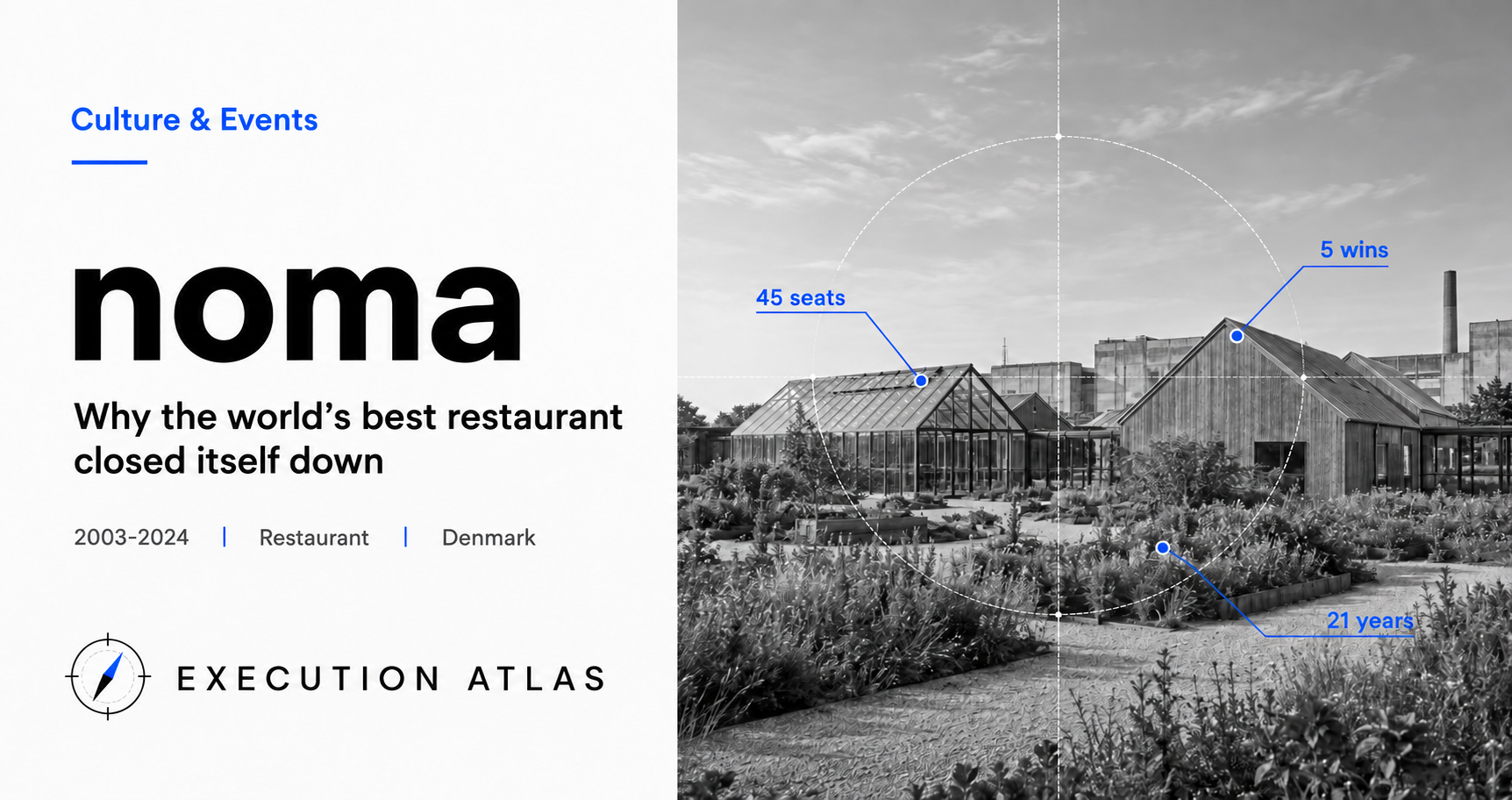
45 seats. Dinner at 4,500 Danish krone, wine pairing separate. Roughly 90,000 yen per person at the time. Five wins at the World’s 50 Best Restaurants. Three Michelin stars. Reservations filled months in advance, and the 2026 Los Angeles pop-up sold out in 60 seconds at $1,500 a seat.
34 paid cooks. Around 30 unpaid interns. Shifts running up to 16 hours. “We were made to work in silence, and laughing was forbidden,” a former intern told The Times.
In October 2022, the restaurant began paying its interns. The additional labor cost: roughly $50,000 a month. Three months later, in January 2023, co-founder and chef René Redzepi announced that the restaurant as it existed would close at the end of 2024. The world’s best restaurant said it was shutting itself down.
The reason, as he put it: “It’s unsustainable. Financially and emotionally, as an employer and as a human being, it just doesn’t work.”
This is the record of how the player at the top made visible an unspoken assumption the entire industry had leaned on for years.
Mission
November 2003, Copenhagen. An old warehouse in the Christianshavn district, inside the Nordatlantens Brygge. A 25-year-old chef opened a small restaurant. He named it noma — a portmanteau of the Danish words “Nordisk” (Nordic) and “Mad” (food).
The chef was René Redzepi. His father was a Macedonian immigrant from a rural village; his mother was Danish. He grew up as the child of an immigrant, entered culinary apprenticeship as a teenager, and spent several months each at elBulli in Spain and The French Laundry in the United States. By his early twenties, he had trained at what were then considered the two best restaurants in the world. His co-founder was gastronomy entrepreneur Claus Meyer, who handled the business and promotional side.
In the early 2000s, Danish food had no international standing. Pork, potatoes, cabbage, bread and butter — traditional, humble, and, as Danish chefs themselves admitted, uninteresting on the world stage. Not French, not Japanese, not Italian. For young cooks aiming at world-class gastronomy, “Nordic” was not a category worth choosing.
Redzepi and Meyer turned this into an advantage. They would cook only with ingredients from the Nordic countries. No imports. Sourced from local farmers, fishermen, hunters, and foragers. Herbs in summer, mushrooms and wild plants in autumn, fermentation and curing in winter, new shoots in spring. Nordic geography became the spec.
In November 2004, Redzepi and Meyer gathered chefs from five Nordic countries in Copenhagen. After two days of discussion, a ten-point “New Nordic Food Manifesto” was adopted: purity, seasonality, ethics, health, sustainability, tradition. The document was quickly translated and circulated worldwide.
noma would not reach the top of the world rankings for another six years. At this point, with no track record to speak of, they were already writing down who they were. Not individual talent, but a movement by design. The mission at this stage was not to make noma successful — it was to leave the philosophy of New Nordic Cuisine in the industry.
Design
45 seats. That single number became the origin of every constraint.
Fine dining has a physical ceiling on seat count. There is a limit to how many dishes a single kitchen and a single chef can deliver without compromising quality. noma aimed right at that ceiling. Beyond 45, the finish on each plate could not be maintained. Below 45, the economics did not work. It was less a constraint than two pieces of tape marking the edges of the only winning path.
Against a capped revenue, costs had the kind of structure that only grows in one direction. The menu was fully replaced each season. Some dishes took months to develop. Identifying and testing wild herbs brought in by foragers, fermentation experiments in the underground lab, varietal selection with farmers, conversations with fishermen about the catch. R&D running outside the kitchen determined the quality of the food.
To keep that R&D separate from operations, Redzepi established Nordic Food Lab as a nonprofit in 2008. Originally a houseboat moored in a Copenhagen canal. An instrument for running fermentation and ingredient research at its own pace, without waiting for after-hours or days off at noma. A research lab built outside noma, but not only for noma.
In 2011, Redzepi launched MAD Symposium — once a year, gathering chefs, farmers, researchers, and thinkers from around the world in Copenhagen for a day of talks. Topics: culinary philosophy, labor, sustainability, education. Outside noma’s kitchen, he opened a forum for redefining the industry that included noma.
In February 2017, Redzepi closed the original Christianshavn warehouse — announcing it as “the end of noma 1.0.” He closed a restaurant that had won the world’s best title four times and was operating stably. By choice. He went to pop-ups: about five weeks at Mandarin Oriental Tokyo in early 2015 (lunch from 40,200 yen, package with accommodation 154,000 yen for two), and seven weeks in Tulum, Mexico in 2017. Redzepi believed that habitual success slowed an organization’s ability to learn.
In February 2018, a new location opened on the island of Refshaleøen just off Copenhagen. “noma 2.0.” The design was by architect Bjarke Ingels and BIG. Not one building but eleven. Drawn from the concept of the traditional Nordic “sæter” farmstead cluster — small cottages connected by covered walkways. Three of the buildings were greenhouses actually growing the vegetables used in the kitchen. At the center: the underground fermentation lab. Redzepi reduced the distance between R&D and the kitchen to zero.
Three axes of constraint worked together: geographic (Nordic ingredients only), temporal (full menu replacement each season), and experimental-pace (fermentation with timelines of months to years). Cuisine that could only exist at the intersection of all three, served across 45 seats. Thin ice as a business. Impossible to replicate as food.
Execution
noma 2.0’s kitchen, seen from the outside, resembled an R&D organization. 34 paid cooks, approximately 30 unpaid interns, Nordic Food Lab researchers, foragers, a liaison for the farm relationships, communications staff — around 100 people in total. Revenue was capped at 45 seats × operating days × course price. At 4,500 DKK per seat and roughly 200 operating days per year, the ceiling on dinner revenue came to around 50 million DKK annually — a little over a billion yen — with margins against operating costs always thin.
The intern system was an industry norm for fine dining. Young cooks from around the world volunteered for unpaid work with one goal: having noma on their résumé. Stays of three to six months, long shifts, high-density labor. When the Financial Times investigated in 2022, there were 30 unpaid interns and 34 paid cooks. Almost half the kitchen workforce was unpaid.
Details of life inside came from former interns. “We were made to work in silence, and laughing was forbidden” (former intern Namrata Hegde, speaking to The Times). Shifts up to 16 hours. A single noma dish could involve hundreds of individual steps. Catching insects, drying them, grinding them to powder, infusing them in oil, incorporating them into a sauce. Work of this density ran on unpaid labor.
The food itself was overhauled season to season. The format was three seasons: vegetables and forests, fish and the sea, meat and fire. August through October was vegetables; October through January, forest and game; February through June, seafood and seaweed — aligned to the local ingredient calendar. One course ran 20 to 25 dishes. Full replacement each season meant developing 60 to 75 new dishes a year. Impossible without a full-time R&D team in the background.
The gap between plan and reality appeared not in the timeline but in the economics. Redzepi had originally talked about closing noma after ten years. In fact, he closed 1.0 after fourteen years and then ran 2.0 for another six. The project’s run-time extended. But the per-dish cost and labor hours kept expanding in a structure that could not be absorbed by raising the course price. The cost of maintaining a world’s-best reputation could not be contained within revenue capped by seat count.
In autumn 2022, Redzepi decided to begin paying the interns. The additional labor cost: roughly $50,000 a month, $600,000 a year. Absorbing $600,000 in additional annual costs at a 45-seat restaurant was not easy. Three months later, Redzepi announced the closure.
The speed from decision to announcement was unusual. When the world’s best restaurant declares “our economic model is unsustainable,” the wave hits the entire industry — because other restaurants were operating on the same structure. noma was simply the one that made it visible. Unpaid-intern dependency was a norm widely shared across Michelin-level experimental kitchens.
People
Redzepi grew up as the child of an immigrant — a Macedonian father, a Danish mother — with a sharp awareness of identity from early on. At school he was treated as “not really Danish”; at home, his father’s table was from another world. His choice of “only Nordic ingredients” as noma’s constraint was partly business logic, and partly an act of building his own sense of belonging through food.
When he opened the restaurant at 25, he had no experience running one. A few months at elBulli, a few months at The French Laundry. Deep learning, but he had never been on the hiring side. Co-founder Claus Meyer was more than ten years older — a gastronomy entrepreneur who had already built bakery and catering businesses. Redzepi held the kitchen and the thinking; Meyer held the business and the social movement. That division was clear from the beginning, and even after Meyer later departed from noma management to expand the Meyers brand and open the Great Northern Food Hall in New York, the two never became adversaries. A higher-level goal — the New Nordic Cuisine movement — remained shared.
The collaboration with Bjarke Ingels shows another side of Redzepi. When designing the new location for 2.0, Redzepi told him: “Don’t build one building — build a village.” BIG drew from the traditional Nordic farmstead cluster, designing eleven cottages connected by covered walkways — a “garden village.” Not a single large building, but multiple small ones arranged like an ecosystem. The same structure as noma’s food.
On February 12–16, 2013, a norovirus outbreak hit noma. Of the 435 guests who visited during those five days, 63 fell ill. The world’s best restaurant had made a basic public-health failure. Redzepi apologized publicly on the website: “We failed. Here is the full explanation.” Not covering it up — taking responsibility. That response, unexpectedly, protected the brand. When a human error occurs in a restaurant that holds itself to strict standards, the willingness to not hide it matters.
In March 2025, allegations of physical and psychological harassment by former employees became public. Redzepi chose to step back from daily operations. After the August 2026 reopening, he would stay involved as creative director. Daily kitchen operations would go to Pablo Soto, R&D to Mette Brink Søberg, and overall management to Annika de Las Heras. The final step in turning noma from “Redzepi’s restaurant” to “the movement Redzepi founded.”
Redzepi has said little publicly about redefining his own role. But at the opening of noma 2.0 in 2018, he said this: “With Noma 2.0, we dare again to fail.”
Legacy
The numbers: five wins at the World’s 50 Best Restaurants — 2010, 2011, 2012, 2014, 2021. Three consecutive titles, then two returns to the top. Three Michelin stars in September 2021. Eighteen years after opening.
Former staff who trained at noma went on to open restaurants around the world. At least 17 in Copenhagen alone. The “noma diaspora” — as the industry calls it — stretches to Stockholm, Oslo, London, New York, Tokyo, and Sydney. Without Redzepi having to explain the ten points of the Nordic Food Manifesto, former staff reproduced it in their own cities on their own terms. A movement by design: its effects showed up not in numbers but in distribution.
New Nordic Cuisine itself became woven into the standard of fine dining worldwide. Local sourcing, seasonality, foraging, fermentation. In 2003 these were noma’s eccentricities. By the 2020s they had become assumed technique at three-star sushi restaurants in Tokyo and Italian restaurants in New York. The ten-point manifesto rewrote the air of the industry.
The impact on labor practices has also lasted. By making its unpaid-intern dependency visible, noma made it harder for other restaurants to keep the same arrangement hidden. Three-star restaurants in London, experimental kitchens in New York, the new generation in Paris — each began reviewing labor conditions, moving toward paid positions or cutting unpaid interns. The fact that noma was not uniquely at fault became the starting point for an industry-wide reset.
On August 5, 2026, noma reopened in Copenhagen. The three-season structure became twelve micro-seasons — menus overhauled monthly. A faster experimental cycle. Redzepi stepped back from daily operations; Pablo Soto became executive head chef, Annika de Las Heras CEO. The 2026 Michelin guide listed noma as out of scope due to “insufficient operating days” — not a return of the three stars but a status of judgment suspended, and a new chapter beginning under it.
Learning: When Those at the Top Let Go of Unspoken Assumptions
noma’s choice to close in 2024 is often told as a story of failure. The economic model that depended on unpaid labor broke down; labor problems pushed it into a corner; Redzepi burned out. All of that is partially true. But when you line up the numbers, a different structure becomes visible.
The additional cost of paying interns: roughly $50,000 a month, $600,000 a year. At a 45-seat restaurant, it could not be absorbed by raising the course price. That calculation had been an unspoken shared assumption in the restaurant industry for years: “Michelin-level experimental kitchens cannot work without unpaid labor.” Few owners said it out loud, but everyone inside the industry knew it.
Redzepi was the first to put that assumption down. He paid the interns before anyone else, and three months later announced publicly at his own restaurant that the model was unsustainable. The moment the player at the very top admits it, the redefinition of the whole industry begins. The flip side: the player at the very top takes the most damage. noma, as the five-time world’s best, became the first casualty of the structure.
Notice the speed of the decision. October 2022: interns paid. January 2023: closure announced. Three months. For the world’s best restaurant to announce “our economic model was broken,” the usual preparation takes years — explanations prepared in all directions: shareholders, investors, staff, regulars, peers, the press. Redzepi did it in three months. Choosing to make it visible yourself when the world’s opinion of you is at its highest is what made a controlled closure possible. The same decision announced after the reputation had fallen would have landed differently.
One more thing: the rewriting of the winning condition. noma had not placed “survival as a restaurant” as its definition of winning. The 2004 manifesto. Nordic Food Lab in 2008. MAD Symposium in 2011. For more than twenty years, Redzepi had placed “leaving the thinking and the methods in the industry” as the win. Even if noma as a business entity closed, New Nordic Cuisine remained. Former staff’s restaurants were opening around the world. Fermentation had become industry standard. The ten points of the manifesto had rewritten the industry’s air.
An organization that places its winning condition in the survival of the entity finds closure to be defeat. An organization that places its winning condition in the survival of a movement finds closure to be part of completion. That difference changes everything about how a project ends.
The cost of being the first to put down an unspoken assumption can only be paid by whoever sits at the top. Flipped around: for anyone else, paying it has little effect. If the first restaurant to abolish unpaid internships had been a small experimental place in a provincial city, the industry’s air would not have shifted. It shifted because the world’s best restaurant admitted it. Being at the top brings both the right to trigger an industry-wide redefinition and the obligation to be the first to pay for it.
Where is your project’s “winning condition” tied — to the survival of the entity, or to the spread of an idea, people, and methods? What is the unspoken assumption in your industry that everyone vaguely senses but the player at the top has not yet admitted? noma’s 21 years left behind a view of that question from the top.
Sources
- Wikipedia, “Noma (restaurant)” (https://en.wikipedia.org/wiki/Noma_(restaurant)). Full history from opening through the 2026 reopening, awards, labor issues
- Wikipedia, “René Redzepi” (https://en.wikipedia.org/wiki/Ren%C3%A9_Redzepi). Redzepi’s Macedonian roots, training at elBulli and The French Laundry, MAD Symposium founding
- Wikipedia, “New Nordic Cuisine” (https://en.wikipedia.org/wiki/New_Nordic_Cuisine). The ten-point 2004 manifesto, participating chefs
- Wikipedia, “MAD Symposium” (https://en.wikipedia.org/wiki/MAD_Symposium). Founded 2011, aims, participants
- The World’s 50 Best Restaurants, “Best of the Best – Noma” (https://www.theworlds50best.com/awards/best-of-the-best/Noma.html). Official record of five #1 wins (2010, 2011, 2012, 2014, 2021)
- The World’s 50 Best, “René Redzepi: With Noma 2.0, we dare again to fail” (https://www.theworlds50best.com/stories/News/rene-redzepi-noma-dare-to-fail.html). Redzepi interview at noma 2.0 opening
- VisitDenmark, “Noma receives its third star at the 2021 Nordic Michelin Star revelation” (https://www.visitdenmark.com/press/latest-news/danish-michelin-stars-2021). Three-star award, September 14, 2021
- The Plan, “NOMA – BIG – Bjarke Ingels Group” (https://www.theplan.it/eng/interior-design-contract/001/noma). Design explanation for the 2018 Refshaleøen garden village
- Paste Magazine, “Noma Announces Its Closure in 2024, Spurs Critique of Fine Dining Labor Practices” (https://www.pastemagazine.com/food/restaurants/noma-closure-rene-redzepi-labor). Closure announcement and labor criticism
- Jezebel, “World-Renowned Restaurant Noma Closes As Workers Speak Out” (https://www.jezebel.com/world-renowned-restaurant-noma-closes-as-workers-speak-1849967312). Former intern testimony, labor conditions
- Time and a Half Newsletter, “January 2023” (https://www.timeandahalfnewsletter.com/january-2023/). Breakdown of 30 unpaid interns vs 34 paid cooks (citing FT investigation)
- Fortune, “‘We’re still here standing’: the restaurant world’s fallen angel is reopening” (https://fortune.com/2026/07/30/noma-reopens-redzepi-departure-new-chef/). August 2026 reopening, Redzepi departure, new team with Pablo Soto
- SFGate, “World-famous Noma is coming to Los Angeles. You won’t be able to get in.” (https://www.sfgate.com/la/article/noma-los-angeles-residency-menu-price-location-21290962.php). 2026 LA residency, $1,500/seat, sold out in 60 seconds, 42 seats
- CNN Travel, “Noma’s Rene Redzepi: Global rise of a Danish chef” (https://www.cnn.com/travel/article/culinary-journeys-rene-redzepi-profile/index.html). Redzepi’s Macedonian background, opening the restaurant at 25