
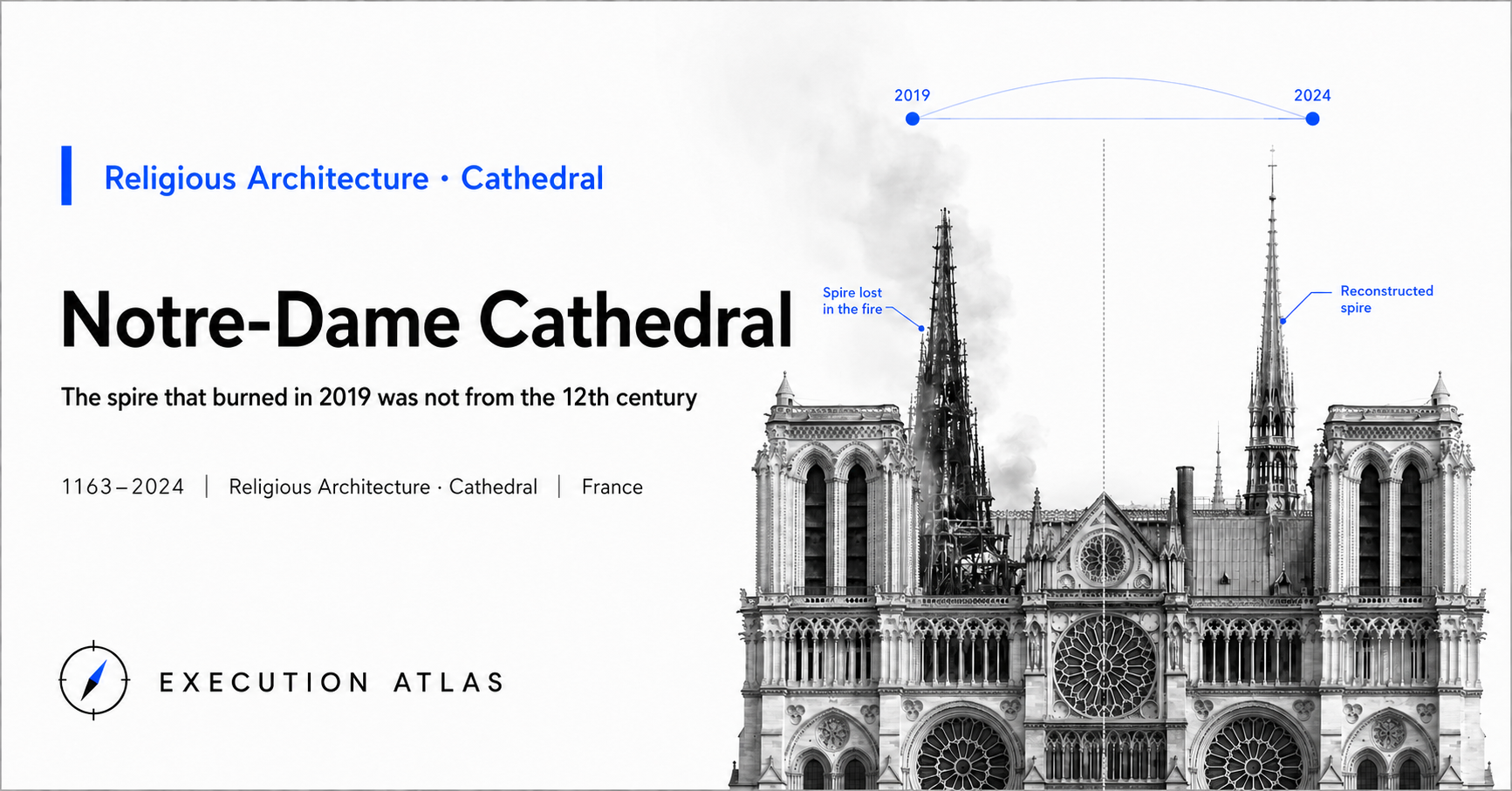
On April 15, 2019, the world watched the spire of Notre-Dame de Paris collapse on live television. Many felt that 12th-century medieval architecture had been lost.
The spire was actually 19th century.
Eugène Viollet-le-Duc rebuilt it in 1859. A neo-Gothic flèche, 96 meters tall. The medieval spire had been removed in 1786 due to decay. A 19th-century architect imagined what it must have looked like in the Middle Ages, and built that.
It stood for 155 years before the fire took it.
The new spire on the Notre-Dame that reopened in December 2024 is a 21st-century reproduction of Viollet’s 19th-century reconstruction. A 19th-century imagination, faithfully recreated in the 21st century. Counting from the Middle Ages, that’s two layers of overwriting.
The building is not being preserved. It is being constantly rewritten.
Mission: Why It Was Built
- Maurice de Sully, Bishop of Paris.
The old Saint-Étienne Cathedral on the Île de la Cité was falling apart. Sully decided to tear it down and build a new cathedral in the Gothic style. An attempt to scale up the new architectural language pioneered at Saint-Denis Abbey, in the heart of Paris.
The cornerstone was laid by Pope Alexander III and King Louis VII of France, sometime between March and April of 1163.
Sully had been born poor, in Cluny. He came to the bishopric late in life and held it for 36 years. The construction ran the entire length of his tenure.
He knew he would die without seeing it finished. That did not matter. A bishop’s job was not to determine what gets completed in his own lifetime. It was to determine what gets started.
Design: A Cathedral Whose Architects Are Unknown
We don’t know who designed Notre-Dame.
The first master architect, the second-phase architect, the third-phase architect — none of them appear in the record. The cathedrals built around the same time at Chartres, Reims, and Amiens have also lost the names of their early masters. The continuity of design lived inside the masons’ guilds, as internal knowledge.
127 meters long, 48 meters wide, vaults 33 meters off the floor. More than 8 meters taller than any other Gothic cathedral of the time. The relative jump in height over previous structures was the largest single leap in the history of architecture.
The problem was that achieving this height required thin walls. They wanted larger stained-glass windows to flood the interior with light. The weight of the vaults pushed the walls outward. Cracks began to appear before construction was even finished.
Around 1180, the flying buttress was introduced.
An arch projecting through open air on the outside of the building, catching the lateral thrust of the vaults and channeling it down to the ground. A structure not in the original design, added after the problem revealed itself. One of the earliest large-scale uses of the form.
It became the standard of Gothic architecture. Chartres (37-meter vaults), Reims (38 m), Amiens (42 m). Each successive cathedral aimed to exceed the last.
Beauvais Cathedral, begun in 1225, aimed for 48-meter vaults. On November 29, 1284, it partially collapsed. It came to be known as the Icarus Cathedral.
Notre-Dame’s 33 meters was the first step toward that limit.
Execution: 182 Years of Construction
Completed in 1345. 182 years after the cornerstone was laid.
No one ever made an initial estimate. Each generation of bishops did what their resources and the technology of the time allowed. At least eight bishops carried the project. In terms of masonry generations, more than six.
It was built in four phases. The first delivered the choir (1177), then the high altar was consecrated in 1182. The second produced the nave and west façade (around 1250). The third added chapels along the side aisles and incorporated upgrades adopted from rival cathedrals. The fourth completed the north and south transepts and rose windows.
In 1250, Jean de Chelles extended the north transept and designed the north rose window. In 1270, Pierre de Montreuil completed the south rose window. They brought in the Rayonnant Gothic style, the most advanced of the late 13th century. A style that had not existed when Sully drew up the plan a hundred years earlier.
In the 14th century, Jean Ravy fundamentally redesigned the 13th-century flying buttresses. Fourteen new buttresses with 15-meter spans, deployed around the choir.
Over 182 years, the design was overwritten many times. Even if an initial blueprint existed, the final structure would have been a different thing. Each generation, while staying within the rules of Gothic style, brought the best of its own time.
A design philosophy that allowed for that is what kept the building being built.
People: Nearly Destroyed, Always Saved
- The French Revolution.
In October 1793, revolutionary mobs pulled down the statues from the west façade. The Gallery of Kings — 28 of them. Biblical Hebrew kings, mistaken for French monarchs, were dragged down with ropes and decapitated in the public square.
In November of that year, Notre-Dame was repurposed as the Temple of the Cult of Reason. Twenty of the cathedral’s 21 bells were melted down to cast cannons. Lead coffins became bullets. Some 1,500 barrels of wine, confiscated from émigré nobles, were stored in the nave.
December 2, 1804. Napoleon’s coronation.
The building was a ruin. Three months of preparation went into dressing it up with plaster, wood, cardboard, silk. Napoleon crowned himself. Ceremonial cover. Not restoration.
In 1831, Victor Hugo published the novel Notre-Dame de Paris. He was 29. The book was a bestseller, and his portrayal of the cathedral’s neglect — together with the moral case for saving it — reached the French public.
In 1844, King Louis-Philippe ordered restoration. The architects selected were 30-year-old Eugène Viollet-le-Duc and his collaborator Jean-Baptiste Lassus.
Viollet spent 20 years remaking Notre-Dame into “what it should have been.”
The budget was cut to 68% of what was requested, and the project paused for eight years when funds ran out. Lassus died before completion. Above the choir, Viollet rebuilt — from imagination — the medieval spire that had been removed in 1786. 96 meters tall, in neo-Gothic style. He also recreated the decapitated Gallery of Kings with new statues. The chimeras along the roof are his original work.
The face of the statue of Saint Thomas, the patron saint of architects, was modeled on Viollet’s own.
- Restoration complete.
His philosophy is recorded in his Dictionnaire raisonné:
“To restore a building is to reinstate it in a complete state which may never have existed at any given moment.”
A 19th-century architect created a “complete Notre-Dame” that had not existed in the Middle Ages, nor before the Revolution. Then, 155 years on, the world had come to recognize it as the masterpiece of the Middle Ages.
Legacy: 2019 and 2024
April 15, 2019. Monday. 18:18.
The alarm at Notre-Dame went off. There had been confusion in the handoff between staff. A security guard who had started three days earlier instructed another to check the attic. The guard who went investigated the attic of the adjacent sacristy, not of the cathedral itself, and came back to report no fire. The real fire was in the attic of the cathedral.
More than 30 minutes were lost.
At 18:51, the fire brigade was called. At 18:52, smoke became visible from outside. The wooden lattice supporting the roof, known as la forêt — the forest. Around 1,300 oak trees, cut down in the late 12th and 13th centuries. Eight hundred years of drying had made the timber catch in a matter of minutes.
At 19:50, Viollet’s spire collapsed. Television carried it live across the world.
At 21:45, the fire was under control. By 4 a.m. it was fully extinguished. Half the roof and the entire spire were gone.
What was miraculous was that interior damage was limited. Something happened that 13th-century architects had not anticipated. The stone vaults, struck from above by the mass of the burning roof as it fell, held. A design with structural redundancy protected the interior from a fire 800 years later.
That night, the Pinault family pledged €100 million, the Arnault family €200 million, the Bettencourt family €200 million. France’s three wealthiest families had committed over €500 million within hours of the fire.
The next day, Macron pledged to rebuild in five years.
In July 2020, the National Heritage and Architecture Commission made a decision. The cathedral would be restored faithfully to its state immediately before the fire. Macron had initially floated the idea of an international design competition that might include a modern spire. The expert commission unanimously rejected that. Macron followed their judgment.
The “pre-fire state” meant Viollet’s 19th-century restoration. A 19th-century imagination, faithfully recreated in the 21st century.
Some 2,000 craftspeople, 250 companies, 68 workshops, and 15 trades were mobilized. The worry that “Gothic techniques have been lost” turned out to be unfounded. Enough traditional artisans remained in France. Oak from 150- to 300-year-old state forests; limestone quarried in the Oise region.
December 7, 2024. Reopening. About eight months past Macron’s pledge. Around 1,500 people attended, including heads of state from 40 countries. Archbishop Laurent Ulrich struck the cathedral doors with a staff made from the wood of the burned roof.
€846 million in donations had been collected from 340,000 donors across 150 countries. A surplus of €140 million was set aside for Phase 3 — façades, sacristy roof, and other work.
Learnings
What burned in 2019 was a 19th-century spire.
What was rebuilt in 2024 is a 21st-century reproduction of that 19th-century spire. The original medieval one was taken down in 1786. No one alive has seen the real thing.
Of the materials that make up Notre-Dame, less than half can be traced back to the 12th century. The 13th-century flying buttresses were replaced in the 14th century. The statues smashed in the Revolution were remade in the 19th. The 19th-century spire was recreated in the 21st. Even with all this overwriting, people see it as the same Notre-Dame.
Not material identity. Continuity of space and meaning.
“Original” is not a question that holds together. You cannot answer it without first deciding which moment counts as original. The first medieval form? The 1345 completion? The 1789 pre-Revolution state? Viollet’s 1864 finish? The morning of April 14, 2019, the day before the fire?
The expert commission in July 2020 picked “pre-fire.” That means Viollet’s 19th-century restoration. Not the Middle Ages.
Restoration is not the exception. It is the default state.
Notre-Dame has lasted 861 years because it has been continuously restored. A cathedral whose architects’ names are not recorded allows each generation to bring in its own interpretation. The flying buttress was added after the cracks appeared. Viollet built a spire that had not existed in the Middle Ages, calling it what should have been there. Macron pledged the rebuild within five years, the day after the fire.
Each decision made sense in its own moment. From a later vantage, the same decisions look arbitrary. A medieval that a 19th-century architect imagined has become the canon of the present Notre-Dame.
Anything that lives long enough accumulates layers of interpretation.
If what you are building now lasts 861 years, whose generation’s interpretation will become the canon? It is probably not the one you are drawing today.
Sources
- Notre-Dame de Paris — Wikipedia (https://en.wikipedia.org/wiki/Notre-Dame_de_Paris)
- Notre-Dame de Paris — Britannica (https://www.britannica.com/topic/Notre-Dame-de-Paris)
- The Builders — Notre-Dame de Paris official site (https://www.notredamedeparis.fr/en/understand/history/the-builders/)
- The Master Builders of Notre-Dame — Friends of Notre-Dame de Paris (https://www.friendsofnotredamedeparis.org/notre-dame-cathedral/history/the-builders/)
- Flying buttress — Wikipedia (https://en.wikipedia.org/wiki/Flying_buttress)
- The Divine Light of Notre-Dame Cathedral — Institute for Sacred Architecture (https://www.sacredarchitecture.org/articles/the_divine_light_of_notre_dame_cathedral)
- Eugène Viollet-le-Duc — Wikipedia (https://en.wikipedia.org/wiki/Eug%C3%A8ne_Viollet-le-Duc)
- Eugène Viollet-Le-Duc: The Architect Who Reshaped Notre-Dame — The Collector (https://www.thecollector.com/eugene-violett-le-duc-notre-dame-de-paris-architect/)
- The Notre Dame Cathedral Was Nearly Destroyed By French Revolutionary Mobs — HISTORY (https://www.history.com/articles/notre-dame-fire-french-revolution)
- When Notre Dame Became The Revolution’s Temple Of Reason (https://artifactstravel.com/notre-dame-cathedral-french-revolution-temple-of-reason/)
- Notre-Dame fire — Wikipedia (https://en.wikipedia.org/wiki/Notre-Dame_fire)
- Notre-Dame fire — Britannica (https://www.britannica.com/event/Notre-Dame-fire)
- Notre Dame Cathedral’s 5-year rebuild post-fire — NewsNation (https://www.newsnationnow.com/world/notre-dame-cathedral-fire-rebuild-timeline-reopening/)
- Inside the $760M restoration of Notre Dame cathedral — CNN (https://edition.cnn.com/style/notre-dame-cathedral-restoration)
- How ‘The Hunchback of Notre Dame’ inspired the cathedral’s 19th-century revival — The Conversation (https://theconversation.com/how-the-hunchback-of-notre-dame-inspired-the-cathedrals-19th-century-revival-115614)