On March 15, 1963, in the wetlands of northern Botswana, a tribal council voted to surrender their land for animals.
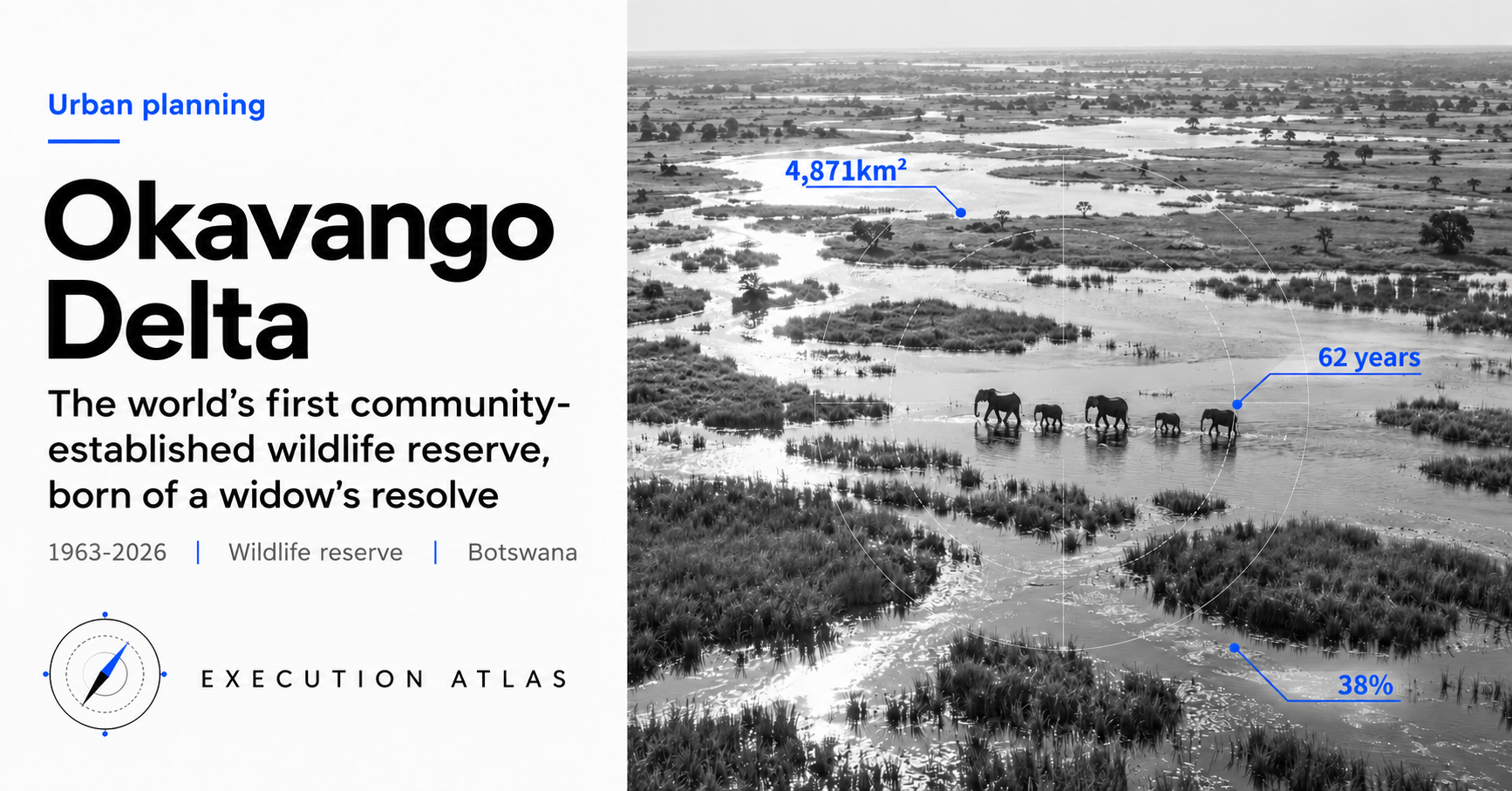
The Moremi Game Reserve. 4,871 square kilometers. The first conservation area on the African continent established by local communities themselves.
The decision was made by Elizabeth Pulane Moremi. Widow of BaTawana chief Moremi III. After her husband’s death, she held effective governing authority. The central government — the British protectorate of Bechuanaland — showed no sign of moving. Animals were disappearing.
Sixty-three years later, this place became the 1,000th site on the UNESCO World Heritage List.
Mission
There was one requirement. “Stop the animals from disappearing.”
Around 1960, white hunters came to the Okavango on a regular basis, and livestock ranches were eating into the edges of the wetlands. In BaTawana oral tradition, the kgotla — the tribal council — debated: “At this rate, nothing will remain for our children’s generation.”
Elizabeth Moremi’s approach was not to petition the government. She would invoke BaTawana traditional land rights and declare a protected area through the tribal council itself. No waiting for the central government’s permission.
The British protectorate administration fell silent on the matter. As a result, the resolution was established not as “orders from above” but as “tribal consensus.”
That difference would matter later.
Design
The classification chosen for the reserve was “Game Reserve” — not a National Park.
A National Park would have prohibited human habitation. Like Yellowstone in the United States, indigenous people living inside would have been expelled. A Game Reserve could ban hunting and some farming while allowing residence to continue. The BaSarwa — the hunter-gatherers known locally as the San — remained in place.
A design that reconciled “protect the animals” with “don’t expel the people.”
Another distinctive feature was that only the boundary was defined; no internal operations plan was written. The zoning maps, ecological monitoring plans, and budget tables that modern protected areas require were entirely absent. The founding documents were close to a verbal agreement.
Instead, two principles were fixed. Protect the animals. Underwrite the arrangement with BaTawana traditional authority.
Execution
Over the 62 years since its founding, this reserve has expanded by a method of “adding layers after the fact.”
Botswana gained independence in 1966. The Botswana Defence Force was established in 1977. In 1987, President Ketumile Masire approved the deployment of an “anti-poaching elite unit,” and in 1988, the BDF conducted its first ever anti-poaching patrol. The Wildlife Conservation and National Parks Act was enacted in 1992.
Botswana is the only country in southern Africa where the regular military has wildlife protection as a direct mission.
The logic goes like this: poaching is a national security issue. Elephants and rhinos are national resources. Therefore the military protects them. A portion of the defense budget funded by diamond exports flows directly to the reserves. BDF soldiers carry shoot-on-sight authority. Criticism from human rights organizations is unending, but poaching rates have consistently been lower than in neighboring countries.
In the field, rangers patrol the wetlands silently in traditional makoros — dugout canoes. On open waterways, aluminum speedboats. From the air, light aircraft. On land, armed patrols. The work of tracking poachers by sight, sound, and presence has changed little since drones were introduced.
The funding story here followed a different trajectory from other reserves too. At founding: hunting permit revenues. Through the 1970s and 80s: safari tourism income. From the 1990s onward: national budget drawn from diamond tax revenues. From 2021: the De Beers × National Geographic Okavango Eternal partnership added another layer.
Over 60 years, the primary funding source has been replaced four times.
People
Elizabeth Pulane Moremi left few records behind. There are almost no photographs. Her specific words survive only in oral tradition.
When her husband died, she held the position of regent — holding BaTawana governing authority in trust until the next chief came of age. During that period, she brought “protect the animals” before the kgotla and passed it.
There must have been political calculation. As regent — a temporary role — she created a permanent institution. She structured it so that when the next chief arrived, it could not easily be undone.
Sixty-two years later, her name lives on as the name of the reserve.
There is another figure impossible to ignore: the BDF. A small military established in 1977. By the scale of Africa as a whole, it is modest in size. Its equipment is not exceptional. But this military deploys for elephants and rhinos.
A modern military rewrote the definition of “what to fight for.” Not a foreign adversary, but poaching syndicates. What to protect is not territory or citizens — first and foremost, it is wildlife.
De Beers positions Okavango Eternal under its “Building Forever” strategy. Botswana’s diamond reserves are finite and will eventually be exhausted. The company is attempting to tie its post-depletion social legitimacy to delta conservation and improvement of community livelihoods.
Corporate survival and ecosystem survival have, in this place, become a single interest.
Legacy
The fluctuation in area tells the character of this place.
In the dry season, the area is approximately 6,000 square kilometers. In the rainy season it expands to roughly 15,000 square kilometers — 2.5 times larger. The water source is rain that fell on the Angolan highlands between January and March, crossing Namibia to reach the Botswana wetlands and hitting peak water levels in July and August. The delta breathes, expanding and contracting.
The wildlife figures are striking too. Over 400 bird species, approximately 200 mammal species, more than 150 reptile species. Botswana as a whole holds Africa’s largest elephant population — roughly 130,000 — and a substantial share of those are in the Okavango basin. The endangered African wild dog forms its highest-density packs anywhere in the world here.
In 2014, UNESCO registered the Okavango Delta as the 1,000th World Heritage Site — a round number assigned to an inland wetland.
From 2021, the De Beers × National Geographic Okavango Eternal partnership has, in five years, carried out 19 research expeditions, mapped peatland at 230 locations, trained 82 local residents as Watchers, and created 2,118 livelihood opportunities. In 2026 the contract was extended for another five years. The next goals: conservation of 5.4 million hectares (54,000 square kilometers) of water source area, and 10,000 livelihood opportunities.
Approximately 38% of Botswana’s total land area is designated as protected — the highest rate in Africa. The starting point of that number was a single night’s discussion in the kgotla in 1963.
Lessons
The lesson this project offers lies in how “what must be decided at founding” is separated from everything else.
Elizabeth Moremi’s 1963 resolution contained no detailed operational plan. Only a boundary and principles were written. “From here to here, protect the animals. Underwritten by BaTawana authority.” That was all.
Sixty-three years later, this reserve carries zoning, monitoring, budgets, anti-poaching operations, multinational partnerships, and corporate fund integration — everything layered on top. Because nothing was decided in 1963, each subsequent era could add its own technology and institutions.
At the same time, the core principles that could never move were fixed from the start. The purpose of protecting animals, and the tribal council as the decision-making body. Those two did not waver through post-independence political shifts, the intensification of poaching, or the introduction of corporate partnerships.
As a design principle for long-term projects, this carries weight. Separate from the beginning what must not change over 60 years from what can be replaced over 60 years.
There is another interesting feature: how the funding sources were swapped. Hunting permit revenues → tourism income → diamond tax revenue → private partnership. When the switch was made, the approach was not to zero out the old source first and then build the new one, but to let the new one get established and then fade out the old one.
Purpose immutable, funding source variable. It resembles how university endowments or religious institutions are operated.
Elizabeth Moremi left almost no photographs and no recorded voice. Yet her name still lives on the map. An institution created in a temporary position as regent expanded, 62 years later, into a multinational conservation plan covering 54,000 square kilometers.
“If we don’t act now, nothing will remain for our children’s generation.”
That single sentence determined how all the eras that followed would add their layers.
Sources
- Wikipedia, “Moremi Game Reserve” (https://en.wikipedia.org/wiki/Moremi_Game_Reserve) — proclamation date of March 15, 1963; Elizabeth Pulane Moremi’s leadership as widow of Chief Moremi III; designation as Africa’s first community-led reserve
- Wikipedia, “Elizabeth Pulane Moremi” (https://en.wikipedia.org/wiki/Elizabeth_Pulane_Moremi) — motivation behind the reserve’s founding and governing authority during regency
- Wikipedia, “Okavango Delta” (https://en.wikipedia.org/wiki/Okavango_Delta) — seasonal area variation; 2014 UNESCO World Heritage inscription as the 1,000th site
- De Beers Group, “Okavango Eternal” case study (https://www.debeersgroup.com/about-us/case-studies/2025/okavango-eternal) — five-year performance figures
- National Geographic Society, “Okavango Eternal extension announcement” (https://news.nationalgeographic.org/national-geographic-society-and-de-beers-extend-okavango-eternal-partnership-for-five-more-years/) — contract extension and post-2026 goals
- Wikipedia, “Botswana Defence Force” (https://en.wikipedia.org/wiki/Botswana_Defence_Force) — anti-poaching mission of the regular military and shoot-on-sight policy
- Wilderness, “Wildlife & Animals in the Okavango Delta” (https://www.wildernessdestinations.com/africa/botswana/okavango-delta-wildlife) — biodiversity across bird, mammal, and reptile species
- UNESCO Okavango Delta World Heritage Data Sheet (http://world-heritage-datasheets.unep-wcmc.org/datasheet/output/site/okavango-delta/) — protected area framework and 1992 Wildlife Conservation and National Parks Act