
In February 1941, a 43-year-old police constable was brought to the Radcliffe Infirmary in Oxford.
Albert Alexander had scratched his cheek on a rose thorn in his garden, and the resulting bacterial infection had spread throughout his body. It was a common cause of death in an age without antibiotics. His face was sealed with pus, one eye had been removed. The other was next.
At that same hospital, on the other side of town, an Australian named Howard Florey, head of the Sir William Dunn School of Pathology, was about to begin human trials of a new drug. It was called penicillin. The year before, it had worked in mice.
The day after the first dose was given to Alexander, his symptoms improved dramatically. But the drug was running out. The entire supply of the Dunn School was exhausted within 24 hours, and he was still recovering.
The team retrieved penicillin from Alexander’s urine. The small amount excreted from his body was purified and administered again. On the fifth day, even that was gone.
On March 15, Alexander died.
Three months later, Florey crossed the Atlantic. Peoria, Illinois. A farming city of 100,000 people, home to a U.S. Department of Agriculture research station. That was his destination.
Mission: Get It Done Before D-Day
In September 1928, at St. Mary’s Hospital in London, Alexander Fleming returned from vacation to find a contaminated culture dish on his desk. Among the colonies of staphylococci, a single patch of blue-green mold had grown, and the bacteria around it had vanished. He photographed it and the following year submitted a short paper to the British Journal of Experimental Pathology.
The paper was concise, well-written for its time, but offered almost no practical applications. Fleming himself had given up on isolation and concentration. His research interests lay in immunological observation.
The paper went almost uncited for ten years.
In 1938, Florey and Ernst Chain, working at Oxford, unearthed it. Chain was a Jewish biochemist who had fled Nazi Germany. With a Rockefeller Foundation grant, he was systematically screening antibacterial substances. Fleming’s decade-old paper was on the list.
On May 25, 1940, Florey and Chain conducted mouse experiments. All four animals in the penicillin group survived; all four controls died. They submitted the results to The Lancet.
The following year, Constable Alexander died.
In December 1941, the United States entered the war. The scale of wartime medicine changed fundamentally. Records from the First World War showed that 18 percent of wounded soldiers died from bacterial infections — blood infections, peritonitis, post-operative sepsis. In a world without antibiotics, surviving a wound still carried nearly a one-in-five chance of dying in the following week.
The War Production Board (WPB) made a simple calculation. If the next European landing operation could halve infection deaths among the wounded, the number of deployable troops would change by hundreds of thousands.
Penicillin was redefined within this calculation as a military supply.
In 1942, the Office of Scientific Research and Development (OSRD) set a target of securing millions of doses by D-Day. At the time the target was announced, U.S. annual production capacity was in the tens of thousands of doses — three orders of magnitude short.
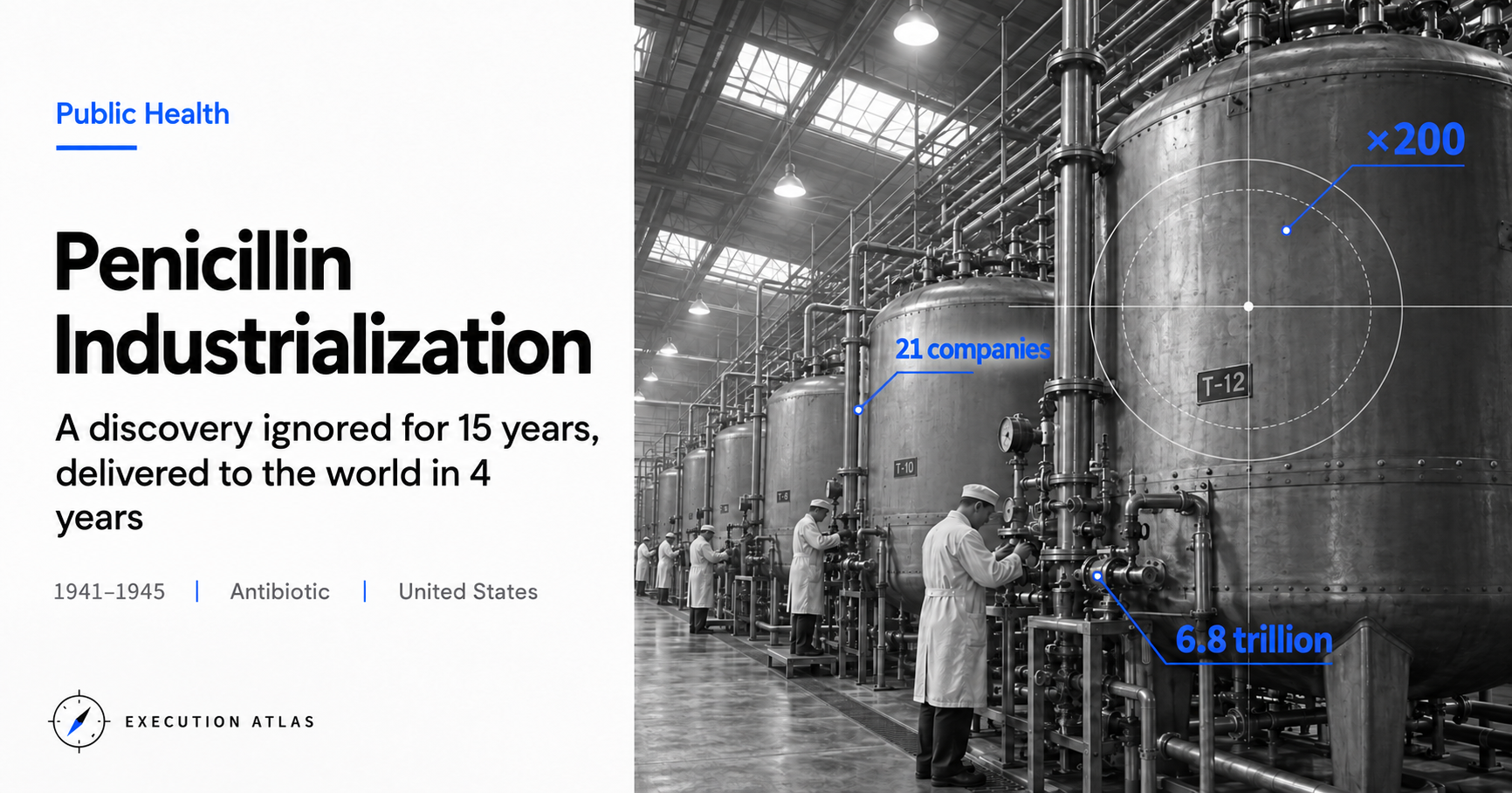
The WPB reviewed 175 U.S. pharmaceutical companies and selected 21. Those selected were given priority allocation of construction materials and labor. At the same time, the government mediated the sharing of production methods between companies. The normal industrial policy of protecting companies through patents was suspended for the duration of the war.
Just as the Haber-Bosch process — which had established a fertilizer plant in four years — was a product of national security requirements, the industrialization of penicillin was an emergency project with requirements defined by the state. The difference was that this one had abandoned patents from the start.
Design: Mold Doesn’t Grow in Factories
What Howard Florey and Norman Heatley were doing at Oxford was closer to cooking than to manufacturing.
Penicillium notatum was spread thinly across flat culture dishes and grown on the surface for about a week. The mold formed a thin film on the surface of the liquid medium. The liquid beneath was siphoned off, and penicillin was separated through several stages of extraction using different solvents, then converted to powder.
Heatley was a 28-year-old biochemist. In 1940, he identified the biggest bottleneck in the process: flat containers with large surface areas. Laboratory glassware was insufficient. His eventual solution was ceramic bedpans from the Radcliffe Infirmary.
They had flat bottoms, wide openings, and could be heat-sterilized. Heatley ordered a custom size from a ceramics manufacturer and arranged approximately 700 of them in the Dunn School. Florey’s team began calling themselves “penicillin farmers.” All of them in white coats, siphoning liquid from bedpans, day after day.
This was the production equipment in 1941 when Alexander was treated.
The problem was clear. Surface cultivation: as volume increases, surface area does not increase proportionally. The amount that could be produced from one liter of medium could not simply be multiplied by 100 to get the production from 100 liters. Only the surface area where the mold was exposed to air mattered, so deep tanks were useless.
For industrialization, Penicillium needed to grow all the way to the bottom of tanks.
The USDA’s Northern Regional Research Laboratory (NRRL) in Peoria was a fermentation research facility. It had long been doing work converting corn, soybeans, and dairy waste into industrial materials — beer, wine, bread, cheese. The knowledge and equipment for growing microorganisms in deep tanks was already there.
The Penicillium notatum that Florey brought over could not grow in deep tanks. The mold sank to the bottom and stopped functioning from lack of oxygen.
NRRL microbiologist Andrew Moyer tried two changes.
First, changing the medium. The medium Florey had been using — a mixture of yeast extract and sugar, standard in laboratories — was too expensive at industrial scale. Moyer substituted corn steep liquor. This was the acidic liquid left over after starch was extracted from corn, treated at the time in the Midwest almost as waste — something food processing plants and paper mills were struggling to dispose of.
When it was added, production jumped by roughly tenfold. The waste liquid turned out to be optimal as a nutrient.
Second, changing the strain. The Penicillium notatum that Fleming had stumbled upon was actually weak as an industrial strain. NRRL instructed its technicians to “collect Penicillium from locally rotting fruits and vegetables.” In 1943, Mary Hunt, a laboratory assistant at the facility, bought a moldy cantaloupe at a Peoria market. From it, a strain of Penicillium chrysogenum was isolated. Registered as NRRL 1951, this strain showed roughly 200 times the yield of Fleming’s original.
She was known around the lab as “Moldy Mary” — the person who would walk through the market buying the most rotten things she could find. Today, nearly all industrial penicillin strains in use worldwide are descendants of the mold from that melon she bought.
Execution: From 21 Billion to 6.8 Trillion
When the deep fermentation technology and the new strain were in place, there were still no factories. The total U.S. annual production in 1943 was 21 billion units. A single severe infection treatment required millions of units, meaning the entire year’s output was enough for only a few thousand patients.
D-Day was June 1944. Fifteen months remained.
The WPB set all 21 companies building deep fermentation tanks in parallel. Process designs, strains, and medium recipes were shared across all companies. Federal authorities coordinated construction materials, labor, and transportation priority. Allocating which company would build which reactor and which purification plant was the job of the wartime industrial board.
Pfizer at the time was a mid-size company in Brooklyn making citric acid from citrus through fermentation — not a pharmaceutical company. But it had in-house expertise in deep fermentation. In September 1943, it acquired the old Rubel Ice Company plant in Brooklyn and converted it. Within three months, 14 fermentation tanks had been installed, each holding 7,500 gallons (approximately 28 cubic meters). The place that had made ice for summer butcher shops was making penicillin by winter.
In March 1944, the Pfizer Brooklyn plant went into full operation. The company produced more than half of the entire U.S. wartime output within three years of the war’s start.
The operation of deep fermentation itself still had elements closer to cooking. Yields varied from tank to tank. With the same strain, the same medium, the same temperature, the same agitation rate, one tank would somehow come in 30 percent lower. The reason wasn’t understood until years later: the turbulence around the agitator blades created different stress on the microorganisms depending on the strain. It was a variable invisible at laboratory scale.
Each company reported weekly production data to the WPB. Factories with low numbers received process engineers from other companies. A rival company’s engineer would come look at what was supposedly secret equipment, and the following week the findings would be used to improve another plant. After the war, this practice disappeared. But from 1943 to 1945, it was standard.
Production figures:
- 1943: 21 billion units
- 1944: 1.66 trillion units
- 1945: 6.8 trillion units
324 times in two years. Place this curve alongside any industrial scaling curve from the 20th century and it sits near the very top.
On June 6, 1944 — D-Day — the U.S. Army landed with 2.3 million doses of penicillin. At forward field hospitals, infection deaths actually fell. The post-wound mortality rate that had been 18 percent in the First World War dropped below 4 percent in the latter half of the Second. Antibiotics were not the only factor, but they were the dominant variable.
In July 1943, one dose of penicillin cost $20 — more than the average American worker’s weekly wage. By 1946: $0.55. A 36-fold drop in three years. By 1949, the price fell below 10 cents per 100,000 units.
When industrial scale exceeds 100-fold, unit cost often drops by orders of magnitude. Penicillin became the textbook case.
People: The Discoverer, the Implementers, and the Invisible
Alexander Fleming was born in 1881 on a Scottish farm. He graduated from St. Mary’s Hospital Medical School in London and remained there. In World War I, he served and saw large numbers of wounded soldiers die from bacterial infections.
In September 1928, Fleming — now 47 — returned from summer vacation to find that mold on a culture dish at the edge of his desk. For the next ten years, he made no serious effort toward clinical application of penicillin. He concluded early on that isolation was beyond his means and not his work. He had no direct involvement in the 1940s industrialization.
He appeared in public life from 1944 onward. British and American media covered penicillin’s success not as a complex industrial project, but as “Fleming’s miraculous discovery.” The names of those who actually directed the industrialization — Florey, Chain, Moyer — were rarely mentioned. Fleming himself repeatedly said in interviews that “Florey deserves the credit.”
Howard Florey was born in 1898 in Adelaide, South Australia. A Rhodes Scholar at Oxford, he became head of the Dunn School of Pathology at 40. The 1940 mouse experiments, the 1941 treatment of Constable Alexander, the transatlantic voyage that same year — he drove nearly every consequential decision, largely on his own.
Florey refused to take out a patent until the end. The British medical establishment held a strong tradition that “commercializing medical discoveries is contrary to medical ethics,” and he represented that position. Despite advice from Oxford’s technology transfer office, the British side did not file a patent application.
From 1945 onward, several U.S. companies obtained proprietary process patents within the United States. Florey resented this for the rest of his life. His biographer quotes a private letter Florey sent to a British medical journalist in 1949: “What we did for Britain, they sold for America.”
Norman Heatley was born in 1911, thirteen years younger than Florey. He accompanied Florey on the 1941 trip to the United States. In Peoria, his job was to demonstrate the Oxford method to local technicians. He returned home in autumn 1942. He had no further involvement in the industrialization, continuing quietly in biochemistry research. Heatley received an honorary degree from the University of Oxford in 1990, when he was 79. The Nobel Prize can go to at most three people. Fleming, Florey, and Chain were chosen. Heatley was not.
Andrew Moyer was born in 1899, a microbiologist who spent 30 years at the NRRL in Peoria. He was a local technical expert. The patent for the deep fermentation method — granted in the U.S. in 1948 — was taken out in his personal name. It became the symbolic incident in the argument that the United States had taken a British invention. Moyer split the patent royalties with the Peoria laboratory and himself.
He died in 1959 at 59. There was almost no press coverage.
Mary Hunt has no biography. Her birth date and hometown survive only in fragments from internal records. She was a laboratory technician at the Peoria NRRL in 1943, estimated to have earned around $2,000 a year. The Penicillium chrysogenum she brought home from the market is, eighty years later, still the origin point of the world’s penicillin production.
Legacy: The Dawn of the Antibiotic Era — and Its Twilight
In October 1945, Stockholm. The Nobel Prize in Physiology or Medicine was awarded to Fleming, Florey, and Chain.
Fleming’s Nobel Lecture was on December 11. He calmly told his audience the story of penicillin’s discovery and path to clinical use. In contrast to Haber, who made no mention of poison gas in his 1919 lecture, Fleming closed with something the audience had not anticipated:
But I would like to sound one note of warning. It is not difficult to make microbes resistant to penicillin in the laboratory by exposing them to concentrations not sufficient to kill them. The same thing has occasionally happened in the body. The moral is clear: if you use penicillin, use enough.
In 1945, penicillin-resistant Staphylococcus aureus was still clinically rare. Five years later, it was the most common problem in hospitals. Ten years after that, resistant bacteria were developing resistance to other antibiotics as well. Fleming’s warning had been precisely correct.
The success of industrialization created the selective pressure for resistance. Because penicillin became cheap and mass dosing became routine, it became evolutionarily rational for bacteria to “resist penicillin.” The drug that was a miracle in the 1940s had half its target bacteria resisting it by the 1980s.
The pace of antibiotic discovery slowed over the following thirty years. Pharmaceutical companies began withdrawing from antibiotic development after 1980. The reason was simple: it was not profitable. Compared to cancer drugs or lifestyle medications, antibiotics have short treatment durations, and each time resistance appears, market value falls.
In the 2020s, the WHO estimates that 1.3 million people die annually from drug-resistant bacteria. By 2050, that figure may reach 10 million per year. Eighty years after Fleming’s Nobel Lecture, the numbers match his warning scenario exactly.
The other legacy lies in industrial structure.
The project structure the WPB assembled in 1943 — patent freeze, information sharing, government procurement — was dismantled within five years of the war’s end. From 1948 onward, U.S. pharmaceutical companies developed streptomycin, tetracycline, erythromycin, and other new antibiotics under normal patent law. By the 1950s, the U.S. pharmaceutical industry had become the world’s largest R&D-spending sector. Annual drug expenditure more than quintupled between 1946 and 1960.
The wartime patent abandonment, from the companies’ perspective, was “an exception never to be repeated.” A product that had gone unprotected by patents saw its unit price drop by an order of magnitude and never recover. The companies that learned from penicillin ensured that subsequent antibiotics would never become public goods.
When Operation Warp Speed was organized for COVID-19 vaccine development in 2020, the U.S. government partially referenced the 1943 WPB model: guaranteed purchase contracts, government-borne risk, parallel development across multiple companies. But patents remained with each company. The “wartime sharing model” that had run just once with penicillin did not run again.
Lesson: The Discoverer Is Not the Implementer
I think this is the hardest lesson from this project.
The discoverer and the implementer are different people. And often, the implementer also hands the bucket to someone else.
Fleming discovered it in 1928. That was where his work ended. He concluded early on that isolation and concentration were not his job, and for ten years he waited for someone to unearth his paper.
Florey and Chain unearthed it in 1938. Mouse experiments, clinical trials, development of purification methods — that’s what they took on. But industrialization was not their job. In 1941, Florey crossed the Atlantic and passed the baton to the fermentation laboratory in Peoria.
What Moyer and Hunt took on was the technological jump from laboratory scale to industrial scale: deep fermentation, corn steep liquor, Penicillium chrysogenum. When those three things were in place, their work was done.
The manufacturing engineers at Pfizer, Merck, and the other 21 companies then carried the baton from there to mass production. The names of the field engineers who ran fermentation tanks in the old Brooklyn ice factory are not in the records. They did not call themselves “the discoverers of penicillin.”
Fifteen years, seven or eight stages of relay. No one accomplished it alone.
Looking back at why this relay never broke down, two mechanisms stand out.
One was Florey’s decision to “acknowledge his own limits early.” In 1941, if he had not made the trip to the United States and had continued producing penicillin quietly in Britain, it would not have been ready for D-Day. Florey did not claim “our technique is the best.” He decided: “Our technique is insufficient. We need to seek help from American fermentation engineering.” When talented people remain fixed within their own excellence, the next relay never happens.
The other was the WPB’s patent freeze. If each company had had an incentive to “keep its own process secret,” the 21-company relay could not have been organized. The “no option to defect and win” nature of wartime suppressed the incentive for individual optimization.
In our own work, we often fail to identify to whom to pass the next bucket. We hold on because we don’t want to let go. Or we pass it not to someone in an adjacent field but to a junior colleague in the same field. As long as the relay stays within the same field, reaching a certain technological jump means someone will always be doing what Heatley did with bedpans — just in a different bedpan.
The industrialization of penicillin was a relay in which medicine passed its bucket to fermentation engineering, universities to regional government research stations, laboratories to food waste recycling networks, and independent individual companies to a government-coordinated consortium. A relay that crossed four disciplinary boundaries. Each crossing changed what the bottleneck was, and the new field’s existing assets dissolved it.
For most technological jumps, the answer doesn’t exist inside the field. It already exists in an adjacent one.
There is a character often left out of the penicillin story: a low-paid laboratory technician shopping in a Peoria market. She probably didn’t know the significance of her work at the time. Eighty years later, her name survives only in internal records.
The people who decide whether a large-scale project succeeds or fails are often unknown at the moment it counts. From the perspective of those designing such projects, there is only one response to this fact:
Know who is out there, beyond the boundaries of your own field.
Sources
- American Chemical Society, “Discovery and Development of Penicillin” (National Historic Chemical Landmark) — Fleming’s discovery, NRRL Peoria’s technical transition, adoption of corn steep liquor
- American Chemical Society, “Penicillin Production through Deep-tank Fermentation” — Details of Pfizer’s Brooklyn plant, deep fermentation tank specifications
- Science Museum (London), “How was penicillin developed?” — Oxford-side Heatley and Florey, bedpan cultivation, Mary Hunt’s melon
- National WWII Museum, “Thanks to Penicillin…He Will Come Home!” — D-Day supply plan (2.3 million doses), wartime public relations campaign
- Nobel Prize Foundation, “Sir Alexander Fleming – Nobel Lecture” (1945-12-11) — Primary source for the antibiotic resistance warning
- Society for History Education (Shao), “How the Mass Production of Penicillin Became Possible” — WPB/OSRD decision-making, the 21-company structure, production volume transitions
- C&EN (American Chemical Society, 2005-06), “Penicillin” — Roles of Merck, Squibb, Pfizer, and Lilly; why Pfizer became the largest producer
- National Geographic, “How World War II put penicillin into every pharmacy” — Postwar civilian distribution and price decline ($20 → $0.55)
- USDA-ARS, “Penicillin: Opening the Era of Antibiotics” — Primary-source account of Andrew J. Moyer and the NRRL
- Wikipedia: “Andrew J. Moyer,” “Norman Heatley,” “Howard Florey,” “War Production Board” — Basic biographical and organizational details
- Kingston, W. (2000), “Antibiotics, invention and innovation,” Research Policy — Postwar shifts in patent strategy and the slowdown of antibiotic development
- WHO (2019), “No Time to Wait: Securing the future from drug-resistant infections” — Current estimates of AMR deaths and 2050 projections