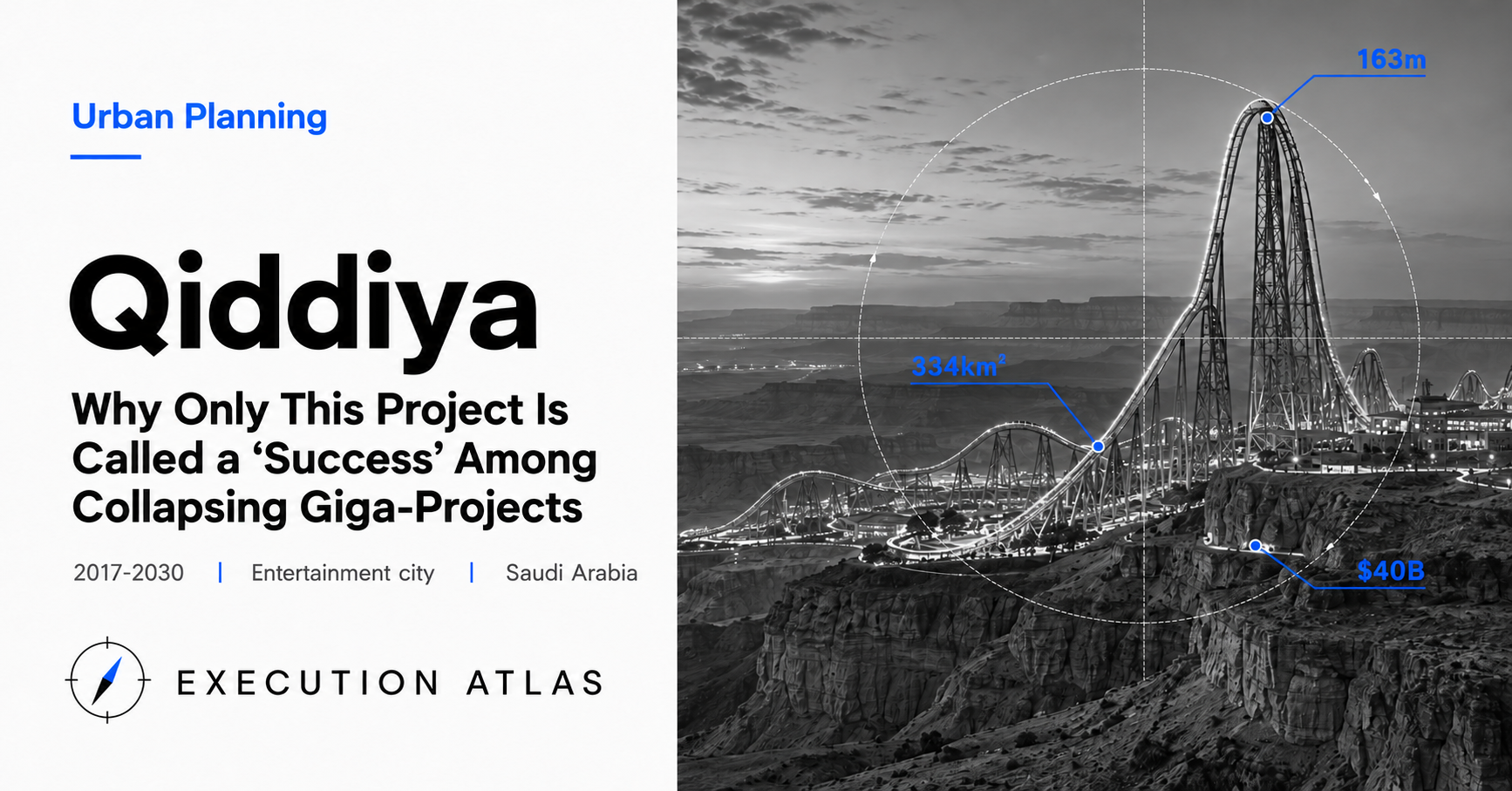
163 meters tall. Top speed of 250 kilometers per hour. Track length of 4,250 meters.
On December 31, 2025, a roller coaster broke five world records simultaneously on the edge of the Tuwaiq Escarpment, 45 kilometers southwest of Riyadh. Falcons Flight. It covers a track roughly five times the height of the Burj Khalifa end to end, completing the circuit in 3 minutes and 35 seconds. The vertical drop is 195 meters. TIME magazine named the ride alone to its “Best Inventions 2025” list, and the following year included the entire facility in its “World’s Greatest Places 2026.”
The theme park is itself only a fragment of Phase 1 of Qiddiya — a far larger development.
Qiddiya’s planned footprint is 334 square kilometers. About three times the area of central Paris, roughly equivalent to 77 Tokyo Domes. 400 attractions, 275 rides, 12 theme parks, 43 sports facilities, 2,000 pieces of public art, 41,000 hotel rooms. Projected annual attendance at completion: 17 million. The long-term budget is estimated at around $40 billion.
Announced in April 2017. Phase 1 was due to open in 2023. What actually opened, in late 2025, was a single theme park. Full Phase 1 completion is now targeted for 2027; the stadium is on track for the 2034 World Cup.
In terms of sheer delay, Qiddiya is no different from Saudi Arabia’s other giga-projects. NEOM’s The Line was scaled back from 170 km to 5 km. Mukaab was halted. New Murabba was pushed to 2040. Qiddiya’s Phase 1 stretched from a six-year plan to more than ten years.
And yet Qiddiya is called “the most visible achievement of Vision 2030.”
A delayed project being spoken of as if it had not been delayed. That is the subject of this article.
Mission: Give the Oil Nation a Reason to Spend Money at Home
For decades, oil revenues accounted for around 60% of Saudi Arabia’s government income. When crude fell below $90 per barrel, the national budget went into deficit. In the first quarter of 2026, the fiscal deficit reached $33.5 billion — nearly 75% of the annual projection of $44 billion, in just three months.
Decarbonizing the economy is not a religious imperative. It is a fiscal deadline.
Vision 2030, announced in April 2016, was designed as a comprehensive strategy for that transition: tourism, entertainment, sports, culture, industrial diversification. The goal was to raise the share of non-oil sectors in GDP. The giga-projects — NEOM, Red Sea, Diriyah, Amaala, and Qiddiya — were the concrete instruments launched through PIF (Public Investment Fund) in 2017.
Qiddiya’s assigned role was slightly different from the others.
To build a domestic tourism and entertainment industry. More concretely: “Saudi nationals are spending billions each year in Dubai, Bahrain, and Europe. Build the infrastructure to keep that money home.” As of 2016, the bulk of Saudi leisure spending was consumed abroad. Movie theaters were not legalized until 2018. In a country where concerts, sports events, and theme parks had no legal existence, citizens with Gulf-level incomes were crossing borders every weekend.
Muhammad bin Salman — Qiddiya’s originator, then 31 years old and Deputy Crown Prince — positioned the project at the April 7, 2017 announcement as “the centerpiece of initiatives for young people.” About 70% of Saudi nationals were under 35. To build, physically, a reason for them to stay.
Translated into contemporary terms: build a domestic entertainment industry from zero. Timeline: roughly ten years. Cost: tens of billions. Failure undermines the credibility of Vision 2030 as a whole.
Qiddiya carried a dual mandate from the start — economic (internalizing tourism revenue) and social (retaining young people domestically). Both are measurable. Both can fail.
Design: Of 334 km², Only 30% Will Be Built
Qiddiya’s site was set at the edge of the Tuwaiq Escarpment, a 40-minute drive from Riyadh — sheer cliffs rising more than 800 meters, with plateau extending in front. The master plan was assigned to Danish architect Bjarke Ingels and his firm BIG (Bjarke Ingels Group). It was released in 2019, two years after the announcement.
Of the 334 square kilometers, only about 30% would be developed. The remaining 70% was to be designated as a conservation zone, explicitly left untouched.
That 30% line was a heavier design decision than it looks.
Vision 2030’s other projects started from an assumption of transforming nearly the entire footprint. NEOM’s 26,500 km² was conceived as a new city-state rewriting the map. Red Sea’s 28,000 km² was a plan to integrate 90 islands into a single resort. Qiddiya declared upfront that 70% would remain undeveloped.
Three reasons seem plausible. First, construction cost: shaping desert cliff terrain artificially costs more than using the cliff as landscape. Second, preempting environmental criticism: designed around the same time NEOM drew international condemnation for forcibly displacing the Huwaitat tribe, Qiddiya baked “conservation” in from the start. Third, room for staged development: leaving land intact preserves options for Phases 2 and 3.
The master plan was organized around “five pillars”: Sports & Wellness, Nature & Environment, Parks & Attractions, Mobility, and Arts & Culture. Each pillar received dedicated facilities: Six Flags Qiddiya City (entertainment), Aquarabia (water park, largest in the Middle East), Speed Park Track (F1), Prince Mohammed bin Salman Stadium (45,000 seats, 2034 World Cup venue), Gaming & Esports District, Mercedes-AMG World of Performance, Performance Arts Center, golf courses, a horse racing track, PlayMaker Studios.
12 theme parks. 400 attractions. 275 rides. The numbers lose meaning on their own. Place them in context: three times the area of central Paris, with entertainment, sports, and culture integrated at 28 times the scale of Disneyland — that is Qiddiya’s density.
The primary design constraint was climate.
Summer temperatures around Riyadh exceed 45°C. Outdoor activity becomes physically impossible for roughly a third of the year. Paris and Orlando have no such constraint. BIG responded by embedding many structures into the cliff face, combining solar shading and natural ventilation. The Six Flags zone is partially indoors; the water park is oriented toward evening operations in summer; the F1 track is designed around a single major annual race.
Not “a theme park” but “a multi-layered facility complex derived from climate.” That is the substance of the design.
Partners were also sourced externally from the start.
Six Flags (North American theme park operator), Hasbro (toys and IP), Warner Bros. (film and IP), Mattel (toys), Mercedes-AMG (mobility), Ferrari (mobility). Faced with the reality that Saudi Arabia had no strong domestic entertainment IP, Qiddiya chose to import rather than cultivate. A pragmatic call to secure visitors and recognition quickly — and simultaneously a long-term commitment to ongoing license fees.
At the time of its announcement, Qiddiya was not “an entertainment capital Saudi Arabia would build for itself.” It was “an integrated platform assembling the world’s IP on Saudi land and capital.”
Execution: How the 2023 Promise Became the 2025 Blow
When announced in 2017, Phase 1 was supposed to be complete by 2023.
The groundbreaking was April 28, 2018. Full construction began in 2019. Up to that point, the project was on schedule.
In 2020, the gears slipped.
COVID-19 disrupted supply chains and closed borders to labor. With NEOM and Red Sea running in parallel, competition for construction materials and skilled workers became acute. Saudi Arabia’s construction sector did not have capacity to run five or more giga-projects simultaneously.
2023 — the original Phase 1 opening year. Nothing opened. Officially: “schedule under review.”
The turning point compounded in 2024.
In January 2024, the design for the Prince Mohammed bin Salman Stadium (45,000 seats) was released and incorporated into Saudi Arabia’s bid for sole hosting of the 2034 FIFA World Cup — formally awarded by FIFA by year’s end. The World Cup gave Qiddiya a new, externally anchored deadline. Canceling or downsizing the stadium would breach the FIFA contract and damage national credibility simultaneously.
In October 2024, Saudi Arabia’s Ministry of Investment officially announced Aquarabia’s target opening as “Q2 2026.” The same month, the groundbreaking for the stadium was scheduled for December 12.
In December 2024, Finance Minister Mohammed Al-Jadaan made a public statement: “Several projects may slow down to avoid inflation and supply bottlenecks.” A de facto “something will be cut” announcement. Within six months, The Line (170 km → 5 km), Mukaab (halted), and New Murabba (deferred to 2040) became concrete.
Qiddiya was not named as a target for cuts.
The reasons are structural: (1) the 2034 World Cup venue commitment, (2) construction already underway on BIG’s master plan, (3) long-term license agreements with Six Flags. Three irreversible factors pushed Qiddiya into the “not reducible” column.
Through 2025, the Qiddiya operating company shifted its communications strategy. Rather than reporting overall progress, it focused on “the facilities opening.” TIME magazine, Khaleej Times, Arab News, Travel Tomorrow. The English-language coverage repeatedly foregrounded “Falcons Flight,” “world records,” “five Burj Khalifas.” Not the whole picture — the numbers of a single symbolic facility.
December 30, 2025: Six Flags Qiddiya City soft opening. December 31, 2025: Official opening.
28 attractions including Falcons Flight. Five certified world records. In the first three days, Falcons Flight queue times exceeded 60 minutes; other rides ran at 15–20 minutes, according to multiple visitor reports. TripAdvisor initial score: 4.1/5.
From announcement to partial Phase 1 opening: 8 years and 8 months. That is a 2 years and 8 months delay from the 2017 commitment. But the tone of coverage leaned toward “finally here” more than “delayed.”
What masked the delay: not claiming “the whole” while claiming “one roller coaster.” TIME’s “Best Inventions 2025,” the World Cup venue, five Burj Khalifas. The axis of comparison in the coverage was set to “world records,” not “comparison with other giga-projects.”
People: The 31-Year-Old Visionary and the Investment Banker Operator
Like the other giga-projects, Qiddiya was conceived by Crown Prince Muhammad bin Salman — 31 years old at the April 2017 announcement, PIF chairman. Vision 2030, NEOM, The Line, Mukaab, Qiddiya: all originated from his personal vision, channeled through PIF.
What separated Qiddiya from The Line was the design of the person running operations on the ground.
The Managing Director of Qiddiya Investment Company is Abdullah Aldawood — a Saudi investment banking professional who served as Vice President in Deutsche Bank’s Middle East and North Africa investment banking division. More than 15 years in investment banking and M&A, then PIF and Qiddiya. His career center of gravity is “finance and M&A,” not “entertainment” or “urban development.”
That is a more important design decision than it first appears.
Placing an entertainment-industry outsider at the top effectively means abandoning from the start any ambition to build a native cultural industry. Aldawood’s job is about how to contract with Six Flags, how to structure Hasbro licenses, which IP to acquire. Not creating content — buying it.
The result pushes Qiddiya toward the economic model of Macau in the casino industry, or Orlando in the theme park industry: import IP, differentiate on land, capital, and tax structure. Don’t compete on content.
The master plan’s architect, Bjarke Ingels (Danish, born 1974), is the founder of BIG. Known internationally for architecture as environmental apparatus — cliff integration, the coexistence of conservation and development. His works include VIA 57 West in New York, CopenHill in Copenhagen (a power plant whose roof doubles as a ski slope), and the Lego House in Billund. Qiddiya’s 30%/70% split is consistent with BIG’s design sensibility.
Where The Line had Morphosis (Thom Mayne’s LA studio) sketch the original form and then 23 international firms — BIG, Zaha Hadid, OMA, others — divide the design work, Qiddiya consolidated with BIG alone and waited for the master plan approval in 2019 before entering full construction. That sequencing difference is what separated their trajectories after 2024.
As of now, Qiddiya’s roster does not feature the pattern visible in The Line: senior departures, cultural scandals, residents arrested for human rights reasons. The low level of ground-level resistance owes much to the fact that nearly the entire site was already royal family land — structurally different from NEOM, which overlapped with Huwaitat tribal territory.
A project that could proceed quietly. That is another axis separating Qiddiya from the other giga-projects.
Legacy: Buying the Legitimacy of National Strategy With a Fraction of Phase 1
As of October 2026, Qiddiya stands in the following state:
- Six Flags Qiddiya City: opened December 31, 2025, operational
- Aquarabia: Q2 2026 opening target
- Prince Mohammed bin Salman Stadium: groundbreaking December 2024, under construction for 2034 World Cup
- Speed Park Track (F1): in design, 2027–2029 target opening
- Performance Arts Center, Gaming & Esports District, golf courses, horse track: spread across Phases 1–3
- Overall completion: 2030 target, with practical delivery likely extending past 2034
Numerically, overall progress is still early-stage: 28 of 400 attractions open, 1 of 12 theme parks, 0 of 43 sports facilities in full operation. Even so, Qiddiya’s position stands out against the other giga-projects.
By May 2026, NEOM officially announced a pause on The Line, with PIF investment pivoting to “AI infrastructure and AI companies.” Mukaab halted. New Murabba deferred to 2040. Diriyah opened in 2024 but its visitor numbers remain undisclosed. Red Sea partially opened but scope is contracting. In that lineup, Qiddiya is the only one where “multiple facilities are moving on a public schedule.”
In economic terms, Qiddiya has supplied one “success” entry to Vision 2030’s PR balance sheet. Not shrinking the sum of failures, but asserting the existence of a success to support the credibility of the whole. That function has intensified since Six Flags Qiddiya City’s opening was covered by TIME in early 2026.
A second legacy is the pace at which Saudi Arabia’s domestic entertainment industry has taken off.
Since movie theaters were legalized in 2018, domestic leisure spending in Saudi Arabia grew at more than 20% annually. Concerts, F1, football matches, theme parks, esports. The structure of “citizens spending money at home” began moving before Qiddiya opened. But a large anchor tenant was missing. Phase 1 of Qiddiya provided that anchor. Of the 17 million annual visitor target, more than 10 million are expected to be domestic visitors.
How much of the weekend-trip demand previously consumed in Dubai, Bahrain, and Doha will return to Riyadh — that becomes the long-term evaluation axis for Qiddiya. Near-term observation points: Ramadan-break attendance in 2026, full Phase 1 opening in 2027, the World Cup in 2034.
International assessment is divided, along lines of human rights and labor.
UK Export Finance classified Qiddiya as “Category A — social and environmental risk” in 2024: the highest-risk designation, reserved for projects with potential for significant adverse impacts. Labor conditions and Saudi Arabia’s human rights situation were cited. With Vision 2030’s overall reported worker death toll exceeding 21,000 (from a 2024 documentary and ILO and human rights organization tallies), Qiddiya cannot be evaluated in isolation.
The charge of sportswashing recurs: Saudi F1 Grand Prix, LIV Golf, the Newcastle United acquisition, the 2034 World Cup. Qiddiya is embedded in a machinery that presents Saudi Arabia as an ordinary modern state on the international stage. Whether that is design intent or byproduct depends on where one stands.
As of 2026, Qiddiya is a project that carries both visible achievements and invisible costs. Evaluate only the visible, and it looks like success. Include the invisible, and it remains undetermined.
Lessons: Masking Full-Project Delays With a Symbolic Early Opening
Qiddiya is called a “success” within Vision 2030 not because the whole is proceeding on plan. It is because the project succeeded in masking the delay of the whole with the early opening of one symbolic facility.
This is worth reading as structural analysis, not failure analysis.
Open Part of Phase 1 Before Phase 1 Is Complete
The conventional opening strategy for megaprojects has been “Phase 1 complete → open.” Denver International Airport waited until the passenger terminal, runways, and baggage system were all ready — opening in February 1995. Sixteen months late, $1.3 billion over budget. Waiting meant the coverage at opening was not “not everything was running” but “parts of the system weren’t working,” landing it as a project management case study in textbooks.
Qiddiya did the reverse. Rather than waiting for full Phase 1 in 2027, Six Flags Qiddiya City alone opened December 31, 2025. And within that opening, Falcons Flight — “a symbol expressible in numbers” — absorbed the coverage. The number of facilities not yet operational was large, but the numbers attached to “what was running” were strong enough to depress the news value of “what wasn’t running.”
The premise of this strategy was a choice between two audiences: industry media that weighs “overall completion percentage,” and general media that weighs “the one experience available.” Qiddiya chose the latter.
Design Symbols Around Verifiable Numbers
Symbolic numbers come in two varieties.
The first — The Line’s “9 million residents,” “170-km structure,” “500-meter height” — circulates unverified, with achievement deferred to the future. The second — Falcons Flight’s “163 m, 250 km/h, 4,250 m” — becomes verifiable the instant it opens.
The first kind damages the credibility of the whole project when unachievement becomes apparent. The second kind becomes a PR card for the whole project the moment it is achieved.
Qiddiya tilted its symbol design toward the latter. Rather than total site area or total investment, it led with a single facility’s world records. This choice looks like a universal strategy for new entrants seeking to establish “presence” in the international market. Dubai’s Burj Khalifa (828 m), Taipei 101 (then 509 m), Petronas Twin Towers (then 452 m). Not “ranked N-th in the industry” but “number one in the world” — one number. Win on the record of one point rather than the economics of the whole.
Eliminate the Option to Downsize by Creating Irreversible Commitments
In Saudi Arabia’s 2024 austerity environment, Qiddiya escaped the downsizing list because the formal award of the 2034 FIFA World Cup was decisive. Canceling a World Cup venue would simultaneously breach the FIFA contract and damage national credibility. Therefore it could not be cut.
That structure resembles the software development judgment of “strategically raising the cost of reversal.” External contracts, published roadmaps, international certifications. These actions add constraints deliberately — but on the other side, they eliminate the option to downsize.
At first glance this reverses rational decision-making. Standard project management recommends preserving optionality. What Qiddiya’s case demonstrates is that in certain environments, “eliminating your own options” protects the project — a paradox. By delegating the power to downsize to an entity outside your own organization, you protect it from internal political pressure. This structure is not unique to national projects.
The Cost Has Been Deferred to the Future
Qiddiya’s success, at this moment, is success among “what is visible.”
Labor conditions, human rights, profitability, the fiscal sustainability of Vision 2030 as a whole — these remain in a judgment-suspended state until the mid-2030s. At the full Phase 1 opening in 2027, at the World Cup in 2034, at the overall completion target of 2030 (in practice, later) — the assessment will be rewritten at each point.
The strategy of masking full-project delays with a symbolic early opening is effective in the short term, but accumulates deferred obligations over time. The delay doesn’t disappear; somewhere it is settled in full. The 17 million annual visitor target, the 400 attractions, the 12 theme parks. A moment will come when the state of those achievements is reported. At that point, will the brightness of Falcons Flight be enough to cover Phase 1’s delays?
That is when Qiddiya will be judged as truly successful or not.
The story readable now is still in the middle.
Sources
- Qiddiya City - Wikipedia (en): Overall scope, area (334 km²), announcement date, groundbreaking, five-pillar structure
- Falcons Flight - Wikipedia (en): World-record roller coaster specs (163 m, 250 km/h, 4,250 m, 195 m drop), December 31, 2025 opening
- Six Flags Qiddiya City - Wikipedia (en): 28 attractions, 5 world records, first Six Flags outside North America
- Prince Mohammed bin Salman Stadium - Wikipedia (en): 45,000 seats, groundbreaking December 12, 2024, 2034 FIFA World Cup venue
- AGBI Giga-Projects Tracker: Qiddiya: Progress, scope changes, 41,000-room hotel plan
- Blackridge Research “Qiddiya Project Riyadh: Latest Updates”: Phase 1 pushed to 2027, 2026 latest status
- PIF “Qiddiya”: PIF investment, governance, Qiddiya’s positioning
- vision2030.ai “Qiddiya”: Long-term budget $40B, near-term $10–13B, progress
- vision2030.ai “2026 Budget Analysis”: Saudi Q1 2026 deficit $33.5B, annual forecast $44B, other giga-project reductions and halts
- Riyadh2030.ai “Six Flags Qiddiya City — Five World Records”: Opening performance, 17M annual visitor target
- TIME “Falcon’s Flight: Best Inventions of 2025”: TIME magazine selection
- Khaleej Times “World’s tallest roller coaster travels length of 5 Burj Khalifas”: Five Burj Khalifas comparison
- designboom “BIG masterplans Qiddiya”: BIG master plan, 2019 design
- Arab News “Qiddiya City to open Six Flags in December”: December 2025 opening announcement
- Qiddiya Official “Abdullah Aldawood”: Managing Director biography