
53.85 km. 24 years. 14 million person-days. 7,455 billion yen. 34 lives.
In 1988, Honshu and Hokkaido were connected by a tunnel under the sea. Total length: 53.85 km. Undersea section: 23.3 km. The longest in the world at the time. At peak construction, 3,000 workers occupied the tunnel simultaneously. Temperatures near the face reached 35°C, humidity above 90%. They dug around the clock in three shifts.
When it opened, the tunnel was called one of “Showa’s Three Great Follies.”
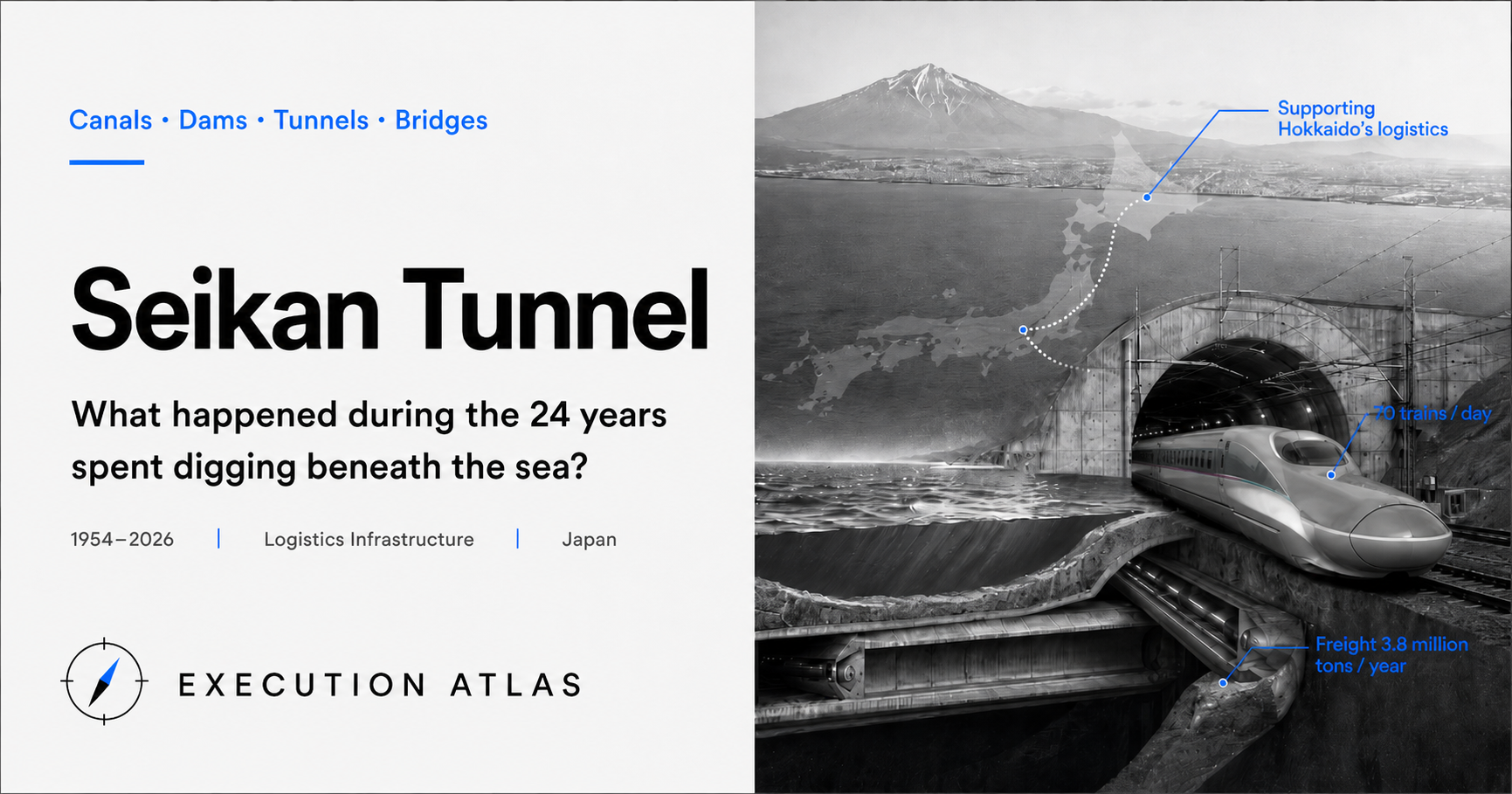
38 years later, roughly 70 trains pass through it every day. If it stops, Hokkaido’s supply chain stops.
Mission: 1,430 Deaths That Ended a Debate
September 26, 1954. Typhoon No. 15 — the Toya Maru Typhoon — struck the Tsugaru Strait.
Captain Kondo Heichi of the Seikan ferry Toya Maru was a 30-year veteran of the strait. Around 17:00, blue sky appeared. He judged the typhoon had passed and ordered departure at 18:39. But the clearing was not the eye of the storm — it was a false break created by an occluded front. The typhoon was still west of Hokkaido. At 22:43, the Toya Maru capsized off Nanae Beach near Hakodate. Captain Kondo’s body was recovered on October 3. No life jacket. Binoculars clutched in his left hand.
The Toya Maru had a structural vulnerability. Waves flooded through the open vehicle deck, raising the center of gravity. Four other Seikan ferries sank that same night. Five ships, 1,430 dead. The worst maritime disaster in Japanese history.
The idea of a tunnel under the Tsugaru Strait predated the war. Geological surveys had begun in 1946. But 1,430 was the number that turned a concept into a national project.
In May 1964, excavation of a survey tunnel began at Yoshioka on the Hokkaido side. Total length: 53.85 km, with 23.3 km under the seabed. Maximum water depth: 140 m. No country had ever bored an undersea tunnel at this scale.
Design: Built on the Premise of Not Knowing
The central problem was geology. It couldn’t be known.
The seabed of the Tsugaru Strait is volcanic, geologically complex. Faults run in every direction. Where the water veins are, where the rock is soft — surface surveys couldn’t determine these. You had to dig to find out.
The Seikan Tunnel adopted a design philosophy: never advance into the unknown.
Three tunnels were dug in parallel. A pilot tunnel, a service tunnel, and the main tunnel. The pilot tunnel always ran ahead, scouting the geology. If it hit a water vein, the main tunnel could reroute. The service tunnel handled material transport and drainage. The point was not to dig the main tunnel alone, but to dig tunnels that made the main tunnel safe.
Advance horizontal boring supplemented the pilot tunnel. From the pilot face, geologists continuously probed 1 km ahead. In 1981, they set a world record: 2,150 m of advance boring.
Originally, TBMs (tunnel boring machines) were planned. But once digging began, the soft strata and water inflows exceeded what TBMs could handle. They abandoned the machines early and switched to conventional methods — blasting and manual excavation. Hard rock favors machines. Unknown geology favors human judgment.
One more design change. At the outset, the Seikan Tunnel was designed for conventional rail. Mid-construction, the plan shifted to Shinkansen specifications, and the tunnel cross-section was enlarged. That decision would pay off 28 years later.
Execution: Four Floods, 2,028 Meters Underwater
Construction was organized as joint ventures. The Tappi section (Honshu side): Kajima, Kumagai Gumi, and Tekken. The Yoshioka section (Hokkaido side): Taisei, Hazama, and Maeda. Japan’s leading general contractors, digging from both ends.
Plan vs. Reality
Detailed original schedule documents are scarce, but the budget tells the story. Initial estimate: 538.4 billion yen. Actual: 745.5 billion yen. A 38% overrun. Including access lines, the plan of 689 billion yen grew to approximately 900 billion yen. 31% over.
The dominant cause was water countermeasures. Four major inrush events halted construction, each requiring months of recovery and sealing. Even between floods, advance boring slowed progress below typical tunneling speed. The cost of safety accounted for most of the overrun.
First Inrush (February 1969)
February 13, 1969. The survey tunnel hit a fault at the 1,223 m mark. Seawater flooded in at 11 tons per minute.
Because the pilot tunnel had gone ahead, the fault’s location was known. The main tunnel route was shifted east. Dig, discover, avoid. Without the pilot tunnel, the main bore would have hit the fault head-on. The design philosophy worked for the first time.
Second Inrush (December 1974)
December 1974. Ten tons per minute. 130 m of tunnel flooded. To bring in pumps, workers built rafts and floated across the submerged section.
Third Inrush (May 1976)
May 6, 1976. Eighty-five tons per minute.
One 25-meter swimming pool every 90 seconds, pouring into the tunnel. 2,028 m of service tunnel submerged. Workers built bulkheads. The water pressure breached them three times.
The method used to stop the water: chemical grouting. Boreholes were drilled radially at 3 to 5 times the tunnel diameter, then injected with cement mixed with chemical hardeners. Solidifying the surrounding rock itself. Rebuilding geology by hand, under the seabed, against the pressure. Recovery took 70 days.
Pilot Tunnel Breakthrough (January 27, 1983)
January 27, 1983. The pilot tunnel broke through. Honshu and Hokkaido connected underground for the first time. Prime Minister Yasuhiro Nakasone pressed the detonation switch remotely from his office in Tokyo.
The two teams had dug over 23 km of undersea tunnel from opposite ends with no intermediate shaft. Alignment error at breakthrough: 37.4 cm laterally, 52.5 cm longitudinally, 19.6 cm in elevation. Hundreds of survey campaigns produced that precision.
Main Tunnel Breakthrough (March 10, 1985)
March 10, 1985. The main tunnel broke through. Twenty-one years since construction began. More than 7,600 days since the Hokkaido and Honshu crews started digging toward each other.
The final three years were spent on finishing: track, electrical systems, ventilation, drainage. A tunnel isn’t done when you break through.
March 13, 1988. The Seikan Tunnel opened. Thirty-four workers had died during the 24-year construction.
Taisei Corporation’s Yoshioka section achieved 2.65 million hours of tunnel work without a lost-time accident. The overall figure of 34 deaths was within the norms of Japanese tunnel construction at the time. Each one had a family.
People: A 24-Year Relay
The Seikan Tunnel has no single hero like Ferdinand de Lesseps at Panama or the Roeblings at Brooklyn. Multiple generations carried the relay across 24 years.
Nisugi Iwao became president of the Japan Railway Construction Public Corporation (JRCC) in 1979, overseeing the final critical phase through pilot tunnel breakthrough. A civil engineering graduate of Tokyo Imperial University, he later became president of Japanese National Railways in December 1983. He called himself a “dokata” — a dirt worker. He died at 100, still proud of the tunnel.
Nakahata Mitsuyoshi served as general supervisor of civil engineering, coordinating technical decisions across multiple sections. He was known for reading people. To a fisherman-turned-tunnel-worker, he once said: “Go to the bottom of the sea, and your time will come. I have an eye for people.”
Kadoya Toshio of the JRCC was one of the engineers who entered the site when survey tunnel excavation began in 1964. The geological data and countermeasure expertise accumulated at the face were passed down to the next generation of engineers.
At peak, 3,000 workers occupied the tunnel simultaneously. 35°C, humidity above 90%. The Kajima team at Tappi, the Taisei team at Yoshioka. Digging from both sides, they met underground in 1983 at the pilot tunnel and in 1985 at the main bore.
This was not a project led by a single genius. Twenty-four years did not permit individual heroics. It was completed through institutional accumulation and transfer of knowledge.
Legacy: The Infrastructure They Called a Folly
March 13, 1988. The Seikan Tunnel opened. Its 23.3 km undersea section was the longest in the world.
”Showa’s Three Great Follies”
Criticism came immediately. “Showa’s Three Great Foolish Budget Approvals” — a phrase attributed to budget examiners at the Ministry of Finance as institutional self-reproach. Battleship Yamato, Ise Bay reclamation, and a third. “You must never name the third,” they said. The implication was clear.
In an age dominated by air travel, did it make sense to spend 24 years and 900 billion yen on a rail tunnel? The Seikan ferries were discontinued. Conventional limited express trains ran through the tunnel, but the time gap against aircraft was obvious. A money-losing line.
Comparison with the Channel Tunnel
In 1994, the Channel Tunnel (Eurotunnel) opened, ending the Seikan Tunnel’s “world’s longest” title after just six years.
The two tunnels contrast sharply.
Total length: Seikan 53.85 km, Channel 50.5 km. But the undersea section: Seikan 23.3 km, Channel 37.9 km. Depth below the seabed: Seikan up to 100 m, Channel 45 m. Seikan was deeper, in more complex geology.
Cost: Seikan approximately 745.5 billion yen (900 billion including access lines); Channel approximately 1.6 trillion yen ($15 billion). Channel was more expensive. Worker deaths: Seikan 34, Channel 10. Construction time: Seikan 24 years, Channel 6.
The Channel Tunnel deployed 11 TBMs and bored through in 6 years. The Seikan Tunnel abandoned TBMs early due to water and blasted its way through by hand over 24 years. Geology determined method. Method determined timeline.
Reassessment by Shinkansen
March 26, 2016. The Hokkaido Shinkansen began running through the Seikan Tunnel. Tokyo to Shin-Hakodate-Hokuto in about four hours. The mid-construction decision to build to Shinkansen specifications bore fruit 28 years later.
In late 2024, the tunnel’s maximum speed was raised from 160 km/h to 260 km/h. Had the Seikan Tunnel been completed at conventional rail gauge, no bullet train would run through it. Someone, mid-dig, decided to enlarge the cross-section.
Today, roughly 70 trains pass through daily. Annual freight: approximately 3.8 million tons. Passengers: about 1.6 million. Hokkaido’s agricultural products, dairy, manufactured goods. If the Seikan Tunnel stops, Hokkaido’s logistics stop.
One more number. Eighteen tons of groundwater seep into the tunnel every minute. Pumps run continuously. If they stop, the tunnel floods within a week. A structure completed 38 years ago still demands constant human maintenance, this very moment.
Learnings: Designing Around What You Don’t Know
The pilot tunnel and advance boring of the Seikan Tunnel demonstrate a way of confronting uncertainty.
The geology under the seabed cannot be known until it is dug. Boring the main tunnel blind means hitting faults head-on. So they probed 1 km ahead, continuously. They accepted that they didn’t know — and built a system that refused to advance without knowing.
This meant tripling the excavation volume. Three tunnels. Three times the cost. But compared to the risk of the main bore flooding after hitting an unknown fault, the cost of knowing in advance was cheaper.
The label of “folly” pinned on the tunnel at opening captures the inherent risk of a 24-year project. The assumptions valid at groundbreaking were obsolete at completion. In the age of air travel, a rail tunnel was unnecessary. In the age of the Shinkansen, it became indispensable.
The time horizon for measuring infrastructure value is longer than the view of the generation that built it.
Sources
- Seikan Tunnel - Wikipedia
- Toya Maru - Wikipedia
- Seikan Tunnel Memorial Museum (JP Only)
- JRTT — Seikan Tunnel Overview (JP Only)
- Seikan Tunnel Technical Challenges — JSCE (JP Only)
- Hokkaido Shinkansen High-Speed Operation in Seikan Tunnel (JP Only)
- Channel Tunnel - Wikipedia
- Showa’s Three Great Foolish Budget Approvals - Wikipedia (JP Only)