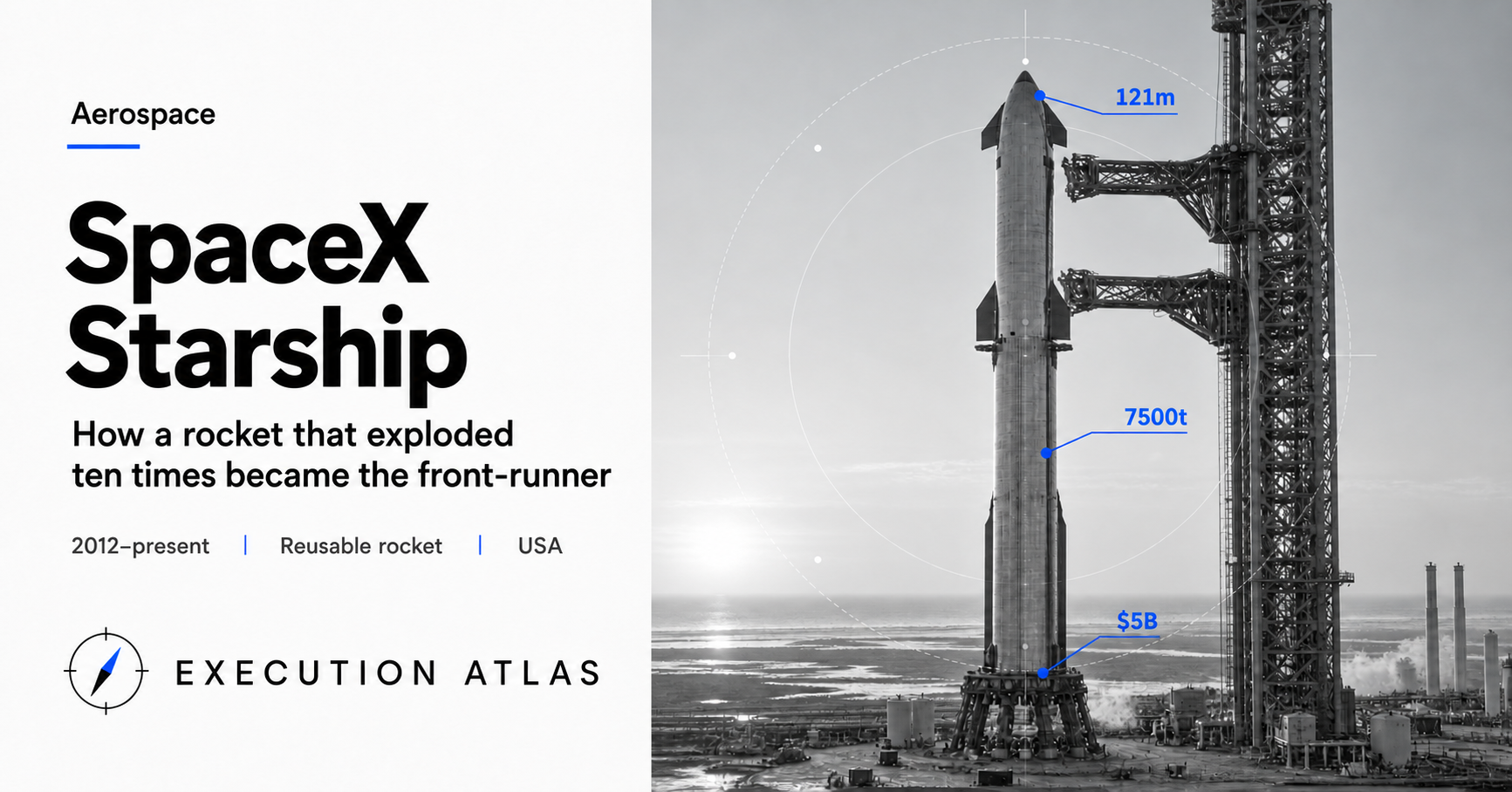
October 13, 2024, 7:25 AM. From a launch pad in Starbase, Texas, a 121-meter rocket rose into the sky. Liftoff thrust: 7,500 tons — more than double the Saturn V, the greatest thrust humanity has ever built.
Seven minutes later, the separated first-stage Super Heavy returned to the launch tower still firing its engines. At the center of the tower, a pair of metal arms called “Mechazilla” waited. Two chopstick-like arms closed around the 71-meter booster and caught it in mid-air.
First attempt. No ground testing. A maneuver that existed only in models and simulations, performed live with a 275-ton vehicle. The arms closed. The booster stopped in mid-air.
This is the SpaceX way.
Twelve years after Elon Musk announced a “Mars colony rocket” in 2012, SpaceX has lost more than ten test vehicles. It destroyed a launch pad once. The first integrated flight test in 2023 ended with an airborne explosion before stage separation. Yet within 18 months, five generations of design were iterated through, and Starship became the leading candidate for a lunar lander.
Starship is not just a rocket story. It is an experiment in how far an organization that “refuses to call failure failure” can rewrite the rules of space exploration.
Mission: Mars Colonization as Requirements Definition
When Elon Musk founded SpaceX in 2002, his stated goal was to make humanity multiplanetary on Mars. Existing space agencies treated a Mars mission as “a concept for decades from now.” Musk redefined it as “within 10 years.”
In 2012, Musk first spoke concretely about the “Mars Colonial Transporter.” A rocket that could carry 100 people to Mars and return on propellant produced on Mars. Three requirements emerged:
Fully reusable. Super heavy-lift. Can produce fuel on Mars.
These three constraints governed every subsequent design decision.
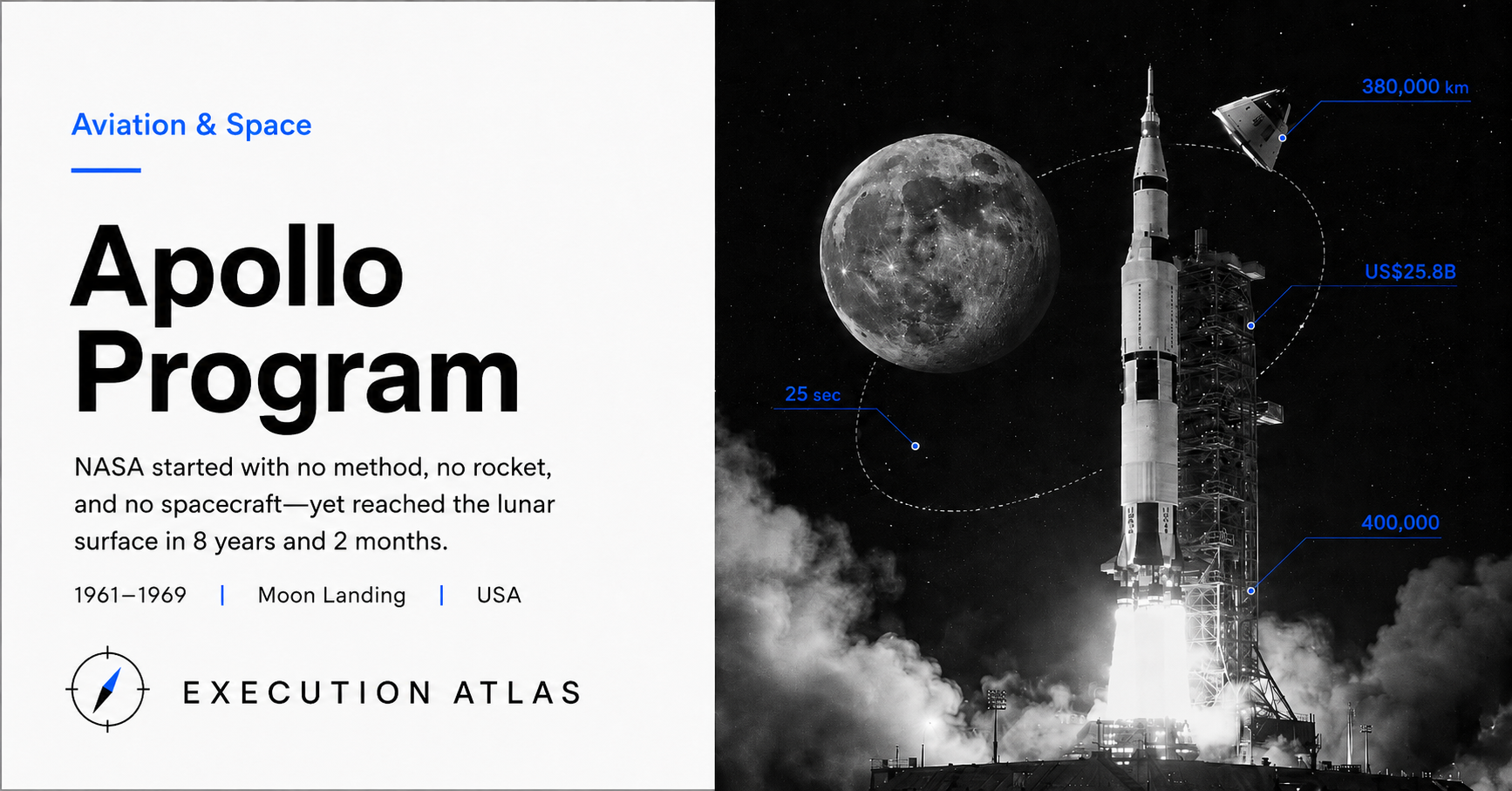
Full reusability means using a rocket like an aircraft, over and over. The 1960s Saturn V was expendable, costing roughly $1.1 billion per launch in today’s value. Cost was blocking the democratization of space. Give up expendability, and physically only fuel costs remain.
Super heavy-lift means the ability to deliver 100 tons to low Earth orbit in a single launch. The Space Shuttle carried 27 tons; the Saturn V carried 140 tons. Starship targets 100–150 tons in its fully reusable configuration, over 250 tons in expendable mode. Mars needs 100 tons of cargo per trip — anything less and the number of launches required to establish a habitable colony becomes overwhelming.
Can produce fuel on Mars. This is why the propellant is methane plus liquid oxygen. Mars has carbon dioxide and water ice. The Sabatier reaction synthesizes methane from hydrogen and CO2, while water electrolysis yields liquid oxygen. Apollo-era liquid hydrogen cannot be made on Mars. Kerosene cannot either. The requirement defined the propellant.
Musk said at the 2016 International Astronautical Congress:
“I want to make Mars seem possible, to make it seem as though it’s something we can do in our lifetimes.”
Making it seem achievable. That is the mission side of “requirements definition.” Funding, talent, recruitment — all of it runs on that sentence.
Design: The Contrarian Bet on Stainless Steel
The most famous design decision in Starship’s history is the material change made at the end of 2018.
The original plan was to build with carbon composites — standard aerospace practice. Light. Strong. Expensive, but in a world where delivering 1 kg to orbit costs tens of thousands of dollars, lighter is always better. SpaceX had even built carbon composite tanks in Texas.
Musk scrapped it. He chose stainless steel (SUS301-series) — a material that had not been used in primary rocket structures since Cold War rockets of the 1950s.
The reason was strength at temperature. Carbon composites degrade above a few hundred degrees Celsius. Surviving re-entry heat requires thick thermal protection tiles, which drive up maintenance costs. Stainless steel holds its strength past 700°C. Less thermal protection is needed. And the cost per ton is a fraction of carbon.
There was another reason: steel can be welded. Carbon composite can only be bonded, requiring specialized autoclaves. A factory investment of hundreds of millions of dollars. Steel can be assembled by on-site welders in Starbase’s tent factories.
The cost of redoing the design almost from scratch versus the ongoing maintenance cost per vehicle. Musk feared the latter.
The vehicle’s exterior reverted to the silver cylinder of 1950s science fiction — not the refined white carbon of modern aerospace, but raw stainless steel. Aerospace engineers offered skeptical assessments. “A material choice from 50 years ago,” wrote industry journals. Some predicted it would burn up during re-entry.
In June 2024, IFT-4, it did not burn up. It shed high-temperature plasma in a controlled manner and splashed down in the Indian Ocean. Steel was right.
Controlling 33 Raptor Engines
At the base of Super Heavy, 33 Raptor engines are arranged in a cluster. Each produces 230 tons of thrust — a total of 7,500 tons. An entirely different philosophy from Apollo’s F-1 engine (680 tons each, five total).
Multi-engine designs have long been criticized. The Soviet N-1 rocket in the 1960s famously exploded four consecutive times with its 30-engine configuration. “Don’t increase engine count” became a maxim in rocketry.
SpaceX went the opposite direction. Because each Raptor is smaller, it can be mass-produced. The factory aimed for one engine per day. With 33 per vehicle, unit cost falls. If one fails mid-flight, the mission can continue. In IFT-4, one engine was lost shortly after liftoff, but the remaining 32 completed the flight.
The control challenge is immense. Independently managing the thrust of 33 engines, canceling combustion oscillations, and maintaining center of mass — these were the problems the Soviets could not solve in the 1960s. SpaceX re-solved them on the back of exponentially greater computational power.
Mechazilla: A Rocket Without Landing Legs
A first stage with no landing legs was another idea Starship was the first to operationalize.
Falcon 9 lands on legs. But legs add mass. Less mass means more payload to orbit. The idea of catching the booster at the launch tower — rather than landing on legs — was first floated by Musk in 2020, but the industry thought it was a joke.
Mechazilla is a mechanism that mounts two hydraulically actuated arms on a launch tower the height of a 20-story building. As the hundreds-of-ton booster decelerates to roughly 15 m/s on its return, the arms catch it. Position accuracy required is on the order of centimeters. A miss damages the arms, the tower, and the booster simultaneously.
On October 13, 2024, IFT-5: first success. No ground testing. First try. The CEO himself had signed off on the decision.
Execution: 18 Months of Not Calling Explosions Failures
April 20, 2023. IFT-1. The 121-meter vehicle lifted off and exploded in mid-air about four minutes later. Three of 33 Raptors failed to ignite at liftoff, several more shut down in flight, and a hydraulic unit failure disabled thrust vector control. The Autonomous Flight Termination System sent the destruct command as the vehicle lost attitude control. A massive crater remained at the launch pad; dust spread kilometers in every direction. The FAA ordered a multi-month stand-down.
In traditional rocket development, this triggers a project restructuring, design reviews, and congressional hearings. It did for Japan’s H3 and Europe’s Ariane 6. SpaceX resumed final assembly of the next vehicle at Starbase the following day.
November 18, 2023. IFT-2. Stage separation succeeded. But Super Heavy exploded just after separation, and Starship was destroyed in the upper atmosphere.
March 14, 2024. IFT-3. Starship reached space. It accelerated to nearly orbital velocity of 8 km/s for the first time. It lost communications during re-entry and broke apart above the Indian Ocean.
June 6, 2024. IFT-4. Both stages successfully splashed down as planned for the first time. One Raptor was lost shortly after liftoff, but the remaining 32 completed the mission. Starship survived the burning atmospheric re-entry.
October 13, 2024. IFT-5. Mechazilla caught Super Heavy for the first time. Sixth generation vehicle; five flight tests and five vehicles lost in 18 months.
The Cost per Failure Is the Key
There is structure here. Not fearing failure is not philosophy — it is because the cost per vehicle is low.
Starship’s estimated unit production cost is roughly $100 million. That is higher than the $30 million for a Falcon 9, but orders of magnitude cheaper than the Saturn V ($1.1 billion in today’s value) or the SLS (~$4.1 billion). Steel structure, the integrated Starbase factory, Raptor mass production, and iterative design all drive unit cost down.
Losing one test vehicle does not impair enterprise value. In fact, after IFT-1 failed, the valuation went up. The market rewarded the shortness of “time to next test.”
NASA’s Space Launch System, meanwhile, took 11 years from its 2011 program start to its 2022 first flight, costing $23.8 billion in total development. Roughly $4.1 billion per vehicle, expendable. A single failure and Congress shuts it down. The constraint of “cannot fail” depresses development velocity.
Musk said at the 2019 Starhopper unveiling: “I love the smell of methane in the morning” — a parody of Apocalypse Now, but the context holds. Smelling the fuel, not fearing the explosion, turning to the next. That is the doctrine.
The Starbase Integrated Factory
Starbase sits at the southern tip of Texas, near the Mexican border, in the middle of nowhere. Factory, test site, launch pad, viewing area, and employee housing are all on one campus. Zero transport time. Weeks from design change to next vehicle flight.
Under the old NASA model, manufacturing (Mississippi), assembly (Louisiana), testing (Alabama), and launch (Florida) were scattered across states — a political arrangement to distribute jobs. SpaceX, as a private company, had no such obligation. Optimizing geography alone multiplied development velocity several times over.
By 2024, more than 2,000 employees and around 1,000 contractors worked at Starbase daily. Transplants from Austin or LA, average age in the early thirties. With Musk on-site, decision latency is low. “Design change Friday, parts ordered Monday, assembly the following week” — a pace impossible at Airbus or Boeing.
People: Shotwell’s Operations and Musk’s Promises
Starship’s face is Musk, but SpaceX functions because of President and COO Gwynne Shotwell.
Shotwell, born in 1963, is a mechanical engineering graduate of Northwestern University who joined SpaceX as its seventh employee in 2002. Whenever Musk makes an ambitious deadline pledge, customers grow angry, and governments tighten regulations, she is the one who smooths it out.
The first NASA COTS contract (2006, $278 million) was won by Shotwell right after Falcon 1 had failed three times in a row. Without that contract, SpaceX would have gone bankrupt. She became COO in 2008 and remains so as of 2026.
In 2016, Musk publicly said: “We’ll send humans to Mars within 10 years.” As of 2026, unachieved. Musk does not call this failure. Crewed Mars has shifted to the mid-2030s; HLS Moon landing has been revised to 2027 or later. He continuously updates the pledges, using them to maintain funding, talent, and political attention.
Shotwell plays the opposite role. In 2023 she said:
“We are going to Mars, and Starship is how we get there. The question is only when.”
Only when is open. Everything else is settled. This dual narrative sustains SpaceX’s fundraising and hiring.
The Co-Dependent Relationship with NASA
In April 2021, NASA selected Starship as the sole winner of the Human Landing System (HLS) contract. Contract value: $2.89 billion. Blue Origin and Dynetics lost on price. SpaceX’s bid was roughly half Blue Origin’s.
NASA Administrator Bill Nelson said at the selection: “With this award, NASA and our partners will complete the first crewed demonstration mission to the surface of the Moon for the Artemis program.”
In November 2022, NASA exercised an option adding $1.15 billion, bringing the total to $4.04 billion. This covers roughly one-third of the $5 billion-plus in Starship development costs. The rest is SpaceX’s own capital — specifically, profits from Falcon 9 and Starlink.
Starlink is projected to generate $15–24 billion in revenue in 2026 at a 60–80% margin. This profit flows into Starship R&D. SpaceX’s FY2025 annual R&D spend was $3 billion; in Q1 2026 alone, $930 million. Starship is the company’s largest internal investment.
In 2016, Musk estimated total development cost at $10 billion. By the end of 2024, over $5 billion had been spent. The estimate contains no padding and no underestimation — unusually honest for a mega-project. SpaceX substitutes over-promising for under-estimating.
Legacy: Rewriting the Price of Space
The primary change Starship brings is to the cost of delivery to low Earth orbit.
Falcon 9’s measured cost runs around $2,720 per kilogram. Down from over $50,000 during the Space Shuttle era — a tenfold reduction. When Starship enters full-reuse operation, the target is a few hundred dollars per kilogram. Another order-of-magnitude drop.
What does this change? Space telescopes, lunar bases, Mars resupply, on-orbit manufacturing, space-based solar power. Ideas that existed but were priced out of reality are suddenly re-evaluated simultaneously.
The James Webb Space Telescope’s design was delayed a decade and its cost ballooned to $10 billion — largely to optimize for a 6.5-ton launch mass constraint. Starship’s payload capacity could deliver Hubble-class mirrors, multiple at once. Design constraints relax, and telescope engineers are freed from the tyranny of mass minimization. This ripples through astronomy for decades.
The Difficulty of Analyzing an Unfinished Project
As of 2026, Starship has zero successful orbital insertions, zero HLS lunar landings, and zero Mars missions. Its actual record consists of three achievements: stage separation, atmospheric re-entry, and the Mechazilla catch.
Legacy space agencies would be cautious about calling this “success.” SpaceX calls it success. Markets agree. The evaluation axis has shifted. The old standard was “full success on first flight.” With SpaceX, “speed of iterative improvement” is becoming the new metric.
Whether this was correct will be judged by the progress of Mars missions in the 2030s. Failure remains possible. Promised timelines will likely not hold. But if humans land on Mars in 2040, the question “how far along was Starship in 2026?” loses its meaning. Only the narrative remains: “The doctrine of not fearing explosions is what made Mars possible.”
The old adage that winners write history works in space too.
Lessons: Lowering the Unit Cost of Failure
Starship’s deepest lesson is about how to build an organization that does not fear failure.
Not philosophy — there is a physical precondition: low unit cost per failure. Steel structure, Raptor mass production, the Starbase integrated factory, reusable design. Only when all of these are in place does the economics of failing five times a year become viable.
Many people try to import this doctrine to other industries. “Fail fast and learn.” But almost always, they carry the words without investing in lowering the unit cost of failure. No willingness to switch to steel. No willingness to consolidate the factory in one place. Just telling the team to “challenge more.” That produces more failures without producing more learning.
The second lesson is the relationship between promised timelines and funding sources. Musk pledged humans on Mars within 10 years and missed the deadline — yet the valuation rose. This works because “believers who fund on the promise” and “realists who invest on results” are distinct populations. SpaceX raises capital from the former and extracts profit from the latter (through Starlink). The NASA contract belongs to the latter side. Splitting funding across three sources built in resilience against timeline slippage.
How far is your project investing in lowering the cost of a single failure? Is your promised deadline a fundraising tool or a binding contract? These two questions apply almost directly to businesses that never leave the atmosphere.
The industry that watched more than ten explosions began asking “when’s the next launch?” The grammar of evaluation changed. That may be the first concrete result a pre-operational Starship has already delivered.
Sources
- SpaceX Starship - Wikipedia — length, thrust, propellant, design evolution
- SpaceX Super Heavy - Wikipedia — first stage specs, 33-Raptor configuration
- SpaceX Starship design history - Wikipedia — Mars Colonial Transporter to current design
- List of Starship launches - Wikipedia — IFT-1 through IFT-6 results and dates
- SpaceX Starbase - Wikipedia — development site, integrated factory/test/launch structure
- NASA awards SpaceX $1.15 billion contract for second Artemis lander mission - SpaceNews — HLS additional contract value
- Business Case for Starship - Chris Prophet (Substack) — development cost, R&D investment, Starlink cross-funding estimates
- SpaceX catches a Starship booster on the first try - Cosmic Log — IFT-5 Mechazilla catch coverage
- SpaceX Mars Transportation Infrastructure - Encyclopedia — Mars Sabatier reaction propellant production concept
- SpaceX Official Live Archives - YouTube — IFT-1 through IFT-6 livestream recordings