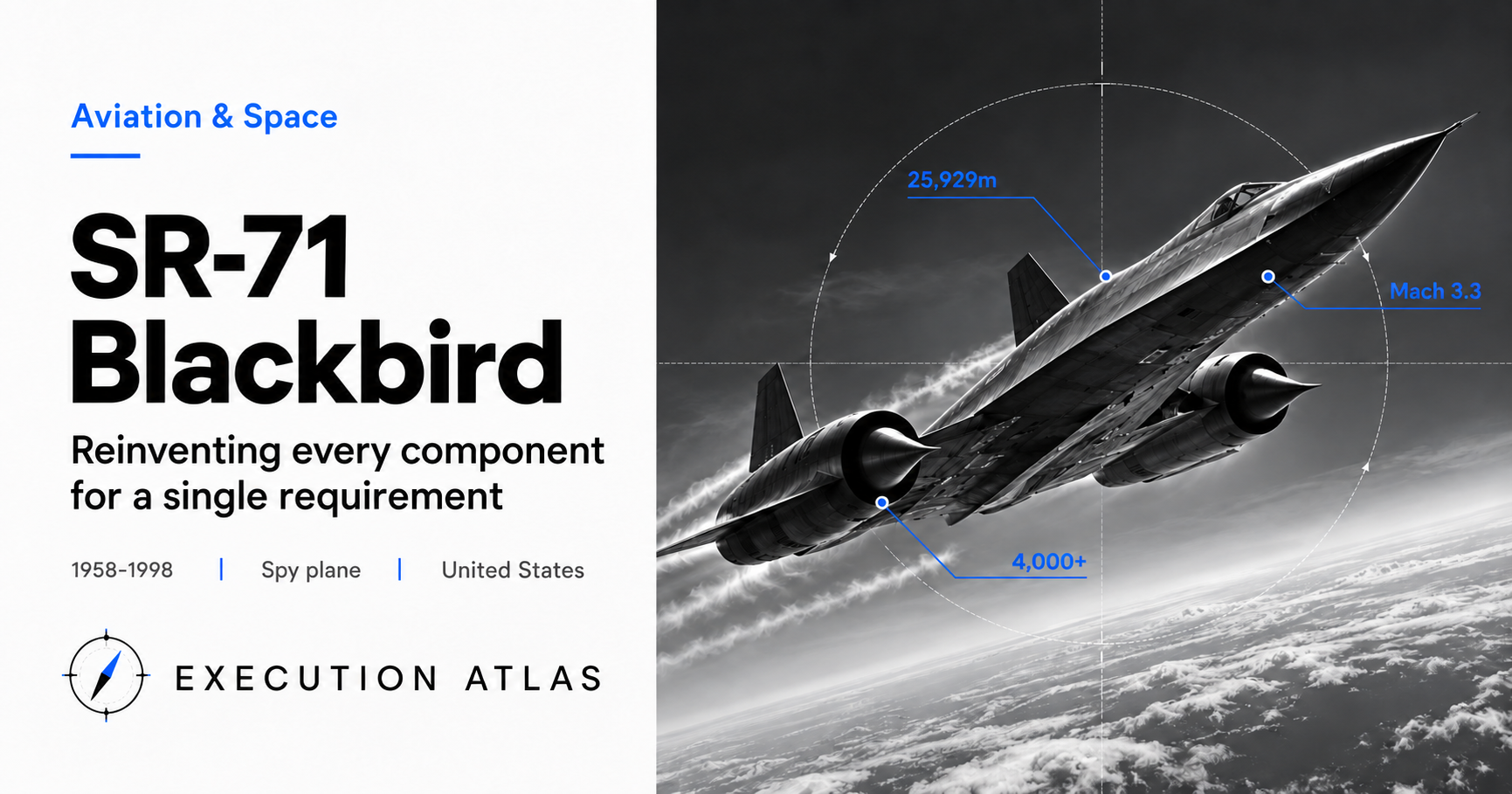
On July 28, 1976, above Edwards Air Force Base in California. SR-71 serial number 61-7958, crewed by Captain Joersz and Major Morgan, passed through a straight course at an average speed of 3,529.6 km/h. Mach 3.3. That same day, a different crew flew the same aircraft to a sustained level altitude of 25,929 meters (85,068 ft). Two and a half times the cruising altitude of a commercial airliner.
These two records have not been broken by any crewed jet aircraft in over 50 years.
What makes it stranger is this: if you tried to build the same aircraft today, you probably couldn’t. The manufacturing technology and machine tools for an airframe that is 85–93% titanium alloy, J58 engines performing to the same spec, the operational culture that accepted pre-takeoff fuel leaks — all of it existed only at the 1960s Skunk Works. Hand someone the blueprints today, and the modern aerospace industry cannot reproduce the SR-71.
The more accurate framing is that, more than half a century ago, a single design philosophy produced an aircraft this extreme.
That philosophy can be stated plainly. The single requirement of “surviving at Mach 3+” forced everything — from materials to supply chains — to be rebuilt from scratch.
Mission
May 1, 1960, above Sverdlovsk in the Soviet Union. CIA reconnaissance aircraft U-2 was shot down by an SA-2 surface-to-air missile. Pilot Francis Gary Powers survived and was captured by the Soviets. The US-Soviet summit scheduled in Paris fell apart, and one equilibrium of the Cold War shattered.
What the United States lost that day was not just a pilot and an airframe. It lost the premise it had believed for five years: that a reconnaissance aircraft flying at 70,000 ft could not be shot down.
The U-2 cruised the stratosphere — photographing at altitudes beyond the reach of Soviet fighters and missiles, then returning. Its design philosophy was close to a glider’s: long wings for soaring, built to the extreme of lightness. Since its 1955 introduction, that gamble had held. The moment it was shot down, any reconnaissance aircraft relying solely on altitude became obsolete.
Lockheed Skunk Works director Clarence “Kelly” Johnson had actually begun studying a successor before the U-2 was downed. In 1958, under the codename Archangel. He had been pushing internally for something faster and higher. The shootdown converted that internal proposal into a national program.
The new requirements were simple: cruise at 80,000 ft, Mach 3+. Beyond the boundary of Soviet air-defense systems at the time, and then some. The CIA approved funding for the A-12 (the CIA-version prototype of the SR-71) in August 1959 and ordered 12 aircraft in January 1960. The Air Force variant, the SR-71, was contracted on December 28, 1962.
Kelly Johnson made a promise to Skunk Works: flying in 20 months.
Design
The moment you write “sustained cruise at Mach 3+” as a requirement, most known technology becomes unusable.
First, materials. When an airframe meets atmospheric friction at Mach 3, the outer skin temperature exceeds 200°C, with the nose and leading edges reaching over 400°C. Aluminum alloy — standard in aviation at the time — loses half its strength at those temperatures. Stainless steel works but is too heavy. The only remaining option was titanium alloy.
Titanium had almost no mass-production precedent then. Temperature management during processing, cutting tools, heat treatment — none of the expertise existed outside of aircraft manufacturing. Worse, domestic US supplies of aircraft-grade titanium ore could not meet SR-71 demand.
Then, fuel. At Mach 3, fuel tanks heat to nearly 400°C. Conventional jet fuel JP-4 vaporizes and explodes at that temperature. JP-7, a new fuel, was developed from scratch for the SR-71. Its flash point is so high that holding a lit match near it at room temperature won’t ignite it. Starting the engine requires injecting a separate chemical — triethylborane (TEB).
Then the fuel tank design itself. At Mach 3, the full aircraft length expands by 6–11 inches (15–28 cm). A sealed rubber fuel tank cannot follow a structure whose dimensions differ between ground and cruise. Skunk Works eliminated the fuel tanks entirely and made the aircraft’s own skin the fuel tank. At ground level, the panel gaps are open and fuel drips. Accelerating to Mach 3, the skin thermally expands and the panels press together to seal.
Leaking on the ground — a design flaw on the surface — becomes the correct answer under the premise of Mach 3+ cruise. Accepting the constraint solved the problem in reverse.
The engine was new as well. The Pratt & Whitney J58 operates as a turbojet from takeoff through Mach 2, then above that speed it bypasses a portion of air and effectively transitions to a ramjet — a combined-cycle engine. Nothing else in the world was ever fitted with it.
The aerodynamic form had to control Mach 3+ shockwaves while also suppressing radar cross-section (RCS). The narrow edge running from nose to fuselage axis — called the “chine” — generates lift while deflecting radar waves at an angle. It is an ancestor of the stealth aircraft that followed.
No single component technology was available off the shelf. Everything had to be invented in parallel.
Kelly Johnson’s response was thorough. The Skunk Works operating rules — the “14 Rules” — were themselves a design for running invention at this scale within a single organization. Strictly limit headcount. Keep contracts thin; approve changes on the spot. Mandate monthly cost reviews. Build an absolute relationship of trust between the military and the contractor. His motto fit in three words.
Be quick, be quiet, and be on time.
Execution
The titanium shop floor was something close to daily crisis.
Chlorine in the factory’s tap water caused stress corrosion — microscopic cracking — when it contacted titanium. Skunk Works banned all chlorinated cleaners and tap water across the facility and switched to distilled water. Drill bits that lasted a full day in steel machining wore out in minutes on titanium. Coolant formulation, cutting speed, feed rate — all had to be redesigned from zero. Early production records show that most of the machined titanium parts in initial batches were scrapped.
Kelly Johnson reflected afterward:
“Everything had to be invented. Everything.”
The titanium ore itself ran short. The world’s largest deposits were, ironically, in the Soviet Union. The CIA purchased Soviet titanium through third-country shell companies. One cover story of the era reportedly claimed the material was “components for commercial pizza ovens.” The anti-Soviet reconnaissance aircraft was built from its target’s materials. The Soviets never found out.
The first flight slipped past the 20-month promise Kelly Johnson had made.
On April 26, 1962, the A-12 (the CIA single-seat variant) made its first flight at the secret test site at Groom Lake, Nevada — later known as Area 51. That was approximately 32 months after CIA funding approval in August 1959: 1.6 times the stated schedule. The SR-71 itself flew first on December 22, 1964, at Palmdale, California — exactly two years after the December 1962 contract.
Whether this is slow or fast depends entirely on where you set the measuring stick. Designing a full-titanium Mach 3+ aircraft while simultaneously inventing the materials, fuel, and machine tools, and getting it airborne in under four years — by any contemporary or modern standard, that is extraordinarily fast. The most objective measure is that no program has done the same thing in the 50-plus years since.
On January 7, 1966, the first SR-71 (the trainer variant SR-71B) arrived at Beale Air Force Base with the 4200th Strategic Reconnaissance Wing (renamed the 9th SRW in June of that year). For the next 25 years, the SR-71 flew reconnaissance across airspace worldwide. The numbers alone:
33 aircraft produced. 12 lost to accidents. Zero shot down by hostile fire. Over 4,000 surface-to-air missiles fired at it on record.
Not that none connected. The SR-71’s missile evasion procedure was “accelerate and outrun.” Cruising at Mach 3.2, it simply went faster than missiles climbing from below. Build an aircraft that cannot be caught and the missile warning system becomes a device that tells you when to accelerate.
Most of the 12 losses were mechanical failures or control-system malfunctions — self-inflicted. A Mach 3 aircraft poses troubleshooting challenges alien to anything on the ground. Even so, the record stands: 25 years of operation, not one aircraft downed by an adversary.
People
Kelly Johnson was born in Michigan in 1910. He earned a master’s degree in aeronautical engineering from the University of Michigan and joined Lockheed at 23 in 1933. The P-38 Lightning, Constellation, U-2, A-12, SR-71 — he designed most of the major aircraft of mid-20th century America.
He founded Skunk Works (officially, Advanced Development Projects) in 1943, for emergency wartime jet fighter development (the P-80). A small team sealed in a single building, cut off from Lockheed’s normal management hierarchy — that operating model was established there.
Kelly Johnson’s “14 Rules” codified that system into 14 items: “The program manager must have complete control authority over the entire program.” “Ruthlessly limit the number of people involved.” “Never let the monthly cost review slip.” “Build absolute trust between the military and the contractor.” Classically direct, and still cited today.
His motto also ended in three words. Be quick, be quiet, be on time. Fast, silent, on schedule.
“Quiet” was the Kelly Johnson signature. Skunk Works released almost nothing. SR-71’s existence became publicly acknowledged in 1964 through a speech by President Lyndon Johnson — before that, only a tight circle within the CIA and Air Force knew the aircraft’s name. The original designation RS-71 was reportedly misread by the President as “SR-71” in his speech, and the name simply stuck. Lockheed chose to change the name rather than correct the President.
Kelly Johnson retired in 1975. His successor was Ben Rich — an engineer who had worked on SR-71 aerodynamics, and under whose leadership Skunk Works went on to produce the F-117 stealth aircraft. The 14 Rules were passed down not as personal charisma, but as organizational operating rules.
Legacy
SR-71 was retired on March 6, 1990. Defense budget cuts, the end of the Cold War shifting reconnaissance demand, maturing reconnaissance satellite capability, the SR-71’s own operating costs (tens of thousands of dollars per flight hour in fuel, hundreds of ground support personnel). The stated reasons were multiple.
Ben Rich later offered a different account in his memoir Skunk Works. The real reason for the SR-71’s retirement, he wrote, was that Air Force Chief of Staff Larry Welch moved to kill the SR-71 program in order to free up budget for the B-2 stealth bomber.
And on March 6, 1990, as part of the retirement ceremony, SR-71 serial number 64-17972 made its final flight. Lt. Col. Ed Yielding and Lt. Col. Joseph Vida flew it from Palmdale to Dulles in 64 minutes and 20 seconds — crossing the continent and setting four speed records in the same flight. A retirement flight that set new records is not something that happens with ordinary aircraft.
1991, the Gulf War. Coalition forces wanted immediate reconnaissance intelligence to strike Iraqi Scud missile launch sites. Reconnaissance satellites could only shoot during orbital passes. Unmanned aircraft were still in their infancy. Voices from the field asked: what if we had the SR-71? In 1994, Congress voted to reactivate it. In 1995, three aircraft were brought back at a cost of $100M. In 1997, an additional $30M. In 1998, retired again.
Reintroducing it, then retiring it again within a few years — economically, that is substantial waste. Recalling skilled maintenance personnel, rebuilding the parts supply network, relearning operational expertise. Recovering an operational capability once lost costs something separate from the original investment. The round-trip damage of “retire then immediately reintroduce” had accumulated.
Twenty-five years of operation, zero losses to hostile fire, over 4,000 SAMs evaded, speed and altitude records from 1976 still unmatched. And an aircraft with that record was retired by a political budget decision. When technology and politics collide, politics wins more often than not.
What SR-71 left behind was not only the aircraft. Titanium mass-manufacturing technology — built from nothing for the SR-71 — became a shared asset of the American aerospace industry. Subsequent stealth aircraft, spacecraft thermal protection, medical implants. Technologies developed as SR-71 byproducts continue working elsewhere today.
Takeaways
Describe the SR-71 as “a Mach 3 reconnaissance aircraft” and it becomes a story about performance.
But lay out the design decisions one by one and a completely different picture emerges. Materials (titanium), fuel (JP-7), fuel tank (integral airframe skin), engine (J58 turboramjet), aerodynamics, manufacturing technique, procurement network — all of it was discarded and rebuilt from scratch solely to make Mach 3+ viable.
This is the opposite strategy of Nautilus.
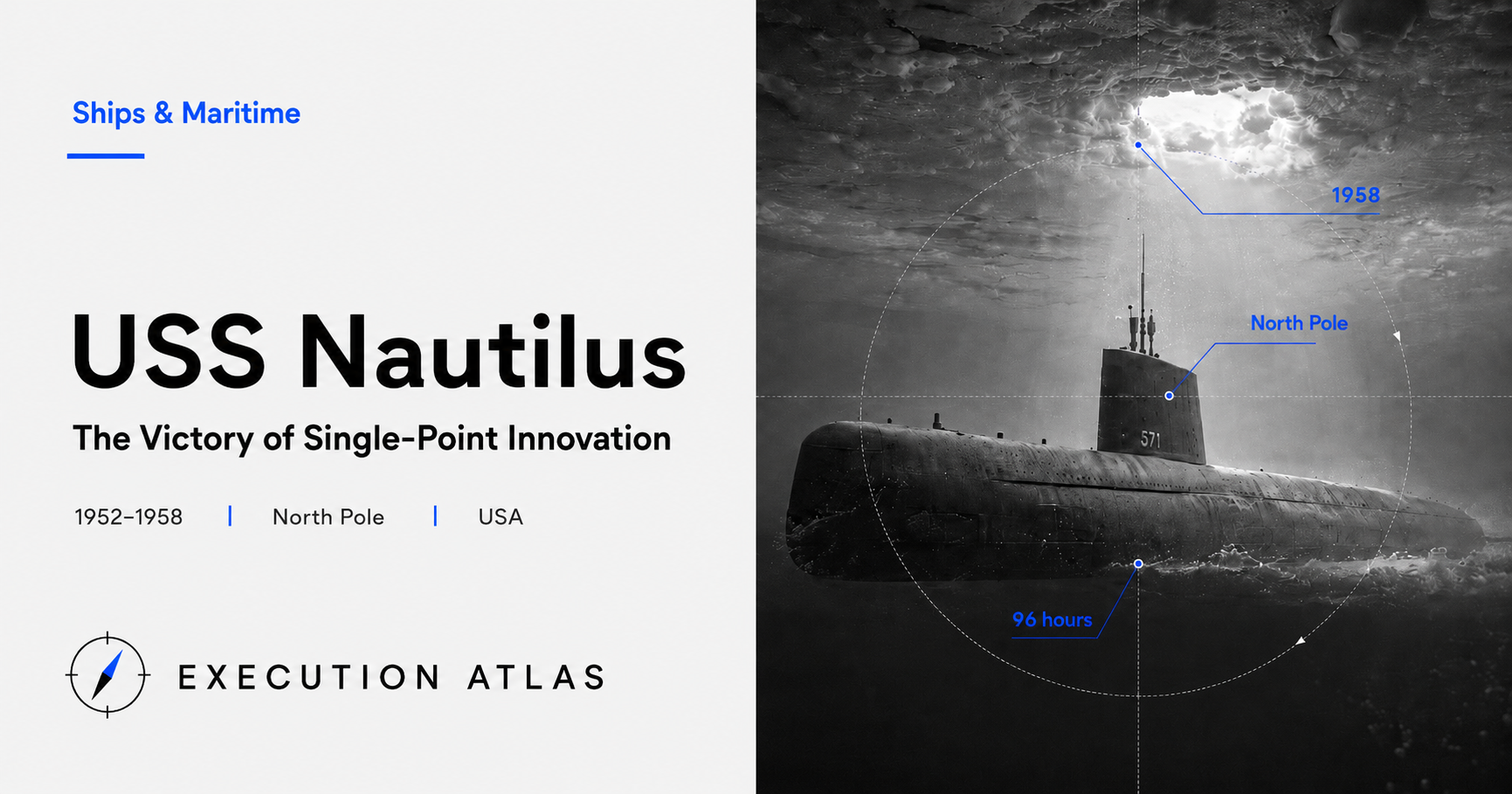
USS Nautilus built “a nuclear submarine” by concentrating innovation at a single point — the reactor — while keeping the hull, armament, and operations entirely on the existing technology curve. Concentrate the paradigm shift at one point; keep everything else conservatively fixed. It is often cited as a design philosophy contrasting with de Havilland Comet, which introduced multiple new technologies simultaneously in a jet airliner and suffered fatal crashes as a result.
SR-71 did the reverse. For a single requirement (survive at Mach 3+), materials, fuel, manufacturing, aerodynamics, and procurement were all redesigned simultaneously.
This was not recklessness. The nature of the requirement was different.
“Nuclear submarine” needed only one new thing — power source — and everything else could be filled from existing stock. As long as the reactor worked, the submarine functioned. That allowed innovation to be contained at one point.
“Reconnaissance aircraft that survives at Mach 3+” was not that. Existing aluminum airframe: melts. Existing JP-4: explodes. Existing fuel tank: cannot follow airframe expansion. Existing engine: cannot ingest adequately. Existing titanium supply network: insufficient. When a requirement negates all existing technology, you cannot contain innovation to a single point. There is no choice but to invent everything in parallel.
Misjudge the distance between a requirement and existing technology and the project dies. Nautilus worked with the innovate-one-point strategy because the requirement was “swap the power source.” SR-71 needed the reinvent-everything strategy because the requirement was “operate beyond the known physical limits.” Deciding this at the outset is the program manager’s job, and getting it wrong means bringing a nuclear-submarine design philosophy to a jet-airliner problem.
One more: the secondary lesson SR-71 left behind.
The commitment to building invention itself into the schedule.
When Kelly Johnson said “flying in 20 months,” he knew the materials, the fuel, and the machine tools did not exist. He decided to “invent them while building the aircraft in parallel.” The normal response is to compromise on the target: lower the speed to what existing materials can handle, settle for an engine that runs on existing fuel. But that choice collapses the requirement itself. A Mach 2 reconnaissance aircraft gets shot down by Soviet air defenses of the day.
“If you want to honor the requirement, put inventing the technology the requirement demands into the schedule too.” This is not written explicitly in the 14 Rules, but it runs consistently through the foundation of Kelly Johnson’s decisions.
And finally, the political story remains.
The SR-71 was retired with its technical superiority intact. The 1976 records are still unmatched. The field called for reintroduction during the 1991 Gulf War. Even so, the 1990 retirement decision could not be reversed. A separate judgment — to secure B-2 budget — was something the SR-71’s performance could not counter.
Winning technologically does not prevent losing on budget allocation. What determines a project’s lifespan is not performance, but its relative priority against other projects the decision-maker wants to protect. Cold, but correct.
Kelly Johnson rebuilt everything from materials to supply chains. Ben Rich inherited the organization. Neither could stop the retirement decision.
Technology and the politics that protect technology are separate jobs.
And in large-scale projects, the harder of the two may well be the latter.
Sources
- Ben Rich, Leo Janos, Skunk Works: A Personal Memoir of My Years at Lockheed (Little, Brown, 1994) — SR-71 retirement backstory, Kelly Johnson’s management, titanium procurement
- Wikipedia, “Lockheed SR-71 Blackbird” (https://en.wikipedia.org/wiki/Lockheed_SR-71_Blackbird) — development history, service, retirement, records, production numbers
- Wikipedia, “Lockheed A-12” (https://en.wikipedia.org/wiki/Lockheed_A-12) — A-12 and SR-71 relationship, Groom Lake first flight
- Wikipedia, “JP-7” (https://en.wikipedia.org/wiki/JP-7) — JP-7 properties, TEB ignition
- NASA Technical Reports, “Design and Development of the Blackbird” (https://ntrs.nasa.gov/api/citations/20090007797/downloads/20090007797.pdf) — material selection, engine, and aerodynamic technical history
- Lockheed Martin, “Fastest Plane in History: The Blackbird” (https://www.lockheedmartin.com/en-us/news/features/history/blackbird.html) — manufacturer records and stories
- Air & Space / Smithsonian, “Setting Records: SR-71” (https://www.airandspace.si.edu/stories/editorial/setting-records-sr-71-blackbird) — 1976 speed and altitude records; 1990 retirement flight records
- Simple Flying, “How the CIA Secretly Bought Soviet Titanium to Build the SR-71 Blackbird” (https://simpleflying.com/how-cia-secretly-bought-soviet-titanium-build-sr-71-blackbird/) — titanium procurement history
- Wikipedia, “Skunkworks project” (https://en.wikipedia.org/wiki/Skunkworks_project) — Skunk Works operating rules, Kelly Johnson’s 14 Rules