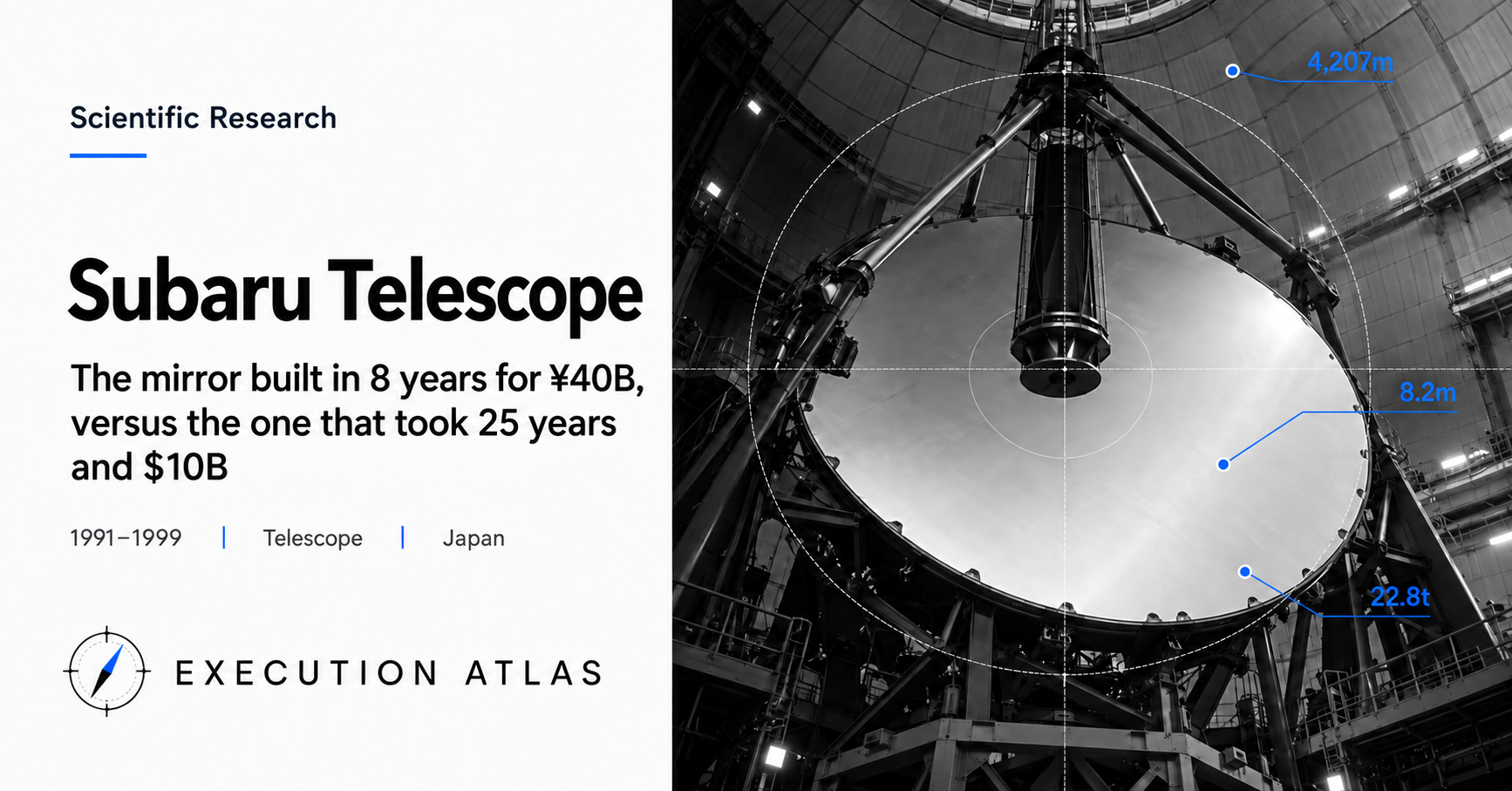
8.2 meters in diameter. 20 centimeters thick. 22.8 metric tons.
A single sheet of glass. It sits at the summit of Mauna Kea on the Big Island of Hawaii, 4,207 meters above sea level, where the air is thin.
261 actuators are embedded in the back of the primary mirror. A computer issues commands to each one every second — watching where the telescope is pointing in the sky, what the outside temperature is, and how much the mirror is deforming under its own weight. The glass moves. There is no “finished mirror surface” created by polishing; instead, surface accuracy is recreated with every observation, integrated with the dynamic support mechanism.
The surface error is 12 nanometers. This is a telescope that continuously re-polishes its own mirror in real time.
This is the story of the Subaru Telescope, built by the National Astronomical Observatory of Japan between 1991 and 1998. Total cost: approximately ¥40 billion. From conception to first light: about 20 years. From groundbreaking to completion: 8 years. For a large scientific instrument, both budget and schedule came in remarkably close to plan.
Mission: From Three Generations Behind in Optical Astronomy to 8-Meter Class with a Single Mirror
In the early 1980s, Japanese optical astronomy was in a difficult position.
The largest optical telescope in Japan was 1.88 meters in aperture (Okayama Astrophysical Observatory, opened 1960). The United States had the Palomar 5-meter telescope running since 1948. While Japan had reached world-class standing in radio astronomy with the Nobeyama 45-meter radio telescope (1982), there was a three-generation gap in optical astronomy.
Around the same time, the next moves were beginning in the United States. Caltech launched the 10-meter-class Keck Telescope project, adopting a new approach of assembling the primary mirror from 36 hexagonal segments to achieve the large aperture. The European Southern Observatory (ESO) was also solidifying plans for the VLT, consisting of four 8-meter-class telescopes.
To compete on the same playing field, Japan needed 8 meters or larger. But whether to follow Keck’s segmented mirror approach or take a different path was left to Japan’s judgment.
The requirements compiled by the Tokyo Astronomical Observatory of the University of Tokyo (reorganized into the National Astronomical Observatory in 1988) translate into requirements-definition language like this:
- Light-gathering power: aperture of 8 meters or more; on par with the world’s latest instruments
- Image quality: minimize seeing caused by atmospheric turbulence by leveraging Mauna Kea’s clear skies and airflow
- Field of view: a monolithic mirror is superior to a segmented mirror in image uniformity across the field; looking ahead to future wide-field surveys
- Wavelength range: dual support for visible and infrared; incorporate cooling systems and stray-light countermeasures from the start
- Site: allow overseas installation; Japan’s first state-owned research facility to be located abroad
The last item carries two simultaneous challenges: the practical reality that there are no climatically suitable sites in Japan for a telescope of this scale, and the unprecedented institutional challenge of establishing a Japanese government facility overseas. Budget negotiations and institutional reform became the main battleground before construction could begin.
Design: A Single Mirror, Thin Glass, Active Optics, and a Cylindrical Dome
Subaru’s design settled nearly every major decision before groundbreaking. The specs that could not change and those that could were clearly separated.
At the center of the immutable specifications was how to make the primary mirror.
Keck’s 36-segment mirror was a rational solution for achieving large aperture. But it requires continuous position control of each segment, which means more moving parts and control software. Subaru chose the opposite: a single piece of glass, 8.2 meters across. The world’s largest monolithic mirror.
A single-piece mirror simplifies the optical system statically. Moving parts are reduced. When a Wide Field Corrector (a wide-field optical correction system) is eventually mounted at the prime focus and large-field observation instruments are installed, the monolithic mirror returns more uniform images across the field.
The trade-off was that manufacturing became harder. The primary mirror material was handled by Corning Glass Works in New York, which produced an 8.3-meter blank from Ultra-Low Expansion (ULE) glass. Polishing was handled by Contraves in Pennsylvania, taking over seven years to finish the surface. The polishing process ran in parallel with construction, organized so that other work streams would not have to wait for the mirror’s arrival.
The other immutable specification was the full adoption of active optics.
Normally, a large-aperture mirror is made thick to prevent deformation under its own weight. The Palomar 5-meter telescope (1948) has a primary mirror roughly 50 cm thick at the center and 60 cm at the edge, weighing 14.5 tons. Scaling to 8.2 meters at the same thickness ratio would result in a primary mirror exceeding 60 tons.
Subaru did the opposite. The mirror was thinned to 20 cm and deliberately designed to “sag under its own weight.” 261 actuators support it from behind, changing the force on each one in response to the direction of gravity and temperature changes, correcting surface accuracy in real time. By abandoning static perfection in favor of dynamic correction, the primary mirror weight was held to 22.8 tons.
The dome was also unconventional.
The traditional shape for large telescope domes is hemispherical, but in Mauna Kea’s airflow, turbulent air from the dome surface flows across the primary mirror, degrading seeing. Subaru chose a cylindrical shape clad in aluminum panels. Air turbulence near the surface is deflected around the sides of the dome. The design was refined through extensive wind tunnel testing, resulting in a dome height of 43 meters. Foundation work was handled by Taisei Corporation: pouring concrete on a lava plateau at 4,207 meters of elevation, under reduced air pressure.
Four focal stations — prime focus, Cassegrain, and two Nasmyth — were provided from the start. The structure allows multiple observation instruments to operate in parallel without swapping them out, a foundation that later enabled large cameras like the Hyper Suprime-Cam.
Execution: A Design Locked In Before Groundbreaking, Completed in 8 Years
Construction began in April 1991. The name “Subaru” — chosen through public competition that same month — comes from the Japanese name for the Pleiades star cluster and also carries the meaning of “to gather together as one,” resonating with the spirit of international collaboration.
Mitsubishi Electric was responsible for system design and main construction, building the telescope mount, tube, and drive systems. Getting materials up to the Mauna Kea summit was itself a challenge; large components had to travel up mountain roads. Workers at 4,207 meters altitude operate at about 70% capacity. Schedule management incorporated time limits on continuous work, oxygen supply, and rotation schedules for descending.
The primary mirror was cast at Corning, polished by Contraves, then shipped to Hawaii by sea. Polishing took over seven years and proceeded in parallel with other work.
Dome foundation, telescope mount, mirror arrival, optical alignment, secondary and tertiary mirror installation, instrument attachment. Construction was completed in 1998. First light came in January 1999, capturing an infrared image of the Orion Nebula. Four science instruments for test observations were operational from that day.
Eight years in the construction phase, at a total cost of approximately ¥40 billion. Compared to other large telescopes progressing at the same time in the US and Europe, the cost and schedule came in without notable overruns.
The James Webb Space Telescope, another large-scale scientific instrument of similar class, stretched from an original plan of 6 years to 25 years, with costs ballooning to nearly 10 times the initial estimate. The difference was made by the length of pre-construction consensus-building and the rigor of specification freezes after construction began.
Most cost overruns on large scientific instruments stem from a habit of locking in specifications while building. Subaru did the opposite: mirror material (Corning ULE), polishing contractor (Contraves), site (Mauna Kea), mirror approach (monolithic with active optics), and dome shape (cylindrical) were all confirmed before breaking ground. The design reduced the number of decision points that could accumulate after construction began. It is one form of “Think Slow, Act Fast.”
People: Keiichi Kodaira’s 20 Years
There is a person whose name runs through this project like a serial number: Keiichi Kodaira.
In the early 1980s, when planning for an 8-meter-class optical infrared telescope began at the Tokyo Astronomical Observatory of the University of Tokyo, he was at the center of it. He became a professor when the National Astronomical Observatory was established in 1988. From 1994 to March 2000, he served as the observatory’s second director. Construction of Subaru was completed during the six years when he simultaneously held the director’s position and overall project leadership.
He drove both the technology and the institutions in parallel. Creating a Japanese state-owned research facility overseas means that the institutional work — visas, employment, procurement, foreign tax law, environmental impact assessment, agreements with indigenous communities — carries the same weight as the telescope’s own engineering. Even when the hardware is finished, it cannot function as a scientific observatory without an operating organization.
“Culture is not merely something to be enjoyed but something to be created.” The words Kodaira and the senior astronomers who worked alongside him poured into Subaru are still preserved verbatim on the observatory’s official website. It is close to a declaration of moving from being users of imported instruments to being creators on the same level as the world.
Kodaira later compiled the 20-year journey into a book: To the Edge of the Universe: Twenty Years of the Subaru Large Telescope Project (Bungeishunju, 2003). Budget negotiations, talks with the Ministry of Finance, explaining the price differential between Japan and the US, the operating framework as a joint university research institution, the launch of the Hawaii Observatory. This is not a technologist’s memoir but the record of an institution builder.
He was awarded the Order of the Sacred Treasure, Gold and Silver Star in spring 2017, with his achievements explicitly noted as “overall director of the large optical infrared telescope project.”
Legacy: 10-Milliarcsecond Vision, a Dark Matter Map of 10 Million Galaxies, a Bridge to TMT
A quarter-century has passed since first light.
The Hyper Suprime-Cam (HSC), mounted at the prime focus since 2013, is a wide-field camera that captures a field of view large enough to hold several full moons at once. In 2018, a three-dimensional dark matter map was published using the first year of HSC data. About 10 million galaxies were used as background sources; the slight distortion in each galaxy’s light was read as weak gravitational lensing to map the distribution of matter across the universe. Combined with observations of the cosmic microwave background by the European Space Agency’s Planck satellite, the result placed further constraints on the nature of dark energy.
These are also images that could only be captured with a monolithic mirror. Achieving the same wide field with a segmented mirror would require calibration to remove image distortions at segment boundaries. Subaru’s design decision paid off as science — 20 years later.
There were also accidents.
On July 2, 2011, ethylene glycol (an automotive antifreeze coolant) leaked from coolant piping at the prime focus unit, covering the primary mirror and instruments including the Suprime-Cam. The orange liquid flowed across the primary mirror surface. Because ethylene glycol has low corrosivity, the primary mirror was recovered with water washing, without needing re-coating.
The choice of coolant determined the feasibility of recovery — a case study later referenced in piping design for other large telescopes.
In 2023, a metal component (a gear rail) fell onto the mirror surface during repair work, damaging it. Nighttime observations were suspended for a period. Maintaining a large optical system after more than 20 years of operation is itself becoming a project.
The experience of Subaru also informs the next step.
In the mid-2000s, Japan considered an independent 30-meter telescope concept, “JELT,” estimated to cost around ¥100 billion — judged too costly to build alone. From 2006, the National Astronomical Observatory’s ELT project office shifted its focus to participating in the US-led Thirty Meter Telescope (TMT, 30-meter aperture). TMT’s total cost is approximately ¥150 billion, with Japan’s share at about one-quarter. The track record of international collaboration and overseas facility operation built through Subaru became the prerequisite for this partnership.
Lessons
Subaru’s deepest lesson lies in the active optics design decision.
“Precision must be built in as a static, finished product” — that had been the conventional wisdom for large optical instruments. Make the glass thick. Make the support rigid. Maintain tight temperature control. Achieve a perfect surface in the fabrication stage. The assumption was that the precision at the moment of completion equals the precision in operation.
Subaru broke that assumption.
A 20-centimeter-thick, 22.8-ton piece of glass begins to sag under its own weight the moment it is placed. Left alone, the mirror surface would deform by microns. Active optics rearranged this situation into a design that “allows deformation and corrects it back.” 261 actuators distribute force as a function of tilt, temperature, and self-weight, continuously restoring the mirror’s shape in real time.
Written this way, it sounds like a 1980s technology story — but the structure persists in today’s work.
Any field has domains where every resource is poured into “making something statically perfect”: thick, heavy design documents; ER diagrams that resist change; API contracts locked in before release; business processes that cannot absorb change. As long as those depend on “perfection at the moment of completion,” their accuracy collapses the instant the environment shifts.
Borrowing Subaru’s framing, the question splits in two: “Where do we truly need static perfection?” and “Where can we insert a dynamic correction mechanism?” The former you do not thin down. The latter you thin down and instead build the correction mechanism.
Running through this article is also the case for “taking longer to deliberate before breaking ground.”
About 20 years from initial concept to first light; 8 years from groundbreaking to completion. The 20-year breakdown — requirements definition, method selection, locking in the international procurement network, creating the institutional framework for overseas installation, budget negotiations — meant that nearly every decision point was resolved before construction began. After groundbreaking, the work was close to pure execution. That is why it came in at ¥40 billion and 8 years.
This is not lazy planning. It is, rather, planning designed to leave no room for hesitation after groundbreaking. In domains where the cost of a post-construction change is many times higher than a pre-construction one, “Think Slow, Act Fast” carries even more weight.
A thin mirror still scans the sky at 12-nanometer accuracy. Integrated with its dynamic support mechanism, its surface accuracy is remade with every observation. This telescope — 20 years after the fact — shows that there is such a way to build.
Sources
- Keiichi Kodaira, To the Edge of the Universe: Twenty Years of the Subaru Large Telescope Project, Bungeishunju, 2003 — the project director’s memoir covering planning through completion, budget negotiations, and the overseas installation framework
- Iye, Masanori et al., “Current Performance and On-Going Improvements of the 8.2 m Subaru Telescope,” arXiv:astro-ph/0405012 — numerical data on mirror thickness, actuator count, and surface accuracy
- Iye, Masanori, “Subaru Telescope — History, active/adaptive optics, instruments, and scientific achievements,” Proc. Japan Acad., Ser. B (PMC8403531) — review article on construction history and instrument systems
- National Astronomical Observatory of Japan, “Subaru Telescope” — official primary source for total cost ¥40 billion, 8.2m monolithic mirror, and location
- Subaru Telescope Official, “Features of the Telescope” — 261 actuators, cylindrical dome, four focal stations, elevation
- Kavli IPMU, “HSC Year 1 Cosmological Analysis” — cosmological constraints from weak gravitational lensing of ~10 million galaxies
- Universe Today, “Subaru 8-meter Telescope Damaged by Leaking Coolant” (July 2011) — account of the coolant leak accident and recovery
- Mitsubishi Electric, “TMT (Thirty Meter Telescope)” — TMT total cost and Japan’s share
- Subaru Telescope, “Observatory Director” page — source of Kodaira’s words: “Culture is not merely something to be enjoyed but something to be created”
- Wikipedia, “Subaru Telescope (National Astronomical Observatory of Japan)” — used as a starting point for the overall timeline