September 22, 2020. Fremont, California. On the Battery Day stage, Elon Musk put up a single slide.
The Model Y rear underbody. A structure that had been an assembly of 70 parts. Now it would be replaced by a single cast aluminum piece. Musk threw one number at the audience.
“About 300 robots in the body shop get replaced by one machine.”
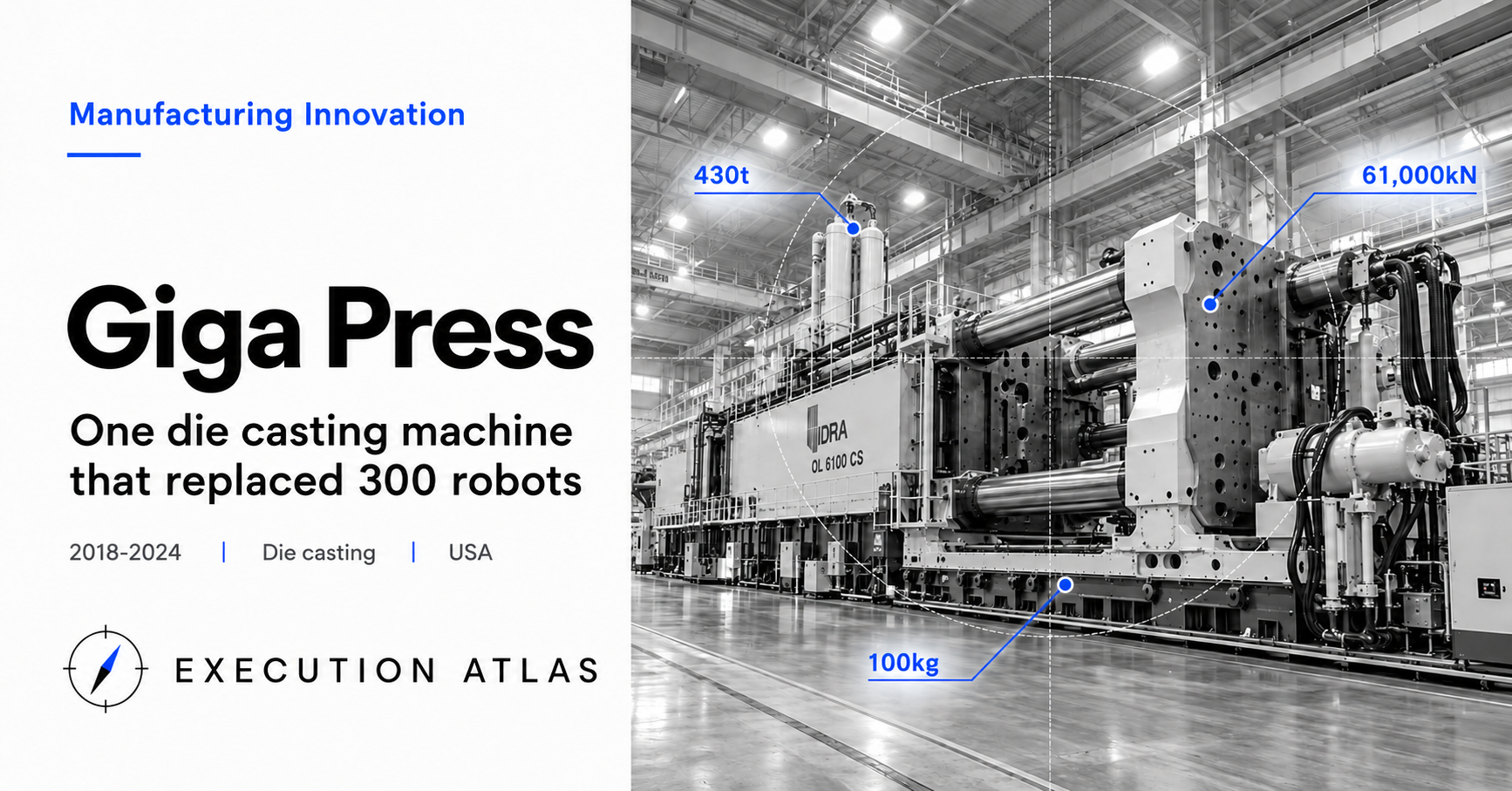
As he spoke, he pointed to a photo behind him. It showed not a car, but a 430-ton, 19.5-meter-long Italian casting machine — IDRA’s “Giga Press” OL 6100 CS.
In the die casting industry, clamping forces in the thousands of tons were the norm. This one: 6,100 tons. An outlier. Why did Idra — a mid-tier industry player — bet on the “XXL” segment? Why did Tesla buy it? And why, in just four years, did Toyota, Volvo, Hyundai, Ford, GM, and Nissan all move to follow?
This is the story of how a single casting machine rewrote automotive design philosophy.
Mission: Why the Giga Press Happened
The origins of the Giga Press lie not with Tesla, but in Italy.
Travagliato, Lombardy. In a small town about 90 kilometers east of Milan, die casting machine manufacturer Idra Group — founded in 1946 — has its headquarters. A steady, mid-sized company that grew through the postwar Italian metalworking industry, it had revenues of around €100 million and roughly 160 employees in the late 2010s.
In 2018, Idra added a machine to its catalog that blew past every industry benchmark. Clamping force: 55,000–61,000 kN. Weight: 430 tons. Aluminum alloy injected per shot: over 100 kilograms. Several times the scale of conventional high-pressure die casting machines.
At the time, the incumbent players in die casting had concluded that XXL machines were not worth commercializing. Market too small. No customers. The industry’s long-standing doctrine was to cast parts “small and separate,” and no automaker existed that wanted giant single-piece castings.
Idra CEO Riccardo Ferrario saw it differently. EV adoption would fundamentally reshape vehicle body structures. Aluminum usage would increase. The existing process of welding together small stamped components would no longer meet the weight reduction and cost requirements of EVs. That was his read.
In May 2019, Idra announced the first order for an OL 5500 CS HPDC machine. The name Ferrario gave it: “Giga Press.”
Around the same time, Tesla in Fremont, California, was hitting the same kind of wall.
The Model 3 production ramp (2017–2018) had ended in a chaos Musk himself called “production hell.” One root cause: the complexity of the body shop. Stamping steel, welding, fixturing, robot assembly — the process was long, with too many sources of quality variation.
Designing the Model Y as an extension of the Model 3 would mean waiting for the same hell. Tesla was looking for another path.
Restated as a requirement: “Manufacture the vehicle’s rear underbody at scale, in a way that structurally eliminates quality variation.”
In software terms, it’s like choosing to deliberately collapse an over-microserviced codebase back into a single function. Interface mismatches drop to zero. The side effect: the function becomes enormous, and once written, it can’t easily be replaced.
Idra’s proposal answered that requirement head-on. Replace the 70-part assembly with a single casting shot. In April 2020, Tesla announced the purchase of two Giga Presses.
Design: How It Was Engineered
The Giga Press’s technical specs read like a declaration of war against the industry.
Clamping force: 61,000 kN. Weight: 430 tons. Dimensions: 19.5 × 5.9 × 5.32 meters. Each shot injects 104.6 kg of molten aluminum alloy into the die at hundreds of kilometers per hour. Maximum projected area: 15,545 cm². More than half the floor area of a passenger car, formed in one shot.
One problem immediately emerged. Casting a part this large in one piece introduces distortion during cooling, as the material shrinks and stress builds up. Conventional aluminum alloys require heat treatment — solution treatment and aging — to achieve structural strength, but heat treatment on large parts compounds the warping. Surface finishing and coating at large scale are also hard to apply uniformly.
Tesla’s answer: build a material tailored to the machine.
An internal materials engineering team developed a proprietary high-strength aluminum alloy that requires no heat treatment. An alloy with the strength and ductility needed for structural use in the as-cast condition. No heat treatment means no distortion. The heat treatment furnace and associated inspection steps could be deleted from the production line entirely.
This was the core of the design philosophy. Rewrite the casting machine, the material, and the body design simultaneously. The conventional order is: design the vehicle → decide the manufacturing method → procure the equipment. Tesla’s order was reversed: what can be made with the Giga Press → redesign the body around it → develop an in-house alloy that doesn’t need heat treatment.
Breaking down the Battery Day numbers:
Previous Model Y rear structure: 70 parts. Welding, joining, fixtures, positioning robots, inspection steps. After: 1 part. One Giga Press.
Robots eliminated: ~300. Factory floor space saved: estimated 30%+. When part count disappears, everything downstream — supply chain, inventory, quality inspection, repair procedures — gets rewritten. The yield of a single casting shot becomes the variable that determines factory-wide productivity.
In the centralization-versus-distribution tradeoff, the Giga Press sits at the full-centralization end. It turns “300 small problems” into “one big problem.” If the single press goes down, the line goes down. When yield falls, enormous defective parts are produced. At 100 kg per part, each defect is 100 kg of scrap.
Framed as a decision, this was a trade: give up reversibility, buy out quality variation and assembly cost. Accept a design that can’t be swapped out, in exchange for eliminating the complexity of the assembly process itself.
Execution: How It Was Built
Idra cataloged the Giga Press in 2018. The OL 6100 CS went live at Tesla’s Fremont factory at the end of 2020. Design to operating hardware: roughly two years. An unusually fast ramp for equipment of this scale.
The timeline:
- 2018: Idra catalogs the Giga Press
- May 2019: Ferrario coins “Giga Press”; OL 5500 CS receives first order
- April 2020: Musk announces purchase of two Giga Presses
- September 2020 (Battery Day): Tesla announces single-piece rear casting for Model Y
- Late 2020: OL 6100 CS goes live at Fremont; Model Y production begins
- Early 2021: Model Y front also converted to single-piece casting
- 2022: 23 Giga Presses sold worldwide
- 2023: 9,000-ton Giga Press introduced for Cybertruck production
Essentially on schedule. With equipment of this kind, design changes, delivery delays, and commissioning stumbles typically compound. Cases exist where buildings require retrofitted floor loads, power capacity, and cooling infrastructure — and equipment still isn’t in full production a year after installation.
Tesla’s fast ramp came from running design, materials, and equipment in parallel. Normally, the vehicle body design is revisited after the equipment is finalized. Tesla was already running “body design assuming the Giga Press” from 2019 onward. The proprietary alloy development ran concurrently. By the time the hardware arrived, the materials and body recipes were already finished.
Immediately after go-live, a different concern rose from the industry.
Repair costs. When a rear collision damages the body, 70 separate parts means replacing only the damaged section. One part means replacing a massive casting in its entirety. Insurers and body shops warned that “gigacast vehicles will see more total-loss declarations.”
Tesla’s response: add to the design.
Engineer swappable small pieces into the large rear casting. A replaceable rear rail — roughly £31 — for the zones most vulnerable to low-speed impact. Instead of bonding or riveting those zones directly to the casting, attach them as removable external pieces. Develop repair procedures for structural adhesive and rivet-based partial replacement.
In 2025, UK’s Thatcham Research published findings. Model Y rear damage repairs cost £2,167 less (partial repair) than the Model 3. Even in full-replacement cases, £519 less. The steel-stamped Model 3 required cutting, re-welding, and extensive repainting of the damaged zone — more labor-intensive, not less.
The disadvantage of single-piece casting turned out to be “a problem solvable through design.” Not denying the problem exists, but designing in a response to it. That difference in posture widened the gap from competitors.
People: Who Led It
Riccardo Ferrario. CEO of Idra Group. A third-generation manufacturer from near Brescia, Italy.
His management decisions have consistently run against industry convention. The die casting machine industry had evolved along two axes for decades: improve precision, cut cycle time. Compete on refining the existing mid-range machine. Ferrario left that game. He multiplied clamping force several times over and created the XXL category himself.
“The name Giga Press isn’t marketing for a bigger machine. It represents a new way of thinking for the die casting industry.” (Idra internal document)
What Ferrario had read clearly: EV adoption would change how vehicle bodies are made at a fundamental level. While incumbents were asking “which machine do we sell,” he was forecasting “what machine will which manufacturer need, and when.” When Idra listed the machine in the 2018 catalog, the Tesla order wasn’t confirmed. He built the product first, in a category with no customer yet.
The result: Idra had sold 23 Giga Presses worldwide by 2022. A market monopolist. Others have tried to follow, but as of 2024, no meaningful competition exists in practice.
On the other side: Elon Musk, Tesla CEO. Born in South Africa in 1971, 49 at the time.
The “300 robots” line wasn’t a PR number. Musk had periods during the two years of Model 3 production hell where he slept on the Fremont factory floor. Every time a line went down, he went to the floor and watched. He understood in his body how welding and joining complexity was eating into Tesla’s costs and quality.
At Battery Day he presented the Giga Press alongside the battery pack, structural battery, and proprietary aluminum alloy. Not as separate innovations, but as a package: “redefining how a vehicle body is built.”
By the time Musk placed the order with Idra, Tesla’s materials engineering team was already developing the proprietary alloy. Equipment, materials, and design operating as a trinity was a precondition for the decision.
There are also the unnamed engineers. Idra’s casting machine engineers, Tesla’s body design team, materials engineers, yield management process engineers. If any one of them had said “that’s not possible,” this project wouldn’t have happened.
Legacy: What It Left Behind
23 Giga Presses sold worldwide by 2022. As of 2024, one OEM after another is making announcements.
Toyota will adopt gigacasting for both front and rear in the Lexus LF-ZC in 2026, installing a 9,000-ton press at its Aichi plant. This will be among the largest die casting machines ever operated in Japan. The implication of Toyota’s own manufacturing heartland shifting to “equipment defines design” is not trivial. Toyota’s own estimate: body assembly time cut from 20 hours to 10 hours per vehicle.
Volvo is investing $900 million in upgrading its factory near Gothenburg, Sweden, adopting megacast rear floors for its next-generation EVs. Hyundai will apply “Hyper Casting” to mass production starting in 2026. Ford, GM, and Nissan have also announced investments.
By market forecast, the gigacasting market is projected to grow from $750 million in 2024 to $2.6 billion in 2030, with over 10 million vehicles expected to adopt large single-piece cast components. A market that didn’t exist four years ago.
The technology ripple extends further. Estimates suggest that the cost structure of EVs will fall below internal combustion vehicles around 2027 due to gigacasting adoption. The premise that “EVs are expensive” is being dismantled by capital investment.
Idra’s position changed dramatically. A mid-tier firm with revenues in the tens of millions of euros until 2017. By 2024, the de facto monopolist of XXL die casting, with the world’s automakers queuing to place orders. Industry structure rewritten by one company’s judgment.
The shift in casting processes ripples into repair networks, insurance, scrap processing, and aluminum smelting supply-demand dynamics. Turning 70 parts into one part means 70 suppliers get replaced by one machine. The tier-1 and tier-2 supply chain contracts. Demand for heat treatment equipment manufacturers, jig makers, and small robot manufacturers disappears.
Long-term durability remains an open question. Early Model Y production began late 2020. Data on vehicles beyond 100,000 km is still accumulating. Whether aluminum cast components have equivalent fatigue, corrosion, and micro-crack resistance compared to steel welded bodies will become clear from five to ten years of field data.
If history has a delayed reckoning, it’s hiding there.
Lesson: Equipment Defines Design
Reading the Giga Press as “a bigger die casting machine” misses the point.
What this project demonstrated was an inversion of order.
In conventional automotive manufacturing, the sequence was fixed: concept → styling → body design → manufacturing method review → equipment and fixture procurement. Design is upstream, equipment is downstream. Equipment is chosen as a means to realize the design.
Tesla’s decision-making folded this sequence in half. Decide first that “we will single-piece cast using the Giga Press.” From there, redesign the body architecture. Develop in-house materials to eliminate heat treatment. Reconfigure the assembly line around a manufacturable process. Equipment is upstream; design conforms to it.
This isn’t simply “we adopted new equipment.” The center of gravity for decision-making shifted — from designers to the people who orchestrate equipment, materials, and process. The entity that defines how a car is made is no longer a body stylist or a vehicle engineer. It’s a manufacturing technology architect.
In software terms: the conventional order is to write application requirements first, then choose the infrastructure. The alternative is to assume the constraints of a specific database or cloud service upfront, then work backwards to the application design. The former is flexible but slow and expensive. The latter is constrained but fast and cheap.
Tesla chose the latter. By making the constraint a given, decision branches disappear, and downstream design converges on its own. Shapes that improve Giga Press yield. Strengths achievable with heat-treatment-free alloys. Structures that don’t need 300 robots. The constraint becomes the driver.
Paradoxically, “equipment defines design” sounds restrictive, but in practice it lets designers skip vast numbers of decisions. Instead of hundreds of engineers each wrestling with “how do we make this,” a single constraint — “what works with the Giga Press” — collapses answers into one. Reducing the total volume of decisions lets the organization move faster.
Looking at historical parallels: Henry Ford’s moving assembly line (K001) was the same inversion. The Model T was painted only in black because “other paints didn’t dry fast enough for the line speed.” The equipment (drying process) defined the design (color). The Toyota Production System (K008) JIT similarly rewrote organization, procurement, and design by treating production equipment constraints as given.
Manufacturing innovation isn’t about getting a new tool. It’s about rewriting the order of decision-making.
The question the Giga Press leaves behind — which of design or equipment sits upstream — is a classic problem, posed again in a sharper form. It isn’t limited to EVs. How much latitude does your organization allow for “decide the tool first → reshape the process around it”?
The reverse question is equally worth asking. When your organization is running in “procure the best equipment to realize the design” mode, is a competitor quietly shifting to “rewrite the design to fit the equipment” mode?
The bill that arrives twenty years later: in the 737 MAX case, safety culture paid it. In the Giga Press case, manufacturers who couldn’t rewrite their design philosophy will pay it in cost competitiveness.
Sources
- Giga Press - Wikipedia — technical specs, history, Idra’s 2018 catalog entry, Ferrario’s naming, OL 6200 CS at 61,000 kN
- Idra Group - Wikipedia — founded Brescia 1946, Travagliato headquarters
- Tesla is deploying a second Giga Press machine in Fremont factory - Electrek — initial Fremont installation, April 2020 purchase announcement
- Tesla starts production of Model Y with massive single-piece rear casting - Electrek — single-piece production begins January 2021
- How Tesla’s Gamechanging Giga Press Shows Other Automakers The Way - HotCars — 70 to 1 parts, 40% cost reduction, 300 robots eliminated
- Tesla Giga Press Die Casting Machine - Sunrise Metal — OL 6200 CS detailed specs (clamping force, shot weight, machine dimensions)
- Tesla Model Y Gigacast Repairs Have Improved Greatly - InsideEVs — ~£31 swappable rear rail, evolution of repair methods
- Tesla Gigacastings Make Vehicle Repairs Easier - notateslaapp — Thatcham Research £2,000 cost reduction verification
- Tesla and other EV makers like Volvo are betting big on gigacasting - CNBC — Toyota, Volvo, Hyundai adoption plans; Volvo $900M investment
- Toyota becomes latest OEM to adopt gigacasting for EV frames - evrepairmag — Toyota Aichi 9,000-ton installation, Lexus LF-ZC 2026 production
- Tesla’s Giga Press Has Led To Systemic Industry Change - CleanTechnica — industry impact, EV cost below ICE forecast
- Gigacasting / Megacasting Update - anp consulting (2024) — market size, unit volumes, OEM deployment status