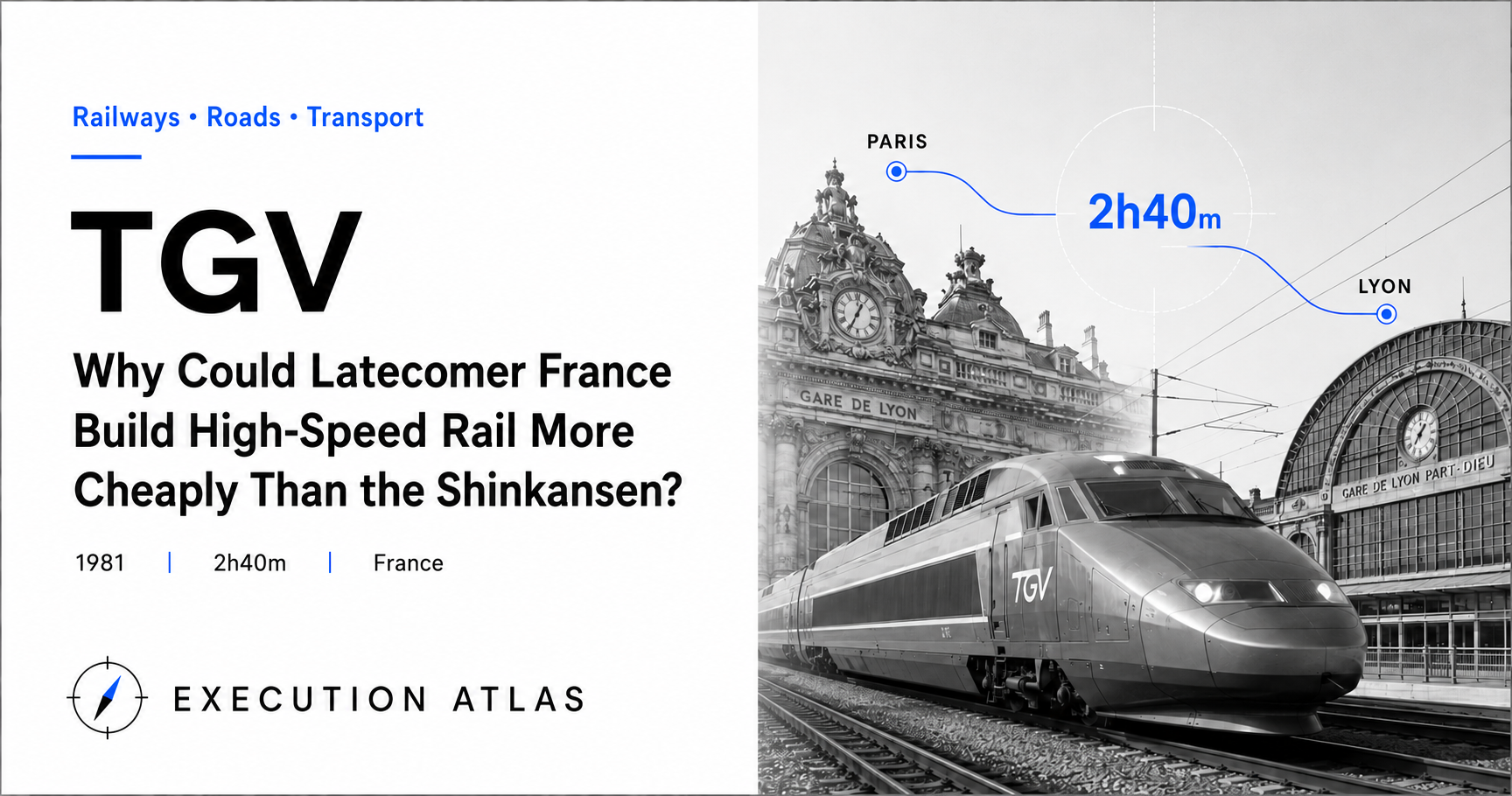
On 27 September 1981, a train began running between Paris and Lyon. Top speed 260 km/h. Roughly 410 km in 2 hours and 40 minutes.
It was not the world’s first high-speed railway. Japan’s Tōkaidō Shinkansen had opened at 210 km/h back in 1964. France’s TGV arrived 17 years later, a clear latecomer.
Latecomers usually pay more. The one who cuts the first path through unknown ground suffers, and those who follow get to read it as a textbook. Catching up still takes real money. The first TGV line did the opposite. Measured per kilometer, it became the cheapest high-speed railway ever built, used no subsidy, and paid back its investment within twelve years of opening.
The Shinkansen ran to twice its budget. The TGV did not. Same kind of railway. Where did the gap come from?
Mission
In 1960s France, rail was a byword for decline.
The momentum of the age belonged to aviation and the motorway. America was extending its Interstates, and Europe too was pointing its money at cars and planes. A vehicle that ran on rails looked like a relic of the nineteenth century.
Inside that atmosphere, two organizations kept researching high-speed rail: the French national railway SNCF and the rolling-stock maker Alsthom (then Alsthom-Atlantique). Their backer was President Georges Pompidou. In 1971 the government approved the high-speed line linking Paris and Lyon, project “C03,” later the LGV Sud-Est.
The aim was plain. Win passengers back from aviation and the motorway. What that required was not the top-speed figure itself but the time from city-center station to city-center station. Airports sit outside the city. There is check-in. If rail could connect downtown to downtown, it would beat the plane on total travel time.
Paris–Lyon was no accident. It was one of France’s densest corridors, the route with the highest chance of earning its money back. Limit the first stretch you touch to the core where the return is solid.
Design
The first major fork came before anything ran.
In 1972, SNCF was running a gas-turbine prototype, the “TGV 001.” That December the vehicle set a world record of 318 km/h as a gas-turbine-electric set. Technically it was faultless. High-speed rail would run on gas turbines, everyone assumed.
In 1973, the oil crisis hit. Crude prices jumped, and the premise of a train that burned oil collapsed. SNCF made the call to switch propulsion from gas turbine to electric.
This also meant throwing away past investment. The TGV 001 had taken six years of testing, more than 5,000 runs and roughly 500,000 km. Normally you cannot bear to let that go. SNCF abandoned the propulsion method but transplanted the body structure and power-distribution concepts into the next electric prototype, “Zébulon.” It separated what to discard from what to keep.
The other design decision is the heart of this story.
A dedicated high-speed line, drawn from an entirely new way of thinking. Not upgrading a conventional line to run faster, but designing track from scratch on the single premise of high-speed running. Here SNCF broke one piece of common sense that no one had questioned.
Railway track is laid as flat as possible. Gradients are a drag that hauls heavy freight consists uphill, so keeping them gentle was the rule. The conventional Paris–Lyon line held its maximum gradient to 0.8%.
SNCF reasoned the other way. A light passenger-only train running at high speed can climb a steeper slope.
The LGV Sud-Est was set to a maximum gradient of 3.5%. More than four times the conventional line. This one number went on to change everything downstream.
Execution
Once you no longer need to soften the gradient, the line stops having to detour around hills.
It could run a straight route that followed the terrain, climbing and descending the rises as they came. As a result, the LGV Sud-Est has not a single tunnel. There was no need to bore through mountains.
Construction kept moving toward cheaper. Viaducts were minimized and the track was laid directly on the ground. Soil cut from one section was used straight away for fill nearby. Cut and fill were balanced site by site, and hauling earth was kept local.
Construction began in 1976. SNCF had already placed an initial order with the Alstom group for 87 production trainsets. The roughly 410 km of new line and the trains advanced in parallel, reaching opening in five years.
The finished LGV Sud-Est cost, in PPP-2022 dollars, about $8.4 million per kilometer. For high-speed rail, strikingly cheap. Cheaper than any high-speed line built by any country in the years that followed.
Set the Shinkansen beside it. The Tōkaidō Shinkansen ran to about twice its original ¥197.2 billion budget, finishing at ¥380 billion. Japan National Railways president Sogō Shinji got the budget through the Diet at half the real figure, and resigned before opening to take responsibility. The work of cutting the world’s first path had its money drained by unseen geology and untried technology.
The TGV came cheap not because the French were thriftier than the Japanese. Nor merely because a latecomer received the pioneer’s tuition as a blueprint. The biggest reason was spotting one fact, that a high-speed passenger train can climb a steep gradient, and loosening that constraint. Cost was not settled by haggling on site. It was mostly fixed in the specification, before a track was laid.
People
The TGV has no single hero standing at the center of the story, no Shima Hideo or Sogō Shinji as the Shinkansen had.
The lead role belonged to one organization’s relentless cost discipline: SNCF’s. Hunting for a cheaper way at every step, doubting the orthodoxy of the gradient, writing even the routing of earth into the design. Not a flashy decision but a stack of quiet optimizations that produced $8.4 million per kilometer.
One of the few names that remain is the industrial designer Roger Tallon. Born in 1929, trained as an engineer, he passed through Caterpillar and DuPont before turning to design. What Tallon handled was not the vehicle’s outer shape or running performance. It was the ergonomics of the seats, the in-car signage, the colors, the very space the passenger touched.
The roles were cleanly split. Engineers took speed and safety; the designer took the ride. Tallon went on through the TGV Atlantique, the TGV Duplex, and the 1994 Eurostar, designing the interiors of France’s high-speed trains without a break.
On 22 September 1981, President François Mitterrand attended the opening ceremony for the first section. Pompidou, who had backed the research, had died seven years earlier. Those who supported the vision did not see it finished, and those who celebrated it were other people. The gap between the ones who start a project and the ones who enjoy it, recurring across large projects.
Legacy
In 1989, the LGV Sud-Est carried its 100-millionth passenger.
A train linking downtown to downtown in 2 hours 40 took passengers from aviation, as intended. The air route between Paris and Lyon shrank, and people moved to the stations. The line’s top speed was later raised to 300 km/h, and on the newer lines that followed it reaches 320 km/h. The TGV became the spine of France.
At the end of 1993, the LGV Sud-Est was fully amortized. Twelve years from the start of operation. The expected financial rate of return had been a floor of around 12%, and the actual figure came in well above it. No subsidy was used. Unlike several of the high-speed lines France built later, which needed support, the first line paid its investment back on its own.
The 3.5% gradient standard of the LGV Sud-Est became the norm for high-speed rail across Europe. The design philosophy of accepting steep gradients to hold down construction cost spread from France to other countries.
The Shinkansen proved to the world that rail could compete with aviation. The TGV proved that high-speed rail could be built cheaply. The pioneer and the latecomer each answered a different question.
Learnings
The biggest reason the LGV Sud-Est came in at $8.4 million per kilometer was not effort on site. Before a single length of track was laid, it was one decision to loosen the maximum gradient from 0.8% to 3.5%.
That call zeroed out the tunnels, straightened the route, and made surface construction and local earthworks possible. Most of the cost was fixed not at the dig site but at the stage that decides the constraints.
When we talk about cost overruns, the gaze drifts to execution. The work ran late, the estimate was soft, procurement came in high. But what really governs cost sits upstream of all that. It is what you accept as an “immovable premise.”
What SNCF doubted was the rule that “track is laid flat,” which no one had questioned. When a constraint built around heavy freight consists was reviewed under the new condition of high-speed passenger-only running, the slope became something a train could climb. Loosen one constraint, and the tunnels, detours, and viaducts hanging below it fall away together.
So the question becomes this. Among the constraints you treat as “absolutely immovable,” which ones could actually be loosened because the premise has changed? And if you loosened one, how far would the cost downstream collapse?
The Shinkansen showed that a project can leave a great result even when it does not begin by honest means. What the TGV showed is the lesson on the other side. The saving that bites hardest comes not from cutting, but from doubting.
Sources
- “TGV,” Wikipedia (SNCF / Alstom) (https://en.wikipedia.org/wiki/TGV) — development history, the switch to electric traction after the oil crisis, the 1976 production order, the 1981 opening, the 100-millionth passenger in 1989
- “TGV 001,” Wikipedia (https://en.wikipedia.org/wiki/TGV_001) — the gas-turbine prototype, the 318 km/h record of 1972, the testing scale, the transplant of its concepts into Zébulon
- “LGV Sud-Est,” Wikipedia (https://en.wikipedia.org/wiki/LGV_Sud-Est) — the 3.5% maximum gradient, the absence of tunnels, the balanced cut-and-fill design, construction cost and amortization
- Alon Levy, “TGV Imitators: Learning the Wrong Lessons From the Right Places,” Pedestrian Observations, 2024 (https://pedestrianobservations.com/2024/10/25/tgv-imitators-learning-the-wrong-lessons-from-the-right-places/) — the $8.4 million/km figure as the cheapest on record, the financial rate of return, the subsidy-free amortization in 1993
- “After 30 Years, TGV Service Prospers Even as its Future is Questioned,” The Transport Politic, 2011 (https://www.thetransportpolitic.com/2011/09/24/after-30-years-tgv-service-prospers-even-as-its-future-is-questioned/) — the 30-year assessment, the share taken from aviation, the line’s profitability
- “Roger Tallon,” Wikipedia (https://en.wikipedia.org/wiki/Roger_Tallon) — the designer’s background and his remit over seats, interiors, and signage