
April 3, 1992, Beijing. The National People’s Congress put the Three Gorges Dam to a vote.
The result: 1,767 in favor, 177 against, 664 abstaining, 25 not voting. An approval rate of 67.75 percent. For China’s legislature, that was unheard of. A body that normally rubber-stamps government proposals unanimously could not bring nearly a third of its delegates to say yes. Before the vote, one delegate reportedly said:
No matter how we vote, we vote in blindness.
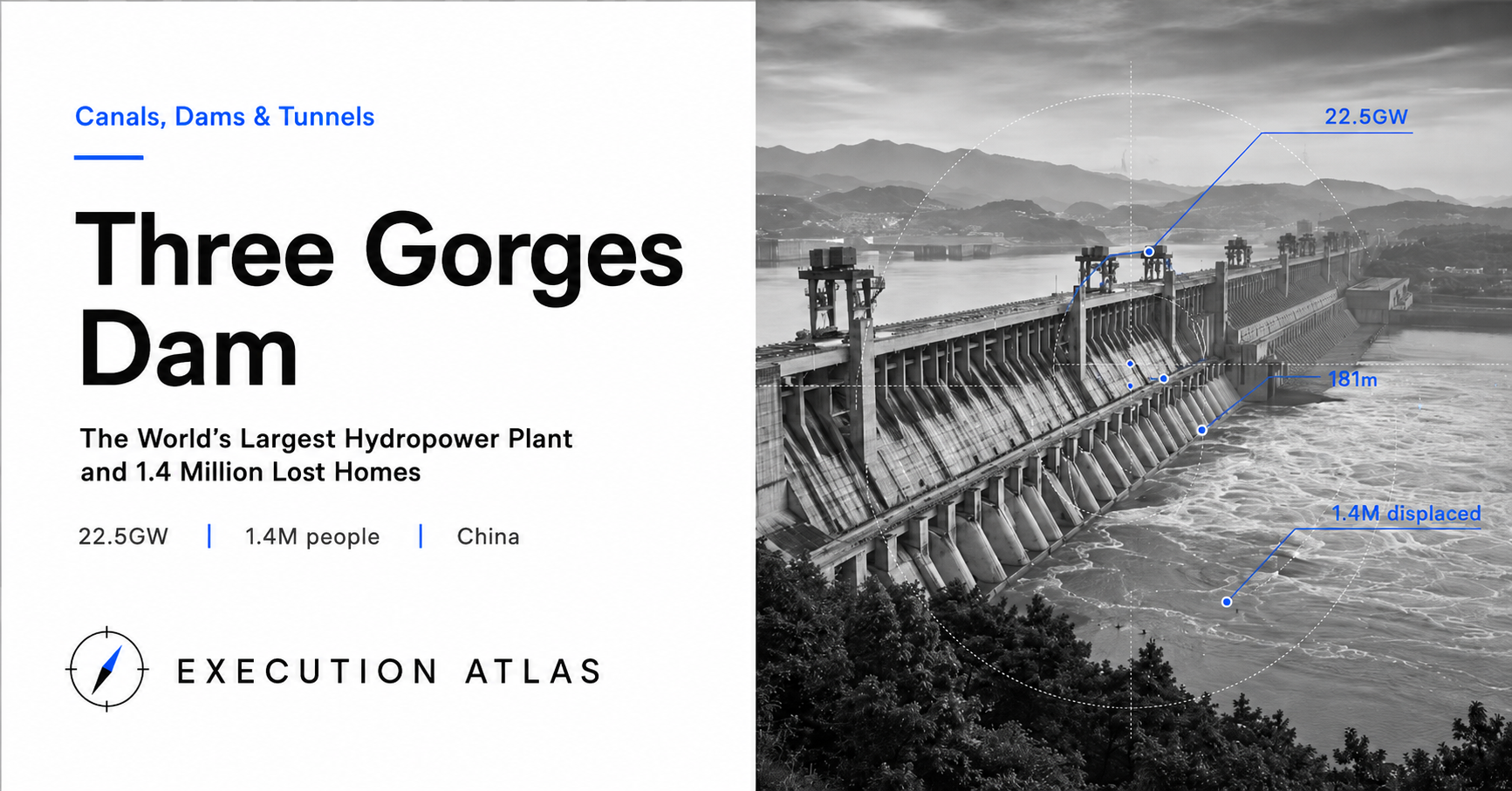
The world’s largest hydropower plant set off with the very legislators approving it admitting they didn’t understand what it was. Eighteen years to completion. More than 1,500 towns and villages drowned, and the people driven from their homes numbered 1.3 million by official count, 1.9 million by outside estimates.
What was paid in exchange for the electricity? That invoice is still open.
Mission: Why It Began
The Yangtze has fed China and killed China.
The great flood of 1931 left a death toll in the hundreds of thousands across the basin. The 1954 flood killed more than 30,000. Yet the river carries so much water that a dam here could draw an extraordinary amount of power. Treating flood control and power generation as one problem to be solved by a single dam is an old idea. In 1919, Sun Yat-sen wrote of a dam on the upper Yangtze. In 1956, Mao Zedong put it in a poem: a smooth lake rising in the high gorges. For half a century everyone spoke of it, and no one carried it out.
What finally forced the decision was electricity.
As the economy took off after Reform and Opening-Up, power demand grew exponentially. Between 1990 and 2010, GDP swelled more than tenfold. Coal power was nearing its limits, and its transport and pollution burdens were heavy. As the card to cover all that demand at once, a plan surfaced to place the world’s largest hydropower plant, 22.5 gigawatts, in the Three Gorges region of the Yangtze.
The man waving the flag was Premier Li Peng, a politician trained as a hydroelectric engineer in Moscow, who pushed the dam forward as his own undertaking. The requirements come down to three. Produce electricity. Stop floods. And show the world that China had pulled it off. The last of these was not a technical requirement. It was national prestige.
Design: How It Was Engineered
The numbers of the Three Gorges Dam are an order of magnitude beyond any existing hydropower plant.
- 181 meters high (crest elevation 185 meters above sea level), more than 2.3 kilometers long
- A reservoir 600 kilometers in length, turning the distance from Tokyo to Osaka into a lake
- Storage capacity of 39.3 billion tons
- Generating capacity of 22.5 GW, the largest in the world at the time
- A 1992 approved budget of roughly 57 billion yuan (about 8.3 billion dollars then)
A 600-kilometer reservoir is no longer a river. It is a long, narrow inland sea. To conjure it into the Yangtze’s gorges meant moving the riverside settlements, the fields, the temples, all of it to the bottom of the water. The essence of the design was not civil engineering. It was selection: what to keep, and what to drown.
Three forces bound the design.
Schedule. A power shortage does not wait. The sooner the reservoir filled, the sooner the turbines spun. So the timeline was pressed forward and forward.
Uncertainty. The Three Gorges sit on a seismic fault zone. A vast body of water bearing down on the crust could trigger earthquakes. How the downstream ecosystem would change, whether eutrophication would set in, could not be predicted with any precision given the knowledge of the time.
Irreversibility. This was the heaviest. Make the lake once, and the drowned towns never return. The people moved cannot be put back to the lives they had. Induced earthquakes and ecological change allow no “actually, let’s not.” You can fail, but you cannot redo.
Did the plan price those three constraints adequately? One man asked that question earlier, and more concretely, than anyone.
Huang Wanli of Tsinghua University. Born in 1911, with a master’s from Cornell and a doctorate in engineering from the University of Illinois, he was a river engineer. He opposed the dam on the grounds of geology, sedimentation, and ecology, and between 1992 and 1993 he wrote three times to Jiang Zemin. The vast load of silt the Yangtze carries would settle in the reservoir and, in time, degrade it. Induced earthquakes and the destruction of the ecosystem were unavoidable. Every letter was ignored.
Huang was driven out of his university as a dissenter and grew old in obscurity. In 2001, at 89 and on his deathbed, he is said to have forced out these last words:
The Three Gorges Dam must never be built.
Li Peng and Huang Wanli. Both were engineers who knew water and earthworks down to the bone. One moved a nation; the other was silenced. The difference was not skill. It was where each man stood.
Execution: How It Was Built
On December 14, 1994, Li Peng declared the start of construction on site. The first great obstacle was stopping the Yangtze itself.
November 8, 1997. The day came to divert the river’s flow into a bypass channel dug over the previous two years and seal off the main channel. Some 50,000 people gathered. On a temporary viewing stand stood Jiang Zemin and Li Peng, watching the water through binoculars.
At the signal, about 400 dump trucks began to move, many of them giant Caterpillar machines. The drivers dropped granite boulders, one load after another, into the narrowing final gap. With each load the river grew a little narrower. It was a contest between the water trying to swallow the rock and the men piling it on. At last the flow bent into the bypass channel, and the Yangtze’s main course was severed by human hands for the first time.
The next day’s Washington Post headline read: Feat or Folly? Even as the principals raised their glasses, the verdict was split.
The schedule ran ahead. Filling began in June 2003. By May 2006 the dam body itself was finished ahead of the original plan. In 2012, all 32 main turbines were running and the dam entered full operation. Concentrated deployment of labor did the work; at peak, 26,000 people were on site.
Behind the pace, the money swelled.
The 1992 approved budget was about 57 billion yuan. The actual cost reached 200 to 249 billion yuan (roughly 29 to 37 billion dollars), about 3.5 to 4 times the figure at approval. The official explanation was inflation, interest, and regulatory change. But a large share of the overrun came from two items the plan had taken lightly: environmental mitigation and resettlement compensation. Neither stopped after completion, and the budget kept creeping upward before it could ever close.
People: Who Led It
The Three Gorges Dam has no single heroic portrait. In its place stands the contrast of two engineers.
Li Peng was born the son of a Communist revolutionary who had been executed, and was raised by Zhou Enlai and his wife. In 1948 he was sent to the Moscow Power Engineering Institute, took a degree in hydroelectric engineering, and returned home. For a man who climbed the power industry all the way to premier, the dam was the work of a lifetime, pouring in both technology and power. He sought the legislature’s approval, he declared the start of construction, he stood at the site where the river was stopped.
The man who sent that same Li Peng three letters, and was ignored, was Huang Wanli. A man who had studied the most advanced river engineering in America, and warned of the dam’s future in the language of silt and geology, could not reach a premier who was himself an engineer. The gap between them was not knowledge. It was whether you stood on the side of power.
And the ones who bore the brunt of this undertaking were the people whose names are not recorded.
On paper, resettlement compensation was paid. On the ground it was otherwise. In Shengquan village, the housing compensation residents received fell short of half the appraised value. Rural-registered households received less compensation than urban ones, though the cost of building materials was the same. In Yunyang county, the best farmland sank to the bottom of the reservoir.
To press their grievances, the farmers chose representatives and sent them to Beijing. Before they could reach anyone, five of the representatives were arrested and three fled.
The money also vanished along the way. Between 1993 and 2004, in Chongqing and Hubei alone, 327 cases of misused resettlement funds were found. By one estimate, about 12 percent of the resettlement budget dissolved into corruption. A single official is said to have skimmed 120 million dollars, and in Yunyang county eight officials were dismissed for taking bribes. Money meant for people who had lost their homes was siphoned off before it arrived.
Legacy: What It Left Behind
The quantitative achievements are real.
The dam generates roughly 100 billion kWh a year. It eased China’s power shortage at a stroke. It realized 22.5 GW, the largest generating capacity in the world, and gave China the technical system to operate a 600-kilometer artificial lake. In flood season it stores upstream water to shave the downstream peak. During the great Yangtze flood of 2020, that regulating function was credited with limiting downstream damage. The two original headline requirements, power and flood control, were met.
The trouble lies with the items the plan never priced.
Once the reservoir filled, small to moderate earthquakes increased nearby, the induced seismicity Huang Wanli had warned of. In the stilled lake, eutrophication advanced and algae bloomed. The Yangtze’s fish lost their spawning grounds and their numbers collapsed. In 2020 a ten-year fishing ban began across the basin. One expert named the dam as the cause. The silt Huang wrote about in his letters keeps settling, over long time, at the bottom of the reservoir.
The social cost is harder still to count. Between 1.3 and 1.9 million people left their homes, and more than 1,500 towns and villages were submerged. Cultural heritage that can never be dug back up lies under the water. Many of the resettled rural people saw their standard of living fall in the places they moved to.
Completion was not the end. Investment in environmental mitigation continues to this day. The rebuilding of the resettled people’s lives has dragged on past twenty years. Count the project’s real span as “from groundbreaking to now,” and it already exceeds thirty years. Short-term glory and long-term debt are stacked on the same dam.
The Lesson: Who Pays the Costs That Carry No Price Tag
Did the Three Gorges Dam succeed? The way the question is framed already contains its lesson.
By the measurable metrics, generating capacity, output, flood regulation, it is the world’s largest hydropower plant, delivering roughly to plan. But that delivery stood on transferring the hard-to-measure costs to someone else. The drowned towns, the 1.3 million displaced, the added earthquakes, the vanished fish. None of these appeared on the project’s balance sheet from the start.
When you optimize for a single success metric above all, everything outside the metric goes unseen. Measure by the one yardstick of output, and the resettled people’s lives, and the river’s ecosystem, round down to a rounding error. The error is usually carried by people who are not in the room where decisions are made. That the farmers’ representatives heading to Beijing were arrested is a symbol of that structure.
And irreversibility does not wait for debate. Whether Huang Wanli’s warning was right will be settled around the time the reservoir has fully silted up. But the lake already exists, and the towns are already sunk. Before the verification is finished, the choice that cannot be undone has already been carried out.
Is there a cost in your own work that gets priced in only later? Behind the easy metrics of schedule and budget, is there a debt being quietly transferred to someone? The Three Gorges Dam puts that question to you at the scale of a 600-kilometer lake.
Huang Wanli opposed it, was silenced, and died without waiting for his prophecy to be checked. Only his last words still remain, over the surface of the lake.
Sources
- Wikipedia: Three Gorges Dam — project overview, timeline, statistics, NPC vote results
- Britannica: Three Gorges Dam — History and controversy — history of the concept and the controversy
- Human Rights Watch: The Three Gorges Dam in China — Forced Resettlement, Suppression of Dissent and Labor Rights Concerns — resettlement and suppression of dissent
- The Washington Post: The Yangtze Dam — Feat or Folly? (1997) — the 1997 river closure on the ground
- Probe International: “No matter how we vote, we vote in blindness” (1992) — testimony from the NPC vote
- CECC: Three Gorges Project Results in More Evictions, Land Scandals, and Corruption Cases — corruption in resettlement funds
- Huang Wanli — Wikipedia (Japanese) — the dissenting river engineer’s career and warnings