Approximately 499 metric tons of copper. 8.5 tons of tin. 2.5 tons of mercury. 440 kilograms of gold.
A total mobilization of 2.6 million workers. 420,000 donors. In a country with an estimated population of five to six million, roughly half of everyone alive at the time had some connection to the Great Buddha.
This is the budget sheet for the Nara-period state project known as the Tōdai-ji Daibutsuden — the Great Buddha Hall of Tōdai-ji. The imperial edict was issued in 743. The eye-opening ceremony was held in 752. It was finished in nine years.
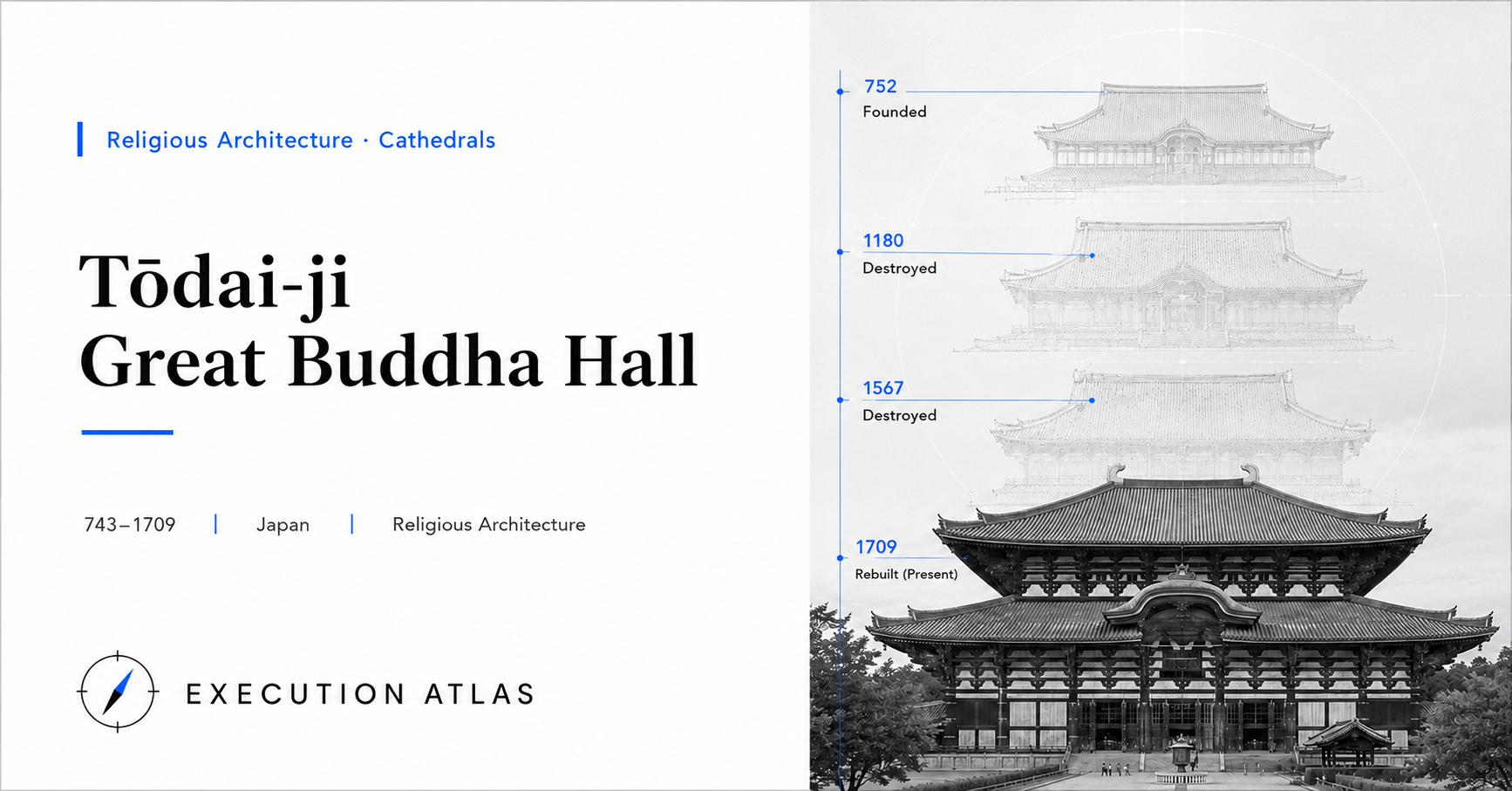
And the building those nine years produced was burned twice. In 1180 by the forces of Taira no Shigehira. In 1567 by the fires of Matsunaga Hisahide’s campaign. The Daibutsuden that stands today is the third version, completed in 1709. The original hall was approximately 86 meters wide; the current one is 57.5 meters. It shrank to roughly two-thirds. In terms of bay count, eleven bays became seven.
The third hall has been standing for more than 300 years. So far, it has not burned.
Mission: In a Country That Had Lost 30% of Its Population
Eight years before Emperor Shōmu issued his edict to build the Great Buddha, Japan had nearly collapsed from smallpox.
The epidemic began in Kyushu in 735. By 737, an estimated 25 to 30 percent of the population had died. That same year, all four sons of the Fujiwara clan — Muchimaro, Fusasaki, Umakai, and Maro, brothers of Empress Kōmyō — died one after another. The central government ceased to function.
Then came earthquakes. Then drought. In 740, Fujiwara no Hirotsugu launched a rebellion in Kyushu. Emperor Shōmu abandoned Heijō-kyō and moved the capital repeatedly — to Kuni-kyō, then Naniwa-kyō, then Shigaraki-no-miya. To anyone watching, the gods had forsaken this country.
On the fifteenth day of the tenth month of 743, at Shigaraki-no-miya in what is now Shiga Prefecture, the edict to build the Great Buddha was proclaimed.
The language of the edict is forceful.
He who possesses the wealth of the realm is Us. He who possesses the power of the realm is Us. With this wealth and power, We shall create this sacred image. The making of the image is not difficult. What is difficult is uniting the hearts of the people.
All the wealth and power in the land belongs to me. So casting the statue itself is the easy part. What is difficult is pointing the people toward a common purpose.
When an emperor writes this, the project is no longer about building a statue. He is constructing a device to reorient a country that has been sinking under consecutive disasters. In terms of requirements, this is a national reboot.
The edict contains one more line:
If there be any who wish to help make this image by offering a single branch of grass or a handful of earth, let them be freely accepted.
One blade of grass. One handful of soil. That much is enough. The participation threshold is set as low as it can possibly go. The person issuing the order is himself admitting that this cannot be pushed through by wealth and power alone.
Design: Breaking Ground at Shigaraki, Starting Over at Heijō-kyō
One year after the edict, in the eleventh month of 744, the central pillar of the Buddha’s body was erected at Shigaraki-no-miya. Preliminary assembly had begun.
But in the fifth month of 745, Emperor Shōmu moved the capital back to Heijō-kyō. Shigaraki-no-miya was abandoned entirely. The construction site for the Great Buddha followed, relocating to Kinshōzan-ji — the future Tōdai-ji — within Heijō-kyō. The pillar erected the previous year was discarded. A year’s worth of work was thrown away.
This was not a sunk cost fallacy in reverse. The premise had changed, so the plan was rewritten. If “build the Great Buddha at Shigaraki” had been the original design, then “build the Great Buddha somewhere in Japan” was the actual objective. The moment the premise — the location of the capital — collapsed, they kept the objective and moved the site.
There were three engineering constraints.
The first was scale. A seated statue 14.7 meters tall, made from 499 tons of copper, could not be cast in a single pour with the technology of the time. Molten bronze at 1,200 degrees could not be poured all at once into a mold that large.
The solution was to divide the statue horizontally into eight layers and cast upward from the base. One layer was cast and allowed to cool. Then molds were assembled atop it, and the next pour happened. The seams between layers were joined with a mechanical interlocking technique called igarakuri. Each layer was effectively an independent phase of construction.
The second constraint was materials. 499 tons of copper was essentially impossible to source from Japan’s domestic production at the time. Mines across the country — in Nagato, Bitchū, Suō, and elsewhere — were pressed into service. It still wasn’t enough. Copper coins and bronze implements were melted down. The 440 kilograms of gold was even more serious. Gold, at the time, was fundamentally an import.
The third constraint was people. No matter how strongly the edict was worded, the court’s official machinery alone could not mobilize this operation. Emperor Shōmu made a decision: to elevate a monk who his predecessors had persecuted, appointing him to the highest rank in the Buddhist hierarchy.
That monk was Gyōki.
Design: An Outsider Appointed as Grand Monk
Gyōki was 75 years old at the time. Born in Kawachi, he had studied at temples in Nara as a young man. At some point, he left the monasteries and began preaching among ordinary people. He built bridges, dug irrigation ponds, repaired roads — and as he did, he assembled networks of followers across the country.
From the court’s perspective, this made him a dangerous figure operating outside sanctioned channels. In 717, an imperial decree was issued banning his activities. He was suppressed as a monk spreading “deceptive teachings.”
Yet Gyōki had already become the leader of popular mass mobilization. Centered on him, networks of lay followers called chishiki had spread across Japan. A system for collecting donations, a system for summoning people, a system for moving goods. Everything the court had tried to build through its bureaucracy and failed — Gyōki had built it through faith.
Emperor Shōmu asked Gyōki to take the role of chief fundraiser (kanjin), and in 745 granted him the title of daisōjō — Grand Monk — the first time such a rank had existed in Japan. The title was invented for this one person.
Bringing inside someone who had been operating outside and giving them an official seat is a concession. The only reason to pay that price was that Gyōki held a monopoly on mobilization capacity, and the court had no other way to access it.
Once Gyōki’s follower networks were activated, donations poured in. Surviving records break down the contributors:
- Donors of timber: 51,590 people
- Labor for timber: 1,665,071 people
- Donors of copper and gold: 372,075 people
- Labor for copper and gold: 514,900 people
Roughly 2.6 million people contributed labor; roughly 420,000 donated materials. That works out to an average of 500 people on site every day.
Gyōki died without seeing the project completed. In the second month of 749, at the age of 82 — three months before casting was finished.
Execution: Gold Found in Mutsu
In the ninth month of 747, casting began.
Over the next two years, the eight-layer casting proceeded one section at a time. A layer cooled and solidified. Clay molds were built atop it. Bronze was poured. Then cooled again. If anything went wrong, all previous layers would be wasted. Five hundred people moved through this each day: mold builders, clay carriers, firewood splitters, bellows operators.
At one point, the project nearly stopped.
Gilding — covering the surface of the statue in gold — required more gold than was available. Japan had no substantial gold mines at the time. The only path was importation, and the supply was uncertain.
In the first month of 749, gold was discovered in Oda District, Mutsu Province — present-day Wakuya-cho, Miyagi Prefecture. It was the first gold mine ever found in Japan.
When word of the discovery reached him, Emperor Shōmu was moved to change the era name. “Tenpyō” became “Tenpyō Kampō.” Then, four months later, simultaneous with his abdication, it changed again to “Tenpyō Shōhō.” Two era name changes in rapid succession told the story of what this discovery meant. The Buddha was still being cast, the gilding layers not yet applied, and then — at exactly that moment — the gold needed appeared from within the country.
Gyōki, incidentally, died shortly after this. He saw the gold from Mutsu. He did not see the statue finished.
In the intercalary fifth month of 749, casting was complete. Three years and several months for eight layers.
Then the surface was polished. Gold and mercury were mixed into an amalgam, painted on, and heated until the mercury evaporated. What remained was a gold surface on the Buddha’s skin. A fire-gilding method. The mercury vapor must have damaged the lungs of everyone on site — but the historical record of that period has no concept of occupational disease.
On the ninth day of the fourth month of 752, the eye-opening ceremony was held.
Exactly nine years from the edict.
The chief officiant was Rōben, first administrator of Tōdai-ji. The priest who performed the eye-opening itself — painting the pupils of the Great Buddha — was Bodhisena, a monk born in India who had come to Japan in 736. He was 48 at the time. A monk from India painted the eyes of a statue commissioned by a Japanese emperor.
The scale of the assembly was extraordinary. Emperor Shōmu (now retired), Empress Dowager Kōmyō, and Empress Kōken attended, along with some ten thousand civil officials and monks. The performances included not only Japanese music and dance, but also troupes from Tang China, Silla (the Korean Peninsula), and Lâm Ấp (present-day southern Vietnam).
The Shoku Nihongi records the day:
Since Buddhism first came to the East, there has never been a religious assembly as magnificent as this.
Even the chronicler sounds overwhelmed.
This was designed as international ceremony. “Rebooting the nation for a domestic audience” and “branding Nara as the center of East Asian Buddhism for a foreign audience” coexisted on the same day.
The brush used for the eye-opening had a long cord attached to it. The cord reached to every person in attendance. In the records, it is called the kechien no tsuna — the cord of connection. One monk moved the brush, but that movement was synchronized to ten thousand hands.
“The making of the image is not difficult. What is difficult is uniting the hearts of the people.” The last line of the edict from nine years earlier was fulfilled here.
People: Those Who Took On the Reconstruction
On the night of the twenty-eighth day of the twelfth month of 1180, Taira no Shigehira carried out the burning of Nanto.
In the conflict between Taira no Kiyomori and the Minamoto forces (particularly the Nara powers backed by Kōfuku-ji), Shigehira marched on Nara under Kiyomori’s orders. It was a night with strong winds. Fire leaped from Kōfuku-ji to Tōdai-ji. Or possibly the spread was allowed to continue. Records support both accounts. Either way, the Daibutsuden burned to the ground.
The statue did not escape unharmed. The copper, exposed to fire, melted. The head fell. Both arms collapsed. In 428 years, the Great Buddha Hall had become ash.
In 1181, the person appointed to lead the reconstruction as chief fundraiser by Retired Emperor Go-Shirakawa was Chōgen. He was 61 years old.
By the standards of his time, Chōgen was already at the age of retirement. His background was somewhat unusual: he had made three voyages to Song China. In the Japanese Buddhist world of that era, experience crossing the sea was rare, and he brought with him advanced knowledge — especially in architecture and construction.
The reconstruction approach he chose was not the traditional Japanese wayō style of the original.
He adopted a new structural system called daibutsuyō — “Great Buddha style.” It made heavy use of horizontal members called nuki that passed through the columns, allowing large spaces to be supported by fewer pillars. He had learned this method from Song China. He did not cling to the Japanese traditional style. He judged that this approach was more fire-resistant and faster to build.
Minamoto no Yoritomo provided support. In 1185, the eye-opening ceremony for the Great Buddha was held with Retired Emperor Go-Shirakawa as chief officiant. In 1195, the completion ceremony for the Daibutsuden took place, attended by Emperor Go-Toba and Minamoto no Yoritomo. At the time of the completion, Chōgen was 74 years old.
Chōgen remained at Tōdai-ji until his death in 1206 at the age of 86. Three voyages to Song China, and then 25 years that began at 61. Without him, the Daibutsuden would very likely have vanished in the wars of the late Heian period.
About 370 years passed.
On the tenth day of the tenth month of 1567, during the Miyoshi-Matsunaga conflict, Matsunaga Hisahide’s forces launched a night raid on the Miyoshi faction positioned at Tōdai-ji. The Daibutsuden burned again. The Great Buddha melted again. This time, there was no immediate reconstruction.
Neither the court nor the shogunate of the Sengoku era had the capacity for it. The statue was left exposed to the elements. The body melted; the head was lost. Makeshift covers of copper plate and wood were put over it, and 120 years passed.
A monk born in 1648 saw the Great Buddha being rained on as a child. His name was Kōkei, a monk of the Sanron sect.
In 1684, at the age of 36, Kōkei began to act. He petitioned the Edo shogunate for permission and launched a nationwide fundraising campaign. The slogan he put forward was ichishi-hanzen — “one sheet of paper, half a coin.”
One sheet of paper. Half a coin. That is enough. That will be counted as a great merit.
The design was not to find one major donor, but to aggregate tiny contributions at scale. He built out an organization: management of donor lists, issuance of fundraising ledgers, a network of regional representatives across Japan. In seven years, 11,000 ryō was collected — roughly one billion yen in today’s terms.
In 1690, restoration of the Great Buddha began. In 1692, the eye-opening ceremony was held.
The following year, 1693, Kōkei traveled to Edo and was received by the fifth shogun Tokugawa Tsunayoshi and his mother Keishōin. The shogunate’s support now joined a project that had already been set in motion by micro-donations. The order of operations matters. If he had tried to persuade the shogunate first, they probably would not have moved. Because the project was already moving, the shogunate could attach itself.
Rebuilding the Daibutsuden ran into another obstacle: timber.
At the time of the original construction, each column of the Daibutsuden had been made from a single massive tree. The hall spanned eleven bays — eleven enormous pillars in a row. To build at the same scale in the early Edo period meant finding trees of comparable size, but there were none. The rush to build Edo Castle, the castles of the Tokugawa clans, and the reconstruction of Kyoto’s great temples had stripped Japan’s old-growth forests.
Kōkei gave up on eleven bays.
He redesigned for seven. The structure would be supported by seven columns instead of eleven. Even then, single-trunk columns were unavailable; the solution was to join three or four shorter timbers together to form each column. The Daibutsuden itself, in geometric terms, dropped to roughly two-thirds of the original scale.
Even so, two pieces — the great curved beams called kōryō — absolutely required single-trunk timber. The search went across Japan. In 1704, appropriate wood was finally found in Shiratori-yama in Hyūga Province, present-day Miyazaki Prefecture. Getting the timber from the mountain to Nara, according to records, required the labor of 100,000 workers.
Kōkei did not see the completion. In 1705, while in Edo for fundraising, he fell ill with dysentery and died. He was 57 years old by the traditional count.
The completion ceremony was held four years later, on the eighth day of the fourth month of 1709. In the ceremonies that Kōkei’s disciples and the shogunate carried through to the end, Kōkei’s name does not appear as chief officiant.
Emperor Shōmu retired and withdrew. Gyōki died before casting was finished. Chōgen was 74 at the completion ceremony and died soon after. Kōkei never saw the final ceremony.
The person who holds the brush at the eye-opening ceremony is never the person who built the hall.
Legacy: Only the Third Hall Has Gone 300 Years Without Burning
There have been three versions of the Daibutsuden. Their widths, laid side by side:
| Version | Width | Depth | Height | Completed |
|---|---|---|---|---|
| Original (Tenpyō) | approx. 86 m | approx. 50 m | approx. 37 m | 752/758 |
| Kamakura rebuild | nearly the same | same | same | 1195 |
| Edo rebuild (current) | 57.5 m | 50.5 m | 49.1 m | 1709 |
Depth and height are almost unchanged. All three versions maintained the minimum dimensions required to sustain the roof structure.
Only the width shrank — to two-thirds of the original.
This was not an aesthetic choice. It was a material constraint. By the early Edo period, Japan’s forests could no longer produce “columns capable of supporting an eleven-bay roof.” It was not a case of being able to rebuild at full scale but choosing not to. The material was unavailable, so the scale was reduced.
And yet something interesting happened.
Only the third hall has not burned.
The original Daibutsuden burned after approximately 428 years. The Kamakura reconstruction burned after approximately 372 years. The Edo reconstruction has now stood for roughly 316 years, and it still exists. There have been repairs, but no rebuilding.
Several reasons can be offered. Construction techniques improved after the Edo period. Fire prevention awareness grew. After the Meiji period, large-scale warfare no longer reached the temple grounds. Even so, the possibility that the reduced size directly contributed to fire resistance cannot be dismissed.
A narrower hall means a shorter path for flames to travel across the roof. Columns assembled from joined timber means that if one piece is damaged, other pieces in the joint can still bear load. The original Daibutsuden, built from single massive trees, would have spread fire faster once it caught.
The hall that gave up on a perfect replica has lasted the longest.
A similar structure exists in the statue itself.
Of the Great Buddha as it currently exists, the portions that remain from the Nara period are limited. Some of the lotus petals on the base, the torso, and the area around the knees still contain Tenpyō-period copper. The head is from the Edo period; both arms are from the Momoyama to Edo periods.
What is called “the Great Buddha of Nara” is a composite — Nara-period sections, Kamakura-period sections, and Momoyama-to-Edo sections joined together. Almost no component is continuous throughout. And yet everyone recognizes this as the Great Buddha of Nara.
There is an ancient philosophical problem called the Ship of Theseus: if you replace every plank in a ship one by one while at sea, is the ship at the end the same ship as the one at the beginning? The Great Buddha of Tōdai-ji is an implementation of that question. Generation after generation of reconstruction workers drove their own era’s copper and craft into whichever section they were responsible for. The seams are visible. The stylistic differences can be seen. And yet the statue sits before its visitors as the same statue it has always been.
Whether “restoration” is the accurate word for what this is — that is not entirely clear.
Takeaways
The hall built in nine years burned after 428. Burned again after 370 more. Was left open to the rain for 120 years.
And the Daibutsuden is still at Tōdai-ji.
The reason lies not with the people who first built it, but with those who rebuilt it.
Emperor Shōmu wrote the original charter. Gyōki assembled the first mobilization network. Without them, the eye-opening ceremony of 752 would not have happened. But if we ask whether the original builders were the deciding factor in the hall’s survival to the present day — the answer is no. The original Daibutsuden burned twice. Of the original statue, only a fraction survives in physical form. Almost nothing from the founding period remains as matter.
What survived was the knowledge of how to build, and the lineage of organizations capable of rebuilding.
Chōgen brought back Song architectural technology and chose daibutsuyō over wayō. He avoided repeating the failure. Kōkei gave up on eleven bays and rebuilt at seven. He abandoned perfect reproduction and switched to achievable scale.
Each reconstruction used the materials of its era, the organizations of its era, and the techniques of its era. They did not build the same Daibutsuden three times. Three different organizations, using three different methods, re-roofed the same site.
The real substance of this project is probably not the building. It is the mechanism that kept rebuilding it.
That mechanism has three components.
The first is the continuity of kanjin — the fundraising model. Both Chōgen and Kōkei gathered funds by rebuilding donation networks from scratch, not through top-down budget allocation. Kōkei’s “one sheet of paper, half a coin” model was designed not to depend on any single patron. Tokugawa Tsunayoshi’s support came after the foundation of fundraising was already in motion. The sponsor was incorporated as a follower, not relied upon as a dependency.
The second is flexibility in technical selection. The original wayō style, Chōgen’s daibutsuyō, and Kōkei’s joined-timber method each represent the optimal technique for their respective era. If any of them had insisted on replicating the original, the reconstruction of that era would never have started. The decision to give up on perfect reproduction was what made reproduction possible at all.
The third is the unconventionality of the personnel choices. Emperor Shōmu appointed Gyōki — a monk he had suppressed — as Grand Monk. Minamoto no Yoritomo trusted Chōgen — a Song-trained outsider — with the role of chief fundraiser. Tokugawa Tsunayoshi gave Kōkei — an obscure monk of the Sanron sect — permission to rebuild. In all three reconstruction periods, the project leader was someone outside the mainstream. Perhaps that is itself the signal: the mainstream organization alone was not enough to start any of the rebuilds.
What preserved the building was not the design. It was these mechanisms.
What we build today probably faces the same fate. Services end. Code rots. Organizations dissolve. Designing for a hundred-year lifespan does not make it likely to still be running in a hundred years in its original form.
But it can be left in a state that can be rebuilt.
If the documentation is in order, it can be reconstructed. If the technical choices are simple, someone else can read them. If the funding comes from many sources, no single withdrawal kills it. If there are multiple organizational lineages, the end of the main line does not end the project.
If the Daibutsuden proves anything, it is this: a building can collapse, an organization can collapse, and if the mechanism survives, the thing can be rebuilt. That is a stubbornly persistent kind of truth.
The Great Buddha sitting under the roof of the third hall has a head and arms and torso from different centuries. And visitors say they have come to see the Great Buddha of Nara.
That is probably fine.